This BBC podcast is supported by ads outside the UK.
You ever feel that deep pull to the land, to know it, to build something that lasts, that itch for your own wild country?
Well, it ain't just a daydream.
In 2025, it matters more than ever.
Whether you're a lifelong hunter or just starting out, dreaming of land to explore, to leave something real, or there is a trailhead where you can start.
It's called land .com, the biggest online network for rural property.
Find the right agent and explore everything from timber tracks to ranches.
Get the tools you need to buy that dream generational property.
Stop dreaming about it and head to Land .com.
It's your place to find your open space.
Travel smarter, not harder, at America's Best Value Inn by Senesta.
With convenient locations from coast to coast and value -packed comfort at every turn.
And when you're a Senesta Travel Pass member, Remember, staying at America's best value -in means earning points toward free nights, upgrades and more.
Go to Senesta .com to book your stay and unlock their best rates with Senesta Travel Pass.
Here today, Rome tomorrow.
Join now at Senesta .com.
Terms and conditions apply.
You're listening to the Global News Podcast from the BBC World Service.
service. Hello, I'm Oliver Conway.
We're recording this at 13 hours GMT on Friday, the 18th of July.
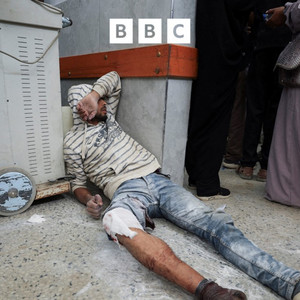
We hear disturbing testimony from a British surgeon in Gaza about the pattern of injuries on Palestinians he's treated.
The EU agrees new sanctions on Russia targeting oil revenues, but will they make any difference?
And President Trump orders his Attorney General to produce more documents on his one -time friend, Jeffrey Epstein.
Also in the podcast, Will ancient ice reveal secrets about the Earth's climate?
And... A new K -pop band sings about escaping from North Korea.
For 20 months, Israel has been waging war in Gaza as it seeks to wipe out the perpetrators of the October 7th massacre.
But as well as Hamas fighters, many thousands of Palestinian civilians have died.
Hundreds have been killed in recent weeks while trying to get food and water.
Now a British surgeon has spoken about what he calls a concerning pattern of injuries in patients brought to hospital from aid centres.
Dr Nick Maynard, who works for a pro -Palestinian advocacy group, spoke to the BBC's Anna Foster.
And a warning, you may find some of what he says distressing.
I'm seeing a very different pattern of injuries.
I'm still seeing relentless explosive injuries from bombs with shrapnel damage to the chest and the abdomen.
And we're seeing that every day, mass casualties.
But on top of that, we're also seeing multiple casualties coming in from the food distribution sites.
And they are gunshot injuries.
They're almost exclusively in young male teenagers, all of whom are going to the food distribution points to get food for their starving families.
And I've seen, I think, probably a dozen now seriously injured young boys who have been shot in the abdomen or the chest. One of them, a 12 year old, died on the operating table because the injuries were so severe.
And they all described to me and their families described to me and indeed colleagues of mine, guards and medical colleagues who are looking for food as well, have gone to these same distribution sites and witnessed these injuries as well.
They're all describing that they're being shot by Israeli soldiers or by the quadcopters, the drones which are being remotely controlled by the Israelis and fire, often indiscriminately, often targeted.
We're all seeing a very clear pattern of injuries.
I've seen the abdominal injuries, but my colleagues in the emergency room describe a very clear pattern where on particular days they'll see different body parts targeted.
So on one day, they'll all be abdominal gunshot wounds.
wounds on another day they'll all be head gunshot wounds or neck gunshot wounds on another day they'll be arm or leg gunshot wounds and last Saturday there were four young teenage boys all brought in very very rapidly in succession with gunshot wounds to their testicles and it's almost as if a game is being played that they're deciding to shoot the head today and the neck tomorrow and and their testicles the day after.
I'm also seeing injuries from people who are living in makeshift tents next to these food distribution centres.
I've operated in the last three days on two young ladies.
One of them was pregnant, three months pregnant.
Another one was breastfeeding her seven -month -old baby.
They were both in their tents in their makeshift shelters, And they were shot by quadcopters, which were indiscriminately firing bullets at the civilian population in these tents.
They both survived.
Luckily, the baby has survived.
But terrible injuries, the like of which I would never have imagined possible unless I were witnessing it with my own eyes.
Obviously, one of the great difficulties in reporting this conflict is that international journalists are blocked by Israel from going into Gaza and from seeing what's happening on the ground.
So evidence from people like you is vital.
And very often, evidence that comes out of Gaza, Israel discredits it by saying it's coming from Hamas, it's coming from the Hamas -run health ministry.
But this is you seeing what you're seeing on the ground as an independent British doctor.
Absolutely. This is not coming from anyone from Hamas.
This is coming from me.
It's coming from many other medical colleagues I'm working with from abroad.
we are all seeing the same evidence so there is not a shred of doubt in my mind this is what is happening nick maynard and this was the response from the israeli defense forces in a statement it says the idf categorically rejects the claims of intentional harm to miners particularly in the manner described for the sake of clarity the army's binding orders prohibit forces from intentionally firing at miners the idf did not operate sniper drones in the gaza strip during the swords of iron war.
Allegations of indiscriminate fire using such tools are baseless and indicate the lack of factual basis in the testimony.
The IDF remains committed to international law and acts in accordance with it.
The statement goes on to say that the IDF is working to ease the distribution of aid in Gaza at designated distribution centres.
Reports of casualties at those sites are being examined and appropriate action will be taken if necessary.
A statement from the Israeli Defence Forces.
17 rounds of sanctions have so far failed to stop Russia continuing its grinding offensive against Ukraine.
Indeed, in recent weeks it's launched some of the heaviest bombardments yet.
But the EU is trying again, with a new set of measures targeting what the European Commission president calls the heart of the Russian war machine.
So will the end result be any different?
I asked Sofia Batitsa in Brussels.
source? According to Kayakalas, the EU foreign policy chief, these are some of the strongest sanctions against Russia yet.
So they target Russia's energy exports, banking sector, and military industry.
Now, all of those things had been targeted in the past. What is different about these sanctions is that they put a price cap on Russian oil at $47 per barrel.
Now, that's 15 % below the average market price.
And it is significant because oil and gas exports are a major source of income, of revenue for Russia.
And the EU has been trying to gradually reduce its dependence on Russian fossil fuels because they think that this would be an effective way to undermine its ability to fund the war.
Yeah, and tell us about some of the reactions to of these sanctions?
We heard from Dmitry Peskov, the Kremlin spokesperson.
He said that these sanctions are illegal.
He said that every new restriction will create negative consequences for those countries that back them.
So quite a standard response from the Kremlin there.
We also heard today from President Zelensky, who welcomes the new measures, and he said that they they are essential, especially because of the intensifying brutality of Russia's strikes on Ukraine.
France says these sanctions will force Moscow into a ceasefire.
So far, there's been no sign of that.
But there are suggestions that the US is increasing the pressure and that may lead to some optimism.
Yeah, there's quite a lot of optimism in Brussels about that, because we heard Heard earlier in the week that Donald Trump was going to send weapons to NATO countries, which could then sell them to Ukraine.
So there's a bit of a collective sigh of relief here in Brussels after months of disagreement, where the feeling is that the Trump administration is shifting its view on Ukraine.
Now, when it comes to these sanctions specifically, I think it's quite tricky to know whether they will work in the short term.
Because if you look at the facts, Russia is still attacking Ukraine on a daily basis.
Russia has found ways to adapt to sanctions coming from the EU, for example, trading and exporting oil to China and to India.
And so I think the idea of these sanctions is that they do work, but they're more of a slow burn rather than an immediate consequence.
sequence. Sofia Petitsa in Brussels.
Well, even when Ukraine does receive new American weaponry, it will still be heavily outgunned by Russia.
So now it's turning to an unusual scheme to try to keep its troops motivated and supplied, as our diplomatic correspondent Paul Adams reports from Kiev.
The images come in every day, thousands of them, men and equipment being hunted down on the front lines.
Everything filmed, logged, counted.
In this uneven battle against Russia, Ukraine is using data in novel ways.
Go, go, go, go, go.
Go, go, go, go, go.
Drone units have been filming their exploits since the war began.
The footage fed back to Kiev for analysis.
And now for every confirmed hit, the units get points.
And points mean prizes.
So this is a Ukrainian drone hunting Hunting down a Russian drone.
Yep, exactly. In an anonymous office in the capital, analysts pour over the footage, verify each hit and award points to the unit responsible.
We've been asked not to reveal the location or any names.
Different amount of e -points goes for the different categories.
It might sound like a video game, but it's deadly serious.
A killed Russian soldier is worth six points, but one who surrenders is much more valuable, a bargaining chip for the future.
The scheme is the brainchild of Ukraine's Minister of Digital Transformation, a man determined to find ways to combat Russia's overwhelming strength in numbers.
I think, first and foremost, it's about quality data, the mathematics of war and understanding how to use limited resources more effectively.
But it's also about motivation.
When we change the point values, we can see how motivation changes.
For Ukraine's frontline troops fighting this long, grinding war, this is a significant innovation.
We've been in contact with a dozen brigades to find out what the soldiers themselves think of the new scheme.
We got some interesting replies.
In general, my comrades and I are positive, says Vladimir.
This is a way to make up for what we lose while inflicting losses on the enemy as effectively as possible.
But a soldier who calls himself Snake isn't convinced.
The fundamental issue of motivation isn't resolved by this, Points won't stop people fleeing from the military.
But most frontline units seem pleased with the new system.
They haven't been running for very long, these point -based programs. But once we figured out how it works, it turned out to be quite a decent system.
Our LEDs are worn out, and nothing really motivates them anymore.
But this system helps.
It's something that keeps you moving forward. Points for kills.
It sounds brutal, even callous.
But this is war and Ukraine is determined to hold on by fighting as effectively and efficiently as it can.
Paul Adams in Kiev.
Could ancient ice help explain our planet's climate history?
That's the hope of European scientists who've obtained nearly three kilometres of ice cores thought to be more than a million years old.
The ice, extracted from deep underground in East Antarctica, contains ancient air bubbles that will be analysed by scientists at the British Antarctic Survey.
survey. Our science editor Rebecca Murrell spoke to the lead scientist Liz Thomas.
Liz we've got our special insulated suits on we're gonna go in the freezer.
We are we're going to go into the freezer which is kept at about minus 23 degrees Celsius.
So you've got these polystyrene boxes here tell us what's in them.
We have the oldest ever continuous ice core from Antarctica.
If I just remove the lid there we go you can see that they're fairly well insulated because these are incredibly precious taking care from how these were retrieved all the way from antarctica right the way to us now in the lab in cambridge so what we're looking at very long thin rectangles of ice each a meter long and in a plastic bag because you have to keep these pristine exactly so what you see in front of you it's a three and a half centimeter by three and a half centimeter section from the middle part of the core.
It's then put into this plastic because we really want to make sure we avoid any contamination from ourselves or from the atmosphere.
The ice core itself was 2 .8km long, taken from Antarctica until it hit the bedrock, actually.
Exactly. So the entire drilling project is many, many years' worth of effort and a huge international collaboration in collecting this ice.
And we're just really fortunate that we are the ones at the end who are actually going to get the ice and do the analysis.
Now on the bench over here, we're just going to head over, avoid the ice on the floor.
You've got a really important piece.
I mean, it's all precious, but this is probably the most precious piece of all.
It is. So this is the oldest piece of ice that we have ever seen from Antarctica.
So I'm pretty excited and incredibly nervous about handling this particular section of ice.
At the moment all of our estimates are that we should be getting to about 1 .5 million years but the truth is we won't really know how old this ice is until we've melted it so the piece we're looking at in front of us could be actually older than we think.
The thing is you've got this incredibly precious stuff here but you actually have to melt it to see what's inside it.
We do melt it and then once we've melted it, it is gone.
There is no backup core.
So it's really important that we get this right and we're working with some amazing different labs and institutes from across Europe to extract as much information as possible from this very small section of ice.
What can you learn about this?
Because you've never had ice cores from this period.
Well, it looks incredibly clear, but actually contained within here, there's small particles.
We also know that there is dust. You can't see it, but there is.
And even marine organisms we know we're going to find within sections of this ice.
Why is that important to find out?
By analysing this piece of ice, even though it's from a very, very long time ago, it's going to provide answers to how the climate and this really complex system fits together so that we can use that information to better predict how our climate may change in the future.
So you're going to melt all of these over a period of about seven weeks.
Is that going to be quite nerve -wracking?
It's incredibly nerve -wracking and we're taking it very, very seriously.
It's a huge, huge responsibility and we're taking every precaution to make sure that we look after this ice.
Liz Thomas talking to Rebecca Morrell.
A new K -pop boy band, including two members who defected from North Korea, has made its world debut.
Universe's first album includes a song about escaping one of the world's most repressive states.
It's called Shattered.
Band member Yoo Hyuk has been living in South Korea since his mother helped him escape from the North in 2013.
He says shattered encapsulates his feelings when he learned how his father starved to death in North Korea.
Nemo Kim is a culture critic based in Seoul.
They're both 25, Hyuk and Seok, and they're both North Korean defectors.
Hyuk is especially more interesting.
he was a child laborer in North Korea left North Korea after years of hardship his father actually died in North Korea due to malnutrition another interesting thing is they're slightly older than the average k -pop idol just debuting they're 25 usually they debut a lot younger another interesting thing is that Hyuk co -writes many of their songs and his experiences as a North Korean defector is reflected in quite a few of his songs.
Unfortunately, hostility towards North Korean defectors is growing here in South Korea.
A poll about three years ago by the Korea Institute of Public Administration found that about 25 % of South Koreans feel negatively about accepting North Korean defectors.
And nearly 70 % said that they wouldn't want their children to marry a North Korean defector.
So since K -pop fandom often centers on idolizing glamorous lifestyles, the presence of these two members could backfire domestically.
But it might also spark greater awareness among younger fans about the difficulties defectors face in South Korea.
And I just want to to tell you, the English version of the song, Shattered, it goes on about the broad youth struggles, you know, like resilience, aimlessness, and so on.
But the Korean version feels a lot rougher and more specific, and it reflects the trauma and survivor's guilt, which are said to be common among North Korean defectors.
South Korean journalist Nemo Kim.
And still to come on the Global News Podcast. Since I was a little kid I was climbing trees I always wanted to see the world from above and I was a big fan of superheroes and suddenly I became one Austrian daredevil Felix Baumgartner who jumped to Earth from the edge of space has died at the age of 56 in a paragliding accident You ever feel that deep pull to the land to know it, to build something that lasts that itch for your own wild country, well, it ain't just a daydream.
In 2025, it matters more than ever.
Whether you're a lifelong hunter or just starting out, dreaming of land to explore, to leave something real, or there is a trailhead where you can start, it's called land .com, the biggest online network for rural property.
Find the right agent and explore everything from timber tracks to ranches.
Get the tools you need to buy that dream generational property.
Stop dreaming about it and head to land .com.
It's your place to find your open space.
Welcome to The W, where elite athletes are redefining the game of basketball.
From buzzer -beating shots, jaw -dropping defense, and logo threes, the WNBA delivers nonstop action and world -class talent every game.
These athletes don't just play the game, they elevate it.
The biggest stars, the brightest age.
AT &T WNBA All -Star 2025 comes to Indianapolis list July 18th through 19th.
Tune into the game July 19th at 8 .30 p .m. Eastern Time on ABC.
Sinesta Travel Pass is the most rewarding way to travel.
Sign up at sinesta .com for instant savings, bonus points, and perks like early check -in and late checkout, room upgrades, and free stays.
Choose from 1 ,100 hotels across 13 brands and unlock their best rates when you you book with Sonesta Travel Pass.
Here today, roam tomorrow.
Join now at Sonesta .com.
That's Sonesta .com.
Terms and conditions apply.
Hi, I'm Cindy Crawford, and I'm the founder of Meaningful Beauty.
When Dr. Sabah and I decided to do a skincare line together, he said to me, we are going to give women meaningful beauty.
And I said, that's exactly right.
We want to give of women.
Meaningful Beauty, which means each and every product is meaningful.
It has a reason to exist. It's efficacious.
You're going to get results.
And then you just go out and live your life.
Meaningful Beauty. Confidence is beautiful.
Learn more at MeaningfulBeauty .com.
The Trump administration has been under increasing pressure over its failure to release promised information about the late convicted sex offender Jeffrey Epstein.
Now President Trump says he's directed the US Justice Department to unseal all relevant grand jury testimony relating to the case.
He's also threatening legal action against the Wall Street Journal over a report that alleges he contributed a sketch of a naked woman to Epstein's 50th birthday album.
CBS correspondent Jared Hill gave more details to Martin Croxall.
The Wall Street Journal has posted an article that says that President Trump sent a letter, a birthday note, to Jeffrey Epstein when he turned 50, when Epstein turned 50.
And within this letter, there is reportedly a comment about his birthday and also about secrets.
And in addition to that, they say that there is an image of a naked woman drawn on this birthday note.
President Trump is lashing out at the paper as well as at the owner, Rupert Murdoch, saying that he didn't write this, saying that this is not the way that he speaks, saying that he doesn't draw, that he doesn't doodle, draw women or or anything like that.
And so we are seeing President Trump again sort of embroiled in this controversy surrounding Jeffrey Epstein as he's been working really hard to separate himself as well as his administration from anything dealing with the convicted sex offender.
So what exactly might we see released in terms of documents?
We've seen President Trump now saying that he is directing his Attorney General, Pan Bondi, to make a request to the courts to get grand jury testimony released in some capacity, whether that's going to be released to the public or just released to the DOJ that is unseen.
Grand jury testimony is typically confidential, and so the question is going to be, one, whether the courts allow for these papers, whatever documents are in there, to be released.
And then, two, exactly what's in this.
There is some skepticism that whatever is in the grand jury testimony wouldn't suffice to appease a number of the people that have been requesting more information.
There's been this call for some sort of a client list or a contacts list that Epstein is alleged to have had.
That's something that the Department of Justice within the past couple of weeks has said that they haven't seen any evidence of.
And so, again, the question is going to be what would we potentially see within that grand jury testimony?
And will that be enough to quiet some of the many voices from within his own party that have been calling for transparency?
transparency jared hill meanwhile u .s officials have confirmed that president trump has been diagnosed with a vein condition recent pictures of the president with swollen legs and ankles and heavy makeup on his hand prompted speculation about his health sarah smith has the details the white house has sought to reassure people that the president is not suffering from any serious condition saying that he's been diagnosed with chronic venous insufficiency which his doctor The White House spokesperson, Caroline Levitt, said there was no evidence of more serious conditions like deep vein thrombosis or arterial
disease and that additional examinations had identified no signs of heart failure, renal impairment or systemic illness.
Sarah Smith. Brazil's President, Luiz Inácio Lula da Silva, has stepped up his war of words with Donald Trump, Trump accusing him of unacceptable blackmail over a possible 50 % tariff on Brazilian goods.
The US president last week threatened to impose the levy over trade disagreements and the trial of the right -wing former Brazilian president Jair Bolsonaro.
Mr Lula was speaking in a TV address late on Thursday.
There are no winners in tariff wars.
We are a country of peace without enemies.
We believe in multilateralism and cooperation between nations.
But let no one won't forget Brazil has only one master, the Brazilian people.
Well, the Brazilian government has sent a letter to Washington in which it said it was willing to negotiate over trade, but expressed indignation at the tariffs.
Our reporter in Brasilia, Leandro Prezerej, has been following the story.
President Lula used very strong language to address the nation on TV.
He said, for example, that Brazil is a peaceful country with no enemies, but that any attempt to interfere in the Brazilian judiciary would be a serious affront to national sovereignty.
This part of his speech is a mention to the fact that Mr. Trump linked the tariffs to the trial that Brazil's former president, Jair Bolsonaro, is facing now.
Bolsonaro is formally accused of leading an attempt coup in 2023, an accusation that he denies.
And Mr. Trump has been calling this case against Mr. Bolsonaro a witch hunt.
Going back to the speech, Mr. Lula made a defense of Brazil's recent measures against social platforms, saying that the country is trying to protect children against bullying, racism and hate speech. And he said also that the country would be willing to use every legal instrument to defend the country against tariffs.
And President Lula's response has been paying off, at least domestically.
A recent poll shows that his popularity has increased since the announcement of the tariffs, which is good news for Mr. Lula, because he had been facing an unprecedented popularity crisis.
Also, the poll showed that he could win now almost all the right -wing potential candidates in the next year's elections.
Leandro Prazeres in Brasilia.
The multi -award -winning BBC podcast 13 Minutes to the Moon has returned with a new series.
13 Minutes presents The Space Shuttle.
It's the story of a sci -fi dream that changed spaceflight forever, ever, as told by NASA astronauts, engineers, scientists and support staff.
We got inside of a minute to launch and I said, John, I think we might really do it.
That was when my heart rate went up to around 130.
John's was down nice calm 90.
Everyone is holding their breath.
in mission control, at Kennedy Space Centre, and everybody watching on TV screens across America and around the world.
Will this new machine fly?
We heard there NASA astronauts Bob Crippen and John Young, who both flew the first mission of the shuttle.
13 Minutes presents the space shuttle, follows on from the stories of the first moon landing and the near disaster of Apollo 13.
It's presented by space scientist Maggie Adarin -Pocock, who you heard a little of there.
And Maggie joins us now.
First of all, what has been the impact of the shuttle mission on space exploration?
I think the shuttle mission was almost a crazy dream that came close to fruition, but it has a strong influence today.
We are trying to use reusable spacecraft. It seems quite dumb to sort of build all this technology and just throw it away each time.
And we're getting closer and closer to that.
the totally reusable spacecraft. So it is an exciting time and it is a strong legacy.
In making this series, what stories particularly inspired you?
Well, I do remember sort of launches of the Space Shuttle as a child.
I remember wanting to go on the Space Shuttle and sort of participate.
And I think it really was hearing about some of the female engineers behind it.
I'm a female space scientist and we are unfortunately still quite rare.
But the idea that right back when they were launching the first Space Shuttles, female engineers were working on this programme, I felt quite proud and following in a long tradition.
Now, space stories seem increasingly popular among World Service and other audiences.
What is it that people find so fascinating?
Space is one of those things that draws people in.
And we're in an exciting time with space because we're looking at the possibility of more and more of us getting out there.
And so I think because there's that hope, that sort of a desire in many of us, Space stories seem to hit the news headlines.
But also, looking backwards in time, space is one of those things that every culture has celebrated.
We've all looked up at the night sky, and so we all wonder what's out there.
And so when a space story comes out, I think more and more people want to find out more.
Maggie, thank you very much. And if you want to hear more from Maggie, Search for 13 Minutes presents the Space Shuttle wherever you get your BBC podcasts.
Finally, the death has been announced of Felix Baumgartner, who became the first skydiver to break the sound barrier.
The Austrian jumped from a balloon 38 kilometres above Earth, recording a top speed of 1 ,357 kilometres an hour.
That was in 2012. A decade later, he spoke to Dan Hardoon for Witness History.
Standing on that step was a very peaceful moment.
You know, five years of preparation, a lot of blood, sweat and tears went into it.
I said, sometimes you have to go up really high to understand how small you are.
I'm going home now.
And then I did this one step forward, and you're on the way.
and everything happens fast. You start accelerating, you know, you start the flat spin.
Took me probably 55 seconds to stop that spin.
Once I stopped that spin, I was out of the woods, you know, the critical moment was over.
And could you talk me through that moment when you were going so fast that you did actually break the sound barrier?
What was that like?
Well, the thing is, first you fly at subsonic speed through transonic speed and then supersonic speed.
It's all on the data, but you cannot feel it in freefall.
At around 90 ,000 feet, the air is getting thicker and you can feel it because it's slowing it down a lot.
And then presumably at some point you're able to open your parachute.
And is that the moment you're able to finally relax and enjoy the view?
Yeah, when I opened my parachute, this was the first moment where I was allowed to open my helmet.
So it was almost like I'm back to freedom because now I'm breathing normal air.
So I was reconnected with the outside world.
world. And then when you know the whole world is watching, I was really worried about my landing.
But I nailed it. It was a perfect landing.
But at that moment, I still didn't know if I broke the speed of sound because, like I said, there's no indication in free fall.
So that took away my record verification device.
They had to plug it in a computer.
It took them about 10 minutes until they told me I broke the speed of sound.
It was the first human in history.
And that was the moment.
So everything that we did in the last five years, you know, finally paid off.
So I was the happiest person in the world.
Felix Baumgartner, who's died at the age of 56 after a paragliding accident in central Italy.
And that is all from us for now, but the Global News Podcast will be back very soon.
This edition was mixed by Louis Griffin and produced by Nikki Verrico.
Our editors, Karen Martin.
I'm Oliver Conway. Until next time, goodbye.
We'll see you next time.