My name is .
I live in Tennessee.
I've got four kids and my wife and I decided a few months ago that we needed to pack up and move.
We actually feel like asylum seekers in our own country.
Our hope is that in Connecticut, the powers that be will be able to protect us.
We're leaving All our friends behind, we've been here for 13 years.
All our family lives in the South.
We'll be 1,000 miles away.
I don't know, the whole thing is heartbreaking.
My wife cried a bunch this morning because we're going to do a big farewell party this afternoon and do a little country boil and say our goodbyes.
All the best.
From The New York Times, I'm Nathalie Kittrow.
This is The Daily.
Since coming into office, President Trump has thrown the full weight of the federal government behind, denying the very idea of transgender identity and pushing to prevent trans minors from getting gender-affirming medical treatments.
In the middle of all that are families scrambling to figure out how to best support their children without becoming targets of the government.
Today, we talk to one of those families.
It's Friday, November 21st.
I'm guessing that their house is this one with the trans flag.
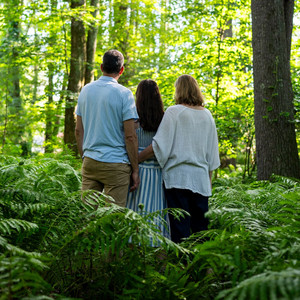
A few months ago, we went to Connecticut to visit the dad who'd reached out to us.
Hello?
Hi.
He and his wife greeted us at the door and showed us to their living room.
Well, should we get set up?
Do we want to find a place where we can all sit down?
They asked us not to use their names because they were afraid of being targeted.
They said they never expected to find themselves living in Connecticut.
They both grew up in South Carolina, both raised in church-every-Sunday kind of families.
While they were in college, they ended up at the same conference.
He joined my group.
He came in late and joined my group.
And then we met as a small group and we were talking about issues.
And he kept talking about, well, I wonder what women think about this.
And I was like, oh, wow, who is this guy?
He kept saying all this stuff about feminism and women.
And I thought, wow, this is something different.
And that's just how I talked all the time.
It had nothing to do with the fact that I really thought she was something special.
I was just going around in groups and saying, what do women think about this?
They hit it off, started dating, got married, had kids.
They moved to Florida and became ministers.
Things were good.
One problem and this was a very specific problem was that they were ministers at different churches, making them what's referred to apparently, as a two-church family.
We had been serving two separate congregations and it just was too hard to be a two-church family, like running back and forth between all the meetings and the churches, and we never really spent any of the kind of sacred holidays together.
In 2013, they found their solution in Tennessee, at a church where they could both work.
By then, they had four children, and they moved the whole family to a house on a cul-de-sac.
The moment where I was like, oh, we're home, was there were fireflies.
And our kids had not seen fireflies.
And so we all went outside, and we'd call fireflies and that sort of thing.
And, of course, the nostalgia.
Having grown up in the South, to then see my kids doing that.
It was like yeah, very much an indicator that this was home.
The whole time we lived there, I kept saying, this is our forever home.
This is our forever home.
In Tennessee they were doing the thing all parents do trying to get to know their kids as they turn from who they might be to who they are.
But with their third child, that was harder.
They've asked us to call her Allie.
Allie had been born a biological boy and from the start she felt different from their other children, harder to reach.
I think she was the one child I always felt like that I didn't know her.
What do you mean by that that you didn't know her?
I don't.
It's just sometimes you think about your kids and you're like oh, I know what this one would want like and silly things like birthday gifts, or like I know what they would think about this show, or I know I wonder what they would say if I asked them.
You know what they wanted to do with their life.
And She was just a little out of grasp, like of being able to nail down who she was.
And not in, like, a bad way, but just like a yearning as a parent.
You know, like, I just mentally remember thinking, like, I need to get to know her more.
From early on, Allie seemed to her parents an effeminate boy.
She loved all things purple and used to dress up in her sister's ballet outfits.
Once, when her dad kicked her a soccer ball, she performed a plié.
She was still a little kid, and her parents didn't really know what to make of it all, if anything.
I mean, I don't think we were equipped to know what we were experiencing.
So I think very early on, we thought, oh, this one might be gay.
Was there a moment that you remember, kind of starting to realize huh, this might not be a sexuality thing?
We might be looking at something that's more connected to gender.
Not me.
I was really slow on the uptake.
Yeah, me too.
As Allie got older, though, this difference became harder to ignore.
Particularly, they both say, during this one family trip they took in 2022.
And then we went to Spain.
Oh, okay.
I was wondering if you went.
Yeah, we went to Spain, and I think...
I think we were maybe in different places a little bit at this point.
Um, and we went into the shop and then Allie found these headbands and they were made out of metal and they were flowers and they were really pretty.
They were very expensive and we had given them maybe like 50 euros each to have a spending money on the trip.
And I just said, that's a lot of money.
And so we walked out and then as we left, she's like, I really want to get those.
Um, And I thought, okay.
And you, um, I think you were a little more hesitant, like, let's just go.
Um, what is she going to do?
And so I remember us having this conversation, like, what does she want with a headband?
And I was like, I think.
Do you remember that conversation?
I do.
I um, yeah.
So she wanted some tear flowery looking thing and we're traveling in a different country and
I wasn't there yet.
And I was scared for her.
Whenever she wore something that presented more feminine to school, I was always like I was afraid that someone would physically assault her.
And so we didn't get it.
And then we came home and it was actually her younger sister's birthday who wanted to get her ears pierced.
And so where do you go to get your ears pierced?
Claire's at the mall.
And so we were, it's like a rite of passage.
And so Allie asked, well, can I get my ears pierced?
And I thought, okay.
And so like just one.
And she's like, no, I want both.
And I was like, okay.
So she got them both pierced.
And then she also said, can I get this headband pierced?
And I mean, it was very, very feminine.
And she was already wearing at this point her lavender chucks and her purple sweater.
And so now we had the headband and the earrings.
I remember walking out of the mall because she had started puberty.
Like she was growing.
How old was she?
I think she must have been in seventh grade at this point.
So 12, 13.
But it's not cute anymore for others, right?
Like to see a boy dressed as a girl is not cute.
And-
I remember walking through the mall and I walked ahead of her because I wanted to just kind of survey, like you know, just keeping safe.
And I, like, saw men look at her with this, like, 30-ish-year-old man.
Like, I saw two look at her and then take a double take with this just hate on their face.
I mean I could— see it and it was really scary and I didn't want her to see it.
So I'm like okay guys, let's go.
Let's go get in the car.
It was kind of walking fast, also like tears are falling.
I didn't want her to see that I was upset, but she was a light.
I mean, she was a light.
There's something that's complicated.
I can imagine about this being a moment when, in some ways, you're seeing your child, who's never felt happier, who's never looked happier, and at the same time, you've never felt more scared for her, like the thing that makes her so happy is the same thing that might put her in danger.
Absolutely yeah, and it's the i think it's The fear of not being able to protect her which is honestly like that fear has never abated.
How do you protect her?
How do you keep her safe?
And also, how do you let her live into her joy without scaring her, you know?
Yeah.
Over the next few years, Allie's parents tried to make home a safe place for her.
They encouraged her to open up, to be herself, to share how she was feeling.
At the same time, they noticed she was changing, growing quieter, spending a lot of time in her room alone.
I felt the most disconnected from her than I had ever felt, in terms of like what I was talking about earlier, like just wishing I had known her more.
They put her in therapy, tried to be patient, But still, she seemed to get more and more distant.
Then she started having issues at school.
Allie had always been a good student, the kind of kid who never really got in trouble.
But starting in junior high, there were a few incidents that began prompting calls to home about what Allie was typing on school computers.
And one of them was a poem.
She says it wasn't a poem.
It read like a poem.
But this one was about That nobody could ever know how she really felt.
That she would wear a smile and everybody needed to think that she was happy.
But that she wasn't happy.
And her body was ugly.
And they have their computers bark alerted.
Bark alerts is like the school has an alert.
Yeah, the school computers.
And if you type something in there or look up something, it'll alert you, know the administration that this is alarming.
And this was the third incident where she had done something that alerted the principal.
And so after one of the times she got in trouble, I said, I'm going to go through your phone.
And she didn't like that.
I don't use that privilege a lot, but I started seeing messages to friends that had been happening over the year where she would say I'm feeling it again.
Like I just, I, You know, are you there?
Like she would text her friends and ask if they're there.
So apparently she'd been leaning on her friends for a while when she was feeling these feelings.
And she started, it was a tool, but it had like a screwdriver on it.
And I think she was using that to scrape herself, to cut herself.
So I kept seeing these marks on her arm.
And I said, what, you know, what are those?
And, you know, she was like, oh, I just was scratching my arm.
It was, of course, all very alarming to Allie's parents, right?
At home, they took her to their bedroom, sat her down, and started asking questions.
What was actually going on with her?
What was this feeling she was texting her friends about?
And this poem that wasn't a poem, was this really how she felt about her body?
I remember just having questions about the poem.
I get, you know, asked, you know, is she okay?
I mean, these are the things that were in my head, because it sounded awful the way she said she was feeling.
And I also wanted to know, like, is this just a poem?
At a certain point, something clicked for Allie's mom.
She remembered this thing she'd read about called gender dysphoria, the idea that the gender you feel doesn't match your biological sex.
And so I started Googling that and said, you know, is this what you're feeling?
And I started reading the symptoms, and she said, yes, yes, yes.
Yes.
And then we looked at like, well, how do you, it sounded awful.
It sounded like she was having an outer body experience and I have anxiety and I'll get panic attacks sometimes.
And when I feel that way, it's when I'm feeling out of body.
I just don't like that feeling.
And so I asked her like, how often do you feel this way?
And she says, I've felt this way since I can remember.
Wow.
And I just thought, holy cow.
Wow.
I cannot imagine spending my entire life feeling like that.
And it was at that point that I was like, would you be more comfortable going by she, her pronouns?
And she said, yes.
It was just like the sigh of relief.
And then I said, why didn't you tell us?
Like, I mean... you know, we love you and support you.
And she said it's just an awkward conversation to have, you know, to kind of sit your parents down and say like okay, this is it.
Like just to name it was too awkward.
With everything that was happening with her.
You know the self-harm.
Was there a moment when, for example, you thought maybe there's something other than gender dysphoria going on?
Like maybe there's a, there are other mental health issues that For me it was now.
So the scripture by the fruits you will know them.
I generally not applied to this uh particular conversation, but you know we, when you see your child at their happiest, when they get their ears pierced or wear a tear or um, put on a dress and go to the Barbie movie.
And you're like, my, my child is flourishing in the, that's not some other mental health thing.
That's somebody like flourishing is not a sign of struggling mental health.
Yeah.
I mean, I felt like she was on the other end of this rope and I just could not like reel her in and like I just couldn't get close enough to her.
And when all this happened in this bedroom, it was like she was right beside me.
The thing that I had been craving.
And it made sense now.
That's why.
She had to keep her distance because she couldn't be who she really was around us.
And she was protecting herself.
And I think when that guard was down, then she was like...
It was immediate.
Yeah.
And like our life changed because in that conversation we knew that lots of things were about to change.
Not just pronouns.
Because my wife, after Allie lit up about the pronouns, what did you say?
You're like, all right, here's question two.
Yeah.
And then immediately I did say like, okay, do you want to, I don't even know what I called it.
I don't even know if I called it the right thing.
But, you know, look at hormone replacement therapy.
And she said yes.
And she was a light.
I mean, I knew.
Like, it all clicked.
Did you have any hesitation about offering up the kind of option of a medical intervention that quickly, that immediately?
I didn't.
In hindsight, it really wasn't this all of a sudden thing.
We had noticed this about her since she was two or three.
It felt to me like what I had been seeing her struggle with over the past year had been that she was going through puberty.
It was the body changing that is unchangeable once she goes through puberty that was causing all of this dysphoria.
What I thought is, the sooner she gets on this, then the slower.
Then, you know, puberty can be paused.
And she now has time to really think this through.
So what I knew was to say, okay, do you wanna get on hormone blockers to like figure this out?
You know, because at least it can stop it for a moment and pause it while you figure this out.
Like, that's okay.
The very next day, Allie's parents started making moves.
They made two appointments for her, one with her therapist and one with her doctor.
It felt like a relief to finally be doing something they thought would help her.
But on the way to the doctor it dawned on Allie's mom that what had felt like a deeply personal issue, a private family matter that was about to run headlong into politics.
Like I had kind of had known that there had been some laws that they had been trying to pass in Tennessee, but honestly, like it was hard to keep track.
And so I do remember there being some anti-trans laws on the books um, or at least being up for debate.
And so on the way to the doctor's office and I was like, you know what?
I don't, I now I think about it.
I do remember them debating this too.
And so I asked her like to Google it, like Google, can we get healthcare?
Um, Wow, you are literally Googling whether you can get this care.
On the way to the doctors.
Yeah, on the way to the doctors.
Wow.
We'll be right back.
Allie and her mom met with the therapist and the doctor, who both agreed that exploring gender-affirming care was a good idea.
But they also confirmed the family's fears.
Tennessee had banned those treatments for minors in 2023.
That ban had grown out of a number of concerns, some of them moral, some of them religious.
But there was also a real debate within the medical community over the right treatment for these kids, over whether to intervene as early as possible or whether to wait until they reached adulthood.
Allie's doctor and therapist said if the family wanted to seek that treatment they were going to have to look outside of Tennessee.
So I went home and told my husband, and we just started.
I mean it was right up on Thanksgiving.
So I remember over the Thanksgiving break, like right before it, we were Googling like what could you do?
Allie and her parents reviewed the evidence, talked it over and started researching where she could get care.
And so I just remember both of us would like Spend a couple of days tracking down.
You know like I tried.
We each tried a couple different places in Georgia.
I remember he spent like he was on the phone with like four different people like getting it to happen.
We got insurance to approve it.
We got all of the stuff and then we're ready to make the appointment.
And the last person we talked to says, oh, we can't provide care for a youth from Tennessee.
We're not allowed to do that border because of your laws, I guess.
Or I don't, I don't know.
Half the country had bans like the one in Tennessee.
And so a lot of clinics had closed.
The ones that were still open had long waiting lists, and many of them wouldn't accept Allie because at 14 she was too young.
They'd stop taking anyone under the age of 16.
We couldn't find anyone who would give care to her.
But then they had a breakthrough.
One clinic called back.
And there had been a cancellation and we were able to go in.
Like I think that was on a Friday and we were able to go in on a Monday, they'd landed a spot at the clinic at the University of Virginia.
It was eight hours away from their home in Tennessee.
It's like, okay, it's eight hours away.
That's what we'll do.
So it wasn't a question of whether we were going to do it.
It was just how hard is it going to be?
Do you remember the first time that Allie goes to the clinic and what it was like when she starts care?
So I drove Allie up for her first appointment at the clinic at UVA.
We stayed overnight hotel, got up early, went there.
Um she was excited.
I honestly was excited um to be able to.
It felt like I was being a good dad.
It was like it just felt right, it's like I'm doing right by my child.
That's what I was feeling.
Um Yeah, I was proud.
I feel like I can see you getting emotional just about thinking about that moment.
What's going through your head?
It feels existential to get that gender-affirming care for her.
And the relief that she express that showed when we got on it.
It was like she didn't have to carry that anymore.
She trusted that we were going to take care of her.
And it was like, we got to, she didn't have to fight for herself.
And so I really don't see it any differently than some other health need.
But just as things started falling into place for Allie and her parents, and national politics began to change.
Yeah.
So, I mean, some of this happened before January for the inauguration.
And so, you know, I had fears about what might happen.
I knew they were attacking trans rights and I knew that they were going to go after them.
I think I just thought that certainly this isn't like they would protect our kids.
Things hadn't exactly been easy up until this point, but Ali's parents had figured out a way to make it work.
But then... I will take historic action to defeat the toxic poison of gender ideology and reaffirm that God created two genders, male and female.
As soon as Trump came to office, he started following through on the promises he'd made during his campaign to limit access to treatment for trans youth.
Attorney General Pam Bondi, issuing a warning to the transgender medical industry, saying quote medical professionals and organizations that mutilated children in the service of a warped ideology will be held accountable by this Department of Justice.
We've issued subpoenas to major manufacturers of the drugs used in trans-related medical interventions for possible violations of drug marketing laws.
Hospitals from Los Angeles to New York City have been canceling gender transition surgeries and hormone therapy appointments for minors.
Suddenly, not only did it feel harder than ever to get Allie treatment, her parents began to worry they may be targeted for pursuing it at all.
Families with children who depend on that care say they feel shocked.
Today, many in the LGBTQ community waking up with a sense of fear.
Many parents are scrambling to learn next steps.
So they started to be much more cautious about everything.
The littlest things began to feel like a risk.
Now, when she wanted to do a play date with somebody, I was very hesitant to let her go play with her friends.
I didn't know whose parents were safe.
I didn't trust the people in my neighborhood anymore.
I didn't tell anyone.
I was scared. all the time.
So then it started getting to the point where the safety that we felt on our street and our community no longer felt safe.
I didn't know who I could trust anymore.
We had to get blood work for her for one of her doctor's appointments.
And even my pediatrician was like, I don't know who you can go to.
So let's just go to this person and just tell them you want to get this blood work for another reason, but don't tell them what it's really for.
Because if they participated and gender-affirming care, then they could lose their license.
So, like, now you're having to lie to doctors.
Yeah, nothing feels sure.
So at what point do you guys start talking seriously about the idea of maybe having to leave Tennessee?
We were already kind of talking about it.
I don't know.
You always kind of talked about it.
It was...
I would go through periods where I was like we've got to get out of here, especially when we started experiencing all these issues with getting health care.
And so we just started researching, like, where can we live?
And you're looking for, what's the criteria that you're using?
Criteria, yeah.
Criteria is states that are blue.
We looked at.
There's maps that show laws that protect trans youth and which states have those that are the most protective.
So those were the top two criteria.
And then, of course, like affordability.
Where could we live with a family of six?
And good schools.
We needed to find affirming schools where they were going to be safe.
You know, public schools that would support them.
And so those were kind of our criteria.
Did Allie know that you guys were talking about this and doing all this research?
So Allie had told her therapist she did not want to move.
She had other friends that were trans, and she wanted to stay and fight for them.
And like I said, it was unimaginable, the executive orders, the things that were happening.
And so she really didn't want to leave.
And then our oldest daughter came up to New York to audition for some schools, college schools.
And I remember us walking around outside of Columbia University and I looked up and saw a pride flag there outside of the hospital.
And my cousin, I looked at her and said, is that, is that the hospital?
And she said, yeah.
And I was like, they have a pride flag hanging out the hospital.
And she was like, absolutely.
And I was like, what?
Like, it's just out there.
And she's like, yes, like there's, you'll find that everywhere here.
And I thought this is on, it's truly unreal.
And so we came home and told Allie about that and said, I think this is what it could be like.
And um, Like her, therapist and I had a conversation because we thought she wants to stay, because she wants to fight, but I don't think she understands, like it's too far gone.
Like, we got to keep her safe.
And so that was a hard conversation.
But when we started like painting the picture of her, of what life could look like, and these spaces where, like there's a pride flag outside of a hospital and there's like bathrooms that say you can come, like like there's a government that'll support you.
I just think none of us realized that was a possibility.
And so she started getting excited and was like, okay.
New York City was out of the question for them.
Too expensive.
But they'd heard about a school in Connecticut that could be a good fit for Allie.
So they reached out.
We went to a fundraiser for queer youth services.
And we met various, like, school administrators and They were just like, we will protect your child.
Your child will be safe here.
And my wife started crying pretty much as soon as we walked in.
It did.
It was like that sense of home that we hadn't felt in so long since, at least in the last several months, what we walked into, that space.
And it really did feel like this sense of home.
It's like you're being told, move here.
Yeah.
And like we weren't this anomaly where there was actually a community.
And so then, to have people that understand and to meet other parents that have moved across the country.
I mean, there's lots of us.
You know we're at this thing, and they introduced us to at least three other parents who had moved from South to Connecticut.
And all of a sudden, you're like, okay, we're not alone.
And for me, that's, yeah, that pretty much locked it up for us that this is where we needed to be.
Once they decided on Connecticut, they started calling around to clinics and pretty quickly found a provider who was willing to take Allie on.
Then they packed up that house on the cul-de-sac that they'd thought would be their forever home.
They said goodbye to their neighbors, whom they'd loved.
It was excruciating, but it also felt right.
But then, before they even got to the first appointment at the new clinic, they hit roadblocks.
We thought we had a person that was going to do gender-affirming care when we got here.
And I saw on this Facebook group that they had issued subpoenas to several different hospitals across the country at gender-affirming care.
And so hospitals were starting to get a little nervous.
And so I immediately called the person that we had talked to about getting her care, and they said they had stopped giving care for anyone under the age of 19.
Wow, we got on the Yale list for 2026 just in time to find out that they had shuttered their clinics and it just kind of feels like people are yanking away chairs, like in this, like musical chair nightmare for kids, and we're just like running around and everybody's just like in this full scramble to try to.
They'd been banking on Connecticut as a safe haven, a place where everything would be easier for Allie.
But as it turned out, it wasn't as simple as blue state, immediate access to care.
The new rules and new threats from the Trump administration seemed to touch every corner of the country.
Clinics were closing just in anticipation of legal action from the federal government.
Allie's parents said... it felt like the ground kept shifting underneath them.
Allie's parents were able to track down a new provider that agreed to treat someone her age and they got an appointment.
But even that felt precarious.
We haven't had the first appointment yet.
This is where we think we'll go, but nothing feels sure right now.
So we have all, we have like plan A, B, C, and D. So it's, private.
It's not part of the big hospital and won't hopefully be as vulnerable to Medicaid Medicare sort of restrictions.
But there's a lot of writing on the wall that there might be a federal rule coming in the next month or so.
And so, I mean, definitely back On the internet, trying to figure out which country.
I didn't know that.
What, which country?
Which country might be better.
Is this the first time you're hearing this?
Yeah.
What's going on for you right now?
I don't know.
It's just so overwhelming.
We just want our child to thrive.
It's also like financial, like we put every, I mean, this wasn't, this was not easy moving here.
Like we put everything, like all of our resources in it and just don't know what we'll do.
I, there's part of me that I guess it really.
It's like if somebody gets really sick and you realize, like what really matters, and uh, and in our case, right now, like I know what I really value, what really matters, and it's the health and wellbeing of of my whole family.
And if we have to do that somewhere else, we do that somewhere else.
Um, and if that means that we don't have, you know, if we're even further away, then that's.
I guess that's what it, what it takes um to, but to feel like uh, stranger in what used to be like your country, or to feel like a refugee.
I just don't know what's happened to our nation.
I don't recognize it.
Is it still clear to you, even with all of that, that you made the right choice in moving and moving to Connecticut?
Oh, yeah.
I mean, yeah.
We didn't have a chance in Tennessee.
And like I said, I... I think we are still blown away by what life can be like for queer folks here.
Like church services where there was a pride service or where like...
They're talking to the children about every single one of you is made in the image of God.
Like, you know, our town has pride festivals.
Like, you know, the governor is going to fight for you.
Like I think the difference is that.
I mean, you know, the principal of one of the schools said she promised to keep her child safe.
Like, the difference is that people are fighting for her here.
They were not.
They were not back home.
And how's Allie doing right now?
She's doing great.
I mean, like, I think, don't you?
Yeah.
She's got her pride flag up in the room.
I mean, she is talkative.
She was never really talkative before.
She still is an introvert, so she's in her room a lot.
But now she wants to share what she's doing, what she's listening to.
Like, if we, you know, our drive to school was 30 minutes.
And so there and back, she wants to share, like, Like she's into some interesting podcasts.
She wants me to listen to them with her.
And yeah, like it's, that's all that's new.
And you know, is trying new things.
You know, like some things at school where I thought how's she going to react to that?
And was a little worried about like her in that space.
And we told people who she was and They accepted her and she made a group of friends and so I think she is thriving.
She misses her friends, but I think she's thriving.
Well, I want to thank you both so much for your time and for being so open with us.
Thank you.
Thanks, yeah.
Thank you.
Since we spoke, Allie's parents say she's begun treatment at a clinic in Connecticut.
We'll be right back.
Here's what else you need to know today.
On Thursday, President Trump accused half a dozen congressional Democrats of sedition and said they should be punished by execution for imploring members of the US military to reject any illegal orders that they may receive from Trump.
I'm Senator Alyssa Slotkin.
Senator Mark Kelly.
Representative Chris Deluzio.
Congresswoman Maggie Goodlander.
The lawmakers, all of whom served either in the military or in the intelligence community, had delivered that message in a video earlier this week.
While the lawmakers didn't specify which orders may be illegal, several of them have worried aloud about the legality of Trump's orders to kill suspected drug smugglers in the Caribbean and his orders to deploy troops in US cities.
Right now, the threats to our Constitution aren't just coming from abroad, but from right here at home.
Our laws are clear.
You can refuse illegal orders.
You can refuse illegal orders.
You must refuse illegal orders.
No one has to carry out orders that violate the law.
And An unlikely mix of Democrats and Republicans came together on Thursday to pay tribute to former Vice President Dick Cheney during his funeral service in Washington.
Among those in attendance were former Vice Presidents Mike Pence and Kamala Harris, and former presidents Joe Biden and George W Bush.
25 years ago, I had a big choice to make, a big job to fill.
I want to know all my options, so I enlisted the help of a distinguished former White House chief of staff and secretary of defense to lead my search for running mate.
Dick Cheney and I went through the files name by name.
In his eulogy, Bush recounted his unexpected decision to pick Cheney as his vice president, against the wishes of some of his advisors.
I remember my dad's words when I told him what I was planning.
He said, son, you couldn't pick a better man.
Notably absent were President Trump and his vice president, J.D.
Vance, both critics of Cheney.
Neither of them were invited to the funeral.
Today's episode was produced by Eric Krupke.
It was edited by Devin Taylor... with help from Ben Calhoun and Paige Cowett.
Contains music by Marion Lozano, Pat McCusker, and Diane Wong.
And was engineered by Alyssa Moxley.
Special thanks to Lisa Tobin and Azeen Goreshi.
That's it for The Daily.
I'm Natalie Kitchoeff.
See you Monday.