
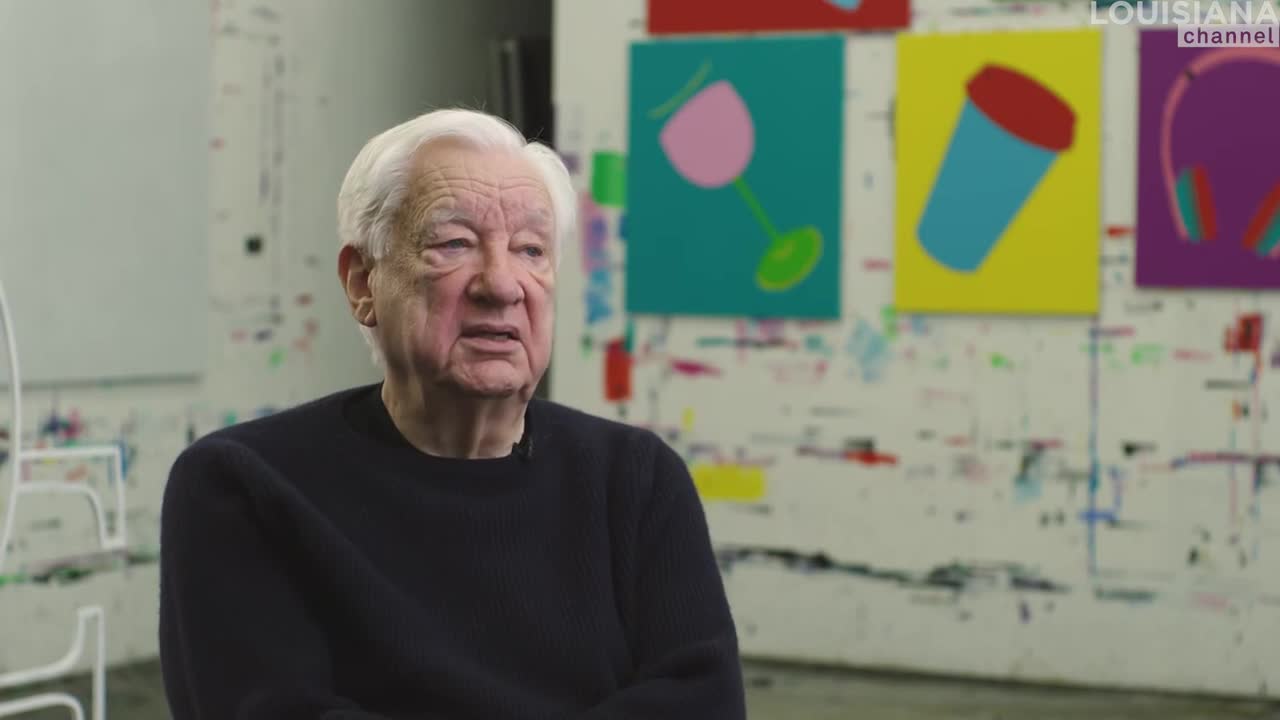
[The Miracle of Imagery: The Foundational Pillar of Human Cognition]-[Painter Michael Craig-Martin: "A picture of a shoe has nothing to do with a shoe."]
📋 Summary
The Primordial Nature of Visual Literacy
The speaker posits a profound philosophical argument: the human capacity to interpret two-dimensional images serves as the essential bedrock for all subsequent human understanding. This cognitive skill is described not merely as a survival trait, but as a "miracle" that precedes the development of complex verbal communication. By analyzing the inherent disconnect between an object and its representation—noting that "a picture of a shoe is nothing to do with a shoe"—the speaker highlights the abstract mental leap required to bridge the gap between physical reality and symbolic depiction.
Imagery as the Precursor to Language
One of the most compelling aspects of the argument is the temporal priority of visual literacy. The speaker asserts that "without that, there couldn't be language, verbal language." This suggests that the brain’s ability to decode symbols and representations is the scaffolding upon which linguistics is built. Before an infant utters their first word, they are already engaged in the sophisticated process of "reading an image." This developmental milestone is described as "one of the most extraordinary things we learn," yet it remains largely invisible to our conscious awareness.
The Unconscious Mastery of Representation
Why do we overlook this foundational skill? The speaker provides a poignant explanation: "we don't have a sense that we've learned it, because we learned it so early and we learned it without noticing that we were learning it." This unconscious acquisition of visual intelligence implies that the ability to perceive and interpret images is hardwired into the human experience. Because it occurs during infancy, it becomes an invisible, automatic operation.
Conclusion: The Key to Everything
Ultimately, the speaker reframes the act of looking at a picture as a gateway to human consciousness. By defining the ability to "see a picture for what it is" as the "key for me to absolutely everything," the speaker elevates visual literacy from a simple sensory function to the primary mechanism of human intelligence. This perspective challenges us to view our daily interactions with imagery—from simple drawings to complex digital media—as a manifestation of the very core of our cognitive identity. The disconnect between the image and the object is not a barrier, but the very catalyst for the abstract thinking that defines the human species.

Deep Learning with ListenLeap


