Hey there, grownups.
We want to learn more about you and why you listen to Circle Around.
Take our short 10 -minute survey and get a special bonus story from me, Rebecca Shear.
Find a link in the show notes of this episode or visit WBUR .ORG slash survey.
WBUR Podcasts Boston Think about your favorite story.
If I asked, you could probably tell me its plot, right?
The series of events that unfold.
But what if I were to ask you about its theme?
The message the story is trying to convey?
Sometimes the message of a story is easy to figure out.
But, as we'll hear in today's episode, sometimes it's hidden.
and requires some serious reading, or listening, between the lines.
I'm Rebecca Shear, and welcome to Circle Round, where storytime happens all the time.
Today, our story is called Out of Time.
We found versions of this tale from the East Asian island nation of Japan.
Some really great people came together to bring you our version of this folktale, including Brittany Ishibashi.
You kids may recognize her voice from Teenage Mutant Ninja Turtles, Mickey and the Roadster Racers and Ultraman Rising!
Grown -ups, you'll know Brittany from Grace and Frankie, Hawaii Five -0, and Marvel's Runaways.
Watch for her in the upcoming Apple TV Plus comedy series, Brothers.
So, circle around, everyone, for Out of Time.
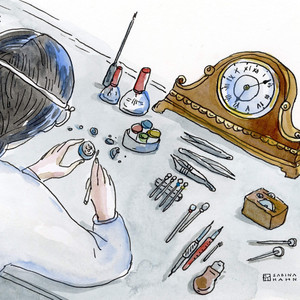
There once was a clockmaker who designed and built beautiful clocks inside a little shop in the middle of town.
The clockmaker had spent months working on her most exciting project yet A gold and silver clock for the governor.
One morning she got to work at the crack of dawn so she could put the finishing touches on the governor's clock and get it delivered.
But just as she was fishing her keys from her purse to unlock her shop, she made a distressing discovery.
Oh! The front door is wide open!
Somebody must have broken in!
The clockmaker hurried inside.
She didn't see any thieves, but what she did see made her heart clench. The place had been ransacked!
Tools were scattered everywhere, the floor was strewn with splintered wood and smashed glass…and what's worse?
The governor's clock is gone!
The clockmaker raced outside, unsure of what to do, and that's when she saw it.
a lone figure taking off down the street, clutching a bulging bag in their arms. The figure was blocks away, but the clockmaker immediately noticed several details about them.
First, they were nearly as tall as a lamppost, as skinny as one too.
Second, their head was as bald as an egg.
And third, they ran with a halting, shuffling gait, like a racehorse past its prime.
That must be the thief.
I can't let them get away !" The clockmaker took off like a flash, but she was too late.
The tall, skinny, bald, shuffling figure was gone.
O Drat! That gold and silver clock was worth a fortune, and I worked so hard on it.
I must get it back, but how?
Her eyes flitted about the empty streets.
Then, they lit up the courthouse.
There it is, just a few doors down.
I'll head on over and see the judge.
I've heard she's very wise and very fair.
Surely, she can help.
It was barely past sunrise, but the judge was already in her office, shuffling through papers.
She invited the clockmaker in and listened to her woeful tale about the break -in.
Not only did they ransack my shop, Your Honor, they made off with a very valuable clock.
I was building it for the governor, and I spent so much money on materials.
If I can't make the sale, I'll be ruined, and the governor will be so disappointed." The judge's brow furrowed with concern.
I'm sorry to hear this news.
Tell me, did you happen to see the person who broke into your shop?
Not exactly. By the time I arrived, they had already bolted down the street.
But you caught a glimpse of them, right?
could you describe them in any way the clockmaker tapped her chin well they appeared to be tall mm -hmm and skinny okay they had a bald head uh -huh and they ran with this kind of shuffling gait big strides but not very smooth I I see.
Did you notice anything else?
That's it. They weren't very close when I spotted them, so I couldn't get a good look.
That's all right. You've given me plenty to go on.
Meet me tomorrow morning in my courtroom, 8 AM sharp.
The following morning, the courtroom was packed with people.
Word of the stolen clock had spread throughout town, and everyone was eager to see who the suspects were and how the judge would decide the case.
The clockmaker was torn between excitement and anxiety.
By the end of the day, she would either know who the thief was and get the governor's clock back, or she would leave empty -handed and have an awful lot of explaining to do to the most powerful person in the land.
Good morning, everyone!
This court will now come to order.
Guards, please bring in the suspects.
All eyes swiveled to the door.
Two muscle -bound guards marched in.
Behind them were two men, both of them tall, skinny and bald, and walking with a shuffling gait.
The court will now commence questioning.
Clockmaker, does one of these men look like the person who robbed your shop?" The clockmaker looked from one suspect to the other.
I'm sorry, your honor, but both men look like the person who robbed my shop.
I couldn't pick out which one actually did it.
The judge nodded, then leveled her gaze on the suspects.
Gentlemen, will you please approach the bench?
After the two suspects shuffled over, the judge began peppering them with questions, which the two men answered quickly and easily.
Where were you the morning of the crime?
I'm a farmer by trade, so I was out in my fields.
I work as a fisherman, so I was in a boat on the river.
Do you have a witness who could provide an alibi?
An individual who could prove your whereabouts?
My farmhands… I greet them every morning when they get to work.
You could ask my boss.
He's always at the fishing shack when I clock in.
Have you been to the clockmaker's shop before?
I have not. Nope. Never been there in my life.
The judge turned to the clockmaker.
Clockmaker, both suspects claim they have never visited your shop.
Is what they say true?
I make a point of chatting with each and every customer, Your Honor.
I've got to say, I have no memory of chatting with either of these men.
Interesting. The judge leaned forward in her chair.
Her face was still, but her eyes were dancing.
Ladies and gentlemen, there's an old saying.
the clever hawk hides its talons.
Despite the testimony our suspects have given thus far, I am certain that one of them is the clever hawk.
And mark my words, by the time this day is through, their talons will be revealed.
What do you think the judge will do next?
What would you do if you were the judge?
We'll find out what move she makes after a quick break.
your jobs more visibility at indeed .com circle round.
Just go to indeed .com circle round right now and support the show by saying you heard about indeed on this podcast. Indeed .com circle round terms and conditions apply.
Hiring Indeed is all you need.
Before we return to our story, a quick reminder and request to take our short survey so we can learn how to make your CircleRound experience even more fun.
It takes 10 minutes and all survey takers get a bonus story from me, Rebecca Schier.
Click the link in the show notes or visit webr .org slash survey.
Welcome back to CircleRound.
I'm Rebecca Schier.
Today, our story is called, Out of Time.
Before the break, a wise judge was trying to decide which of two similar looking men was guilty of robbing the clockmaker's shop.
Ladies and gentlemen, we have heard some convincing testimony from both of our suspects.
I have asked them a series of questions and they have answered.
But there's one more question I'd like to pose.
Farmer, Fisherman, will you please tell us a story?
A story? Yes! A tale, a yarn, an anecdote!
I'd like each of you to tell a story about the cleverest person you've ever heard of...
a person so intelligent, so witty...
you can't help but hold them in admiration.
How about you go first, farmer?
The farmer thought for a moment, then rose to his feet.
My story is about a farmer just like me.
But, while I only grow vegetables, this farmer also raised rabbits.
Rabbits? Yes. He was the only rabbit farmer in his humble little village.
Well, one morning, the farmer woke up and discovered that one of his rabbits was missing.
He searched high and low, but he couldn't find the cute little bunny anywhere.
And this mystified him, because his rabbit stayed locked in the barn overnight.
And there was no sign of a break -in.
Sounds like a very clever thief.
You've got that right.
In fact, the thief was so clever that the same thing happened the next morning, and the next.
One morning after another the farmer woke up and discovered another rabbit was missing.
So what did he do? Well, he gave it some thought, and then he got an idea.
His sister was the local school teacher.
She taught every youngster in the village, so he asked his sister to give her students an assignment.
Every day for a week they must keep a journal of everything they ate.
And at the end of the week, when the teacher looked through the assignments, do you know what she found?
Do tell! Well, this was a humble village, so all of her students had written about humble foods—vegetables, rice, beans.
But one student wrote about something else.
He wrote about rabbit stew.
Rabbit stew? Yes! He went on and on about how his dad had surprised the family every day by bringing home a rabbit.
so they could cook it up and, well, you know.
Anyway, the teacher told her brother what she found and instantly he knew who the culprit was.
He went to the village judge, the kid's father was brought to court, and he confessed his crime.
And that is why the rabbit farmer is the cleverest person I've ever heard of." The judge flashed the farmer a grin.
Well, though I'm very sorry for the rabbits, that is a very good story about a very clever person.
Thank you, farmer. Now, let's hear a story from our second suspect.
Fisherman, tell us a tale about the cleverest person you've ever heard of.
The fisherman stood up with a smile.
It would be my pleasure, your honor.
As it happens, my story is also about a theft. Is that so?
Sure is. It all started with these two thieves, and they were arguing about which one of them was the better crook.
So the first thief said to the second thief, I'm so good at robbery, I could steal the silk sheets off the mayor's bed while he's sleeping on them.
Of course, the second thief didn't believe that for a minute, so he bet the first thief 10 gold pieces that he couldn't steal the silksheets off the mayor's bed while the mayor was sleeping on them.
It does sound like a rather unlikely heist. Well, the first thief gladly accepted the bet.
In the middle of the night, he'd slipped inside the mayor's mansion, he snuck into the bedroom, He tiptoed to the great big four poster bed, and there was the mayor, fast asleep on his shiny silk sheets.
So what did the thief do?
He reached into his pocket and pulled out a feather.
A feather? Yes. He took this feather and he used it to tickle the mayor's face.
The mayor didn't wake up.
He just groaned a little and rolled over toward the edge of the bed.
Now that the mayor had moved, the thief took one side of the silk sheet, untucked it, then bunched it up in the middle of the bed.
Sooo, one side of the mattress was now bare?
That's right! Next the thief crept to the opposite side of the bed and tickled the mayor's face again!
The mayor groaned and rolled over the other way.
He rolled right over the bunched up sheet and onto the bare mattress, which gave the thief a chance to untuck the rest of the sheet, snatch it off the bed, then slip out of the house with proof that he won the bet.
And the mayor didn't wake up?
He did not. He just kept snoozing away.
So the first thief brought the mayor's sheets to the second thief, he collected his 10 gold pieces, then he moseyed on home with a pocket full of money...
...and fancy new linens for his bed.
And that is why the first thief is the cleverest person I've ever heard of.
The judge's eyes twinkled.
Thank you, fisherman.
That is also a very good story about a very clever person.
And you know what? It's inspired me to tell a story of my own.
The judge pushed back her chair.
Then she got to her feet, came out from behind the bench, and began pacing around the courtroom.
there once was a judge.
A very wise and clever judge, but one day, this judge was given a case which she simply could not decide.
There were just two suspects, but they looked very similar.
So similar that the one and only witness couldn't tell which one she spied running from her shop after it was robbed.
The judge paused and glanced about the room.
She could tell she had everyone's attention.
The judge began peppering the two suspects with question after question, but their answers weren't very helpful.
So she decided she'd try something else.
She asked each suspect to tell a story, but not just any story.
She asked them to tell a story about the cleverest person they had ever heard of, someone whom they admired for their intelligence and wit.
And then, the darndest thing happened.
The judge smiled. The room was so quiet you could've heard a clock ticking on the other side of the courthouse!
You see, one of the suspects told a story about an honest man who used a trick to catch a dishonest thief.
The other suspect told a story about a dishonest thief who used a trick to steal from an honest man.
So one suspect clearly admired honesty, while the other suspect clearly admired dishonesty, which, lo and behold, is what led the judge to make her decision.
In a flash, she knew the man who admired honesty was innocent, and the man who admired dishonesty was guilty.
She snapped her head towards the fisherman.
One look at her glowering expression, and he knew his goose was cooked.
In an instant, he rocketed out of his seat and began pushing his way toward the exit.
I've got to get out of here, uh, everybody out of my way!
The room erupted in chaos.
The judge ordered her guards to seize the fishermen and search his house.
And when they did, can you guess what they found stashed away in his attic?
The stolen gold and silver clock!
The precious timepiece was promptly returned to the clockmaker, who happily put on the finishing touches before delivering it to the Governor.
And so, in the end, justice was served, all thanks to a clever judge who appreciated the power of a good story and always remembered the importance of reading between the lines.
Now it's your turn.
This episode marks the grand finale of Circle Round's eighth season.
Now that we've shared nearly 300 episodes with you, we want to know, what is your favorite Circle Round story?
If you fast -forward to the end of this, or any other Circle Round episode, you'll hear recordings from fans like you talking about their favorite tales, and you can be one of them!
Grown -ups, head to a quiet spot in your home, then grab a smartphone and use the Voice Memo app to record your Circle Round fan saying their name, location, and favorite Circle Round story.
Once you're done, email the recording to circleround at W -B -U -R dot org.
We look forward to hearing from you.
This week's episode, Out of Time, was adapted by me, Rebecca Shear.
It was edited by Dean Russell.
Our original music and sound design is by Eric Shimalonis.
Eric's featured instrument this week was the KOTO, the official national instrument of Japan.
You can learn more about this plucked zither with a thousand year history in Japan and see a photo on our website WBUR .org slash Circle Round.
Circle Round's artist is Sabina Han.
Sabina has created a black and white coloring page for every single Circle Round story and you can print them out and color them in while you listen.
Grown -ups, you can find all of our coloring pages at WBUR .org Special thanks to this week's actors, Evan Casey, Theodore Chin, Don Ursula, and Britney Ishibashi.
You kids may recognize Britney's voice from Teenage Mutant Ninja Turtles, Mickey and the Roadster Racers, and Ultraman Rising.
You may also remember her from our 2024 circle round episode, The Weeping Witness.
Love circle round and looking for even more ways to circle round with us?
Join the circle round club!
As a member, you'll be supporting public media while also getting ad -free episodes, bonus bedtime stories, early access to live events, exclusive CircleRound swag.
You can even order a personalized birthday message from me, Rebecca Shear.
Join our community of superfans and show your support for public media by visiting wbur .org slash circleround.
Grownups, if you enjoy Circle Round, please leave us a five star rating, or review, on whatever podcast app you're using right now.
It helps other listeners find the show, so we can make the circle round circle even bigger.
Circle Round is a production of WBUR, Boston's NPR.
I'm Rebecca Scheer.
Thanks for circling round with us.
Now that you've made it to the end of this Circle Round episode, we want to know what's your favorite circle round story?
Thousands of fans just like you have been telling us about the circle round stories they like best. Take a listen.
Maybe one of their favorites is one of yours, too.
My name is Isla and I'm from Toronto.
My favorite circle round story is the blizzard wizard. And my favorite part is when Ayana's mother gets trapped in the crystal prison.
My favorite part is when the air and I'll say, I'm looking for some twitter to eat for dinner.
My name is Chelsea and I'm from Hudson, New York.
And my favorite circle around the story is the goat in the garden, and my favorite part is when the goat says, don't you know who I am?
I'm the Billy Goat from the Hills and Mountains.
So you get out. My name is Patrick.
I live in Charleston, South Carolina.
My favorite circle around the story is Home Sweet Home.
My favorite part is when the leopard runs away.
Hi My name is Natalie and I live in Fairfax, PA and my favorite circle round story is the Princess and the Bee and my favorite part is when the Bee helps her find the right flower.
My name is Ester and I live in Massachusetts.
I love the lion's whiskers because I like when they get angry and to say, we need your iron to whisk up, so making us stop fighting.
My name is Oliver. I live in Belmont, Massachusetts.
And my favorite circle round is all of them.
I like all of the parts.
Did someone mention a story you've missed?
Not to worry. Grownups, you can find all of our circle round stories, plus links to the circle round club, picture books, coloring pages, and oh so much more.
on our website, wbur .org slash circle round.