This is the Global News Podcast from the BBC World Service.
I'm Chris Barrow and in the early hours of Monday, the 29th of December, these are our main stories.
Donald Trump and Volodymyr Zelensky say that at least 90 has been agreed of the plan to end the war in Ukraine.
Taiwan deploys what it calls appropriate forces as China prepares for a major military exercise around the island.
And Myanmar holds a national election amidst a civil war and accusations that the vote is a sham.
She was the traditional sex goddess as a character, but also as a person in real life.
She was someone who asserted her own desire.
She went after the men she wanted.
She takes the lead, if you like.
Remembering the French actress Brigitte Bardot, who's died at the age of 91.
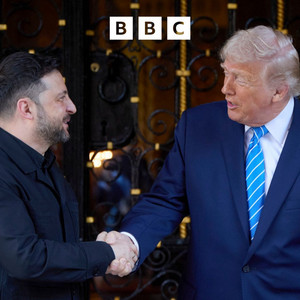
The Ukrainian President, Volodymyr Zelensky, has visited Donald Trump's Mar-a-Lago property in Florida for face-to-face talks on ending the war with Russia.
On the table was a new 20-point plan for peace unveiled by Mr Zelensky last week.
After the meeting, both leaders said that progress had been made but that talks would continue in the coming weeks.
Still, President Trump said that a peace deal was closer than ever before.
Our meeting was excellent.
We covered everything.
Somebody would say 95%.
I don't know what percent, but we have made a lot of progress on ending that war, which is really certainly the most deadly war since World War II, probably the biggest war since World War II.
And, for his part, President Zelensky said Ukraine was ready for peace and thanked the US president for a great meeting.
We discussed all the aspects of the peace framework, which includes and we have great achievements 20-point peace plan 90 agreed, and US-Ukraine security guarantees 100 agreed.
U.S.-Europe-Ukraine security guarantees, almost agreed.
Military dimension, 100% agreed.
Both leaders claim that the deal is 90 to 95 percent finished, with one or two very thorny issues remaining, to quote President Trump.
I asked our reporter, Bernd De Busseman, what these are.
The key sticking point, according to Trump, in particular, seems to be the control over Ukraine's land that is lost and what territorial concessions they would have to make for the war to end.
This is something that Trump his own position on this has changed quite a few times over the course of the year since he's returned to the White House.
At one point, he had suggested that Ukraine might be able to take back all its territory.
But now he seems to have shifted course yet again, saying that It's a very tough issue that he thinks will get resolved.
But his advice to Ukraine was that they're better off making a deal.
And they spoke to European leaders after these bilateral talks.
What does Donald Trump think Europe is going to be doing in this kind of peacekeeping role in the territory?
Will there be actual troops there in the proposals?
President Trump sees Europe as the ones who will do the groundwork and the legwork, as it were, to any potential security guarantees for Ukraine in the future.
Now, as part of the 20-point plan, Europe would kind of take the lead in financing and equipping the Ukrainian defense forces.
And the US president's been very unequivocal that he does not see a role for US troops on the ground yet.
There was one moment where he was asked if there was no resolution, would the US go in there?
And he kind of went, well, we might do.
We're not sure yet.
So it's kind of not nothing really seems fully off the table ever with Donald Trump.
Nothing's ever really off the table with this White House, and that's very indicative of how President Trump has carried out foreign policy since returning to the White House in January.
He's very fond of saying that he doesn't like people knowing what he's thinking or what he's planning to kind of keep an element of uncertainty there.
But one fact is that among many of his supporters here in the United States, any very serious US involvement on the ground in Ukraine might be very, very unpopular with some of his core supporters.
He did, after all, campaign on avoiding foreign entanglements.
And he's been very quick to say, for example, that Ukraine is paying for the weapons that it's getting from the United States, rather than them being gifted to them.
This is something that some of his MAGA base feels very, very strongly about.
The biggest question, I guess, after these talks is, where does Russia stand?
Will it agree to the proposal?
We know that Donald Trump spoke to Vladimir Putin before meeting Vladimir Zelensky.
Do we know what was said in that conversation?
And if there's any indication that Russia is closer to agreeing some of these points?
President Trump had kind of a mixed messaging about that issue in his remarks to the press.
On one hand, he said that he spoke to Putin.
Now he believes very strongly that Putin does want peace.
This is something he said in the past and he didn't really offer much in the way of evidence tonight would be that, according to him, Putin and Moscow have no interest in a ceasefire to allow Ukraine to hold a referendum on some of these which could be controversial elements of the 20-point plan.
He said he understands Moscow's position, because stopping and starting the fighting might put them at some sort of military disadvantage.
And he was very clear about that, that he understands Moscow's position here.
But he did sound not for the first time very confident and trustful of President Putin's remarks in their phone call earlier.
Yeah.
And he almost I mean, you could say he's slightly parroting the Russian line there.
I mean, is there really any hope with these talks if he is such good friends with Putin as he keeps saying?
Well, I think that is something that will be asked a lot in Kiev and in European capitals today.
When he said that Putin wants Ukraine to succeed.
I think that's something that many Ukrainians and many Europeans will object to quite strongly.
He offered again no evidence or no proof that Putin does want peace or does want Ukraine to succeed.
I mean, the one kind of specific he gave was that Putin, according to him, is willing to sell energy to Ukraine at a very discounted price in the future, should there be a peace between the two.
But besides that, he didn't really offer any glimpse into that conversation or what now again leads him to trust Putin, after repeatedly expressing skepticism about Putin and after previous conversations and fighting continued.
Bernd De Busseman.
And, as he mentioned, Ukrainians might be asked to vote in a referendum to approve a deal to end the war.
So what did they make of these latest talks?
Our correspondent in Kiev, Samira Hussain, gave us this assessment.
I think for so many Ukrainians, they have been here before.
They have seen these peace negotiations continue, but no actual deal.
I would say that probably the tone of what we've been hearing from President Trump and President Zelensky just now suggests that they are in fact closer and that both seemed quite upbeat.
But for Ukrainians it would certainly mean a possible land deal in which they would have to give up.
There would be some territorial concessions.
And that's going to be a really hard sell for so many people.
This is a country that has been fighting a war for almost four years.
And to now say that well, you're going to have to give up parts of your country, that's not going to be an easy message to take.
And Donald Trump said it was potentially, if all went well, a deal could be reached within weeks.
Is that feeling amongst the people of Ukraine that it could be weeks, or is it still too uncertain to say?
I think for so many people, they are just so hopeful for an end to this war.
It has been long.
It is winter here.
It is cold.
And Russia has really been concentrating their efforts on the energy infrastructure here in Ukraine.
I mean over the weekend we saw this barrage of drone attacks and missiles from russia hitting kiev, the capital, and a lot of their energy infrastructure and, as a result, there are thousands of people that are still without heat or electricity in these cold temperatures.
So there's been a concerted effort to make it all just so difficult that people here are war weary and they do want an end to the war, but not at any cost.
Is there much appetite for a referendum?
Because that was discussed as well.
It's hard to envision a situation in which the country will have to redraw its lines without getting buy-in from the people who live in the country.
And so this idea of a referendum, I think, would be necessary politically for Mr. Zelensky.
But it's hard to see how you can have a referendum without any kind of ceasefire.
And that is, of course, another sticking point here. in these peace negotiations.
Samira Hussain.
Well, President Trump's attempt to end the conflict between Russia and Ukraine is just one of countless occasions this year that he's thrust himself into the spotlight.
Tariffs, targeting drug traffickers, deporting migrants.
His policies have affected so much of the world in 2025 and he says he's changing it for the better.
But there's another world leader who has perhaps shown himself to be more able to navigate the complicated international arena and promote his own country's interests without much fanfare.
Mickey Bristow looks back at what's been a good year for China's leader, Xi Jinping.
The world's two most important leaders couldn't have more contrasting styles.
There can be few people who haven't heard of Donald Trump or don't know something of his in-your-face style.
He's everywhere.
The same cannot be said of Xi Jinping.
He exudes a quiet confidence. and seems to weigh up every word he says.
He's not known for off-the-cuff statements.
As opposed to Mr Trump, he appears thoroughly uninteresting, like a very measured diplomat.
Part of his confidence comes from experience.
He's led his country for more than a decade and with no presidential elections in China, Mr Xi doesn't have to appeal to a fickle public.
The Chinese president was one of the few world leaders this year to resist Mr Trump's tariffs.
China imposed its own duties on American goods and introduced restrictions on the sale of rare earths vital metals used in a multitude of products.
Mr Trump was eventually forced to back down.
The two leaders met in South Korea in October.
Well, thank you very much.
It's a great honour to be with a friend of mine, really for a long time now, if you think about it.
Afterwards, Mr Trump was upbeat.
He said the meeting had been amazing, 12 out of 10.
But the talks also seemed to lay the groundwork for subsequent deals that Beijing will be happy about over TikTok and US chip sales to China.
At home, Mr Xi has so far avoided any major blowback from a flagging economy.
Internationally, he's held his own.
The US regularly berates Beijing for supporting Russia's war in Ukraine.
But Xi Jinping has ignored US criticism and continues to show very public support for Vladimir Putin.
Mr Xi appears to believe the US president is presiding over a waning power and is positioning China to fill the void.
In this video from Chinese state-controlled media, Mr Xi says the world is at a pivotal moment in history.
China's rejuvenation, he says, is irresistible.
Unlike Mr Trump, there's no limit on how many years he can serve, so he might still be around to see that prediction fulfilled.
Mickey Bristow.
And staying with China, the country has announced it will conduct a major military exercise around Taiwan, the self-governing island that Beijing considers its own territory.
The Chinese army, navy, air force and rocket force will be involved.
The Chinese military will practice blockading Taiwanese ports and deterring outside military intervention.
Japan recently said it might get involved if China tried to retake Taiwan by force.
These exercises will include live-fire drills.
Taiwan's President, Lai Ching-de, said the manoeuvres were a provocation, adding that the island's own military would monitor the exercise.
Our correspondent in Beijing is Stephen McDonnell.
I asked him what China is trying to achieve.
There are two things, really.
One is a military objective and the other is a political one.
If you look at the military objective, it's quite simple.
And they've been practicing this in all these recent drills.
You surround Taiwan and you can see it by the maps that are released by the People's Liberation Army, these zones, and that's to practice blockading the island.
But also it's a dress rehearsal for invading the island from all sides as well and overwhelming Taiwan's military in that way.
The political objective, I suppose, is to try to convince not only the people in Taiwan but the rest of the world that Taiwan's unification with mainland China is somehow inevitable.
It might not happen next year or the year after, but it is going to eventually happen and thereby somehow or other water down resistance to this concept.
The problem, of course, is that people in Taiwan have shown time and again, whether it be opinion polls or election results, that they don't want this.
They don't want to give up their free lifestyle with independent judiciary, with free media and what have you, and be governed by Beijing.
They would prefer the status quo.
And Beijing, on the other hand, considers this to be a rogue province that, just by a kind of accident of history, after the end of the Civil War became this island, operating beyond its control.
And there's the rub, really.
And so it's what this is all about.
But in terms of the military, it's also, I suppose, to try to scare people in Taiwan.
You just have to look at the propaganda that's been released in conjunction with these drills, this image of a shield with the PLA saying that anyone who comes in contact with this shield will be annihilated.
So the idea being you can't resist us if we really want to take the island by force.
And it's not just blockading the ports.
They've actually said about this drill, particularly that it's preventing others coming to help, like Japan, which I mentioned.
I mean, is that an escalation in terms of talking about these drills?
Well, it seems to be the first time it's been publicly mentioned.
And I suppose in that way, you might call it an escalation.
But you do get those messages anyway from the Chinese government.
It's not clear though, from that language whether they're talking about we're going to use these drills to actually dress, rehearse a military response should other countries like the US or Japan or their allies try to get involved?
Or are they trying to say that by just having these drills, we will discourage anyone from becoming involved and achieving the result in that way?
Either way, it has increased tensions in the region.
Stephen McDonnell.
Still to come in this podcast, a look back at 2025 at the Vatican.
He's dealing with the problem of coming after Francis, who was incredibly charismatic, with an instantaneous connection with the people.
We hear how Pope Leo has adjusted to his role as head of the Catholic Church.
The first phase of an election that's been widely condemned as a sham has taken place in Myanmar.
It's the first vote since the army overthrew the government of Aung San Suu Kyi nearly five years ago, and it's taking place despite the fact that the country is in the grip of a civil war.
Thousands of people have been killed and millions forced from their homes.
Most of the candidates allowed to take part in the election have links to the military.
Our correspondent Jonathan Head reports from the city of Mandalay.
For the people of Myanmar, a chance to vote, yet with no real choice.
New electronic voting machines ensure the process goes smoothly.
Yet everyone casting their ballot at this Mandalay polling station knows their vote won't change who runs the country.
With Aung San Suu Kyi still jailed and her party dissolved, only one party can win this election the military's own USDP.
Yet there is little enthusiasm for it.
At this rally, the local candidate an army man of course, General Taizajaw, promised better times ahead.
But the crowd they'd brought in could hardly keep their eyes open.
I asked him whether the military accepted responsibility for the disastrous events since the coup.
It's they who want to destroy this country with violence, he said, referring to the armed resistance which rose up to fight the coup.
It's our job to prevent them.
Those who are with the enemy, he said, are not the people.
They're just terrorists.
He was unapologetic about the bombing of schools and hospitals.
The climate of fear hangs over this election.
Everywhere we went, people were too frightened to express any opinion.
I will vote, said this vendor, but not with my heart.
They have good reason for caution.
More than 200 have been arrested just for criticising the poll.
Some were given sentences of more than 40 years.
One woman was brave enough to speak openly to us, but on condition we concealed her identity.
This election is a lie, she told me.
Everyone is afraid.
We have lost our freedom.
On the other side of the Irrawaddy River from Mandalay, villages are still under the control of armed insurgents known as PDFs, loyal to the ousted democratic government.
And they are still being bombed by the Air Force.
Travel there is difficult.
We tried to reach a famous temple complex but were held up at a government-controlled village while they discussed whether we could go on.
So we've just stopped in this... rather spacious tea house.
And this police officer.
He's been checking our documents, but he's also giving us a rundown of the security in the area.
Two very young looking men who've just walked in with automatic weapons sitting down having a cup of tea.
He says they're volunteers from the village.
He said there's been a lot of fighting.
His job was difficult, he said.
Everyone here has taken sides.
No one is ready to compromise.
He goes everywhere armed.
The next village was controlled by the armed resistance.
They would shoot me if they saw me, he said.
In the end, he decided it was too unsafe for us to reach the temples.
Go ahead!
Go ahead!
Mandalay has always been a stronghold of support for Aung San Suu Kyi.
The scene of multiple protests against the coup until those were brutally crushed.
Today it feels sullen and beaten, an unhappy backdrop for an election which promises only more military rule.
Jonathan Head with that report from Myanmar.
France's culture minister has paid tribute to the actress Brigitte Bardot, who's died at the age of 91, saying she was a legend who helped shape our imaginations wildly free, and so French.
She was a superstar of 50s and 60s French cinema, playing characters with hedonistic lifestyles which led to fans and intellectuals alike revering her as a sex symbol.
The French feminist philosopher, Simone de Beauvoir, even declared her to be the most liberated woman of post-war France.
In her later years she made headlines for her controversial political views and was fined multiple times for inciting racial hatred with some of her public comments.
So what made Brigitte Bardot the archetype of the modern sexual icon?
Jeannette Van Sando is Emeritus Professor in Film Studies at King's College London and has been speaking to my colleague, Krupa Pardee.
On the one hand, she was the traditional sex goddess, a very sexualized image on screen, with everything designed to show off her figure, to really enhance the eroticism of her presence on screen.
And at the same time, she was someone who as a character, but also as a person in real life, and the two became really blurred.
She was someone who asserted her own desire.
She went after the men she wanted.
She had a subjectivity as a character.
So most sex icons of the period and I think including Marilyn Monroe, who was in some ways a model for Bardot, was always presented as somebody who reacted to male desire.
And I think Bardot is very different.
She takes the lead, if you like.
And in saying that I'm also saying what Simone de Beauvoir said.
She wrote a text about Bardo in 1959 and she said in the game of love, she's the hunter as much as the prey.
And I think that really sums up the unusualness, but also the modernity of her figure at the time.
It almost sounds like she was a symbol of empowerment for women at the time, but equally that image of hers drew in the male gaze.
Absolutely, yes.
And she was extremely beautiful.
She's really projected beauty sexuality on screen in a very powerful way, but had something else and something different.
And I think that's why she had such an impact on the culture at the time in both in France and outside France.
That film, God Created Woman, 1956, caused enormous scandal at the time.
And I think that the violence of the reaction she provoked is also testimony to the fact that she was such a transgressive figure.
Let's talk about the later chapters of her life.
She later publicly defended the disgraced actor Gérard Depardieu and pushed back the Me Too movement.
How important is it for us to re-evaluate her as a figure of feminist rebellion, do you think?
Well, I think one should not re-evaluate her in that first part of her life.
We have to remember that Bardot stopped acting in 1973.
And so to me, there are really two Bardots.
There's Bardot, the film star, and then there's Bardot Sins, who devoted herself to animal welfare, and so on.
She also is somebody who always spoke her mind.
She came from a very privileged background.
She felt quite entitled to say what she thought.
And I think that's something that is carried on.
And that's one way of looking at it.
I think the other way is that she liked to provoke.
But to me, what she's saying about Gérard Depardieu, and about Me Too, to some extent it's a generational position that, as an older woman, she clearly does not understand what is happening today.
And I think that one can be very critical of that.
But I don't think one should read her earlier career in the light of these remarks because you know these were different times.
It would be anachronistic to want her to adopt current feminist position way back in the 1950s, 1960s.
Jeanette Van Sondo.
Australia's Nick Kyrgios has won a so-called battle of the sexes tennis match against the women's world number one arena Sabalenka, taking victory in straight sets in the best of three contest.
The match in Dubai was played with modified rules.
There was a smaller court for Sabalenka and both players only had one attempt at a serve per point.
Our sports correspondent Natalie Perks was watching.
Well, that'll do it.
It is Kyrgios who emerges victorious.
She's the biggest name in women's tennis, a four-time Grand Slam champion, but in a result that surprised no one.
The injury hit world number 671.
Nick Kyrgios claimed victory over the world number one in straight sets.
Speaking after the match, Kyrgios praised Irina Sabalenka's performance.
Look, considering I took away one of her strengths, her first serve, she's an amazing athlete.
And honestly, she was right there.
Honestly, it could have gone either way.
I'm not even joking.
You know, I wouldn't call myself the champion tonight.
I think seeing someone as great as Irina out here and myself, I think it truly is a spectacle.
And I think this is a great stepping stone forward for the sport of tennis.
Sabalenka had arrived for the match in a crystal-encrusted coat, dancing to Eye of the Tiger.
It was more akin to a ring walk than a tennis match.
The 1973 Battle of the Sexes between Bobby Riggs and Billie Jean King was a genuine catalyst for change in sport and society.
This was nothing more than entertainment in front of a sell-out, celebrity-filled crowd in Dubai.
Nick Kyrgios appeared to be feeling the effects of only having played six times in three years.
His T-shirt drenched in sweat.
But whilst there were glimpses of Sabalenka's power throughout, several mistakes from the female number one, coupled with Kyrgios' superior power, meant it was over in two sets.
Sabalenka had said this match would help bring women's tennis to a higher level.
That is up for debate, though it will have certainly elevated both their bank balances.
Natalie Perks.
Now, back in May, much of the world was transfixed as Catholic cardinals converged on the Vatican and began their mysterious conclave, locked behind the giant doors of the Sistine Chapel, to elect a new pope, following a series of rituals that are centuries old.
The result, though, was something new.
The first North American pope.
Conservative Catholics in the US initially welcomed Leo XIV as an ally, as he reinstated a number of traditions cast out by his predecessor, Francis.
But he's since begun voicing his concern about US policy, especially on migration, as well as the rising tensions with Venezuela.
He also recently appointed a new Archbishop of New York, replacing a man close to Donald Trump.
Sarah Rainsford reports from Rome on how the new head of the Catholic Church is making his mark.
On his first Christmas, Leo XIV restored a tradition.
CHOIR SINGS
Beneath the giant dome of St Peter's Basilica, he led the main Christmas mass.
That's something no pope has done in decades.
But Leo himself is a novelty the first ever North American in the role.
And after the high drama of the conclave this spring, the baseball fan from Chicago is starting to give a sense of his priorities for the papacy.
He's dealing with the problem of coming after Francis, who was incredibly charismatic, with an instantaneous connection with the people.
Professor Massimo Fagioli of Trinity College Dublin sees Leo as cautious, but he has already signalled to powerful conservative Catholics in his home country those close to Donald Trump that he won't be their man in the Vatican.
Immediately after the election of Pope Leo, we saw the attempt of right-wing Catholics in America to say Pope Leo liberated us from Pope Francis, from our nightmare.
Pope Leo is the anti-Francis.
That's not true.
I mean when it's about key issues like immigration or what it means for a Catholic to be pro-life, there is no significant difference.
Through the power of the Holy Spirit, be among us.
All the way up the cobblestone avenue leading to St Peter's.
All year long there's been processions of pilgrims following wooden crosses.
I'm curious how much of a hit for these people.
Hopefully it has been.
His personality seems a bit colder, more detached from society, from us, but I also think he's improving in Italian, so I think I need to get used to it.
But yes, I like him so far.
Do many people buy the Pope Leo merchandise?
Is he popular?
Yes, now it's very popular because we can sell rosary-like magnets.
Yeah, very important because it's only here.
Too much people, you know.
I'm sorry for my bad English.
No, it's perfect.
So at the end of this year you can relax a bit.
We hope.
We hope.
Leo believes in relaxation too.
Every Tuesday he takes the day off and heads to a papal property outside Rome.
Most people think that he's going there because they've got a tennis court.
There's been no official word on that, but I can't think of He could be slumped on the sofa watching Netflix.
I doubt he's watching Netflix on the sofa.
He could do that here in Rome.
The only reason to go there is because they've got a covered tennis court.
Those days in the country produced another novelty, because when the Pope's ready to leave Castel Gandolfo for Rome, journalists gather and pepper him with questions.
He's addressed everything from migration to the US bombing of Venezuelan ships and to war in the Middle East and Ukraine.
No army, but a very influential voice one, it seems Leo XIV is now finding and increasingly ready to use.
That was Sarah Rainsford.
And that's all from us for now.
There'll be a new edition of the Global News Podcast later on.
If you'd like to comment on the podcast and the topics we cover, do send us an email.
Our address is globalpodcast at bbc.co.uk.
You can also find us on X at BBC World Service and you can use the hashtag Global News Pod.
This edition was mixed by Chris Ablakwa.
It was produced by Peter Goffin.
The editor is Karen Martin.
I'm Chris Barrow and until next time, goodbye.