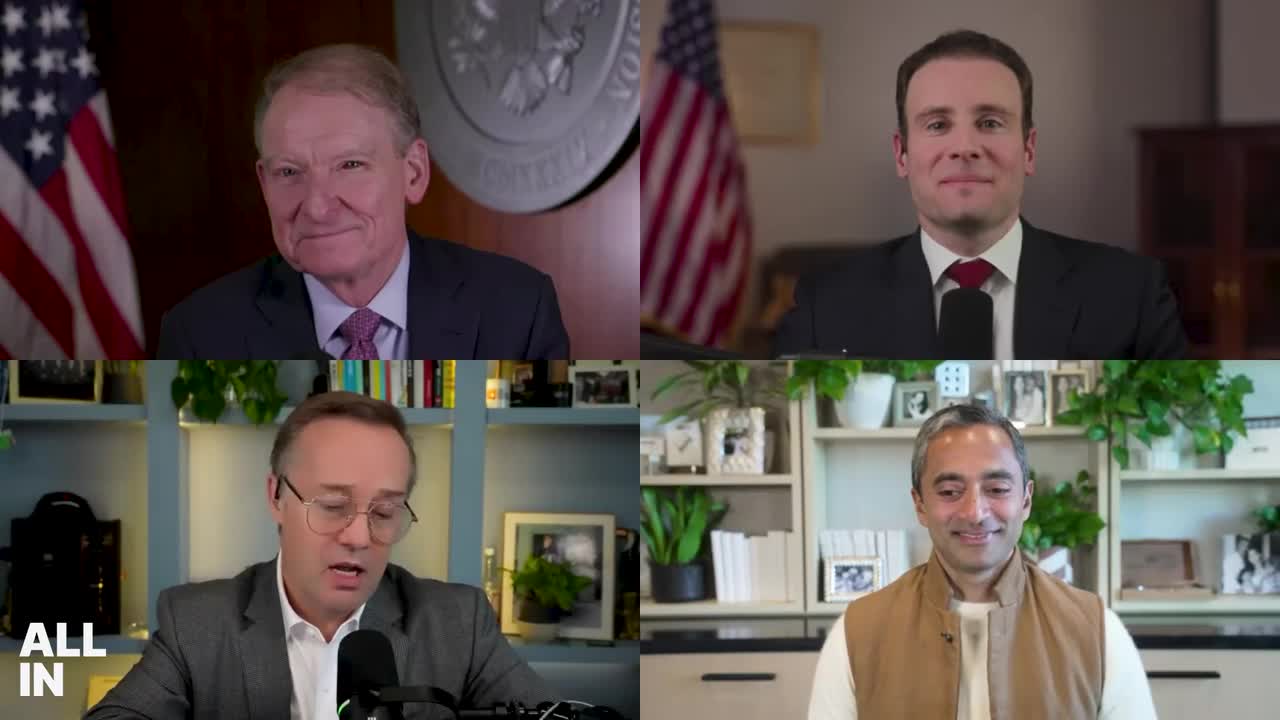
All right, everybody.
Welcome to the all-in interview program.
Today we are delighted to have two of the most important individuals shaping capital markets over the next couple of years.
Sec chair paul atkins is with us, as well as cftc chair michael selig.
Welcome to the all-in interview show, gentlemen.
Glad to be here.
Thank you very much.
Great to be here.
Also with me, my bestie, Chamath Palihapitiya, who is known to participate in capital markets.
I think there's a great structure here for us to talk.
Many opportunities and then guardrails and things that we should be concerned about in such a dynamic time.
Chairman Atkins, this is your third tour of duty since the 90s.
Things have changed dramatically.
So maybe just to start us off here, and I know Chamath's got a lot of great questions ready to go.
I'm just curious in your time, let's say the last 40 years or so, what have you noted here about capital markets and how they've changed and what's important for us looking forward?
It's great to be here and see both of you all today.
I started out as a young lawyer in New York City doing corporation finance work, new offerings and that sort of thing in the mid-'80s.
And to be a startup company and to build your products and do RD and all that.
You had to go public in order to so.
Apple and Microsoft, Advanced Micro Devices all of those companies started off as IPOs.
Andreessen Horowitz has, I think, a really good bar chart where they compare the companies of the early and mid to late 80s to today, where it just basically demonstrates through the ROI that insiders versus the buyers of the public stock enjoyed from those early companies the insiders being there's not much private equity or a venture capital back then, but the insiders meaning the officers, directors and whatnot they had a relatively thin slice of the entire pie.
I mean, everyone made out well obviously, but the public purchasers in the ipo, you know, made out very well over the years and then had the lion's share of that.
You look at today, the current situation where we have robust private capital markets and we have fully today half the number of public companies as we had 30 years ago, and it's completely reversed.
The return on investment is mainly to the insiders private equity, venture capital, the corporate officers and employees versus the public, because they're mature companies when they actually go public.
So that's a huge change.
The private markets are very robust and strong.
But anyway, the American capital markets are very healthy, I think.
When you look at that back then, there was a real requirement for everybody to do an enormous amount of work because, to your point, these companies were quite young.
You'd be a four or five year old company and you'd go public, because the going public was not about monetizing anything.
It was actually a fundraising moment.
It was like a Series C or a Series D.
I guess the answer is the reason it changed was probably because, to your point, there's all these returns.
And so investors said, Well, let's go capture these in the private markets for us and our LPS.
But what it also does is then change the nature of how these markets behave.
Can you just comment on the amount of time companies are staying private?
The dearth of the IPO, because it has become a liquidity defining moment in is much more so than the financing moment and whether things should change.
And if so, how do you want to change that?
And why?
Yeah, well, it's a free market, obviously.
So, you know, investors, we should allow the market to develop as it will.
But you're exactly right.
So now it's more of a liquidity event for insiders.
And so what we are seeing now is in the private markets.
You know, there's a lot of capital.
That's where people are willing to deploy it to companies at early stages and then to stay on.
But at the same time, there are inhibitions for private companies to go public.
And one of them is the cost of our rules, to comply with our rules, and the disclosure ones, especially where you have all the annual report requirements, proxy statements and all of that.
And so in the quarterly reporting and so forth.
So that is one big inhibition where things are not necessarily focused on materiality anymore.
Are you allowed to convene a group of people and start to line item these rules out or change them?
Or does it have to go through some much more robust process where there's a lot of competing reasons why some people, some lobbies maybe may want these rules?
Oh, sure.
I mean they're vested interests in everything.
But that is part of my program for this year, and going into next is to go through our rule book.
We need a spring cleaning.
We need to clean out the attic, the basement and the garage and to really look at things, Unlike the agency has ever done before, with a real focus on materiality.
So that's one.
The second to make IPOs great again is to focus on litigation.
And so that is another thing that is a key inhibition, I think, for people to go from the private markets to public the threats of class action, lawsuits and vexatious litigation with every dip in the stocks.
You have issues like mandatory arbitration fee, shifting loser pays, that sort of thing, both of which Delaware has recently outlawed for public companies, but there are other states out there.
And then the third is the weaponization of corporate governance around shareholder proposals, that sort of thing.
So it becomes a pain to deal with the annual general shareholder meeting and that sort of thing.
So those three are maybe not the only inhibitions, but there are three key ones that I've heard over and over and over again over the last 30 some years from venture capitalists, private equity folks, investment bankers, lawyers and et cetera.
Mike, what are your top priorities for 2026 in the CFTC?
Well, like Paul, I started off working in private practice at a law firm and right around 2021 2022, every week my clients would get a subpoena from Gary Gensler or from the CFTC and were faced with this onslaught of regulation by enforcement.
They were faced with regulations that did not work for their business models.
And these were crypto firms, prediction markets, artificial intelligence firms, as well as our traditional financial market participants.
They were just relentlessly attacked by the federal government under the prior administration.
I really came into government to help right the ship, to help make sure that we have purpose fit rules and regulations for new innovative technologies and financial products.
A big piece of my agenda has been crypto, our crypto asset markets.
As you all, I'm sure, are tracking.
There's some legislation that we're really hopefully working with David Sachs to get across the finish line and the president.
But that's gonna be a key piece.
So the CFTC would have a broad amount of authority over the spot markets and we're getting ready to implement those rules should the legislation get across the finish line.
Another key piece of our agenda has also been modernizing and upgrading our rules and regulations for on-chain software systems, blockchain networks and other types of digital asset products, regardless of legislation.
It's really important that we have future proof rules and regulations that are ready for the innovations of both today and tomorrow.
And that's blockchain, but that's also artificial intelligence and other areas of technology innovation.
So there's a lot of things we need to change within our regulatory framework to make sure that we're ready to accommodate that.
Let me ask both of you guys a question.
So this sits at the intersection of tokenization, crypto, and what I would call systemic risk.
So, if everything becomes tokenized and digitized, and 24 by seven, what do you think needs to happen to make sure that the systemic risks to the system are managed?
And here's what i mean.
If you go on x, i've gone down the automated trading rabbit hole.
So i don't know if you guys know, but there are these incredible young, vibrant projects that are basically replacing a citadel, replacing a millennium, and they're building these automated agent-based hedge funds that are transacting across all kinds of markets all the time.
And on the one hand, I'm completely attracted to it.
I think it's totally democratic.
It's the free market.
It's like, let's figure out what's going on there.
And on the other hand, I ask myself the question, where's the kill switch?
Or where's the circuit breaker, if you will?
And I just want to give you both a chance to talk about how you see these markets converge and both the positives and the negatives of it.
Absolutely.
We need to be considering these risks as we're developing rules.
And this, to me, is the whole reason.
We need to have a purpose-fit regulatory framework for these products and autonomous agents and all of that.
Up until now, I think the approach has always been let's apply the old rules and regulations, and that's going to work out and make sure that nobody can actually innovate and create something new.
So we are embracing these opportunities in the markets.
We need to study them and make sure that we understand the risks.
But we can develop rules that accommodate that.
So having a regime in place that says go build, don't ask us for permission, but we need to study that work with the market.
Participants understand the risks.
And on our end, we need to set up guardrails.
So I do think there are unique risks when you have the ability for an agent to go out and deploy capital on basically an autonomous basis.
And that's going to be something that our markets we've really never seen before as regulators.
But that doesn't mean we have to stand in the way and block it.
I think we need to really understand the risks, make sure that we have the right guardrails, whether that is us operating nodes on blockchains or really having technologists that are studying the contracts and the code.
But I don't think there's any reason we can't have these technologies built here in America.
I agree with that.
And from my point of view there are so many benefits to come from distributed ledger technology for the financial services industry, where we're right at the cusp of achieving T0.
Basically, you know immediate delivery versus payment, receipt versus payment on chain by uh, you know digital assets and uh, so that's pretty exciting.
Uh, what we may even have to build in speed bumps uh, you know, to prevent fraud and things like that.
But for many and for some instruments it might not be possible.
But Your discussion there 24-7 and all that I think is really an exciting prospect.
But there are challenges from the liquidity perspective, having the whole concept of best bid and offer.
What does that mean?
So that's one that we will be wrestling with.
But ultimately at least our approaches, and what Mike and I are striving to do in harmonizing the approach of our two agencies is to and hopefully we'll get a statute out of the whole Clarity Act discussions going on on the Hill right now.
That's really necessary to future-proof what we're doing so there is no backsliding in the future.
But we need to focus on if it's a security underneath, then it's tokenized, it still is a security and it's still the securities laws still apply.
But it's up to us to make sure that our rules are fit for purpose.
And as the whole purpose changes and as the the delivery mechanism changes, We need to accommodate that.
Unfortunately, in the previous administration, it was said, oh, come in and talk to us.
We have a simple form for you to fill out.
It's on our website.
Well haha, it's called an S-1 and it takes lots of lawyers and accountants to try to figure out how to do it for an existing company, much less for a new digital asset, a crypto sort of asset that you know, where the form is completely inapposite.
There's no board of directors.
There are no offices around the country, around the world or whatever.
It's just the thing needs to be adjusted so that it is fit for purpose.
So that's what we're striving to do going through a rulebook to make sure it can accommodate the new technologies.
So let's build on Chamath's conversation here and his points.
One of the key dangers and innovations, opportunities in the market is leverage.
And we see it, obviously hedge funds have been doing this for a long time.
We're starting to see it in prediction markets Mike, and we're seeing it in crypto.
What is the proper amount of leverage and who should set those rules?
Obviously, you have congress making laws.
You're responsible for executing them chairman, in order to make sure the markets are orderly and that you protect investors.
So just walk us through what you think is the proper amount of leverage and your framework, and you've been at this for a while, as we mentioned.
How has that changed over time?
Educate us a bit on how we got to a world in which Bitcoin investors might be 100x or 50x and people might be leveraging their prediction market and seems like it has a function, but it also seems like almost every story starts and ends with leverage, right.
Well, so i think it depends on the marketplace and and on the type, because obviously you have banks and they're all about fractional uh deposits and and all of that and lending um so uh, you know.
So we've gone through that back in 2008 and 2009 and the financial crisis and going all the way back to 1929 and then even in the 1800s, obviously all the repeated problems with financial disruption and financial markets.
So we have to be careful about that.
There are all sorts of rules for broker-dealers, for banks, for in the futures markets, for margin and all of that to um like, put a lid on some of this and to have some controls around it and and transparency.
You know, in the futures markets the the the, the exchanges have a lot of power.
You know over their members and over margin and you know closing things down.
We saw that even in the COVID time and whatnot, when the markets got hairy there.
Those things are constantly looked at.
The Fed plays a role as well with margining in the securities market.
All that has to be adjusted.
And now we need to look carefully at these new markets and then see what's analogous and see what authority we have and uh, and then make sure that you know we're not killing uh trading, but we also have to keep an eye out for the future to make sure that we're not allowing things to then blow up in our face.
Here's a question that may sound dumb, so i apologize if it does, and this is to both of you.
I think a lot of people don't understand or at least I don't where the SEC and the CFTC cooperate most effectively.
But then as with all things, where does coordination maybe break down?
Could you just explain that to people so that we understand and level set about what the expectations of each organization are and how you guys actually work together day to day when you have to.
Having been around the two agencies now for 30 some years, I can really say that unfortunately the two, And not necessarily at the commissioner level, but certainly at the staff.
There was a lot of sniping back and forth.
So I compare it to two fortresses with no man's land in between.
And so the no man's land is littered with the bodies of would-be products that people were unsure like.
Is it CFTC?
Is it SEC?
And the crossfire between the two just killed the products.
They never went to market.
Single stock futures portfolio margining, which has so much potential benefits for a making the financial markets safer and more efficient.
But Mike and I are setting out to change that, and I'll let you go forth on that one, Mike.
Absolutely.
The two agencies have unfortunately rarely worked well together and we're really moving forward in a new direction with our harmonization efforts.
We have a memorandum of understanding that the two agencies are working on hammering out and getting in place that will allow us to share information, coordinate on specific issues and make sure that we don't have this turf battle between the two agencies going forward.
Part of that starts, of course, at the top.
Chairman Atkins and I work very closely together to make sure that we're coordinated on policy, but also at the staff level.
So when exchanges and brokers and market participants are coming in to register or to offer a new product, we need to make sure that there's not this fighting over where they're supposed to be registered and what they're able to offer.
Some of these products cross jurisdictions.
A great example are some of the prediction markets products.
Some of them involve public companies and securities, and others are related to things like sports and politics.
And that crosses jurisdictions.
So we need to make sure that we have clear lines and that our market participants aren't subject to duplicative regulatory frameworks.
And Chairman Atkins and I have talked about substituted compliance regimes where You have a primary regulator at the SEC or the CFTC but we work together to figure out the crushed jurisdictional products so that you don't get stuck with duplicative regulation and registration.
Another area is crypto, where we've got blockchain networks, we've got smart contracts, we've got protocols that have both securities and non-securities trading on them cross-jurisdictually, and we need to make sure that the standards are consistent, because it won't work if we've got one blockchain for securities and another blockchain for commodities.
Nothing in between.
So I think this is really critical that the agencies bury the hatchet and move forward with a harmonized and coordinated approach.
As we look towards the future, I mean to build on.
Yeah, there are two separate regimes and there are differences in approaches based on the statutes that govern us.
But we also, in speaking for the SEC, we have a lot of flexibility with respect to exemptive authority and whatnot.
So my dream is one day that and I hope we can achieve that here in the next couple of years to have like a super app approach where you know there is okay, blurred lines between the two, but we've coordinated our approach.
We've coordinated uh, you know, to reduce the friction between dually registered companies and then to make everything work very efficiently.
I want to ask a question around prediction markets.
Let me try to set this up the way that i think about it.
So i think that there is this inexorable tension that's always existed and will always exist between the investor protection that has to happen when you have publicly traded securities or commodities or derivatives, then the capital formation process that on behalf of the company or whatever that wants to get access to this, and there's always been this kind of back and forth tension.
The best example of this is reg fd, where we said at some point hey, let's hold the trains.
If one person knows something every person needs to know, that thing makes a ton of sense when you get into prediction markets.
I think that this is going to stress test this assumption to the nth degree.
And the reason is that there are just certain things that some people know.
And we see it now.
Every other day there's an article about some prediction market that turned out to be right, or a bunch of other markets that were almost manipulated.
It seems like it's ripe for this question to come up all over again.
The corollary to this is Brian Armstrong tweeted something which I thought was quite an interesting comment about prediction markets, which is that certain prediction markets only thrive on insider information, which is to say that they know a secret, And so that's how the market can exist and actually conform to an outcome.
And that creates these two sides.
I just want to get your thoughts on prediction markets.
What role do they play?
How do we balance the capital formation that the market creates versus the investor protection, the insider trading that may be happening?
It's a very complicated space.
I'm not going to hold you to any of it.
I just want to think out loud.
Well, these markets aren't new.
We've had them since the 90s.
They started off with the electronic market in Iowa where folks were predicting the political outcomes on elections.
We've been surveilling and monitoring and policing fraud and manipulation in these markets for a very long time.
And to the extent that there are contracts in certain markets.
For example, what color Gatorade is going to be dunked on the coach at the Super Bowl?
Some of this stuff is potentially at risk of being manipulated.
And there's a risk that somebody on the team is able to go trade because they have special information about the Gatorade they put in the cooler.
We have standards to make sure that those contracts should not be listed, and it's on the exchanges, as the first line of defense, as self-regulatory organizations, to evaluate each contract and certify to us, the regulator, the CFTC, that those contracts are not readily susceptible to insider trading manipulation, fraud and the like.
We saw actually recently Kalshi, one of the prediction markets, brought two enforcement actions against participants.
One involved a contract related to Mr Beast's YouTube channel, where one of his employees insider traded based on information of when a video was going to launch or what was in the video.
And the same sort of authority that you have at the SEC around a duty of care to your employer is prevalent in our markets.
To the extent somebody insider trades on information, we police that.
It's really important for folks to know it's not just securities insider trading.
We've got it in the commodities world as well and the exchanges are policing that.
We're policing that and, to the extent folks are listing contracts that are susceptible to manipulation, there's consequences to that.
We can reject those contracts or we can police fraud on the back end, but there is a cop on the beat there want to caution that insider trading is not something that's necessarily allowed in our markets, but we do believe that markets are truth machines, that they do create a really powerful source of information.
We've seen hoaxes, the fake news, and the manipulation of the polls.
The prior administration tried to ban these markets ahead of the 2024 election and they really increased turnout and showed that they were correct when a bunch of the fake polls were put out right ahead of the election.
So we really have to foster these markets here in the United States and make sure that they don't flourish in Russia or somewhere else where they really will turn out to be a source of disinformation.
So we do believe it's valuable to have that trading and information flowing through the markets.
But insider trading is still illegal here in the US.
Can you take us through some examples there, Mike?
It's very obvious and clear to people who work at Microsoft if some new version of software is coming out or the sales are dynamic and the numbers haven't been released, obviously you can't trade on that.
You're going to jail.
It's insider trading.
If I am a reseller of Microsoft software or a friend of my works at Microsoft and says hey, things are going great with this new product we have and I make a thoughtful wager on a prediction market.
Or if i intentionally do something like i'm a streaker at the super bowl was one that came up recently and i actually am the streaker not that i'm planning any of this to make the bet.
Where are those rules?
Where do they live and who's responsible?
Is it the prediction market?
Is it you?
Or is it TBD?
Because it does seem that there's a bit of gray area as Chamath was sort of alluding to here.
And does this need to be codified?
And does there need to be a bit more education for the public on it?
A lot of the gray started off, with the prior administration really trying to ban these markets and not facilitating proper rulemaking and guidance in the markets over the past year.
You know I've been in the office for a couple of months now, for the past year, under the acting chairman's leadership.
A lot of these products have really exploded in popularity.
And so now is the time to put out guidance and make sure that we're not Regulating by enforcement, as the prior administration did, but we are setting standards.
We are making clear what our statute says, and that is that these contracts cannot be listed if they're susceptible to manipulation.
We take that very seriously.
That's an interesting standard.
Yeah.
The exchanges are responsible for policing that and reviewing the contracts, and they certify to us, the regulator, that they are free of the risk of manipulation.
And if there's manipulation, the markets were policing that.
The exchanges are policing that.
So there are controls in place.
But a lot of these questions as to what's susceptible to manipulation are up for debate.
And I think there's some risks.
There's a possibility.
You know your example with the streaker if somebody can just jump out of the stands and go streak across and collect on the contract, I mean that's something that does seem potentially at risk of manipulation and fraud.
And so we need to be careful about that.
The exchanges need to be on the lookout for that.
And if they're not, you know there's consequences with us as a regulator.
The markets should take the first step and make sure they're thoughtful about which ones to fire up to begin with.
And we have seen that they are not saying, hey, this dictator is executed.
They're saying this dictator is deposed or is no longer in power.
That seems to be a very tricky one as well.
Yes, Mike.
Well, there's got to be integrity in the contracts.
Our rules require that the contracts have, for example, certain fungibility and standardization.
They're derivatives contracts.
This isn't simply just betting with a bookie and a casino.
And so, each contract, that's correct.
You would look for...
Is it tied to an election or is it tied to a very specific event?
Is there a risk that that event can be manipulated or insider traded?
And the exchanges are evaluating that.
And there are instances where something is insider traded and it wasn't something they could have foreseen.
It wasn't readily susceptible to manipulation.
And so they police that they bring, uh, actions against the traders and call.
She did just this with some of its fines in the past few weeks.
Let me ask a question about quarterly reporting, because maybe where there was the most manipulation in the past was around that right.
People would try to front run these quarterly reports.
They would try to make guesses.
Invariably, you would find some people that crossed the bright red line.
But recently Paul, President Trump said maybe we should move to six month reporting or one year reporting.
And it was really well received by a lot of people.
Do you think that quarterly reporting has sort of also killed the IPO?
Meaning when we think about making an IPO.
Great again.
Just the complexity and the burden of such short-termism.
Has it made the markets better or worse, do you think?
Yeah, well, that's a great point.
And I just wanted to add one kind of a little note to the previous discussion there that if something is a tokenized security, the federal securities laws apply.
And so that goes for insider trading with respect to trading securities, wherever they may be online or on an exchange floor, or wherever
But then to your point about the cadence of reporting, I think that's an important one.
And we are going to come out with a a proposed rule and seek comment on it.
And I frankly, am a bit agnostic myself personally because, if you look at things, we haven't always had quarterly reporting.
In fact, when the SEC was formed back in 1934, it basically codified the New York Stock Exchange rulebook which, at the time, called for annual reports.
So annual reports prevailed until 1955 and the SEC went to semi-annual reporting.
And by the way, the UK did the same thing around the same time.
And then in 1970, only did things go to quarterly.
And then the UK parted way, they did quarterly as well.
But then in 2014 or so, they changed to go back to semi-annual.
But if you wanted to still report quarterly, you know, God bless you and go ahead and do that.
So we're select quarterly, and so the president did send out an electronic message about that.
But our staff was looking at, we're looking at what we call filer status.
There are all sorts of different categories of filers with different rules large accelerated filers, accelerated filers, emerging growth companies, and so forth.
So we're looking to kind of simplify all of this.
And part of that also is perhaps smaller companies could benefit from reduced cadence of reporting, but maybe not.
They have trouble finding analysts to follow their stock.
That's another thing that It might be an inhibition to go public for small companies.
And maybe analysts want quarterly.
Maybe they don't.
Maybe they would prefer semiannual too.
So I think this is a great debate to have right now.
And you did have Barry Diller, even taking the other side of it, where he's like I'm just tired of giving predictions.
I'm tired of playing this gamesmanship quarterly.
I'm just going to release our accounting numbers every month and you all can have fun with numbers as much as you like.
But that's amazing because you can do that now, right?
You can have software that's so vibrant that it can just Jason release a stream, And there'll be people that have, you know, developed agents and develop these AIs that will just process all of that and they will then publish out a dashboard and the whole thing will be almost real time.
It could be real time yeah, and there are services that do semi interesting things already that you can buy that maybe people with budgets for data search streams can do.
Let's talk a little bit, chairman atkins, about the history of accreditation in this country.
I think when you brought up microsoft in the early part of your career, watching these companies go public, i did a little research while we're here, when you were speaking.
Microsoft and apple went out with a thousand and twelve hundred employees each and about four hundred million dollars in revenue in today's dollars 120 million in those dollars.
So obviously there was this incredible opportunity for you to create and place a bet on these companies as an individual with a stock trading account and maybe move from you know, one tier in societal wealth to another, and that's a big part of the american dream.
But as we talk about private markets, the SEC has ancient rules now going on close to a century old to protect investors, called accreditation laws.
They apply to 95 of the country apparently, and about 5 of us get to trade in some way in private companies where the value is created.
The SEC has been challenged and charged with changing these evolving these and it never seems to happen. my perception is which sec chair is ever going to take this on because hey it's just easier to keep the status quo but is there not an argument i know there's some legislation now to create a sophisticated investor test so instead of you inherited a million dollars you're qualified to buy stock in uber when it's a private company why not a sophisticated test like a driver's license, and you learn how to trade in private companies, and you get to participate in that market instead of just saying to people well you can only participate in sports betting or blackjack in vegas but you can't if you were an uber driver or an airbnb host or an hr person using linkedin as a private company buy those stocks where you have an insight and you have an instinct into maybe purchasing so so talk about the accreditation test and sophisticated investor tests and your personal view on it.
Yeah, well, great point.
And so, well, here's one chairman who is going to tackle that issue.
And so we intend to do that, the accredited investor definition.
And so interestingly, I mean to your point, in the statute, in the Investment Advisors Act of 1940, I believe, or Investment Companies Act of 1940, There's a definition of that and it includes knowledge, not just wherewithal or sort of assets that you have.
It has the word knowledge in it.
So to your point, why can't we have and people have suggested this over time equivalent of a driver's test or something like that, or recognize somebody who has a CPA or a CFA or whatever, but maybe a type of Series 7, but not so complicated as that that FINRA administers?
Part of the thing is like who's going to make the test, who's going to administer it and how do you get there.
But anyway, but we can.
Those are issues that we want to tackle and i remember when this issue came up when i was a commissioner back in the aughts, There was one comment letter that came in that really struck me and it said today I am able to this is a comment letter, a commenter speaking today I am able to buy a hedge fund, a private asset or whatnot.
But tomorrow, once you raise the standard of you know I have to have X amount of money, of assets or income or whatever.
I won't be able to.
So what's changed?
Why?
Why are you going to take that away from me?
So why does a finance professor who makes a hundred thousand dollars and lives in an apartment and doesn't have any other assets, why is he not able, to your point, to invest in uh, some of these uh types of securities, whereas an heiress who just came into 10 million dollars or something like that suddenly is now?
She can hire people to advise her, but they could be dummies too, i mean, who knows what they are, but so anyway.
So i think we have to take a fresh look at all this, and we are going to do that uh, here this year and uh um, with a proposed rule to address that.
I have a question around the derivatives markets.
Well actually, before I ask the question, I want to ask about the futures markets, which is you have an enormous number of high frequency trading firms that really dominate futures volume.
Can you just tell us both the value that these folks are providing, is it truly liquidity?
Or is it and there's been some speculation about this very sophisticated market arb.
And if it's the latter, Where do you think we need to do necessarily a better job?
I think the best example is, if you look at this, the volume of futures activities and spot prices of certain commodities.
The basis is starting to kind of get out of whack.
So just tell me about the market participants part of these derivatives and futures markets and what you think about what's going on.
Our markets have three core types of participants.
We've got the hedgers, we've got speculators, and we've got market makers.
And the liquidity is really the result of all three.
So there's going to be market participants that really rely on whether it's a cattle contract or a credit default swap product.
They need to enter into these agreements to hedge key risks in their business.
Then you've got folks that are willing to provide liquidity, whether they're speculating and taking another position on that for their proprietary basis, or they're doing so to make markets and earn a spread.
That's right.
We're regulating these markets.
We're making sure that the trades that are going through have integrity and that folks aren't wash trading and trying to manipulate markets.
There are some strategies that raise particular risk of manipulation or fraud, and we police that.
We've taken actions in the past to make sure that The exchanges are not subject to illicit behavior and trading.
And the exchanges, similar to my point earlier related to prediction markets, are our first line of defense here as well.
They surveil their markets and we're in constant communication with them, as well as the traders.
We're oftentimes sending information requests to traders about their activity.
So I do believe that these all three participants are very important to make sure that our markets are liquid.
So, on that last point that you just made, which I think is a very good one, Post-GFC there was, like these central clearing functions, right to make sure that derivatives contracts were not getting out of control.
And we had a good sense of systemic risk.
But it turns out that one blind spot everybody has is to these bilateral swaps.
I mean, I've done certain bilateral swaps with certain counterparties.
It's not clear to me that you know that on the back end of it.
Can you talk about that and how you think that that should stay the same change, what that is, whether that keeps you up at night, whether it should keep us up at night sure well, i'm not a huge fan of dodd frank, but in the wake of dodd frank, we got swap data reporting and these bilateral over-the-counter swaps are now generally all there are some exceptions but sent to swap data repositories where we're getting information on a daily basis, as well as these third party swap data repositories that compile that information.
So the markets are much less opaque.
We have transparency today.
But my concern about the swap data reporting regulations is that they have really been a tool for our enforcement divisions in the past, where You've got so many different fields.
It's really difficult to characterize each different type of swap.
I'll tell you when I was in private practice and folks started entering into Bitcoin swaps and crypto swaps, characterizing that as a type of derivative relative to cattle and wheat and other commodities really was a whole lot of legal advising and a lot of wasted money, frankly.
So we need to simplify.
We need to make sure that our swapped out reporting regime is rational and coherent and make sense for the everyday participant in the market.
You shouldn't have to go hire a high-priced law firm just to enter into a risk management tool.
But these markets, these developments, Post.Frank, some of them make sense, some of them don't.
A big priority of mine is going through rule by rule, to make sure that all of our regulations are really the minimum effective dose.
I have a question for both of you.
Is there something that, if you could borrow from the other person's regulatory toolbox, Something that they can do, that you cannot, that you would love to also be able to do?
From my perspective, one thing for new products that the CFTC has is called self-certification.
So for repetitive products, that once you go ahead and approve the general type of certification uh framework for it uh, then it's self-certification by the markets uh and by the people who are, of course, coming forward with the products.
We don't necessarily have that kind of uh thing we do for some things, like for etfs and whatnot, where we've come up with rules that then it's up to the market participants to abide by the rules and have their product conform.
But on so many other products we have a much more complex you know, labor intensive, let's just say approach to it that requires approval by the staff and the commission and that sort of thing, whereas it's much more streamlined on the CFTC side.
On our side, there's one regulation that I think has been really effective on the SEC's jurisdiction, and that's the alternative trading system.
On both sides of the house, we have full-born, very intensive exchange registrations.
The SEC went ahead with a rulemaking that allows broker-dealers to then set up an alternative trading system.
And it's really an Exchange Lite framework, and I'd love to see that on the CFTC side as well.
Chairman Atkins, I want to talk about fund formation and the power of venture capital in the US economy.
20% of the GDP of this country comes from venture-backed companies.
40 of the SP obviously with the MAC-7 contributing heavily comes from venture-backed companies that we all know and love their products.
But fund formation for venture capital is ancient and there are massive limitations on it.
There's two ways, obviously, to address this.
One is the path to accreditation for people to become sophisticated.
We just spoke about that.
But the other is how many people are allowed to participate in a fund.
As but one example, when I raised my last fund, I had well over 100 million in accredited investors who wanted to have a small bite of the apple and get into venture capital, but I can only accept 100.
I can only accept 10 million and doesn't make any logical sense because in fact, it would be better if more people could put in smaller amounts.
Many hands makes for light work and more people could participate in this.
This would have a dual impact on the economy one more startups would get funded and two more individual investors would get to participate in this very closed ecosystem known as venture capital.
So i was wondering your thoughts on venture capital specifically, and formation of what is the driver of the us economy.
You raise a great point, but a lot of that that you're talking about with funds is statutorily mandated.
And so there are two big exemptions in the uh investor company act of 1940 that are pertinent here, and so those were adopted by congress with a lot of debate and whatnot, and so um, so that is more difficult to change and there's certain ways that we can change them, and so we are going to look at this and there you have a lot of different types of accredited investors.
You have qualified purchasers, you have also qualified institutional purchasers and whatnot, or buyers rather.
And so all of these things need to be, I think, looked at anew, and where we have the authority through our exemptive power under the various statutes, we'll be able to use that.
But I do think that, especially now, as we talk about opening up private funds or private types of products to a broader range of people, including to 401K plans and whatnot
We're working with the Department of Labor and the Treasury Department uh, to address this, and we all feel very strongly that here you have to have good guardrails.
You just can't open up the barn door wide open, that we have to have standards for what can go into these sorts of uh you know plans for 1k plans, pension plans.
But retail investors are already exposed to the private markets through their pension funds, insurance companies and all that.
So all of this needs to have a, you know, fresh look and you know, come up with good new ideas to basically provide, democratize it.
And just as a quick follow up there, one that I think would be super easy, is just hey, 10 of whatever your last two years average income was or, you know, no more than five or 10 of your net worth.
Michael, there are some common sense ideas here that would would increase the amount of participation.
Can you think of Michael, any reason that we should restrict Americans from being able to participate in venture capital?
Is there any argument here?
If there were some basic level controls, as I've outlined here.
Sophistication, taking a test or a cap, you can only put 5k and you make 150k a year.
You can put in 15k per year.
What are your thoughts, Mike?
I'm a believer in free markets and I really think that allowing more access to our capital markets is really a powerful thing for everyday Americans.
We saw the ICOs, you know the initial coin offerings where things just kind of moved into crypto and you had all sorts of investments in different projects and they were attempting to get under the radar of the securities laws, even though there are capital raises with different tokens.
And I think the markets always find a way.
So allowing for more access, decreasing some of the requirements around accreditation, I think that's a really great thing for the american people and really will just allow for people to have some skin in the game and maybe they lose sometimes but other times they really hit it big and it's such a great thing for everyone nature finds a way right like exactly don't allow people to persuade they start doing icos and when i looked at them i looked at a hundred chamath I said, wow, 99% of these are white papers with spelling errors in them.
These are not the real companies that you and I look at in our daily lives in venture capital.
So it reminds me of what happened with crypto, which is hey, it went offshore, it went to another stream.
I want to talk about just the capital markets globally.
We're in this very unique moment where there just seems to be this separation, where the American capital markets and you two are tips of the spear have enormous credibility.
And then when you look at some of these other capital markets.
Paul, you mentioned the UK, but I hate to say it so bluntly, but the UK is a disaster.
It is impossible to raise money there.
It's impossible to raise money or innovate in a European exchange.
It's a little bit easier in Asia, but it's complicated.
But then you do see some of these upstart exchanges that are trying to push and innovate in Abu Dhabi and KSA, etc.
If you just take a step back for a second.
I just love your perspective on what's going to happen to capital formation and specifically, What does America need to do to get this next couple of trillion dollars to be brought onshore.
Well, first of all, I think, you know, our capital markets are the envy of the world.
I mean it really is amazing when I travel through Europe or Japan and the UK and Middle East and whatnot.
People really envy our huge capital markets and how robust they are, how fair they are.
And it goes back to our rule of law and enforceability of contract.
And that's the essence of what is the foundation of our freedom and our ability to you know, innovate and have all these new products.
So they would love to have that plus the um uh, you know the, the.
I guess what they also really um, envy is our uh, a risk appetite here in the United States, where people have an equity investment culture and that is really largely absent in Japan uh, and in europe, and in a lot of ways they can't get out of their way, because out of their own way, because through their regulatory system and whatnot, i mean ours is bad enough, but they in many ways take it to a different extreme with a very narrowly constructed code that really hamstrings them and is is not very flexible in the future.
So that's where, as far as if we can open up our markets, as far as you know some of the things that we've been talking about here, as far as new products, allow innovation to take place here onshore and then also to fix some of the things like the accredited investor standard and that sort of thing.
I think we can then, to your point, turbocharge it to continue our growth.
Crypto has been a bit of the wild west and we have things, NFTs, ICOs, meme coins.
They feel they look like stocks to people, whether it's dollar sign Trump or dollar sign Doge, whatever it is.
But they have a ticker symbol.
They have a chart.
They trade like a stock.
What do we need to do in regards to crypto?
What, what should, and where is the line between launching a, a crypto token, and the public being protected there?
Chairman atkins versus hey, it's a publicly traded stock because for a lot of them, they get into it and they're the suckers at the table.
It feels it looks it quacks like a duck.
It looks like a duck and so they buy it like it's a duck, but it's not a duck, obviously.
So what?
And then this was gensler's, i think you know, maybe a logical point, although his execution was poor.
There was a logical point to hey, we have rules.
We can't let you break these rules for your dollar sign whatever, if everybody else is doing their company properly, you know, and following this set of rules.
So how do we evolve that to protect which is the top mandate the consumer?
Well, that's a great question.
I think the real problem has been uh definitionally, and so the the kind of the very vague lines, and so people weren't sure they were.
And, as mike was talking about, People paid lawyers a lot of money to try to do it.
Some lawyers just gave happy talk and then people got in trouble with the SEC and other lawyers just said forget it, go offshore.
You know you, there's no use to even trying here in the united states.
So that's part of what uh, you know, mike and i are trying to do as far as harmonize, so where?
If it's a tokenized security, then that's one thing under the sec's rule book.
But if it's things like tokenized also digital coin, a digital token sorry, or digital tools or digital collectibles, then those sorts of things fall under the cftc's oversight and their a rule book is really more apposite for these sorts of things than ours is.
But you have to have a logical oversight over things like that to prevent fraud, because the one thing that really you know attracts people to our markets from overseas is that they perceive that there is.
You know that fraudsters do get caught and you know we have protections around, as we've been talking about inside trading and then things like that trading on material non-public information by insiders, that is you know.
So we have a robust so thing for that, Mike.
Unpack that for us.
And maybe you could add to it the role of sometimes we see celebrities promoting these things.
And it just feels like it's a bit of it was a bit out of control there for a bit.
And your job is to make it controlled.
So So what should the crypto community that wants to release utility tokens and participate here?
What do they need to know going forward?
We have to separate the capital raising activity and selling something for the purpose of raising capital to form a business.
When you're going out there and giving folks the white papers and the business plans and making promises to them from the actual thing that people are buying.
The tokens themselves in many of these cases are just goods.
As Chairman Atkins said, they could be a digital commodity, something that's an input for a network like Ethereum or Solana or anything else, where you're using it for a function within the network.
But the capital raise is something separate and they could be collectibles, like an NFT or a tool that you're using to run a command on a network that sort of stuff.
I mean, they're commodities or they're goods or things that potentially neither of us regulate.
We don't go out and regulate widgets that are sold as part of a capital raising that the sec has brought many cases over the years related to fundraising with chinchillas and whiskey barrels and all sorts of things, but we've not had those uh trading as securities in our markets and and we don't want that for the digital world either.
As we start to wrap here, i have a final question, which is Both of you sit on top again, as I said, the most, in my opinion, important capital market in the world.
You guys are responsible for the well functioning and the pass through of literally tens and tens of trillions of dollars.
You are responsible for enabling and not slowing down just the great vibrancy of the American economy as reflected in these markets.
That's the upside.
The downside is that that also comes with a lot of pressure when you're in the bowels of the job.
Obviously, I don't know what that's like every day, but what are the couple of things that the two of you think about at night?
What are the critical risks to this experiment that you just know you have to get right, or the critical issues that in the next year or two you must get right for all of this to continue?
Maybe Michael start with you and Paul, two big things concern me.
The first has been this push of innovation offshore.
We've got to get it back here in the United States.
That's really what's built this country over the years.
Thomas Edison didn't have to go ask for permission to go innovate.
We need to make sure that our builders, our visionaries, our entrepreneurs have the courage and the confidence to come and develop new things and build here in our financial markets.
And that means blockchain, that means artificial intelligence, that means prediction markets.
We'll set the rules for it and make sure that it's possible to do it, but we don't want everyone fleeing to the Cayman Islands and the Bahamas and Russia to go do this stuff.
So that's really concerning to me.
I want to make sure that the folks are back here in the US.
The second piece, of course, is the risk to our system.
If we've got too much manipulation and center trading fraud, I mean, Why not trade elsewhere?
And there's real risk to our investors.
And so making sure that we have the right controls, customer protections.
We can't have another FTX in the United States where funds are lost and there's an absolute fraud on our American people.
So that's a really critical concern balancing innovation with our financial system, the integrity of our markets.
And we're going to do it, but it's definitely hard work ahead of us.
And for me.
So I mean I agree completely with the innovation point that you know we need to make sure that we are allowing people to innovate here on shore.
And FTX One is a great point where uh, there was one part of ftx that uh didn't implode with the rest of it and that was their investment in uh swaps trading platform called ledger x was, which was supervised by the cftc and examined, and they had um uh they, they had their uh accounts segregated and all that, so no customers lost any money through that and it still lives on today.
My worry is that we're fighting always the last battle.
You know, the French built the Maginot Line and that didn't work very well.
And then so we had the same thing coming out of the financial crisis.
So we have to think ahead.
We're confronting a lot of new challenges.
So artificial intelligence, of course, you know is uh, you know, developing very quickly and um, but we're also seeing it on the fraud side.
I mean this horrible stories i hear about uh people who's uh who've lost their entire retirement, uh nest egg through fraud.
Where there are confidence people who, through all sorts of manipulative types of communications, then draw people in and get them to send off their money elsewhere, or even their Coinbase account or things like that, where they give passwords away with these confidence artists out there.
We have to be attuned to that.
We have to be the cop on the beat, because that's the real threat that will lead people not to necessarily invest their money here.
But I think we are a cop on the beat.
We're out, make sure that we can find the bad guys, but we can't then put too much overwhelming uh you know restrictions on the good guys, so that they can't innovate and can't come out with new products.
Those are great answers.
I think both opportunity and policing.
I just want to end with a final thought.
As these markets open up wagering stocks crypto, we do have an issue, a second order effect.
That's happening.
Young men.
18 to 30, 45 report that they've had a problem with wagering gambling and 10 meet the addiction criteria.
A third have placed a bet.
The upside to this, in my mind, is we have a generation generation bet that understands capital formation, markets and how to participate in them, but we do have a downside.
Outcomes, yeah. outcomes?
Yes.
And to really think about that.
There's obviously a downside here, which is a very young developing brain might not be ready for that.
So Mike, and then Chairman Atkins, what are your thoughts on how to protect these young men?
Who you don't they're.
They're excited about participating in these markets, but maybe their brains aren't fully formed and ready to take on that responsibility.
I think education is critical here.
We need to make sure that our market participants are providing information to participants and we don't regulate the casinos and the gambling and all of that.
But I do believe that that is a key piece of their initiative as well to make sure that folks are informed when they're coming into the casinos.
We should do the same at the federal level make sure that our participants voluntarily of course, this isn't necessarily something that we mandate on our derivatives exchanges, but I do think it's an important thing to be informing the public.
And, of course, we've got really robust standards on brokers and on our exchanges and they're making sure that there's uh, the the persons are participating in the markets, have the ability to participate, that they're suitable to invest and participate in our markets, and i think those controls, combined with some education, are really going to be important here.
Chairman Atkins.
I agree with that.
And but it's not just education of the, in many cases children or, and you know, adult young men and women too.
But it's also their parents, you know, especially for the children, where I think there is a large ignorance on the parent's part as to what their kids are doing and with their phones or elsewhere and getting involved in these things.
I hear that from a lot of my friends, so just apocryphally there.
We shouldn't forget that the schools are important as well, but the signs of that sort of addiction are really important to recognize that and then take action.
But we have the same thing with other sorts of gambling, lotto or lotteries and that sort of thing.
So it's not just in the securities markets or crypto markets or elsewhere, but it's also on everyday things that we have to really watch out for.
I love your suggestion mike because uh, i i noticed robin hood.
Now, if you want to go trade, something complex puts, calls you know, spreads everything.
It forces you to go through a little wizard to make sure you understand it and and to teach you what exactly you're doing.
So i think education so critical and it can exist at the platform level.
This has been an incredible hour plus.
I want to thank you, two gentlemen, for joining us here on the all in interview and we'll see you all next time.
Bye bye thanks, gentlemen.