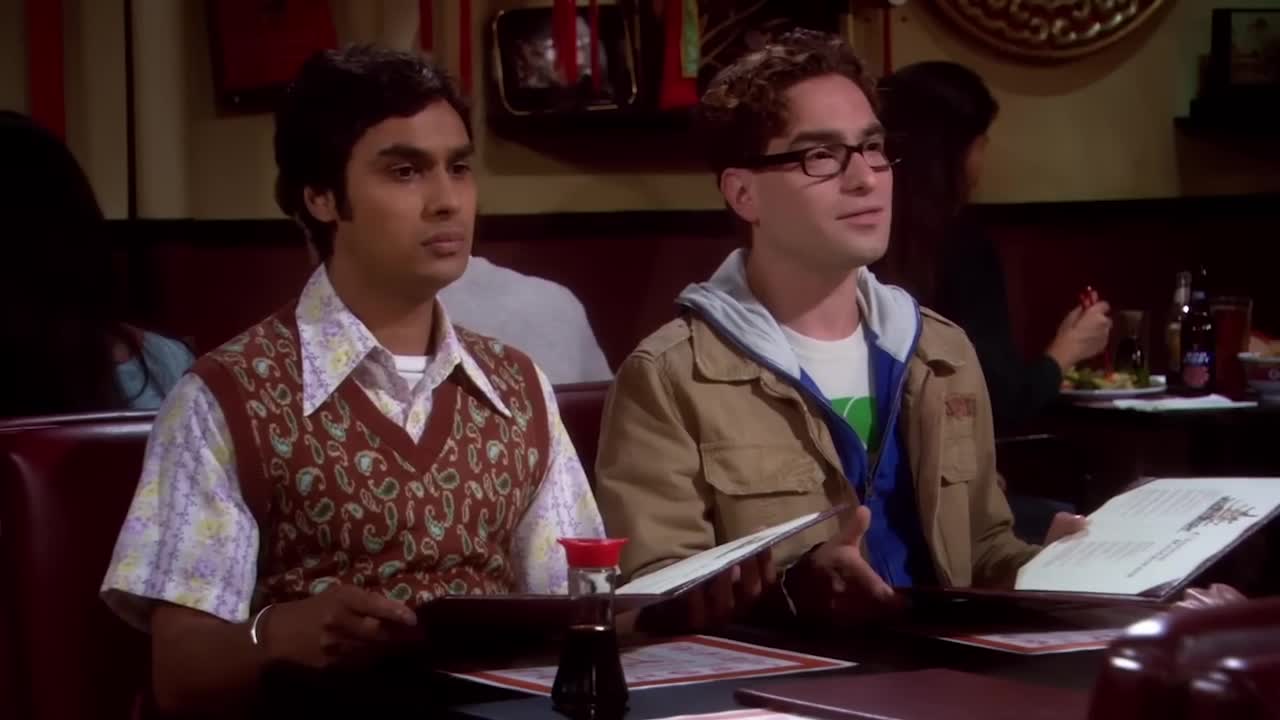
We cannot do this without Wolowitz.
We can't order Chinese food without Wolowitz?
Let me walk you through it.
Our standard order is the steamed dumpling appetizer, General Tso's chicken beef with broccoli, shrimp with lobster sauce and vegetable lo mein.
Do you see the problem?
I see a problem.
Our entire order is predicated on four dumplings and four entrees divided amongst four people.
So we'll just order three entrees.
Fine.
What do you want to eliminate?
And who gets the extra dumpling?
We could cut it into thirds.
Then it's no longer a dumpling.
Once you cut it open, it is at best a very small open-faced sandwich.
Hi, fellas.
Oh, where's your annoying little friend who thinks he speaks Mandarin?
He's putting his needs ahead of the collective good.
Where he comes from, that's punishable by death.
I come from Sacramento.
Can we get an order of dumplings, but with three instead of four?
No substitutions.
This isn't a substitution.
It's a reduction.
OK.
No reductions.
Fine.
Bring us three orders of dumplings.
That's 12.
We'll each have four.
That works.
No.
If we fill up on dumplings, we need to eliminate another entree.
No eliminations.
If we have extra, we'll just take the leftovers home.
And divide it how?
I'm telling you, we cannot do this without Wolowitz.
Wolowitz is with his new girlfriend.
If you had let me invite Penny, then you would have had your fourth.
Have you seen Penny eat Chinese food?
She uses a fork and she double dips her egg rolls.
We don't order egg rolls.
Exactly, but we'd have to if she was here.
Can you please make a decision?
Not only are the children starving in India, there's an Indian starving right here.
There's an idea.
Why don't we just go out for Indian food?
Oh, ugh.
You are nice boys.
Tell you what I'm going to do.
I'm going to bring you the four dumplings.
When I'm walking over to the table, maybe I get bumped.
One of the dumplings fall to the floor.
No one has to know.
I'll know.
How about soup?
Yeah, we can always divide soup.
What about the wontons?
Just saying, you can take the damn plastic off the couch once in a while.
Why, so you and Howard can hump on it?
Ladies, ladies, I'm sure there's a middle ground.
Shut up, Howard!
You guys talk, I'm gonna take my scooter out for a little spin.
You drove your own son out of the house!
Why don't you stop fighting him?
You don't belong!
What are you guys doing here?
It's Halo night!
He's not a man, he's a putz.
And don't you take that tone with me, you gold digger.
What did you call me?
You heard me.
And I'll tell you something else.
You're barking up the wrong tree.
Because as long as you're around, Howard is out of the world.
You know what?
I got better offers.
I'm out of here.
That's right.
Go back to babble on, you whore.
So Halo night, huh?
Sheldon, why is this letter in the trash?
Well, there's always the possibility that a trash can spontaneously formed around the letter, but Occam's razor would suggest that someone threw it out from the Institute for Experimental Physics.
They want us to present our paper on the properties of super solids at the topical conference on Bose-Einstein condensates.
I know.
I read it before I threw it out.
If I may drill down to the bedrock of my question, why did you throw it out?
Because I have no interest in standing in the rose room of the Pasadena Marriott in front of a group of judgmental strangers who wouldn't recognize true genius if it were standing in front of them giving a speech.
Which if I were there, it would be.
I don't know, Sheldon, those topical conference on Bose-Einstein condensates parties are legendary.
Forget the parties?
Forget the parties?
What a nerd.
Are there any other honors I've gotten that I don't know about?
Did UPS drop off a Nobel Prize with my name on it?
Leonard, please don't take this the wrong way, but the day you win a Nobel Prize is the day I begin my research on the drag coefficient of tassels on flying carpets.
The only thing missing from that insult was your mama.
I got one.
Hey, Leonard, your mama's research methodology is so flawed.
Shut up, Howard.
Sheldon, we have to do this.
No, we don't.
We have to take in nourishment, expel waste and inhale enough oxygen to keep our cells from dying.
Everything else is optional.
Okay, let me put it this way.
I'm doing it.
You can't.
I'm the lead author.
Come on.
The only reason you're the lead author is because we went alphabetically.
I let you think we went alphabetically to spare you the humiliation of dealing with the fact that it was my idea.
Not to put too fine a point on it, but I was throwing you a bone.
You're welcome.
Excuse me, I designed the experiment to prove the hypothesis.
It doesn't need proving.
So the entire scientific community is just supposed to take your word?
They're not supposed to, but they should.
All right, I don't care what you say.
I'm going to the conference and I'm presenting our findings.
And I forbid it.
You forbid it?
If I'm not taking credit for our work, then nobody is.
So you admit that it's our work?
No, once again, I'm throwing you a bone.
And once again, you are welcome.
Oh, no, he didn't.
Are there any questions?
Yeah, what the hell was that?
Any other questions?
Dr. Sheldon Cooper here.
I am the lead author of this particular paper.
Thank you.
And you sir, you have completely skipped over the part where I was walking through the park and I saw these children on a merry-go-round, which started me thinking about the moment of inertia in gases like helium at temperatures approaching absolute zero.
I didn't skip.
It's just an anecdote.
It's not science.
Oh, oh, I see.
It was the apple falling on Newton's head.
Was that just an anecdote?
You are not Isaac Newton.
No, no, that's true.
Gravity would have been apparent to me without the apple.
You cannot possibly be that arrogant.
You continue to underestimate me, my good man.
Look, if you weren't happy with my presentation, then maybe you should have given it with me.
As I've explained repeatedly, unlike you, I don't need validation from lesser minds.
No offense.
Really?
So why did you come?
Because I knew you'd screw this up.
Maybe I didn't go to college when I was 11 like you.
Maybe I got my doctorate at 24 instead of 16.
But you are not the only person who is smarter than everyone else in this room.
No offense.
And I am clearly not the only person who is tormented by insecurity and has an ego in need of constant validation.
So you admit you're an egotist?
Yes.
My name is Dr Leonard Hofstetter and I could never please my parents, so I need to get all my self-esteem from strangers like you.
But he's worse!
Okay, that is it.
Stop it.
You cannot blow up my head with your mind.
Then I'll settle for an aneurysm.
Stop it.
You hit me.
You saw that.
He hit me.
I'm trying to blow up my head.
So it was working.
It wasn't.
It was not.
You are a nutcase.
Oh, see about that.
Heads up, you people in the front row.
This is a splash zone.
Stop it.
Quit it.
Is this usually how these physics things go?
More often than you think.
Let's go out tonight What the hell is that?
I don't know, but if cats could sing, they'd hate it too.
Hey, guys!
Hi!
Where are you going?
What?
We just had to mail some letters.
And... throw away some chicken.
You'll never guess what just happened.
I give up.
I don't guess.
As a scientist, I reach conclusions based on observation and experimentation.
Although, as I'm saying this, it occurs to me you may have been employing a rhetorical device, rendering my response moot.
What was that?
Believe it or not, personal growth.
What happened?
All right, remember when I auditioned for that workshop production of Rent but I didn't get it and I couldn't figure out why.
I have a conclusion based on an observation.
No, you don't.
No, he doesn't.
Well, the girl they picked to play Mimi, she dropped out, and they asked me to replace her.
Oh, congratulations.
What a lucky break.
It's not a big deal, just a one-night showcase, but they invite a lot of casting people and agents, so you never know.
I think I know.
No, you don't.
He doesn't.
It's this Friday at 8.
Do you guys want to come?
No.
Because Friday we are attending a symposium on molecular positronium.
I think that's a week from Tuesday at 6.
No, it's this Friday at 8.
Oh, too bad.
Well, I got to get to rehearsal.
See you guys.
See ya.
Let's go out tonight.
You just lied to Penny.
Yes, I did.
And you did it so casually.
No rapid breathing, no increase in perspiration.
So?
So lack of a physiological response while lying is characteristic of a violent sociopath.
Sheldon, are you worried about your safety?
No.
I imagine if you were going to kill me, you'd have done it a long time ago.
That's very true.
I'm uncomfortable having been included in your lie to Penny.
What was I supposed to say?
You could have told her the truth.
That would have hurt her feelings.
Is that a relevant factor?
Yes.
Then I suppose you could have agreed to go.
And what would I have said afterwards?
I would suggest something to the effect of singing is neither an appropriate vocation nor avocation for you.
And if you disagree, I'd recommend you have a CAT scan to look for a tumor pressing on the cognitive processing centers of your brain.
I couldn't say that.
I would have to say, you were terrific, and I can't wait to hear you sing again.
Why?
It's the social protocol.
It's what you do when you have a friend who's proud of something they really suck at.
I was not aware of that.
Well, now you are.
All right.
Leonard?
Yes?
When we played chess earlier, you were terrific, and I can't wait to play you again.
Good night.
Oh, dear God.
Leonard!
Leonard, I'm sick!
Leonard?
Leonard?
Leonard, my comforter fell down and my sinuses hurt when I bend over.
Leonard?
Ow.
Hey, Leonard, where are you?
I'm at work.
At 6.30 in the morning?
Yes.
On Sunday?
Yes.
Why?
They asked me to come in.
I didn't hear the phone ring.
They texted me.
Well, as I predicted, I am sick.
My fever has been tracking up exponentially since 2 AM and I am producing sputum at an alarming rate.
No kidding.
It has shifted from clear to milky green.
Howard, it's the phone!
I know it's the phone, Ma.
I hear the phone!
Well, who's calling at this ungodly hour?
I don't know!
Well, ask them why they're calling at this ungodly hour!
How can I ask them when I'm talking to you?!
Hello?
Howard, it's Leonard.
Code Milky Green.
Dear Lord, not Milky Green.
What do you see?
What do you see?
The living room appears to be empty.
Okay, he must be in his bedroom.
My spare glasses are in my bedroom, on my dresser, next to my bat signal.
I'm not going in there.
Raj?
No way, Jose.
I can't do it.
I can't see anything.
It's all right.
Wireless mini-cam and Bluetooth headset will be your eyes.
Fine.
One more thing.
This is a subsonic impact sensor.
If Sheldon gets out of bed and starts to walk, this device will register it and send the signal to the laptop.
At that point, based on the geography of the apartment and the ambulatory speed of a sick Sheldon, you'll have seven seconds to get out glasses or no glasses.
Won't my footsteps set it off?
No, you'll be on your hands and knees.
Now, you'll need to get the sensor as close as you can to Sheldon's room.
But how do I carry it if I'm on my hands and knees?
Stay low.
Bare left.
Now keep true.
What?
It means go straight.
They just say go straight.
You don't say go straight when you're giving bearings.
You say keep true.
All right.
I just hit my head.
Because you didn't keep true.
The picture's breaking up.
Angle your head to the right.
Now a little more.
A little more.
That's it.
Now just keep true.
All right, you're close enough to Sheldon's room.
Deploy the sensor.
It wasn't on?
No.
Then why did I have to crawl?
Oh, I guess you didn't.
OK, it's on.
Good.
From this point forward, you will have to crawl.
I know.
Hang on.
The sensor's picking up something.
Turn your head back.
You rat bastard.
Told you the sensor would work.
Why?
You deliberately stuck me with Sheldon.
Come on, I had to.
You see what he's like?
Betty, Betty, I'm hungry.
Uh, it's okay, sweetie.
Good news.
Leonard's home.
No!
Here you go.
Good luck.
Bye.
Wait, wait.
Leonard, I'm hungry.
Wait, Penny, take me with you!
I want grilled cheese.
Thanks for coming over.
No problem.
Ooh, you made little sandwiches.
Yeah, that's cucumber and cream cheese.
That's turkey and loganberry.
And don't tell my hips, but I'm warming up a brie in the oven.
Nice.
So what's up, okay?
Well, i've been reading up on all the side effects you can get from estrogen and i need you to be honest with me.
Do my boobs look bigger to you?
Well, it's kind of hard to tell.
Come on raj, it's a yes or no question.
I'm not sure.
Um wait, Jump up and down.
Let's see if they jiggle.
Uh, you know, I... I still can't tell.
Uh... Oh, you know what?
Okay.
Uh, give me some of this.
Seriously?
Do you want my help or not?
Okay, yeah.
See, that looks like they could be bigger.
But you know, I bet when I do it, mine do the same thing.
Yeah, they kind of do.
Hmm.
Let me see something.
Hey, easy.
My nipples are sensitive.
Oh, yeah.
Sorry, sorry.
Yeah, maybe.
Let me feel.
No, I am definitely up a cup size.
You know, but they're very firm, so you've got that going for you.
You think?
Yeah, yeah, yeah, very perky.
Thank you.
I really needed to hear that today.
Ooh, breeze ready.
Yay!
I made you a little something.
You didn't have to do that.
Well, it was fun.
I used some of the jewelry techniques you taught us.
It's a lightsaber belt buckle.
This is so cool.
Thanks.
Oh, it gets better.
Wow.
And that's not even the best part.
See?
I have one too.
Check it out.
You can wear yours, and we can have little sword fights whenever we want.
What do you want?
Brought you a little gift.
New kite.
The kite you made me lose was an authentic patung, an Indian fighting kite that my brother sent to me from New Delhi.
It took me a day to put together and two days to paint.
This is Hello Kitty.
Yeah, but it comes with a little coin purse.
There's a petongue.
Wow, you just don't get it, do you?
Buying me something pretty isn't gonna make a problem.
Just go away.
Look, I admit, I haven't always been the best friend I could be.
You've been a sucky friend.
A sucky, sucky friend stipulated and you do it all the time.
Last week in the mall at radio shack, we were looking for a phone with giant numbers for your mother and i suddenly realized you're not even there.
I know where were you getting shot down by the girl at hot dog on a stick, but in my defense, she was gorgeous and working that squeezer to make the lemonade.
Going up and down, It was like a free pole dance right in the middle of the food court.
You're impossible.
Hey, at least I can talk to women without being drunk.
Excuse me, I have selective mutism, a recognized medical disorder.
You're just a douche.
No, you know what?
Maybe that's what this whole thing is about.
You're not mad at me.
You're mad at yourself.
No, I'm mad at you.
I hate myself, but I'm mad at you.
Fine, you're mad at me.
I get it.
How about we go spend the day together?
Just the two of us.
We'll go anywhere you want.
I don't know.
Let me take you someplace nice.
I do enjoy the La Brea Tar Pits.
Really?
Now?
With the traffic and the parking?
Okay, fine.
The Tar Pits.
Let's go.
Why can't I stay mad at you?
I really like my saber-toothed cat.
Thank you.
My pleasure.
Maybe after lunch we can go to Marie Callender's and have some pie.
I'd like that.
This is turning out to be a perfect Saturday.
Good.
I'm glad.
Oh, man.
Did you see the way she smiled at me?
Fine.
Go ahead.
No.
This is our day.
If you want to chase after her, chase after her.
Oh, who am I kidding?
I wouldn't have a shot with a girl like that.
Don't put yourself down.
You're a very attractive man.
You think so?
Oh, absolutely.
It wouldn't kill you to take a Pilates class with me now and then.
But you have a certain wiry appeal.
Yeah, well, it doesn't matter because she wasn't really smiling at me.
Actually, in this case, I think she was.
Really?
Yeah.
Bye.
Bye.
What a douche.
It's been more than a year since I've even kissed a girl.
What about that hookup at Comic-Con you told me about?
Oh, grow up.
I was lying.
I lie all the time.
Nobody wants to kiss me.
Poor, poor thing.
Raj, you have to know, you're a wonderful man.
There are a lot of girls out there who want to kiss you.
Where?
You just have to look.
Well, this was fun.
Hey.
Hey.
Hello.
Hey.
Hey.
You get to play with Roger's big telescope last night?
Where did that come from?
He never touched my telescope.
We need to go shutting up.
I did shut up, now you shut up.
Fine, thank you.
I can't believe you didn't call me this morning.
Did I miss anything?
Did they kick Giselle off?
Not yet, but her underwater photo shoot was an embarrassment.
Sadly, Mrs. Giselle Wolowitz is sensitive to chlorine.
Lucky for her, I like my fashion models pruney and bug-eyed.
Sheldon, food's here!
There's the house!
Freeze frame!
Freeze frame!
What are you doing?
Marking the star positions and physical landmarks so we can find the house of the supermodels.
Why?
Isn't it obvious?
Every week they kick out a beautiful girl, making her feel unwanted and without self-esteem.
AKA the future Mrs. Howard Wallace.
So, based on our triangulation, we've narrowed down the location of the top model house to three square miles in the Hollywood Hills.
Or possibly Durham, North Carolina.
When we find it, you wanna go with us?
To do what?
Party with the pretty girls, dude.
Are you insane?
You're not gonna party with them.
You're not even gonna get anywhere near that place.
That's what they said to Neil Armstrong about the moon.
No one said anything of the kind to Neil Armstrong.
The entire nation dedicated a decade of effort and treasure to put a man on the moon.
Well, my fellow Americans, before this year is out, we will put a Wolowitz on one of America's top models.
And a large number of people will believe it never happened.
There's the house.
I found America's top models.
Are you sure?
Look, on the roof, Anais and Giselle are sunbathing.
European style.
You can recognize people on Google Earth?
Of course not.
I got a buddy of mine at NORAD to have a spy drone fly over.
NORAD?
You're using military aircraft?
It was already targeted to poke around a nuclear reactor in Siberia.
I took it an hour out of its way, tops.
Can I help you?
Yes, we're here to fix the cable.
I think we have satellite.
That's what I meant.
Oh.
OK, come on in.
She's taller than all the women in my family combined.
What do we do now?
Follow Mrs. Wolowitz.
I don't know about this, Howard.
What?
You're having trouble with the long-distance lovemaking?
This is your answer.
There are two interfaces that simulate a human mouth.
You have one.
Priya has one in India.
When you move your lips and tongue on yours, it transmits exactly what you're doing to hers.
See?
Internet kissing.
Uh, try.
I don't think so.
I'll try it.
Like this?
Almost.
Really get your tongue in there to activate the motion sensor.
Like this?
Close.
Really French it.
Better?
Yeah, you got it.
You got it.
I'm impressed.
This is very lifelike.
Well, you just bit my tongue.
Oh, I nibbled.
I was being playful.
Why do you have to make everything weird?
Sorry.
Better?
Oh, yeah.
I have a question about dating and relationships.
You told me you were gonna have the talk with him.
I've been waiting for someone to have the talk with me.
More to the point, it's about finding a way to keep Leonard and Stephanie together.
Oh, I don't think you can.
Why not?
Look at Leonard's record.
27 days with Joyce Kim.
During which she defected to North Korea.
Two booty calls with Leslie Winkle.
For which she awarded him the nickname Speed of Light Leonard.
And a three hour dinner with Penny.
Which would have been two and a half if they ordered the souffle when they sat down.
Based on the geometric progression, his relationship with Stephanie should have ended after 20 minutes.
Yes, I'm aware of the math.
Y equals 27 days over 12 to the nth.
The issue remains, how do we circumvent his inevitable rejection?
Well, if you want to guarantee his appeal to Stephanie, your best bet would be to kill all the other men on the planet.
I'll tell you what you shouldn't do.
Don't spritz them with that body spray from the commercial, where the women undress when they smell it.
That doesn't work at all.
No matter how much you put on.
So that's all you've got?
Apocalyptic genocide and go easy on the cologne?
Yes.
What do you do for jobs?
We're scientists.
Yeah, you know, the dark sciences.
What are the dark sciences?
Well, I am an astrophysicist, and a lot of that takes place at night, when there are vampires and miscellaneous undead out and about.
Oy vey.
That sounds really cool.
Does it?
Okay, if you like space stuff, I designed components for the International Space Station, which is in space.
Whereas, I'm sure you know, no one can hear you scream.
So what do you girls do?
I work at the Gap.
Really?
How about that?
I've been to the Gap.
I've been there as well.
I like your t-shirts with the little pocket.
I work there too.
Not that anyone cares.
You know, this place is boring.
Yeah.
Why don't we go somewhere else and have some fun?
Okay.
Sure.
We are fun.
We are fun people.
But dark and fun.
Come on.
I know a place you'll really dig.
Did you bring the black condoms?
In my fanny pack.
Let's go.
Are you happy now?
Not particularly to our Stan Lee.
Why insist on giving all his characters first and last names that start with the same letter?
Come on, why would you do that?
Bruce Banner, Reed Richards, Sue Storm, Stephen Strange, Otto Octavius, Silver Surfer, Peter Parker and, worst of all, J Jonah Jameson Jr.
Okay, I'm cutting.
I'm not gonna talk to Stan Lee after you've cheese him off.
Look at that.
To my friend Leonard from Stan Lee Excelsior.
Awesome.
Mine says, to my friend Howard from Stan Lee Excelsior.
Mine says, to Raj from Stan Lee.
It's because you pissed him off about his character names.
Hey, I didn't even mention Dum Dum Dugan, Green Goblin, Matt Murdock, Pepper Potts, Victor Von Doom and, worst of all, Millie the Model.
Fantastic Four, Daredevil, Invincible Iron Man, Happy Hogan, Kurt Connors.
Just let it go!
And worst of all, Fin Fang Foom.
As soon as she gets here.
So she knows I'm cool with it.
I'm going to make a joke about her being deaf.
I was thinking, hey, did you hear the one about, oh no, I bet you didn't.
Maybe we should revisit your lonely fat guy plan.
Oh, she's here.
No joke.
She says she's sorry she's late.
Tell her it doesn't matter.
Tell her her eyes shimmer like opalescent lilies in the lake of the Palace of the Celestial Maidens.
Really?
That's the first thing you want to say?
I worked on it all night.
Use it.
I don't know the sign for Opalescent.
Spell it.
I don't know how to spell it.
But you're blowing this for me!
He likes your eyes.
You're making me sound like a caveman.
She says thank you, you have nice eyes too.
Really?
Ask her how many children she wants and whatever number she says, say me too.
Our action figures have arrived.
It's the best $500 I've ever spent.
$1,000 on action figures?
How can you afford that?
Easy.
His family's loaded, and Bernadette has a great job.
My wife came with both fun bags and money bags.
Say hello to an exact scale model of me.
Oh, I'm not dark chocolate.
I'm melting your mouth caramel.
Oh, man.
Look at my nose.
Maybe it's a shipping problem.
What?
Yeah, maybe Wesley Snipes and Toucan Sam just got action figures that look like you guys.
This sucks.
I can't believe I wasted all that money.
Oh, and my girlfriend wouldn't let me get one.
Look at my face.
Do I look smug?
I feel smug.
Always bet on black.
Get that waste of money out of my face.
It's only a waste of money if we don't play with them.
He's right, dog.
Please, I'm working.
You know, there is a way we can get action figures to look exactly like us.
Oh, yeah, how's that?
Two words, 3D printer.
Maybe it's three words.
No, hang on.
Okay, one word, a letter, and a number.
And maybe a hyphen.
3D printer.
I have always wanted a 3D printer.
Of course you have.
They're an engineer's dream.
Anything you can design, a 3D printer can make out of plastic.
Yeah, but they're so expensive.
Oh, come on.
You deserve one.
You worked hard to find a woman who makes a lot of money.
Well, the prices have been coming down.
Well, true.
They're practically giving them away.
You know, in exchange for money.
And we can make stuff we need for work with it.
Prototypes of my cat cam design, specialized tools.
Not to mention Malibu Kootrapalli in his totally bitching dream house.
We don't need Malibu Kooter Polly's dream house.
Really, smart guy?
Where's he supposed to park his sweet little Corvette?
Okay, give me a superhero pose, and I will scan you into the computer for your action figure.
Oh, I wish I was in better shape holding your stomach in.
I'll give you a six-pack with the computer.
Oh, okay, great.
Now I can look like Val Kilmer as Batman instead of Val Kilmer as he looks today.
All right, you can suck it in a little bit.
So Dennis, how long have you been in America?
A year and a half.
No kidding.
You speak English really well.
So do you.
Except for your tendency to end sentences with prepositions.
What are you talking about?
That.
He's not wrong.
All right.
And this is my office.
Is this part of the tour?
Nope.
Goodbye.
Come on, Sheldon.
We've hardly shown him anything.
All right.
This is my desk.
These are my books.
This is my door.
Please close it behind you.
Goodbye.
Looks like you're doing work in Quantum Loop Corrections.
Keen observation.
Goodbye.
You see where he went wrong, don't you?
Leonard?
Yeah?
Get him out.
Come on, Dennis, I'll show you the rec center.
They've got Nautilus equipment.
Do I look like I lift weights?
Not heavy ones.
It's startling to me you haven't considered a Lorentz invariant or field theory approach.
You think I haven't considered it?
You really think I haven't considered it?
Have you considered it?
Get him out, Leonard.
Come on, Dennis.
I'll show you the radiation lab.
Wow.
You won the Stevenson Award?
Yes.
In fact, I am the youngest person ever to win it.
Really?
How old?
14 and a half.
You were the youngest person ever to win it.
It's like looking into an obnoxious little mirror, isn't it?
Sheldon, I think I've made a mistake.
I can see that.
Unless you're planning on running a marathon.
Choosing both stuffing and mashed potatoes is a starch-filled redundancy.
No, it's about Penny.
A mistake involving Penny.
Okay, you'll have to narrow it down.
I don't think I can go out with her tonight.
Then don't.
Other people would say, why not?
Other people might be interested.
I'm gonna talk anyway.
I assumed you would.
Now that I'm actually about to go out with Penny, I'm not excited.
I'm nauseous.
Ah, then your meal choice is appropriate.
Starch absorbs fluid, which reduces the amount of vomit available for violent expulsion.
Sheldon, this date is probably my one chance with Penny.
What happens if I blow it?
Well, if we accept your premise and also accept the highly improbable assumption that Penny is the only woman in the world for you, then we can logically conclude that the result of blowing it would be that you end up a lonely, bitter old man with no progeny.
The image of any number of evil lighthouse keepers from Scooby-Doo cartoons comes to mind.
Tell me whether or not to go through with the date.
Schrodinger's cat.
Wow, that's brilliant.
You sound surprised.
A moment.
What if someone and of course we don't know who this would be does ask where you've gone?
What should i say?
I don't know?
Just tell him i went to the office.
Are you going to the office?
No well, how can i say it convincingly?
Just say leonard went to the office.
All right, leonard went to the office.
What is No, not like that.
Just Leonard went to the office.
This would have worked out a lot better if you'd just told me you were going to the office.
I'm going to the office.
See, why don't I believe you?
I'm going out for a while.
Okay.
Doesn't anyone want to know where he's going?
Okay, where is he going?
Leonard is going to the office.
Here you go, fresh from the cleaners.
Good as new.
Really?
Great.
Sheldon, look, good as new.
From that key maker, I highly doubt it.
Come on, Sheldon, just give it a try.
All right.
There.
Nice and comfy cozy.
Zero, zero, zero.
There's one more zero.
You forgot the time parameter.
Sit on the damn couch.
Nope.
What do you mean, nope?
What's wrong with it?
Nothing.
It's what's wrong with him.
It's exactly the same.
Penny, Penny, I think I know what to do.
Shelton, I have some bad news.
More?
I'm afraid so.
You know the cashew chicken I get you on Monday nights?
Yes, from Szechuan Palace.
Szechuan Palace closed two years ago.
What?
Where did my cashew chicken come from?
Golden Dragon.
Oh, this isn't right.
You know, our food always comes in Szechuan Palace containers.
Yeah, well, before they went out of business, I bought 4,000 containers.
I keep them in the trunk of my car.
But... Oh, this changes everything.
I thought that might take his mind off the cushion.
What's real?
What isn't?
How can I know?
You did make that up, right?
I wish I had.
Leonard?
Yeah, buddy?
I still don't like this cushion.
Obtaining five friendships promises to be a Herculean task, so...
I'm going to have to let one of you go.
Me, me, let it be me.
Leonard, you are my roommate, my source of transportation and you help me fold my sheets when they come out of the dryer.
You are safe.
Can I whistle?
Don't be silly.
Howard, you do not have a PhD.
Your cologne is an assault on the senses and you're not available for video games during the Jewish high holidays.
Guilty as charged, I'm out.
No, you two are safe.
Come on, what do I have to do?
Okay, you know what.
I see where this is going.
I'm not one of you guys, i'm not a scientist, so just penny penny, penny.
Everything you're saying is true, but please allow me to continue.
Raj, you're out.
It's a good question.
While you do provide a certain cultural diversity to an otherwise homogenous group, your responses to the questionnaire were truly disturbing.
How could you for a moment think that my favorite amino acid is glutamine?
He had lysine, but changed it.
Shoulda, woulda, coulda, Raj.
Your Facebook status update, Leonard Hofstetter is in a relationship.
What?
No, no, that's not right.
Oh man, did you switch your status before she did?
Speaking as an expert, way to look needy.
Seriously?
You went first after only two weeks?
That's bold.
It's not bold.
It's a mistake.
I didn't change my status.
Well, then who did?
I had no choice.
He cried in front of her.
You hacked my Facebook account?
Oh, it's hardly hacking when you use the same password for everything, Kal-El.
Are you insane?
Now she's going to think I'm desperate.
You've destroyed this relationship.
And you want to know.
The worst part is, you don't even understand what you did wrong, because you can't conceive of something that you are not an expert in.
In which I am not.
Don't even.
Don't want to hear another word out of you.
What's wrong, Lassie?
Timmy fall down the well?
Oh, wow.
She just updated her Facebook status.
Stephanie Barnett is in a relationship with Leonard Hofstetter.
Really?
Oh, look at that.
I have a girlfriend.
If I'm permitted to speak again, Dr. Sheldon Cooper, for the win.
To begin with, you will remove funny bone for $200.
For this, I went to MIT.
And begin.
I think I swallowed something.
I can't press any of the buttons with my gloves.
Oh, son of a bitch!
Adversity is to be expected.
Continue.
Oh, boy, am I gonna get sued.
Okay, I can't do this.
Me either.
Gentlemen, use your imagination.
Innovate.
Did Han Solo let Luke Skywalker freeze to death on the ice planet of Hoth?
No.
He cut open a Tauntaun and used its internal body heat to warm him up.
You heard the man.
Hold him down and I'll cut him open.
I know I don't possess the tools of leadership, but I don't understand why we can't assemble the equipment inside the hut and then take it outside.
I hadn't thought of that.
I guess we're done here.
Oh, boy.
What?
I can't comment without violating our agreement that I not criticize your work.
Then what was oh boy?
Great restraint on my part.
There's nothing wrong with the science here.
Perhaps you mean a different thing than I do when you say science.
Okay, how's that?
You actually had it right in the first place.
Once again, you've fallen for one of my classic pranks.
Bazinga.
Well, now, here's a peculiar email.
The president of the university wants me to meet him at his office tomorrow morning at 8 a.m.
Why?
Doesn't say.
Must be an emergency.
Everyone at the university knows I eat breakfast at 8 and move my bowels at 8.20.
Yes, how did we live before Twitter?
I guess you'll find out what it is in the morning.
That's 14 hours away.
And for the next 840 minutes, I'm effectively one of Heisenberg's particles.
I know where I am, or I know how fast I'm going, but I can't know both.
How am I supposed to carry on with this huge, annoying thing hovering over my head?
Yeah, I know the feeling.
The problem appears to be unsolvable.
Maybe we could run some computer simulations.
There are too many variables.
It would take forever.
We've got to be missing something.
Let's start again.
The movie is playing here at 7.20, here at 7.40.
Here at 810 and here at 845.
All right, these theaters have to be eliminated.
Why?
They're state-of-the-art digital projection 20-channel surround sound.
Yes, but they have no icy machines.
Despite my aggressive letter-writing campaign, I might add.
What about the multiplex here?
The seats are terrific.
They have Twizzlers instead of Red Vines.
No amount of lumbar support can compensate for that.
Well, it's going to take at least an hour to eat, and I don't see a Sheldon-approved restaurant proximate to a Sheldon-approved theater.
We could eat off to the movie.
Done.
Acceptable.
The delay would result in tomorrow morning's bowel movement occurring at work.
Hang on, hang on.
There's a 7-11 here.
We smuggle Slurpees which are essentially ICs in under our coats after having a pleasant meal either here, here or here.
Wow.
I don't see how we missed that.
Excuse me, in what universe are Slurpees ICs?
That's how we missed it.
Sheldon, would you be prepared, on a non-precedential basis, to create an emergency ad hoc slurpy icy equivalency?
Oh, Leonard, you know I can't do that.
Okay, I guess we only have one option.
Yep, I don't see any way around it.
Bye, Sheldon.
See ya.
Later, dude.
They're right, it was the only option.
Stew the cockatoo is new at the zoo.
Author.
Sarah Carpenter lives in Fort Wayne Indiana, with her husband and best friend Mark, and their cockatoo Stew.
Probably makes her an expert in making friends, wouldn't you agree?
I don't like birds.
They scare me.
Me too.
Most people don't see it.
What are you reading?
Curious George.
Oh, I do like monkeys.
Curious George is a monkey.
Somewhat anthropomorphized, but yes.
Say, maybe sometime you and I could go see monkeys together.
Would you like that?
Okay.
Sheldon, what are you doing?
I'm making friends with this little girl.
What's your name?
Rebecca.
Hi, Rebecca.
I'm your new friend, Sheldon.
No, you're not.
Let's go.
We're really hitting it off.
Don't look up those cameras.
You've been talking about Frozen for an hour?
You should have seen us after The Good Dinosaur.
It was a classic western set in the post-Jurassic period and it changed my life.
I see you're reading Saga.
Yeah, I hear it's pretty good.
It is.
And not a lot of comics have a woman with wings breastfeeding a baby right on the cover.
I'll take your word for it.
You should.
He's really looked.
I'm Raj, by the way.
This is Howard.
Hi.
Claire.
Well, I've never seen you here before, Claire.
It's my first time.
I'm looking for inspiration for this movie I'm writing.
You're a screenwriter?
Well, screenwriter slash bartender slash a month away from living in my car.
Yeah, I get that.
I'm a scientist, slash party planner, slash small dog enthusiast slash guy who probably should have stopped at scientist.
You're really a scientist?
Astrophysicist.
That's perfect.
Do you think I could pick your brain for my movie sometime?
It's animated sci-fi for kids.
Sure, I love animated movies.
He does, and he has the Lilo and Stitch collector plates to prove it.
Excuse me for wanting a little magic in my life.
Here's my number.
Give me a call.
We'll get together.
Yeah, great.
See ya.
Yeah, bye.
What are you doing?
You have a girlfriend.
So?
So how do you think she'd feel about you helping a beautiful girl with her screenplay?
I wouldn't say she's beautiful.
Really?
You don't think she's attractive?
I do.
I just wouldn't tell my girlfriend.
Okay, little one, here we are back at home because you weren't quite ready to come out yet.
You wanted to make an entrance.
I get it.
And here's your daddy.
When he tries to tell you he used to be cool, you can see he wasn't.
All right, enough with the camera.
Well, this is not for me.
This is for the baby.
Someday she's going to want to see this.
I'm sorry.
Who's going to want to see this?
I said she, but lots of things are she.
Boats, cars, whales.
Da, she blows!
You're doing great.
Hi.
OK, I'm going to sign off now.
This next part may contain some adult language.
How could you?
You made it this far without knowing, and you've ruined it.
Well, you guys have no idea how hard it is to know something like this and not say it.
You told me it was a girl, and I didn't say it.
You were supposed to keep that to yourself.
Oh, yeah.
I guess it is hard.
I don't get how you can enjoy cricket.
It makes no sense.
Did you just come here to complain?
Yeah, that's the sport of my people.
That's Ravi Chandran Ashwin.
He's amazing.
He makes Hardik Pandya look like Bhuvaneshwar Kumar.
Whoa, whoa, whoa, whoa.
Save some syllables for the rest of us.
Hey, I think that's Bernadette's friend over there.
Oh, yeah.
Hey, Ruchi.
I hope this isn't awkward.
The last time we met, I kind of embarrassed myself.
Let's see if you can go two for two.
Hey, guys.
Hey.
Are you here by yourself?
Yeah.
I couldn't convince anyone to come watch cricket with me.
Tell me about it.
I'd have dragged this guy.
You're more than welcome to join us if you'd like.
Thanks.
What'd she say?
Ah, that clears that up.
She's telling the bowler to bowl a yorker.
It's the most brutal ball in cricket.
I was at the match when Shobh bowled back-to-back yorkers.
Well, I was there too.
What a coincidence.
Well, there were 120,000 people at that match, so... Yeah, India, right?
Everywhere you go, there's like 120,000 people.
So, what do you think of our chances at the World Cup?
Ah, World Cup.
You know, it'll all depend if Kohli's batting in form.
I know.
It doesn't even matter how many all-rounders you have.
Isn't that the truth?
You know, I was the best leg spinner in my high school.
Yeah, like, I bowled the meanest googly.
Speaking of googly, I'm gonna go.
Well, this party's a disaster.
Don't blame the party.
You know how many favors I had to call in with my bounce house guy to get Wonder Woman?
Is that Wonder Woman?
Technically, it's a Chinese knockoff called Happy Strong Swimsuit Lady.
Then I take it back.
It's a great party.
You know what?
You can sit here and sulk if you want.
I'm gonna go celebrate Hallie's first birthday, which I planned with no help from you.
What are you doing?
It's a bounce house!
I'm gonna go bounce in it!
You're supposed to take your shoes off before you go in there.
You know what?
I'm stressed about my daughter's birthday party.
I don't need your attitude.
Well, I worked really hard on this, and you haven't even said thank you.
I'm sorry.
Thank you.
Thank you for blaming me for everything that's wrong in your life.
Thank you for walking out on our friendship.
You are welcome.
And thank you for mocking me for all of these years.
Thank you for making it so easy.
Why are you being such a jerk?
Because you're my best friend and you hurt my feelings.
Well, you're my best friend, you hurt my feelings!
I can't believe you shoved me!
I can't believe you shoved me!
But it was kind of fun, wasn't it?
It was!
Do it again!
Badly!
Okay, now at the same time.
That was awesome.
Okay, this time knees, then feet.
One, two, three.
Okay, don't be weird.
Don't be weird.
Don't be weird.
Hello?
Hey, you found my drone.
Yeah, yeah, yes.
It took a while to track you down, but to see the look on your face, it was worth it.
Aw, sweet.
Rajesh.
Cynthia.
Pleasure to meet you.
Likewise.
I feel like I should give you a reward or something.
Oh, no, you don't have to do that.
No, I insist.
How about your phone number?
Give me your phone.
Thanks, so... I'll call you, Cynthia.
Great, Rajesh.
And thanks again.
Sure.
Just checking.
I have a good feeling about this girl.
Like, we really hit it off.
Stop flying it around.
You're going to break it.
Why do you care?
Because we have to give it back to the beautiful mystery girl.
Aw.
Abby, did you see how hot she was?
I want to get all up on that and start making babies.
That's exactly what underwear I'm going to wear on our first date!