This message comes from Schwab.
Everyone has moments when they could have done better.
Same goes for where you invest.
Level up and invest smarter with Schwab.
Get market insights, education, and human help when you need it.
Aside from great performances, you never quite know what you're going to get with a new Paul Thomas Anderson movie.
Sometimes it's a twisted romance or a loose coming-of-age tale, or even a sprawling epic with biblical implications.
His latest feature is one battle after another, and this time he's in action-thriller mode.
Once again, he's in fine form.
Somehow.
This is Anderson's first time working with Leonardo DiCaprio, who's playing a stoned-out dad searching for his missing daughter while raging against the machine.
The film just earned 13 Oscar nominations, including Best Picture, Best Director and the Lead Actor nomination for DiCaprio.
So we thought it was the perfect time to revisit our conversation, which first aired in September.
I'm Glenn Weldon.
And I'm Ayesha Harris.
And in this Encore episode of NPR's Pop Culture Happy Hour, we're talking about one battle after another.
Joining us today is freelance film critic and programmer Monica Castillo.
Welcome back, Monica.
So glad to be back for this one.
Lovely to have you.
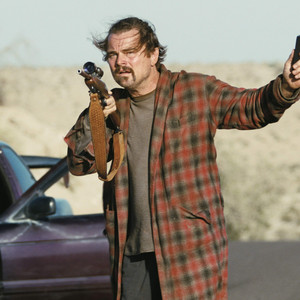
So one battle after another stars Leonardo DiCaprio as Bob, a washed up ex-revolutionary living quietly with his teen daughter Willa.
She's played by Chase Infinity.
One day, his past comes back to haunt him.
Colonel Lockjaw, that is his actual name.
He is the officer who effectively dismantled Bob's crew of militant activists some 16 years earlier, and he's tracked him down and is after Willa now.
He's played by a very colorful and very sinister Sean Penn.
Bob seeks help from what's left of his old group, the French 75.
He's also aided by Willa's karate instructor Sergio, played by Benicio del Toro, and the ensemble also includes Tiana Taylor as Perfidia.
Beverly Hills Again, these names.
Chef's kiss.
She's playing Bob's love and Willa's mom.
One Battle After Another is streaming on HBO Max.
And Glenn, I'm going to start with you.
How did we feel about One Battle After Another?
We loved it.
I mean, this movie is really clear-eyed and immediate and urgent, and it's ridiculing an ideology that is, as they say, in the news right now, which is white supremacy.
And I'm not particularly proud of this, but I know that if this movie had been made, even as recently as last year, if it had come out, then I know me.
I'd be sitting here on this podcast bloviating about fictional villains.
I'd be like, I don't know, guys.
You make your villain a white supremacist.
That's like making your villain kill puppies or club baby seals.
It's so cartoonishly evil.
It's so unbelievably evil.
It's like you don't have to put in the work as a filmmaker to make a layered characterization, because you can count on the fact that literally everyone in your audience is going to agree that they're horrible people.
That's why frankly, back when the ending of Breaking Bad came out, I was it didn't hit as hard as it could have, because it's all about this show's all about moral gray area a good man becoming a monster.
But then at the very end they go, oh, you know what's worse than a monster is literal Nazis.
We can all agree.
Yeah.
It felt like a cop out.
This doesn't because white supremacy isn't a radical fringe notion.
It's back in the public square.
It's public policy.
And that's ridiculous.
And that needs to get called out and ridiculed.
And that's what this movie is doing.
And not for nothing, having a great time doing it.
I mean, given the subject matter, this should really come off as kind of strident and polemical, but it really doesn't.
It's fun in every way that Eddington isn't.
Yeah.
I had a great time at this.
Yeah, Sean Penn is sort of the locus for this racist, xenophobic, all of these things.
Yeah, he's the face.
He is hamming it up.
And I don't mean that in a derogatory way.
He seems to be having maybe too good of a time playing this character.
He's been waiting his whole life to play this kind of villain.
He's so good at it.
It's so scary.
I didn't recognize him at first, and then I realized who it was.
Yeah, neither did I.
Oh, God.
Oh, my God.
I also really loved it.
I was super on board with it.
You know, I think we sometimes we take Paul Thomas Anderson for granted because of course he's such a great filmmaker.
Of course, he's going to give us something good.
And then we come to this movie, and not only does he push himself and really try different things, both visually and narratively, it just feels like everything works together so precisely.
Very entertaining. completely riveted.
I can't believe that he just grabbed onto that third rail of like let's talk about politics right now, and made an exciting thriller out of it.
I mean, one of the best sequences in this movie is a car chase that I really want to single out.
I got to see this in IMAX and I felt like I'd never seen a car chase that good before.
I mean, it was eye-poppingly beautiful.
So shout out to Anderson and his cinematographer, Michael Bauman, who he worked with on Licorice Pizza.
So they're back together again.
And it is just incredible.
Just so inspiring.
I also went back and visited some of Anderson's previous works and getting to see like little threads of things throughout his career that he's bringing back for one battle after another.
There's a beautiful.
It's just a little scene of just like a camera moving on top of a car door that's being closed at the same time, but it just feels so exciting.
And it's borrowed from Punch Drunk Love kinds of painterly compositions that he uses for the master is also here on display.
He's just so good at what he does and he comes out swinging.
I mean, it is a masterclass, firing it all on cylinders.
I can't say enough great things about this movie.
I think we're going to be talking about this one for a while.
Yeah.
I love that you talked about the car chase scene because it really is.
I mean, you can't really give away a car chase scene, but I do find it fascinating that It takes place in the desert and it's the hilliest desert I have ever seen.
And I've driven through a lot of desert.
A lot of it is flat.
Or if you're driving through it, it's very slow ascent.
It kind of felt like French Connection, but in the desert because it was just like so many hills.
It's like, what is happening here?
But it's so well paced and so well choreographed.
This movie comes in at almost three hours and I did not feel those almost three hours.
Not at all.
I agree with so much of what you both have said.
I have a couple of small nits and they keep this from being a great movie for me from a very good.
But I think that Leonardo DiCaprio, we've kind of seen him play a sort of character like this in like Once Upon a Time in Hollywood.
I feel, at least in the second half of this movie, you know, when he is very just kind of checked out and washed up, as you said.
But it's fun.
It's funny.
There's a whole sequence where he is trying to charge his phone while also trying to remember a code that he got 16 years earlier to identify himself in order to get help from the French 75.
What time is it?
Uh.
You know, I don't remember that part.
Let's just not nitpick over the password stuff.
Look, this is Bob Ferguson, all right?
You just called my house.
Let's cut that.
I need the rendezvous point.
What time is it?
The sequence goes on for a very long time, but it is great.
It's so well-sustained.
And you have Benicio Del Toro playing with it and just being cool.
That's what Benicio Del Toro is really good at.
I just found this really, really fun.
I do want to kind of talk about the way this movie does incorporate the more topical and very of the moment issues.
Because at the center and what I think most of Anderson's focus is on, like this relationship between Willa and Bob, father and daughter.
And then, of course, Colonel Lockjaw and this kind of triangular thing.
But then it opens with the French 75, this radical group, infiltrating and freeing detained immigrants.
And we see that happen again later on.
We see what's happening and the way that people have to feel like they're forced into hiding.
This movie has a lot of tunnels and a lot of like walking to places both sinister but also liberating.
I kind of want to pull a little bit more on that and how you feel Anderson weaves those in and sometimes takes a back seat, I think.
And I wonder if.
Well, what occurred to me is that this movie's understanding of counterculture radicalism, is more layered than it appears on the surface, because DiCaprio is so – he's doing so much that he kind of steals focus.
But if you grew up anytime after the 60s, your understanding of what –
The 60s, counterculture was was, if you think about it, it was dictated entirely to you by the culture that the counterculture was trying to counter.
Right.
So history is written by the winners, and 60s radicals and revolutionaries have been portrayed in mainstream culture forever as hippies burnouts losers, dismissible.
So DiCaprio represents that archetype.
Now, it's not 60s radical culture here.
It's more contemporary.
Yeah.
But his character is a loser even when his group experiences a win, as it does in those opening scenes you mentioned.
He's still nervous.
He's needy.
He's a raw nerve.
That's my favorite DiCaprio.
You mentioned Once Upon a Time in Hollywood.
We also see a bit of it in Wolf of Wall Street.
He's feckless.
He's insecure.
You tell me if you think this is a stretch.
I think he's the audience surrogate.
Oh, yeah.
When we catch up to him, 16 years later, he's gone complacent with weed and booze and TV and watching the Battle of Algiers.
Yeah.
And the film's world is very specific.
It doesn't seem to be at first, but it is because the world he worked to prevent has come to pass.
And it literally has.
In the world of the movie, which is maybe the most Pynchon-esque little filigree bit that's kind of staying in the film because it's a very loose adaptation on the Thomas Pynchon novel Vineland.
Because it's not white supremacy writ large as a cultural reality.
There is this very specific white supremacist secret society.
It's strongly implied that it actually runs the damn country.
And so you know, that's when you kind of recalibrate the Leo DiCaprio character, because he's not paranoid, because people are actually out to get him.
So he's not paranoid.
He's just perceptive.
And I think if people think of that –
Secret Society is a cop-out, which I would have even a year ago.
I mean, in drama, in fiction, you need to particularize and localize what you're fighting against.
250 years of systemic oppression needs a face.
A face you can punch.
And this film smartly.
In the end, I think this film is filled with very punchable faces that I wanted to see punched.
Yes, including Tony Goldwyn, aka Fitz from Scandal.
Oh, yes.
Surprise, surprise.
I also can relate to the need or the sort of malaise that sets in after so many years of trying to fight the power.
It gets really exhausting.
And maybe you just want to live life.
Maybe that's all you have the bandwidth for.
There's been so much conversation over the past few years about, Since you know, the Black Lives Matters movement and different things like that.
How do you sustain a cultural momentum like that in these kinds of movements, in these grassroots organizing?
And what happens next?
Is this a lifelong thing?
Or like, how do you make it a lifelong thing without necessarily burning out?
Because burning out is a real reality for a lot of folks, especially for as much activism as, like Leonardo DiCaprio's character takes on.
He's, you know, really involved with this countercultural group.
And then all of a sudden, you know, he tries to, you know, go back to life as a civilian.
And it turns out that you can't always go back.
So that's a very you know, real discussion and reality that you know happens in countries the world over, let alone you know what might happen here.
It was an interesting sort of tension there to see, like yeah, you can tap into the movement but you can't necessarily always quit it.
Right.
Let me lay all my cards out on the table, which is that the more I've mulled over on this, the more I've come around to.
This is very, very good.
I want to watch this movie again.
Same.
I think to your point Glenn, about how it really kind of captures what it means when the revolution is no longer sexy.
It's sexy until it's not.
You know, eventually most, if not all, revolutionaries find themselves in their older age, whether it's actually the system breaking them down or just getting older, maybe getting a bit more conservative.
Things just change.
And I love that aspect of this film and how seriously it takes it.
I think for me, where I was wanting something a little bit different, and it's always a gamble to argue that a movie should have been this when it's not, because it's like you have to judge what's on the screen.
But I do think the movie does give me something that I wanted more of.
And that is, you know, this idea of Tiana Taylor's character Berfidia, and what exactly her motivations are, beyond just being a Black woman.
That's not his focus.
And I wonder, is it because Leo is a bigger name and is a white man and he just understands it more?
The whole white supremacy stuff I was totally on board with.
I wanted perfidia.
That part of it felt a little surface level for me because it kind of rushes by really, really quickly in the first act of this movie because we're in the past and we're seeing them before they've had their daughter.
And she's such a fascinating character because she is kind of like a, a Pam Greer in the seventies.
Like she is depicted as like this revolutionary, like black power figure, but then she's using her sexuality and actually like, gets off to some extent on like wielding a gun and on having this sort of power.
And there's even a moment where they're robbing a bank and Jungle Pussy, who is the rapper who plays a character named Jungle Pussy in this movie and she's part of the Friends 75.
At one point, she says like, I am what Black Power looks like.
And I was like, okay.
I guess what I wanted more of was like a little bit more of an understanding of what that revolution is for those Black characters, because it does mean something the fact that we know that they're the ones leading this and people like Leo are just kind of along for the ride.
And Alana Haim also shows up very briefly like kind of blink if you miss it as part of the group.
But the black and brown people are leading this charge.
And I kind of wanted a little bit more of that before we turn to focusing on, on the Leo character.
And I think that's kind of where I, and also like Regina Hall is in this movie.
I was going to say, she is completely under you.
Yeah.
It's, Okay, this is not an excuse, but here's what I think was happening in PTA's mind.
He wants to say, I need to represent the culturally common idea of a revolutionary.
That's DiCaprio.
He also wants to acknowledge that he is not the whole story.
We see in this movie that revolution... or at least resistance, is a noble thing.
And that revolutionaries can also be competent.
And you want to get behind them.
And yes, if they take the form of Tiana Taylor, they can be sexy.
I agree that's pretty much all she is in this movie.
That's her characterization.
But in the same way, if it takes the form of Benicio Del Toro, revolution can be chill as hell.
And I would argue that chill as hell is also...
Pretty much the extent of his.
That's who he is.
But, you know, he's effective.
I mean, there's a lot of really compelling images in this film, including that chase scene you guys talked about.
But the one that I'm going to be kept with is the silhouettes of these kids leaping across rooftops.
Joyful, purposeful, gorgeous.
And then I think what he's trying to say and I don't think he's doing it a particularly layered way, but he's saying that's the resistance.
Yeah.
And then we see DiCaprio huffing and puffing behind them.
And then he's like, that's us.
Yeah.
Which is why I think the film wants to be a call to action, but not a humorless or didactic one, but a fun one.
It is a mainstream movie that has subversiveness at its center.
It's not a deep subversiveness, but it's there.
And all it's really saying is get off the couch, look around and help each other.
And I bought it.
Yeah.
I really dug the fact that you have so many different examples of what a revolutionary leader looks like, whether that's more the showstopper, more the person who gets off on control, like perfidia, or like Deandra, which is Regina Hall's character.
Like she's way more in control than, I think, almost anyone else in the movie, up until a certain point.
And she's kind of running, you know, a good portion of that movie.
I enjoyed that.
And same thing with Benito del Toro.
Like, even though he has this very cool reflective service, like nothing's going to trouble him.
He's overseeing, you know, a huge operation.
And you know, while Leo's character Bob, is freaking out and like throwing himself on the floor to not be seen by the cops yeah, benicio is like just slowly and purposely packing his stuff getting ready to go into the next mission.
Yeah, so you have all different kinds of responses to this moment of action, a moment of crisis, absolutely.
I think all of those points i agree with them and i think they're so important to point out.
I have to say like this is again this is a me sort of critique.
I think also, i'm just looking at it from the sense of like the history of Black people on film and Black women specifically on film, and how you are kind of like playing with fire here to have a Black woman character who is so sexualized in a way and in a violent way.
And I'm not saying he doesn't necessarily pull it off, but I do think that I wanted a little bit more complications with that.
And also, again, this movie is almost three hours long.
I'm not sure what I would cut to make more room for that.
I will say, while I felt I wanted a little bit more from Deanna Taylor's character and Regina Hall's character, we do get to spend a good amount of time with Willa Bob and Profitia's daughter, who is played by Chase Infinity, who is actually new to me.
Yeah, also new to me.
I think she does an astounding job with the complexity of the role.
First you get to meet her.
She's like this naughty 16 year old who doesn't like trust her dad or just like eye rolls, whatever he's freaking out about something, and also kind of, to be fair, bob is a little like no phones, not world's best dad.
He is actually kind of looking out for him.
Yeah, at that beginning set and then it's trying to, you know, get him to wake up.
Essentially,
And then she is kind of like coming into her own at this moment and this again moment of crisis, and has to kind of reckon with her family's past, her own you know role in this and what she, what is she going to do?
Is she going to run away?
Is she going to stand and fight?
There's a big, you know, question for her to answer.
And I mean, she throws her all into it.
I mean, she's, she's really great and such a great scene partner for Leo as well.
Yeah, she is a very convincing 16 year old who is both sheltered but also is like whatever dad.
I'm doing what I need to do to try and feel as normal as possible.
I think overall, like this is such a I don't know.
Paul Thomas Anderson, for me, has never made a bad movie.
You know, this is his 10th feature.
He's just one of our most consistent working directors today.
I'm just very happy that he even decided that I want to at least try to address something that is happening now.
Something that's been happening for a very long time.
But yeah, it's a fun time.
I think people are going to have thoughts about it.
You should definitely tell us what you think about one battle after another.
Because there is so much to talk about, so much to chew on.
I'm going to see it again.
And who knows, I might see it again and change my mind completely on how I feel about this.
But Find us on Facebook at facebookcom slash pchh.
And on Letterboxd at letterboxdcom slash nprpopculture.
We'll have a link to that in our episode description.
And up next, what's making us happy this week?
This message comes from NPR sponsor, Capella University.
Sometimes it takes a different approach to pursue your goals.
Capella is an online university accredited by the Higher Learning Commission.
That means you can earn your degree from wherever you are and be confident your education is relevant, recognized and respected.
A different future is closer than you think with Capella University.
Learn more about earning a relevant degree at capella.edu.
This message comes from NPR sponsor Adobe.
Introducing the all new Adobe Acrobat Studio, now with AI powered PDF spaces.
Need to turn 100 pages of market research into five insights with a click?
Templates for a sales proposal that'll close that deal?
Or an AI specialist to tailor the tone of your market report?
You can do all that with the all new Adobe Acrobat Studio.
Learn more at adobe.com slash do that with Acrobat.
This week on.
Consider This, the bigger story behind President Trump's trip to the World Economic Forum in Davos, how he's rewriting the rules of the economy and how the rest of the world is coming to terms with a global order not led by the United States.
Listen every afternoon to Consider This on the NPR app or wherever you get your podcasts.
There is a lot of fear these days that AI could be a bubble.
So, Nick, is it?
I don't know.
Right.
It is hard to tell.
But there are some clues that economists say might kind of sort of help us predict bubbles.
On the Planet Money podcast, the dark art of bubble detection.
Listen on the NPR app or wherever you get your podcasts.
Hey, before we get back to the show.
Yes, you.
You with impeccable taste in podcasts.
If Pop Culture Javier has ever helped you win a group chat debate, find a hit series before everyone else or pretend you saw that movie, you definitely didn't do us a solid and leave the show a review wherever you listen to podcasts.
It helps more people find us and helps us make the show even better for you.
And now it's time for our favorite segment of this week and every week, What's Making Us Happy?
Monica, welcome.
Let us know.
So this past Saturday, Amazon hosted a live stream of the end of Bad Bunny's residency at El Choli in Puerto Rico.
It was the end of his No Me Quiero Ir De Aqui residency.
So it was a big to-do.
For those of us who were able to log into the broadcast, great.
If you missed it, I'm so sorry.
But good news is there's like little clips and everything that keeps circulating.
And I'm so in love with the number of memes and reactions and posts that people have been doing ever since then.
It just felt like a moment for the community to come together and enjoy something kind of celebrate Latino joy that even if we aren't Puerto Rico, we can all still take joy in each other's arts, send support and solidarity for a lot of the things that Bad Bunny was singing about and drawing awareness to.
It really felt like a moment that we all kind of tuned in and watched the same show at the same time, which we don't usually get to experience that much.
So I was glad for it.
And I'm glad that the memes and the videos are living on and having a second life, even though the live stream has expired.
So that was Bad Bunny's final show for his residency, which was live streaming on Amazon.
And we should note that Amazon supports NPR and pays to distribute some of our content.
Thank you so much, Monica.
That was great.
Glenn, what is making you happy this week?
Plain Clothes is a film that's in theaters now.
It stars Russell Tovey and Tom Blythe.
It's the debut feature from writer-director Carmen Emi.
And it's about a young undercover cop, played by Blythe, whose job it is to entrap and arrest gay men cruising in public toilets.
You will not be surprised to learn that the Blythe character is very deeply conflicted about this, because he's still wait for it in the closet.
And then hot daddy Russell Tovey shows up into the men's room and complications ensue.
This movie isn't reinventing the wheel, but it's a solid wheel that is not overwritten.
It's really solid.
And I should note that some reviewers haven't liked some of the film's stylistic flourishes.
It switches to handheld video at certain, you know, really emotional moments.
I kind of love that frankly especially, especially when you consider the film's really about surveillance.
It made sense to me.
And I'm curious to see what Emmy does next, which is the best thing a first film can do.
So that is Plain Clothes.
It's in theaters now.
Thank you so much.
I've heard nothing but good things about it.
So I'm definitely going to Add that to my very, very long to-watch list.
No, I want to catch up with that one.
I missed it at Sundance.
Yes, so did I. Well, one movie that I did not miss at Sundance is actually My Happy this week.
And it is one of the best things I saw at the festival this year.
That is Predators, which is directed and produced by David Ossett.
You may be familiar, if you're of a certain age, of the show To Catch a Predator, which first aired as a news segment in 2004 on Dateline NBC and then continued for a few years after.
And I don't really remember watching this myself.
But once I watched this documentary I was like oh yeah, this was the format of the show, which was adults who could convincingly look like they were minors, would impersonate minors online, then lure would-be sex offenders to a house that was part of an undercover operation.
And then the host, Chris Hansen, would show up, confront the men and reveal the entire production crew hidden in the house.
And then afterwards, they would usually be arrested by police waiting outside.
This documentary is so fascinating because it focuses on the consequences and the effects on those who were involved, including You know the emotional toll it took on the decoys who were being used to lure these people.
And also the highly publicized suicide that led to a lawsuit and then the end of the program eventually.
This is a doc that kind of like asks, what has all of this wrought?
Like, did this actually work to stem abuse?
Or was this just another form of shame, humiliation put on display for everyone's entertainment?
So it's really complicated.
It's really layered and really harrowing and devastating.
And I highly recommend it.
So that's Predators.
It is in theaters limited release currently, and then it's supposed to expand nationwide on October 3rd.
It's tough stuff, but also really, really fascinating as well.
That's what's making me happy this week.
If you want links for what we recommended, plus more recommendations, you should definitely sign up for our newsletter at nprorg slash pop culture newsletter.
That brings us to the end of our show.
Monica Castillo, Glenn Weldon, thanks so much for being here.
Thank you.
Thanks for having me.
This episode was produced by Liz Metzger, Carly Rubin and Mike Katzeff and edited by our showrunner, Jessica Reedy.
Hello, Come In provides our theme music.
Thanks so much for listening to Pop Culture Happy Hour from NPR.
I'm Aisha Harris, and we'll see you all next week.
This week on the NPR Politics Podcast, President Trump's first year.
You know, it's not just that there aren't really the guardrails on Trump's presidency this term.
It's that he's doing things that are just not conservative.
We unpack the ongoing transformation of the Republican Party on the NPR Politics podcast.
Listen on the NPR app or wherever you get your podcasts.
This is Tanya Mosley, co-host of Fresh Air.
You'll see your favorite actors, directors, and comedians on late-night TV shows or YouTube.
But what you get with Fresh Air is a deep dive.
Spend some quality time with people like Billie Eilish Questlove, Ariana Grande, Stephen Colbert and so many more.
We ask questions you won't hear asked anywhere else.
Listen to the Fresh Air podcast from NPR and WHYY.