As the saying goes, you can lead a horse to water, but you can't make it drink.
I think that old chestnut really sums up the product onboarding to adoption pipeline.
Just because a user has found your product doesn't mean they'll end up paying for it.
When I get it, it's frustrating when new users seem to arrive at your product, take a sniff, and gallop off into the sunset.
But we're not here to commiserate about runaway users.
We're here to zoom out on this kooky little analogy and understand how to get that horse to drink.
Because when you look at the context around successful product adoption, you'll notice that many parts of that journey actually begin long before and continue long after user activation.
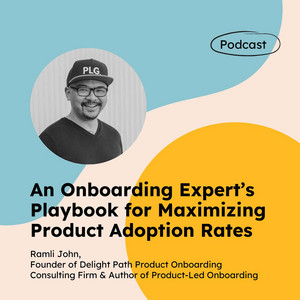
My guest today is Ramly John, author of Product -Lead Onboarding and the founder of DelightPath, a product onboarding consulting firm.
Ramly is like the guy for product -lead onboarding wisdom, so we were really lucky to have him come on and share some practical frameworks, tactics, and tools for figuring out how to evaluate and refine your user onboarding journey.
So to come back to that horse analogy, it behooves you to try them out.
Sorry, I couldn't resist.
Let's jump in. Welcome back to the Product Manager podcast.
We are here today with Ramly John and we are very excited to have you here today.
Thank you for joining us, Ramly.
How are you doing? Pretty good about yourself, Hannah.
Feeling really good.
Can you tell us, to start off, a little bit about your background and how you got to where you are and your whole journey in product -led growth and onboarding?
Yeah. I got in, I've been working on SaaS for quite some time.
I got a chance to work on growth and onboarding with SaaS and then eventually connected with Wes Bush.
He wrote the book, Product -Lead Growth.
And people don't know this, we actually went to the same university, University of Waterloo, but 10 years apart, he's like 10 years younger than I am.
Yeah, that's how we connected.
I got a chance to work with him and worked with product -led companies and helped them with onboarding.
And I got on to work on AppQist as well.
It's a product adoption software for product -led companies, and you can probably see the pattern is all brought up.
And now I'm in the light path where I help product -led companies with their product onboarding experiences.
So, just a little bit about me in 60 seconds or less.
Yeah, yeah, perfect.
And this all connects to our core topic of the day, which is product -led growth, product onboarding as part of that product -led growth process.
So let's kick it off.
What are some of the key misconceptions, as far as your experience has shown you, that you think product teams have about activation and user retention in that whole journey?
Yeah, I think in terms of activation itself, people think first of all, there's a few ones.
One that really gets to me is the whole … The classic example with just having seven friends in 10 days, there's a Facebook metric.
I think that is a great metric because it's easy to explain.
But the challenge with that is even the head of growth at Facebook, they were straight up saying that it's not fully based on full data, like they don't have the full correlation because it's hard.
And for a lot of B2B companies, they don't have enough data to do that.
They picked that number because they found a pattern and it was easy to communicate, and there's obviously a lot of different variables that get into stickiness.
And that's why teams that I work with, like, I need to get that seven friends in 10 days metric.
It's like, you're all over -complicating it.
Just pick a deal moment, like a sticky moment or a moment where it requires commitment from the user and just get users to do that once.
And that's a good place to start in terms of activation.
That's a common one.
Second thing is often that they see it as a product problem.
And often onboarding is actually such a very, very cross -functional issue that marketing has input into it, especially the positioning and messaging that I got a chance to chat with the folks at Fletch, Anthony and Rob.
And really, if you don't have your messaging and positioning nailed down, then it's really going to impact what people expect from your product.
And if people come in with unrealistic expectations of the product, there's no product experience onboarding or in -product guidance or tours that can really help them get to that aha moment because they had a different aha moment in their minds.
It's not really going to happen there.
So I think this is a couple I can keep going on and on.
And we could probably dedicate a whole episode of this, but I think those are a couple of common ones in terms of misconceptions about activation.
So you're the founder of DelightPath product onboarding consulting firm.
You're the author of product that onboarding very well respected literature in this space.
And you also have developed a five step framework called the Eureka framework for onboarding.
I want to dig into the framework because I don't think we've got time to go through everything in the book.
Can you walk us through how that helps the organizations that you work with with user activation?
Yeah, of course. I think kind of touching upon the first misconception I mentioned, when I approach it, this is like five steps.
It's an acronym for Eureka and one of them is the two letters, so it becomes four or five steps into it.
The first one is really about establishing that team, the cost -fulficial team.
If you're like, oh, round me, we need help fixing our onboarding.
And somebody from product, I'm working with a team right now and it's from somebody from product -led growth, their product team, it needs to be cross -functional, especially if it's B2B.
Customer success isn't input, marketing hasn't input, sales isn't input into it, so I bring that team together and the first step in Eureka is establish that team.
So, E. Then next I walked into some exercises and it's U.
U stands for understanding success for your users.
Even before we think about in -product, out -of -product, onboarding emails, let's first figure out what does your users think is success?
Because if we don't have that nailed down and we're going to build the wrong path to the wrong success state for your users.
The second one, the third is RE, so that's reverse journey map, the happy path.
So it's really about reverse engineering.
What does your best customers, what do they do in the first seven minutes, in the first seven days, in the first seven weeks, in the first seven months and kind of map out what they're doing already and see, hey, this is what they do.
Let's create the same pattern and reverse engineer what success looks like.
And then K stands for keeping the new user engaged, kind of figuring out both in -product, so like product tours and checklists and out -of -product, like onboarding emails, human interaction and educational content, the right kind of mix to get the right users engaged throughout this journey.
And the very last step is A, which is about applying these changes and kind of repeating it for different kind of use cases and personalize that for different quote unquote jobs to be done, or customer jobs that your users are trying to get to.
So that's the Eureka framework is five steps into it and if you want it to begin each one, happy to do so.
I think we'll come back to that because I'm actually very curious about the reverse engineering path.
So let's put a little pin in that one.
But I want to talk a little bit about friction.
I think it's often pinned as the main obstacle in onboarding.
And I think there's just there's many opportunities for users to kind of hit friction.
But you said in the past that there's three types of friction.
So there's product friction, there's social, there's emotional.
Can you break down the different types of friction and how each one of them affects the user journey?
I was inspired by he was the former head of product at LinkedIn.
His name is Sachin Gupta.
And I've kind of adopted it to apply to the jobs we've done framework.
And he called it the hierarchy of user friction in terms of user experience.
But I said in B2B actually, it's kind of different.
So the very bottom is product friction, like you mentioned.
Those are things that are barriers in the product itself, things like too many steps or overwhelming them with showing too many fields or prop ops or whatever is in the product friction.
The one above that that people don't often think about is the social kind of friction.
And I think this applies to both consumer products, especially social products where you show your friends and colleagues.
But more so in B2B as well, where sometimes you need kind of buy in from your team, and this applies to both product -led and sales.
So for product -led, the user signs up and they need to get the buy in from their manager or director to be like, hey, we should pay for this.
So it's like that social friction where they have a challenge within the organization to sell the product itself.
And then in a sales org where it's top down.
Sure, the buyer, maybe the executive level, bought the software for the team, but they're too ingrained in what they're doing already that they're like resistant to that change.
So social friction is, it's all about that politics, that organizational barriers that can block your customer from fully adopting it.
And then at the highest level is emotional friction.
And that's like deep seated psychological fear about change.
Things like adopting something new could be threatening.
There's a saying that you can never go wrong buying IBM.
There's a reason why they say that is because it removes the risk of making the wrong choice.
And for a lot of companies, if you pick the wrong product, your job could be on the line.
And especially if it's an expensive product that it promises it's going to 10X your productivity or bring in 10X the revenue.
If that doesn't happen emotionally, you're like fear of like, my job is on the line.
I could look bad in front of other people.
And that is part of the whole onboarding that people don't think about as a change.
Like onboarding is not just onboarding to the product.
You're onboarding them to a new way of doing work or doing life.
And change is usually a scary thing for most people.
So those are the three levels of friction that a lot of teams don't think a lot about.
They often just think about, let's just tackle product friction because it's easy, but social and emotional friction are something that often you can't tackle with just a simple product change.
We actually talked a little bit about this in an episode previously with George Brooks on I think is something that the effect of the barriers to product onboarding are what you think.
Had a lot to do with that, the kind of like social and emotional friction that kind of takes place outside of the purview of the analytics that we're collecting that we're kind of trying to gauge, you know, what's going on, why are we losing people?
Why are we not getting the adoption levels we want?
So I'm curious, like from your perspective, is there any way that we can kind of bake like accounting for those factors into the process of evaluating how adoption is going?
And rather than just going, you know, it's not being adopted the way that we expect.
It's got to be a product problem.
Yeah, I would say the two, both the social and emotional, the whole product you mentioned is a lot harder to measure because you're just seeing a drop off in people like not doing that.
I would say that's where human interaction is very clerical and qualitative data is really important, where trying to understand the why behind why they're not fully adopting it and understanding who are the other stakeholders involved and kind of like figuring that out.
That's why I'm a big fan of like, especially earlier on, doing one on one onboarding process, especially for companies that are more product led because those things are things that you can uncover to like figure out like, hey, we'd love to help exactly why the challenge is to this step not happening.
And they can provide some kind of explanation or other things like that in terms of that.
I would also suggest trying to figure that if you already have some recordings from your customer onboarding as well as sales process, that could definitely be something that could be mine for insights like those as well.
So anytime they can use words like there's conflict or any kind of barriers in terms of getting buy -in, I think those are critical things that is like, okay, there's a challenge here.
How do we add a human or educational content or the right kind of email when we know that the reason why they're not completing a certain step in onboarding is not necessarily product friction is actually barriers.
An example I can think of is when I was working at AppQs, one of the key steps in this is for a lot of B2B products where they had to install a code snippet to their production code base.
And often the person signing up a product manager is not the one who has access to the code snippet.
And that is something that often we found that a human interaction and asking for help and what kind of limitations or challenges they're facing was the critical path as well as well as if they say they're a product manager right on the onboarding.
How do we kind of like, hey, here's how you can invite and provide the right kind of instruction to engineering, because we know that this is not a product friction.
It's a social and also an emotional friction, because if the code breaks your production, that's not a good experience for your users itself.
So I think there's just some kind of tips and examples of how this can be baked into the whole onboarding process.
And I like this train of thought too, because as you kind of mentioned earlier, like this is a cross -functional endeavor.
So have you had any other kinds of breakthroughs in the past that have kind of been like, ah, you know, like this is kind of an antidote to some of the silos that are really inhibiting us from really creating this really seamless product onboarding journey that's like leading to higher adoption rates
or any kind of like breakthroughs that you've kind of been able to conquer with your consulting clients, where it's just like, ah, like if only everyone was doing this.
Yeah, I would say the first thing and this is I'm going to go from the hardest way to do it to the easiest way to do it.
Maybe let's start with a quick win.
I think that's a common quick win.
It's like kind of like kind of aligning the different teams into a common metric success goal in terms of how it would impact them as well.
For example, rather than like telling the sales, hey, we need you to like tell us exactly why, you know, what are the challenges in terms of your sales process that our activation rate is falling off.
Instead of saying that I think it's getting everybody on the common ground like, hey, if we can get this right, then it's going to be easier for all of us to not just sell the product but actually to keep those customers going on, going forward.
There needs to be a champion who would kind of explain exactly why that is such a critical moment for everybody and tying them.
OK, the reason why activation rate impacts sales is if we know that they're the right kind of people coming in and they're more likely to close and how it's going to impact marketing is that we know that based on this, this kind of channels here are the ones that actually bringing this in.
Often I find that the champions for this experience is somebody from customer success and they kind of bring that in and kind of tie everything together.
That's I think I would say quick win, not really quick win because it is kind of pulling everybody together.
One that I found easiest that we actually did at AppQs is when there's executive buy in from the leadership level, they actually got a chance to form a growth squad we call the Tiger team essentially, whereas a cross -functional team and they found a business problem, our trial to pay conversion rate
was low. So how do we fix this?
So they formed like a cross -functional team, somebody for marketing.
I was part of that, somebody from customer success, somebody from product.
And for six months, we met every week to just like, hey, we need to raise this twice what it is right now.
How do we do that? What are the things, different components that we can impact in terms of product, in terms of marketing, in terms of sales, in terms of customer success?
So together we're tackling this problem from different lenses that we all come from.
And that is, for me, the ideal situation where you can pull everybody together.
When I work with teams, that is the first step I do.
Like, hey, randomly we need help fixing our onboarding.
I like, I'm going to do this onboarding audit workshop and there's going to be multiple people from different teams that are coming into this so that we can get all on the same page because often those teams don't talk to each other.
They don't like really understand what, first of all, what is the Aha moment, activation moment for the product itself.
And that's what happened to us at AppQs were a product and customer success in marketing.
We all had different definitions.
And if you can't even define what initial success is for the user, then good luck trying to get them fixing your onboarding and getting them a seamless experience.
Those are just a couple of ways I think that could really make a big impact on getting everybody on the same page working together.
Web designers, this one's for you.
I've got 30 seconds to tell you about Wix Studio, the web platform for agencies and enterprises.
So here are four things you can do in 30 seconds or less on studio.
Adapt your designs for every device with responsive AI.
Reuse assets like templates, widgets, sections and design libraries across sites and share them with your team.
Add no code animations and gradient backgrounds right in the editor and export your designs from Sigma to Wix Studio in just a click.
Time's up, but the list keeps going.
Step into Wix Studio and see for yourself.
Yeah, yeah. OK, because I think this is just like every organization, especially remote organizations.
So always a struggle to try and get folks to work together the way that we envision it should work.
So it really appreciate those tips.
But I think this is a really good kind of segue into going back to the reverse engineering part of the framework, your framework, because I think that in general, we accept that reverse engineering success is a good, you know, best practice.
But how that actually looks is kind of murky.
Like how do we kind of apply that physically?
Would you be able to pull like an anecdote or like kind of like tell us the story of an actual kind of like process that you've used kind of to reverse success?
Like, how did that functionally go?
How can we kind of copy and paste that into our own strategy?
Yes, this is how I think about it.
I start off at the end.
So the end in mind with an example, I got a chance to work with a team, Spark Toro, which is like a audience intelligence software or platform where I know that's like a buzzword, but essentially to help you find where your audience hangs out online so that you can do co -marketing with influencers or find
the right kind of places to kind of market your product.
So that's what they do.
They have like this database that you can kind of search for specific keywords.
One of the questions I got a chance to chat with their team, Ren, Amanda and Casey, was starting with the end in mind.
So the question I have is what is the ultimate win?
What is success for the user itself?
What would they do?
You're like, oh, yeah, they actually got something valuable.
And one of the things that they had in terms of end success is when you find something valuable in terms of like, OK, my audience hangs out at this subreddit at Reddit .com.
Or they listen to the specific podcaster.
What they would do and what most people would do at Airbnb or in other kind of search type functions is they save it to a wish list.
So they have a list function.
And that to us was like, OK, this is a leading indicator that, yes, they found something and they've added it to all this.
That's the ultimate win.
So we work there. So what are the I call the win mapping, like what are the mini wins along that way that gets them to that ultimate win?
So if they need to get them on a list, first of all, they need to do a first search.
So that's another win.
So they find a first search, like a search, like I don't know, product manager or some kind of keyword, what do they need to know before that?
So they need to, first of all, understand what search works and what, you know, find the result and kind of get a good result.
And another win is creating like a list.
So creating, actually creating and naming a list is actually important before they can get to the ultimate win.
So rather than like mapping out all the steps, I'm just like, hey, what are the key milestones?
But I call it what are the key mini wins or wins to get them to that ultimate win?
And along that way, OK, here's like this ideal journey.
So first one is make that first search.
Second one is actually create a list.
And then the ultimate win is actually finally saving an item to that list.
We found that it took about two to five searches before they found that.
So we talked about how do we reduce and refine the search and kind of offer them suggestions as autocorrect to get them there as well.
So that's how I would think about it.
Obviously, for more complicated products, there could be like seven or eight wins, mini wins until they get to the ultimate win.
And even for more complex products like, let's say, AppQs, where the ultimate win can take two to three weeks because they need to set up some stuff.
One of the things I suggest to those teams is like, is there like a same day win that you can do for your users within them?
So the AppQs we focus really on getting them to start building right away.
So building a tour or a checklist and any kind of other in -product experience.
Because we found through customer interviews, that's like an aha moment, like an early aha moment.
And the ultimate win was getting it published live and then actually getting data with that.
So that's kind of like a high level approach.
So find your ultimate wins first step.
Second step is what is the mini wins along the way.
And the third step is actually filling in all the steps along that, like the minimum number of steps under to set up that mini wins.
I really like that process.
That kind of reminds me.
I don't know if you ever did in school.
There was this exercise, I remember doing it in like middle school where they're like explaining instructions to open a jar of peanut butter and make a peanut butter sandwich or something like that.
And like you have to you have to really think is like so much of it is muscle memory because you're so close to that.
It's just so, you know, every day that you don't even think about the steps, like the many steps that lead to kind of like that like ultimate goal.
So like kind of like thinking about it like really, really granularly.
Like what are even just like the foundational knowledge?
Well, you have to know to do this.
It's a process that there's a lot of thought.
Well, since we're talking about brass tacks, I want to move on to something a little bit more concrete as well, which is tooling.
I think that's something that we don't talk about enough on this show.
What tools would you say are essential for product teams when you're designing onboarding experiences?
And we're thinking about this cross functionally, but I'm thinking kind of more in the scope of the product team.
Yeah. In the scope of the product team.
I think in terms of the product team, I would look at a few things.
I would, first of all, look at gathering insights.
And then second is like actually implementing the in -product experience.
And then third, I would be looking at how do you experiment with that?
So I think in terms of the data and analytics itself, there's some great tools out there.
I'm not associated with any of the use.
I've never worked for them.
I'm not paid by them at all.
Things like Amplitude, I think Amplitude and Mixpanel is great.
One of the things that I like about this couple of tools there, they can kind of cheat sheet.
And what they do is they try to find the correlation or try to figure out the exact user actions that lead to retention.
So they're based on your best user.
They do this three things in the first week, which is like super cool for them to be able to pull in that insight.
Obviously, there's other tools like June that I saw is great for more B2B stuff.
So I think analytics like that.
So that's more analytics.
There's also user session recording.
I'm a big fan of Full Story and PostHog where you can actually watch your users click around and surf, which is great.
The great thing about Full Story is you can actually they have some algorithm that kind of figures out when users are rage clicking is what they call it, where they're clicking something multiple times because they're frustrated or they're angry or there's an error code in the product itself.
So those ones are in terms of the last one in terms of analytics, kind of gathering information.
So like qualitative surveys, like in product wise.
So when you're signing for a product, there will be a thing that would pop up on the side that would say, hey, what made you sign up today?
Or like what kind of challenges do you have?
So things like SurveyMonkey, I think can do that.
AppQs can do that as well.
And then that's the first set of tools.
The second set of tools is around like in -product experience.
So like obviously I used to work at AppQs, heads up.
AppQs is one of them.
There's also a bunch of other ones that have similar capabilities, things like user pilot, Chameleon, there's Pendo, different tools like that.
And then I think in terms of the experimentation side, I think that's where I find huge challenge.
And I think I've heard Google experiment can do this and AppQs and Chameleon and Pendo can also do like split testing, where they send you users to different experiences and based on that, they can analyze that as well as amplitude.
So I think those are just a few tools that I know there's so many tools out there.
I would look at those three things to start off with.
Like how do you measure success for your users and how do you know they're getting there?
Second is like how do you deploy in -app experiences, in -product experiences?
And third is like how do you experiment and continue to improve over time?
Yeah, awesome advice.
Yeah, always love to hear recommendations from folks who are really in the space.
Recently, we did a panel event that you were part of.
Thank you so much for doing that, by the way.
That was awesome. And we talked a little bit about the intersection between AI and product led growth, but it was a very, you know, folks can check out the panel.
It's all available on our website if you're interested, but I would like to kind of reiterate some of those points and kind of like talk a little bit about how AI kind of how some of these new AI features that exist in some tools are kind of helping to facilitate and optimize onboarding.
Can you talk about some of the ones that you found to be like the most ROI positive?
I think in terms of AI and specifically, let's say more focused on, I think this could apply to both product -led and sales -led, a company that I got a chance to work with.
What they did was like, oh my goodness, this is so cool.
What they do is they take five or ten of their best customer onboarding calls.
It's like one -on -ones for enterprise.
They fed it into like a chat GPT and funneled it in to like, hey, learn what these people are saying.
What are the challenges?
They train the model and they ask straight up just like what are key moments that people struggle?
What are steps that they're struggling with and how do we deal with them?
So what kind of things did our customer onboarding managers or customer success team members do to kind of overcome these challenges?
So kind of mining hours of calls and just getting data from that to kind of improve your in -product experience is so, so powerful.
One thing that I suggested to them as well is like, why don't you go further and like get your best, maybe even your worst sales calls and put it into that model and ask like, where are people getting confused?
Because that's where copy within the product experience can also kind of inform like, okay, here are where most people are getting challenged.
Where, how do we overcome that in product as well?
There's one way that I've seen it.
There's another one that I'm really excited about.
I'm seeing some teams like kind of hatched together in product experience.
So based on what users are served on the website itself, they actually tailor like in product experience for them so that they can actually see a different guidance and a different tool based on what they've done as well.
That's another great example of one where kind of leads them to a different path based on what they've done.
And the third one that I'm seeing more and more teams apply AI for, it's a lot of like this tools that require data.
They have something called the blank page problem where you come in, there's no data.
So what do you do? And often the approach is like, okay, let's just give them dummy data.
So let's give them like fake calls or records, you know, Bruce Wayne at Bruce Wayne .com, something like that, where it's like, it's obviously a fake support ticket or fake contact in the CRM.
But I'm seeing more products that actually use AI to like, what are you trying to do?
An example is Zapier.
Zapier is like an automation tool.
They have different zaps.
They have millions of zap potential.
They're like, what are you trying to do?
Big fan of Zapier by the way.
Yeah, same. And you can just say, hey, straight up, this is something they implemented in the last year.
We're like, what are you trying to do?
Are you trying to connect this and this?
And so here are the top three recommendations for zaps for you, which is like super cool.
So I'm seeing more tools to use AI to kind of like tailor custom recommendations or as well as build like a teaching or training path for them specifically.
I always love a really actionable, really useful recommendation for AI because there's so many features.
It's hard to tell which ones are actually worth the squeeze.
So I appreciate that very much.
Last question here, kind of out of left field.
Talk a little bit about feedback loops.
How can teams create feedback loops during onboarding to keep iterating and improving?
Because we're kind of talking a little bit about improving things over time.
I think that's a really good way to kind of put a bow on this.
Yeah, I think in terms of making sure that there's clear feedback loops, it goes back.
Yeah, I think you mentioned putting a bow on it.
It goes back to there are some valuable insights that sales as well as customer success who are always chatting with your customers, as well as your prospects.
They have insights there where it's so valuable to have that connection with them as often as possible.
So that you're pulling in those insights and getting feedback as to like, especially like because if you have a one on one customer onboarding experience or even like a human -led customer onboarding experience where it could be one to many where it's like a live webinar with multiple customers, new
customers. There's so much insights where like you're hearing straight up customers saying, I'm struggling to do this.
I don't know how to do this.
That is such great feedback that often that is lost in terms of the loop because there's not that much connection.
I keep going back to AppCues because we were trying to be as product -led as possible.
Even for us, that feedback loop back to product team from customer success often was like, how do we have the right kind of process?
How do we send this insight into the product team so that they can get actioned, whether it's through a spreadsheet or a Slack channel that's focused on customer onboarding feedback that we're getting, whatever it is.
I think they really need to be tied back to the product team as well.
I think the second thing in terms of feedback loop is making sure that everybody has like a clear line of like what the success for our users looks like.
Because if we see a drop as a team in terms of users getting there on a specific week or a specific cohort of users, then that is something that needs to be tackled together as a team and like, OK, where did it go wrong or what was the challenge?
Is it because marketing did our campaign and it was targeting a lot of Facebook users and they don't get activated, so it's not a product issue.
It's actually more of a channel issue versus like, product team actually released a new feature and it kind of messed up the whole onboarding experience.
Or is it the sales team promised something out of left field that nobody knew about?
Now people are not getting to that success or how ultimate win for your product or is it something else where there was a lot of people, customer success that was sick and then they were responding to it.
There's so many possible issues and it really needs to be pulled in together, especially if you have a common metric that you're like, this is what's exciting for our users.
If we're not hitting that, then we need to have a discussion together as a team.
That concludes our discussion today on product onboarding.
This has been fantastic.
Thank you so much for joining us.
Where can our listeners follow your work or you access some of the resources you mentioned today?
Yeah, for sure. They can find me on LinkedIn.
I'm quite active there.
Ramly, RJ, and John.
I also have all my content, my newsletter, I saw the new book I'm writing in 2025.
DelightPath .com is in a new book is called Eureka, which the framework that we talked about is I've refined it for fast, high growth, beauty company.
So this on DelightPath .com.
Awesome. Well, thank you so much for sharing that and for joining us today.
It's always a pleasure, Ramly.
Thank you so much. Thanks for listening in.
For more great insights, how to guides, and tool reviews, subscribe to our newsletter at TheProductManager .com slash subscribe.
You can hear more conversations like this by subscribing to The Product Manager, wherever you get your podcasts.