¶¶ Hello and welcome to the NVIDIA AI Podcast.
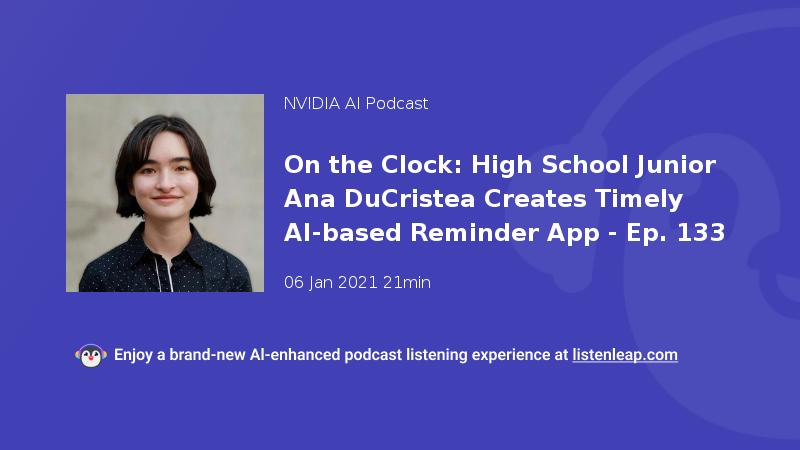
I'm your host, Noah Kravitz. Earlier this year, a Canadian high school student named Anna heard about a summer camp called AI for All.
She applied, she got in, and she went to the camp.
At the camp, she attended a talk given by Sonya Fidler, a college professor in Toronto and a director of AI here at NVIDIA.
At the talk, Anna won an NVIDIA Jetson Nano.
So she took it home. and tried to see what she could do with it.
Turns out she came up with something pretty cool.
And now she's here to tell us about it, and more importantly, and no pressure on you Anna, Give us a little insight into how the future of artificial intelligence is actually in the really good hands of young people like her.
Anna Duke-Christia, thank you so much for taking the time to come on the NVIDIA AI Podcast.
Thank you. The actual project I made with the Jetson Nano was written in Python.
It's a project I've been thinking about doing for a while now.
I've been always annoyed a bit with phone alarm apps that you can only snooze for specific amounts of time with.
10 minutes to an hour. Sometimes I want to snooze for a day, many hours, a specific time.
So I was thinking, how could I make something for myself and for other people? that was more convenient, I could change it myself.
I made a program that integrates with Discord.
You can message a bot on Discord and it will extract the subject and time from your message.
Okay. Probably lots of people listening know what Discord is, but just for the uninitiated, what is Discord?
So Discord is an application you can run on your desktop or your phone.
It's basically a messaging, application you can have group chats with your friends, things like that.
Got it. So you can send the bot a message like, remind me to do math homework at 6 PM on Tuesday. and what my program does is it'll parse that you want to get a reminder to do math homework, and it'll send you a message at 6 PM on Tuesday.
So you can get a sound on your phone, you can look at it, and you can message the bot say, snooze it for five hours and it'll do so.
So there's even another layer here that I didn't get.
You're using Discord as a service. You're telling the bot in Discord to remind you of something at a certain time.
Yeah, so the bot is just... someone you can message basically.
Got it. Cool. Okay. So where does AI come in?
Where does NLP come in? What did you build?
So the natural language processing comes in when you send a message, you're sending something like, Remind me to do math homework at 6 PM on Tuesday.
It's a natural request. So the actual NLP has to know when exactly to remind you.
There's a lot of different ways you could say it.
You could say, Just remind me on Tuesday and you might expect it to remind you somewhere in the middle of the day or not even with a date, just today, 6 p.m.?
? The NLP comes in there. I tried various different methods.
Lots of them were pretty complicated including vectorization, even neural networks.
But I found that for my specific purposes, I simply wanted to do a template search because I did not have a big dataset of examples.
Usually neural networks works best when you have thousands of examples, but they weren't really easily findable.
I saw in a course I took about AI, they were using Regex and Python to find templates from a shorter list of examples.
I was able to make a version of that to extract templates.
You would often say, remind me to, and then the subject would be after that.
Right. And the time would be after the keyword on, for example.
Right. You're getting into one of the biggest challenges with AI and machine learning and everything in NLP is exactly what you're talking about.
There's so many different ways that human beings naturally, even in the same language, even in English, so many different ways you can phrase the same request.
Had you had experience with language processing?
Had you had experience with AI before? going to AI for all and then getting the nano?
Yeah, I did have a bit of experience because I took a course on EDX.
It was the course CS50 introduction to AI with Python.
Did you take that before AI for All? It was before AI for All.
Okay. And was that part of high school or on your own?
It was on my own. OK, you had some interest.
You had some. So there was an interest and there was a need with the notifications just not doing what you wanted them to do.
And so what was the process like? I mean, you said trying to find data sets and your initial things being kind of very complicated, I think is what you said.
But how is the process of working through that?
Did you do it through AI for all? How did you find answers to the problems you encountered?
Yes. I had some practice with this in AI for All because we did have a final project.
I had to work with a group, and we did try many different things in the IFRL for our final project.
For this Discord bot project, I worked through some more complicated things first because there were definitely existing things.
I can ask Google Assistant, to remind me for something but of course they don't exactly publish their findings right and they have their own servers, things like that.
It's a specific application So eventually I kept thinking, what did I learn at AI for all?
What did I learn at the course I took before AI for all?
And I used that knowledge. And so how does your solution work now?
Are you happy with it? My solution definitely has some work to do because The template search totally is good for some basic things, but it has some problems.
For example, it's kind of under fit. It can get multiple different interpretations of what you asked.
So right now what I do is I ask the user which one they want and they can just press a button.
But if I wanted something much more accurate, definitely training. something with deep learning, that's something I want to do in the future.
Was this your first experience with a piece of AI-specific hardware, to put it that way?
Yeah. Okay. And how was that to work with?
It was quite easy to work with, actually.
It's very similar to a Raspberry Pi. I would say they have... a developer kit that includes Linux on it.
I did come across some problems with the Python version on it, but overall it was pretty good to work with.
And so how long ago, we're recording this in the middle of November, and AI for All was over the summer.
How long would you say, not in terms of hours, but just from when you started till when...
I mean, I don't know if you'd call it finish, but when you publish something that worked, how long did it take you?
It's difficult to say because I was balancing this with school, of course.
Yeah. I would say probably making the program took about, two months and it also took me a while to do the write-up for it and I kept making new changes, finding bugs because I was using it for a while.
Yeah. That's awesome. I mean, that's, you know, everything else aside, it's easy to get caught up in just all the amazing things that people are doing with AI and how fast things have accelerated over the past three to five years is what we always talk about on the show.
But to actually stop for a second and think in two months, you went from, oh, I won this thing.
And, oh, I've got this other problem that's annoying me and, you know, this reminders that I use.
I wonder if I can use this thing to fix that.
And two months later, you have a solution, which, you know, not perfect what is, but that's just amazing.
So, A, congratulations. B, in working through this, has it left you wanting to do more with AI?
Has it left you, you know, feeling like all these things are too, like, how do you feel about it now?
Do you want to keep going? Thank you. Yeah, I was thinking I do want to keep going.
I am interested in the area of computer vision. and of course, natural language processing.
I'm also exploring other routes in STEM like robotics, but those can also integrate with AI which is a really nice thing.
Absolutely. Our guest today is Anna Ducristia, a high school student in Calgary.
You're in 11th grade now, is that right?
Yep. And we're talking about her summer experience at the AI for All summer school program and her experience first hands-on experience with an NVIDIA Jetson Nano Developer Kit and the notification customization.
Do you have a name for the app? No. I don't.
No name yet. All right. Her as yet nameless solution to the problem of custom notifications on her phone.
So Anna, let's kind of shift gears for a second here and go back in time, if you will.
When was the first time you used a computer and you can use that term broadly because computer means so many more things now than it did when I was in 11th grade. first time you used one and thought not just like, Oh, this is cool.
It can do some meat stuff, but I want to know how this thing works.
And I want to like, get this inkling of wanting to be able to make it do stuff.
Do you remember when that was? I would say it happened when I was very young.
Maybe about nine years old. I mean, my parents have always encouraged me to go into STEM.
They've tried different things. My dad has taught me a bit about electronics.
And one day they gave me a Python book and I was working through it for maybe a week or so.
And I was thinking, this is really fun. It's very interesting that I can tell a computer to do what I want it to do.
Now, was this when you were nine? yeah yeah i would say yeah all right so sure working through a python book when you were nine you're like this is kind of cool i want to get with this So did you dive deeper into Python?
Yeah, definitely. I've been working mostly with Python for most of the time.
Although I've tried other languages too, Python is very broad in the range of what it can do.
So how much of this, How much of your experience working with Python and then all the different things you've talked about, NLP and robotics and other things, How much of that has come through school?
How much of that has come through kind of Formal programs, things like AI for all that were outside of school.
And then how much has just been, you know, on your own, you know, parents giving you Python books, that kind of stuff.
So school has not been a big part of it because Only now that I'm in high school, there's more computer science classes.
I'm learning Java right now in school. So when I was in middle school, it was mostly things like Scratch, I did learn a bit of Arduino.
Most of it was outside of school taking courses. on my own so there was another CS course I took, it was the introduction to computer science.
That was mostly with C. With C, I was going to ask.
Yeah, okay. Yeah, and with Python itself, I would say that was mostly...
My own learning a bit of my parents, but I've kind of surpassed their programming skills now I'm sure they're quite proud of you.
My son shows me. It just makes me realize how little I know about using the computer I use every day when I see him do stuff with it.
So that's awesome. And so how do you learn then when you're doing things on your own?
Is it books? Is it YouTube? Are you following tutorials online?
There's nothing wrong with tutorials. What's the way that you're going about finding knowledge and then also getting help when you run into issues?
So one thing I like to do is think about a project I want to make, even if it's really small, and then I'll keep Googling things, trying to find out how I can make that project.
So learning by doing. I prefer text to videos because you can control F on the page.
You can go at your own pace. I stumbled because I was like, oh, I don't want to badmouth videos.
It's just I much prefer text myself. So yeah, cool.
And do you have friends or folks that you work with on this stuff, or is it more of a solo pursuit?
Partially solo, the learning is more solo definitely, but I have participated in hackathons, other TeamSTEM competitions, and it's always nice to meet friends and other kids in my school who are interested in STEM.
I don't want to put this on you and make you the spokesperson for all people under the age of 18 in the whole world or what have you.
But when I was coming up and I was your age, there was definitely still Still something of a stigma around, oh, if you're into computers or let alone into science, it's kind of nerdy or whatever. whatever disparaging term you want to use.
My sense as an adult is there's a lot less of that now, and it's much cooler to be into computer science and science and tech generally and probably in part because it's so much more pervasive in everyday life and But what's it like for you being in, you know, into science, into STEM?
And then again, not to make you a supposed person for anything, but yeah, As a girl, is it different as well?
Yeah, I would say that definitely there is less stigma coming with STEM than there was many years ago.
That's good. It's definitely still cooler in school to be a sports person, things like that.
But people... My classmates admire me for all the projects I've done.
Good. Being a girl, I would say, well, one thing in Canada, there's a lot less... sexism, probably.
But in my computer science classes, sometimes I'm the only girl that I don't necessarily feel like It's bad for me, but I'm just surprised there's not a lot more girls going into STEM, taking these classes.
So in that regard, and my whole thing, I keep saying I don't want to make you the spokesperson for anything.
Forget it. It's too late. You're here. What would you say? to other girls who you know might be interested or not even know they're interested but just you know hear you on this podcast see you you know see you doing something with your phone on an app that you built.
Like, what would you say to them to, I don't know, to encourage them to get into this stuff?
Yeah, well, there's so many programs even exclusively for girls now in STEM.
I would say go for them, lots of them. You don't even need any experience.
They'll do workshops, they'll teach you things.
Definitely go for it if you think it's something you might be interested in.
Even if you don't think so, Sometimes something can be a day long event and it could spark an interest in you.
So thinking either about the notifications app solution that you're working on, or just kind of generally about going back to that first Python book.
What are some of the hardest or one of the hardest challenges that you came up against in learning to program and programming solutions and then working with AI?
And then what's something that maybe was kind of surprising as you think back on it?
Yeah, so one of the main challenges with programming I'd say is motivation.
Sometimes you'll be writing a program and it just won't work and you really lose motivation.
You have an error, you can't fix it. So when that happens to me, sometimes I will take a break.
Of course, I'm not just working all the time.
Also just thinking about the reward I could get thinking the finished product.
Yeah. Satisfaction. Yeah. Yeah, we're recording the audio, but we're actually using video as we talk and we both have headphones on.
And so now I'm curious, do you listen to music when you program?
Yeah, I do. What do you like? I like retro music, like 60s to 80s.
Okay. And music with words or without? While I'm programming, I'm okay with words.
In a way, it's kind of like doing math. There's not a lot of words happening there.
Yeah, yeah, cool. Are there any uses of AI that either, you know, you use every day and you happen to know that they're AI driven or maybe things you've come across in your own you know, learnings and going out and Googling to find new knowledge that have just kind of blown your mind.
And it's okay if the answer is no. Yeah.
I think self-driving cars, that's pretty mind-blowing how well some of them are doing right now. even though sometimes there's some glitches and very horrible things happening.
But it happens with non-self-driving cars as well.
I just think it's amazing how... It can see the surroundings, process everything.
So you're in school now. We're recording in November, middle of the school year.
Are you doing school from home? Yes, I am doing school from home.
Okay. Hopefully that's going, I'm not asking you for details, but hopefully that's going well.
Are there things you're looking forward to or what are you looking ahead to as you?
In Canada, high school goes through 12th grade?
Yep. Okay. So you've got another year and a half, basically, of high school left.
Not to put any pressure on you, but tell the whole world here, what's on the horizon for you?
Are you going to pursue... AI? Are you going for further schooling?
Are you going to start a notification app company?
What's on the horizon for you? Yeah, so I'm planning on going to university, probably taking software engineering or computer engineering, hopefully to further my knowledge and make me think more about what specific field I want to go into.
Yeah, and with that kind of a background these days, I mean, the world is your oyster and then some because it's all advancing so quickly and touching all aspects of life.
Any feedback for the folks at NVIDIA? You mentioned that getting Python running, I think you said, was a little bit, there were a few hiccups in there originally with the Jetson dev kit.
Anything you'd like to see from a company like Nvidia or just from the industry in general? maybe to make AI development tools more accessible, maybe there's a piece of hardware that you just wish somebody would create, anything like that?
Honestly, the Jetson Nano is a lot more accessible than most things in AI right now.
And a lot of the problems with the Python, it's because of Linux, things like that.
Yeah, I don't know if this exists already, but it would be nice to get a kit of the Jetson with probably a Wi-Fi dongle and maybe even an SSD because that does take some effort to set up.
Got it. All right. Good to know. So Anna, before I let you go, And I'm going to ask you in a second, but hold this thought.
People who want to know more about the work that you're doing, maybe the work you've done on the app that we mentioned, if there's somewhere online that people can go to learn a little bit more about you.
And then I also want to give another plug for AI for All.
It's a great summer program people should check out.
It's just spelled the letters AI, the number four, and then A-L-L, AI for all.
But before that, do you have any thoughts about where you think things will be, let's say five years from now?
And whether that's your own career, you mentioned going to university studying software engineering.
Are there things that you're kind of, just kind of expecting or anticipating will happen with AI and related technologies. go into robotics or STEM or what have you that you think are really going to make a big impact on the world?
Yeah, I definitely think AI. is only going to grow especially just five years from now, and also a combination of AI and hardware.
I think right now there's not a lot of that.
I mean, there's self-driving cars, of course, but definitely there's going to be more about that inside people's homes even.
Yeah. Cool. All right. So for folks who want to know more about you, where can they go on the Internet?
So I have my LinkedIn account. You can Google my name.
That'll probably turn up. Also, it's linkedin.com slash IN slash Anna C-O-D-A.
Anacoda. All right. Yes. Also, my GitHub is linked there.
That's where you can see some of my projects.
Excellent. Perfect. Well, Thank you so much for taking the time.
More importantly, thank you for doing what you're doing.
I think it's such a cool thing that you, I don't know, again, so quickly. got from you know hearing about ai for all to now we're talking about this project that you built on a jetson nano And it's really just the beginning of your journey with all this stuff, which is pretty awesome.
So thank you so much for coming on the show.
Thanks very much for inviting me. Thank you.
¶¶ Thank you.