Examining the events that impact and shape China and the rest of the world.
This is the Beijing Hour, one hour of news and information brought to you every weekday.
Now here's your host. Shane Bigum with you on this Wednesday, August 6th, 2025.
You're listening to the Beijing Hour, coming to you live from the Chinese capital.
On today's program, a UN official says Gaza will need aid deliveries in huge numbers for months or even years to come.
A report from Shizhong notes environmental improvements in the ecologically sensitive region in southwest China.
Many European officials say the EU's trade deal with the U.S. gives them no reason for celebration.
In business, China's guidelines for supporting new industrialization.
In sports, China names its flag bearers for the World Games in Chengdu.
In culture and entertainment, an exhibition featuring art masters of the Tang and Song dynasties.
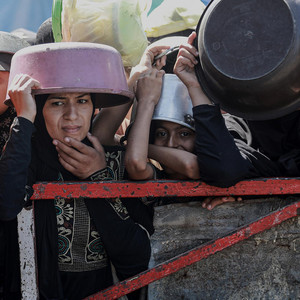
Now checking the day's top stories. A U.N. spokesperson says a huge number of aid trucks must enter Gaza daily for months or years to ease severe shortages.
Jens Larke from the U.N. Humanitarian Office warned that current aid is far too little to meet desperate need as people starve daily.
The need inside Gaza is such that there should be hundreds and hundreds and hundreds and hundreds and more hundreds of trucks.
Not only every day, not only every week, but for months, possibly years to come.
This has been building up. We are now at the brink of famine, as you know.
That is not something that happens overnight.
The spokesperson says current aid is not enough.
I hope you understand the magnitude, the difference between this very small amount of aid that has now come in, and everybody expects me to clap and say thank you, and the massive needs that are there, where people are literally dying on a daily basis.
It's out of proportion. Israel's blockade and war with Hamas have blocked safe aid delivery, pushing Gaza toward famine.
Recently, Israel allowed limited aid trucks and airdrops, increasing supplies.
But crowds such as hungry families and armed gangs swarmed the trucks, grabbing cargo before it reached UN warehouses.
Many have died in the chaos. Witnesses say Israeli troops fire on crowds near trucks, killing and injuring hundreds.
The Israeli military says it's only fired warning shots to control crowds or at people who approach its forces.
Thousands of Palestinians carried bags of flour from the Zikm crossing on Tuesday.
Displaced teacher Isa Kadar walked 15 kilometers under fire to get flour for his family.
We, the people of Gaza, see this sack of flour as white gold.
I had to come to this place to look for food.
I walked about 15 kilometers, dragged three kilometers, and walked on the fire.
I said goodbye to my children because I might return carried by people or wounded.
Israeli Prime Minister Benjamin Netanyahu has hinted at expanding Gaza operations, even as former army and intelligence chiefs have urged ending the 22-month war.
Gaza's health ministry said over 61,000 Palestinians have died, including people seeking food.
The Israeli Defense Body announced a deal with local merchants to improve aid.
Witnesses in the U.N. say Israeli fires killed hundreds near aid sites since May.
Israel has denied this, claiming only warning shots.
Israeli strikes have killed or injured a number of Palestinians waiting for aid in Gaza.
Data from the U.N. shows the attacks have killed almost 1,400 people since May.
Rami Amigari reports from Gaza City. Continuation of Israeli airstrikes bombardment over different various parts of the Gaza Strip including the Gaza City, different parts of Gaza including apartment buildings in eastern Gaza City and north of Gaza City were hit because of the Israeli airstrikes and bombardments leading to the deaths of each case to five to six people.
Other strikes hit the southern Gaza Strip, actually, including the killing of five or six Palestinians in a strike against a tent, a shelter tent, in southern Gaza Strip, city of Khan Younes, mainly on the coastal road.
That is related to the terrorist strikes and bombardments. by the Israeli army that is continuing unabated.
Regarding the deaths of Palestinians who are seeking food aid or food supplies, in northern Gaza there has been the killing of nine Palestinians, of those seeking food aid in the northern Gaza Strip where truckloads happened to enter from that part of the Gaza Strip.
Also, in the southern Gaza Strip, there were several people killed in a different, in a similar flashpoint, in a similar delivery site of the aid themselves.
Also, in central Gaza Strip, in the Netarim Junction, where there is also another site, and all these sites, the two sites in Netarim and southern Gaza belong to the Gaza Humanitarian Foundation, that is a US NGO backed by the Israeli army.
The situation here is still desperate with more deaths of those being hungry, succumbing to having succumbed to hunger and starvation as it's still going on.
That's because of the fact that the lack of vitamins, minerals, and various foods and various essential supplies that are still lacking in the territory.
That was Rami Al-Meghari reporting. Israeli Prime Minister Benjamin Netanyahu reportedly favors a complete military takeover of the Gaza Strip.
He met senior security officials on Tuesday to discuss a new strategy for Gaza, but divisions remain within his cabinet.
Jonathan Mergev has more from Tel Aviv. But the Israeli government is saying, what the officials are saying, is that Hamas is no longer willing to free any of the hostages unless Israel signs what these officials describe as a surrender agreement as far as Israel is concerned.
The terms are unbearable for Israel, are things that Israel cannot agree to.
They include the complete withdrawal of the IDF forces from the Gaza Strip, the international commitment that Israel will not renew the war, no security perimeter that Israel is asking for.
Of course, all of the crossings, the Philadelphia corridor and all the others will be back to the hands of Hamas and that according to the officials means that the next October 7th attack is around the corner.
It may take a year, it may take two years, it may take five years.
Eventually it will happen and therefore the officials are saying that as far as Israel is concerned that is a surrender and that is something that Israel will not agree to.
But this is the only way to free hostages with an agreement.
Therefore, the only other option is to dramatically increase the pressure on Gaza by declaring a campaign to completely conquer the Gaza Strip.
Not everybody agrees with that. The chief of staff, Yael Zamir, for example, says that it will demand very heavy prices from an already outstretched army and, of course, it will come with a form of casualties.
And the issue of the hostages, it will include the army going into areas, especially in the central Gaza Strip, where the army has not operated so far, because the army believes that this is where the hostages are held.
And any operation there can endanger, seriously endanger the lives of the hostages.
And hostage families are saying this is a death penalty for the hostages, period.
That was Jonathan Regev reporting. Senior UN officials warned against the possible expansion of Israeli military operations in Gaza.
At a Security Council meeting on Tuesday, UN Assistant Secretary General Miroslav Yencha said that the move might lead to further disasters.
The latest reports regarding Prime Minister Netanyahu's possible decision to expand Israel's military operations through the entire Gaza Strip, if true, are deeply alarming.
This would risk catastrophic consequences for millions of Palestinians and could further endanger the lives of the remaining hostages in Gaza.
International law is clear in this regard.
Gaza is and must remain an integral part of a future Palestinian state.
In response, China's Deputy UN Representative Gong Shuang has urged Israel to immediately halt its dangerous actions.
He's called for a ceasefire and has urged countries with influence to take steps to achieve it.
The brother of an Israeli hostage told the Security Council to use its leverage to secure the immediate and unconditional release of remaining hostages and to ensure humanitarian aid reaches them.
Coming up, environmental improvements in the Shenzhen region of southwest China.
He can't live without the Yellow River in his eyes.
Both my grandpa and dad made a living from the river.
The Yellow River Mosaic is a 12-part series of multimedia stories featuring the people who live by the river and share a close bond with it.
Subscribe The Yellow River Mosaic on your favorite podcast platform or visit radio.cgtn.com for more in this program.
Ten minutes past the hour. The environment in a southwest Chinese region continues to improve, keeping it among the most pristine worldwide.
According to an annual report from Shizhong, also known as Tibet, the air and water quality remained excellent in 2024.
The regions also set up six national-level monitoring stations to enhance environmental oversight.
Shizhong is home to 97 nature reserves covering 434,000 square kilometers and shelters 246 wildlife species under key national protection.
It's also a vital wintering ground for more than 80% of the world's Tibetan antelope, wild yak, and black-necked crane populations.
The Lalu Wetland, west of the regional capital, is one of those unique ecological treasures high on the plateau.
Researchers have been using cutting-edge scientific methods to protect the lungs of Lhasa.
Xianghui Zhang has more. At Lalu Wetland, Professor Zhang Jifeng from Xizhang University in Lhasa and his team are monitoring water quality.
We conduct regular surveys of the health of the wetland's water environment.
My students' on-site sampling can measure water temperature, dissolved oxygen, chlorophyll, and other parameters.
The Lalu Wetland is known as the lungs of Lhasa.
It is the highest altitude and the largest urban wetland in China and an important ecological barrier on the Qinghai-Sizang Plateau.
The Lalu Wetland is home to a large number of high-altitude wetland species, making it a valuable gene bank.
This holds immense significance for the ecological restoration of high-altitude wetlands.
In 2023, Zhang Jifeng responded to the call of the country and referred from Chinese Academy of Sciences to Shizhong University, becoming its youngest full professor.
From Beijing to Lhasa, he brought new technologies and ways of thinking.
The Lalu Wetland Fuel Observation Station was completed in 2024, marking the beginning of a new era of intelligent wetland conservation in the region.
This device can observe greenhouse gas emissions from the wetland as well as their carbon cycle.
This infrared camera can automatically photograph animals.
These observational data are fed in real time into the Eye of Bhoomaputra Ecological Safety Monitoring Platform.
It enables round-the-clock monitoring of the ecological environment of this river basin.
In 2009, Zhang Jifeng set foot on the Qinghai-Sizang Plateau for the first time to conduct research for his master's degree.
For him, it was a revelation. While conducting our research, we also experienced the unique culture of the plateau.
Many people have misconceptions about Shizong, thinking that life here is very difficult.
In fact, the climate in Lesa is quite pleasant, with temperatures around 20 degrees in summer and not too cold in winter.
16 years have passed, and he has traveled to all seven districts in Xizong.
Road conditions in Xizong have improved a lot.
In the early years, the roads were not as good as they are now.
I remember going to investigate a lake in northern Xizong around 2010.
We spent five whole days on the road, eating and sleeping in the car.
The wheels often got stuck in the mud, and we had to dig and push the car along the way.
Zhang Jifeng never walks alone on the road ahead.
He believes that cultivating a team of talented individuals rooted in the plateau is just as important as the research.
Research conditions in Xizong are improving, and what we need most is talent.
I hope more young people will come here and use their scientific knowledge to protect the ecology of this land.
From student to professor, Zhang Jifeng's connection to Xizang has become inseparable.
He and his team have made it their mission to decode the ecological mysteries of the high-altitude wetlands.
That was Xiong Huizhong in Xizang. Let's continue our special series, Resolve and Resilience, the main eastern battlefield of World War II.
Today's episode focuses on the Battle of Tai'ar Zhuang, one of the fiercest battles in China's War of Resistance against Japanese aggression.
Tai'ar Zhuang is a critical choke point on the Grand Canal in eastern China.
Seizing this area was important to the Japanese invaders, as it meant opening a gateway to the city of Suzhou, linking the northern and southern war zones and speeding up their overall takeover.
China remembers the battle as a morale-boosting triumph that shocked the world.
Huang Yicheng visited a museum commemorating this particular event and spoke to the staff.
In late 1937, just months after the Nanjing Massacre, Japan intensified its aggression from both directions.
Cities like Jinan in the north and Hangzhou in the south fell one after another.
Their next target, Taizhuang, a critical town along the Grand Canal.
Not long after, Japanese troops claimed control of most of the town and were preparing to cross the canal in a further push with seemingly unstoppable momentum.
One headline from a Japanese war correspondent declared, Taizhuang will fall within days.
China faced one of its darkest hours. It was that moment troops from all regions put aside their past rivalries in the earlier internal conflicts and stood united as one.
For many, it was a fight with no way back.
The commander of the 31st Division, Chi Feng Cheng, ordered the destruction of the only retreat route, the canal bridge, and declared with unwavering resolve, Taiyazhuang will be the grave of all my officers and soldiers," he said.
Facing an enemy with far superior weapons, China's forces turned to strategy.
They lured the Japanese into a deadly trap in the town of Taiyazhuang.
A brutal battle broke out in the narrow alleys.
Then Chinese troops struck from all sides, fighting to the death.
We can see in this scene that the city of Taiyazhuang was reduced to complete ruins.
No wall was left standing, no house was left whole.
Locals described it as red sky, red earth, red blood, saying there wasn't a single wall untouched by bullets, nor a patch of ground that wasn't soaked in blood.
In the fierce Ali fighting, only 13 Chinese soldiers survived.
Yet their sacrifice helps reclaim most of the lost ground.
Soon, Japanese military newspaper changed their tone.
Complex battlefield conditions, surrounded, unable to break out.
After 20 days of bloody resistance, a heartfelt victory was finally won, and over 10,000 Japanese troops were wiped out.
But it came at a heavy cost. More than 30,000 Chinese lives were lost, making it one of China's first major victories since Japan's full-scale invasion.
The victory of the battle was an unprecedented consolidation of national consciousness.
There is an old Chinese saying, brothers may quarrel within the walls, but unite to repel external aggression.
Unity can overcome everything. 87 years have passed.
The gunfire is long gone. Only some brick walls remain as witnesses.
But the 30,000 were never forgotten. In today's Taichung, visitors keep coming to pay their respects. reconnecting with and remembering the story of unity that continues to echo.
That was Huang Yicheng, recounting the rogue battle of Taiar Zhuang against Japanese invaders in eastern China.
Coming up, many European officials are less than enthusiastic about the EU's trade agreement with Washington.
United in purpose during World War II, the Chinese military and people stood as one fearlessly resisting Japanese fascism.
China's unwavering whole-nation effort forged the pivotal Eastern Front.
Through fierce battles, immense sacrifices, heroic endurance, and decisive support to the allies on the European and Pacific battlefields, China has helped secure liberation, the final victory, and a lasting legacy for global peace and human progress.
Resolve and Resilience, the main Eastern battlefield of World War II, only on CGTN.
19 past the hour. There's been mixed response from major U.S. economic partners as trade talks continue.
The European Commission's formally suspended retaliatory tariffs on the U.S., drawing mounting criticism from key member states.
The decision was made after the EU and U.S. reached the Framework Trade Agreement last week.
Spokesperson Olaf Gill of the European Commission has hailed the deal.
We have achieved an insurance policy that no higher tariffs will emerge... for European businesses in this extremely volatile and unpredictable contemporary economic environment.
This horizontal 15% tariff ceiling, which the Commission negotiated on behalf of our member states, on behalf of our industry, is all-inclusive and will also apply in the future.
For more on the trade talks, here's William Denslow in Brussels.
European officials say the deal reached with the US is no cause for celebration, but avoided an escalation that would have hurt the economies on both sides of the Atlantic.
US President Donald Trump had threatened 30% duties on European goods, but that figure was halved after a framework agreement was struck last week.
Roughly 70% of European products are now subject to a 15% tariff, and Commission officials say that rate is already in effect.
A number of European politicians and business leaders have criticised the deal, calling it lopsided.
Germany's finance minister says the EU has been weak and should have been stronger during the negotiations.
The Commission has balked at that suggestion, saying they were following the wishes of the vast majority of member states by striking this framework agreement.
But this agreement is not legally binding, and a joint statement has not yet been agreed between Brussels and Washington.
Negotiations are still continuing as the EU looks to secure a number of tariff exemptions for a range of products, including wine and spirits.
The EU has put the threat of retaliatory tariffs on the back burner for the next six months, but warns that it could reintroduce them should the US renege on its commitments under the deal.
Talks between the trade teams continue. And while no time frame has been given on the remaining sticking points, officials here say the deal with the U.S. is an important foundation for a relationship that accounts for roughly 43% of global GDP.
That was William Densler reporting. Canadian officials are meeting with their Mexican counterparts in Mexico City to discuss trade and strong bilateral relations.
They're looking for ways to improve their trading partnership outside of the U.S. after Washington imposed steep tariffs on both countries.
Frank Contreras has more from Mexico City.
High-level diplomatic and trade talks got underway Tuesday here in the Mexican capital.
Canada sent the Minister of Foreign Affairs, Anita Anand, and Minister of Finance and National Revenue, Francois-Philippe Champagne.
The goal, to enhance already strong relations as U.S.
President Donald Trump bears down on both countries.
Canadian trade and investment with Mexico has been growing steadily, with two-way commerce reaching nearly $56 billion in 2024.
Mexican President Claudia Sheinbaum says enhancing trade and diplomacy with Canada is good for Mexico.
We need to fortify our internal market, substitute imports from other places as we have been planning, and seek additional markets beyond the United States that will allow us to strengthen the economy and well-being of the Mexican people.
In 2024, Mexico was Canada's third largest trading partner.
Top trade categories include passenger vehicles, auto parts and flat screen televisions.
Canada and Mexico also saw high volumes of trade in agricultural products in recent years, including avocados and berries.
Facing a trade war with the U.S., both countries have been struggling to get a trade agreement with Trump.
But the future of the new North American trade agreement among the US, Canada and Mexico remains uncertain.
Still, this week's high-level talks between Mexico and Canada are expected to result in a bilateral meeting between Canadian Prime Minister Mark Carney and the President of Mexico, Claudia Sheinbaum.
That was Frank Contreras reporting. U.S.
President Donald Trump signed an executive order that imposes further tariffs on Canadian goods.
Talks between the two countries are expected to continue, but the tariffs are impacting both sides of the border.
Dan Williams visited a logistics company to find out more.
It has been a turbulent few months for the thousands of workers at this vast Stellantis plant, situated in Windsor, Canada, just across the US border.
Production at the plant was paused earlier in the year after the US imposed a 25% tariff on auto imports.
But in June, the plant returned to two full shifts.
Although against a backdrop of escalating tariffs, the future remains uncertain.
I've been in the trucking industry for 40 plus years.
Initially started with six trucks in the basement of my house.
Steve Ondeko is the president of On Freight Logistics.
A major component of their business is auto.
Everybody is down a substantial amount over the past, certainly the past six months, but certainly more so in the past three.
Our industry is down anywhere from 10 to 15 percent and the outlook isn't great.
The auto industry has been hit hard in the tariff war.
General Motors reported a 35% drop in second-quarter profits, while Ford and Stellantis have warned that the tariffs will cost their companies billions of dollars.
And then, last week, a further escalation in the tariff war, as U.S.
President Donald Trump signed an executive order increasing tariffs on all Canadian goods not covered by the U.S.-Mexico-Canada free trade agreement to 35%.
Officials here say they expect trade talks between Canada and the U.S. to continue.
Despite the new tariffs being imposed, the hope for many businesses here is that a new deal can soon be reached that will bring companies, indeed entire industries, much-needed certainty.
That's our biggest issue right now is the indecision and the indecisiveness of business.
We like to see some decisions as to where it's going so that then business can start taking over and preparing. and investing and doing the things that they need to do to prepare the business.
Let's get negotiating. Let's figure it out.
In the meantime, industries on both sides of the border continue to feel the tariff impacts.
That was Dan Williams reporting. To better understand the latest dynamics in global trade, Gas Manicom earlier spoke with Professor John Gong at the University of International Business and Economics.
Now, a number of European politicians and business leaders have called the deal with the U.S. lopsided.
How would you assess the deal where it stands?
Well, it's obviously lopsided because the tariffs levels on both sides are totally not equal.
America imposes way more tariffs in terms of the tariff rate than the Europeans do.
And I think This speaks to the sense of President Trump's trade agenda as part of his foreign policy agenda.
That is that the United States wants to establish a hub of bilateral relations with other countries or other trading blocs. outside, totally outside of the rules-based order with WTO at its core, which is something that the United States actually helped establish in the first place.
So I think President Trump is totally upending the trade order, the rules-based international order here.
And there's not much the European Union can do about it other than, you know, I would advocate that the European Union and China and other key trading nations unite to still uphold the WTO.
I think we're increasingly facing a system of what I describe as N plus one trade order.
That is, the United States is going to drop out of the WTO system.
Now, in another development, Professor Gong, Canada and Mexico are meeting to discuss their relationship.
Now, what are we expecting from their meeting?
And how do you think this is going to shape future trade relations with the U.S.?
? Well, this again reflects President Trump's trade agenda.
He's going to establish individually bilateral relationship with his trading partners.
USMCA is going down the drain. That's the trade agreement among three North American countries that President Trump helped establish in his first administration.
Now it's flowing out of the window. But nevertheless, I think Canada and Mexico still want to maintain a close trade relationship.
So in effect, USMCA becomes MCA. Again, it's a three minus one situation here.
So I think we're increasingly facing a world that the United States is going to be behaving like this.
It's totally disregarding any norms and rules pertaining to the international order and establishes its own rules and norms in a totally different way.
So I think this is becoming more of a phenomenon that the entire world has to deal with as we move forward in the coming years.
That was Professor John Gong at the University of International Business and Economics.
Around 29 past the hour, Beijing expects a hot and sunny day ahead.
Temperatures will climb to 34 degrees Celsius with light winds in the afternoon.
A few clouds may drift in, but no rain is expected.
If you're heading outdoors, don't forget your sunscreen.
In Nancheng, the skies will be cloudy this evening.
Temperatures will hover around 35 degrees on Thursday.
It's time for a short break. So far this hour, a UN official says Gaza still needs aid deliveries in huge numbers for months or years to come.
A report from Shizhong notes environmental improvements in the ecologically sensitive region of southwest China.
And many European officials say the EU's trade deal with the U.S. gives them no reason for celebration.
Shane Bigham with you. Stay with us here on The Beijing Hour.
Listen up. Can you hear the heartbeat of our world?
It's vibrant and pulsating with the essence of life itself.
From the stem of trees to the gurgle of rivers.
From the silent strength of mountains to the icy whispers of glaciers.
Even the solid ground beneath our feet Right there, in the midst of all, beats the heart of humanity.
What if those other heartbeats were to stop?
Would ours keep on ticking? Ever wondered what's actually going on in Africa through the perspective of an African?
How are things really going between China and Africa?
What's the narrative of this relationship?
Well, get a perspective with China Africa Talk.
Hear from African diplomats, entrepreneurs, academics, Chinese natives and more.
Get on our wavelength every week to find out what's real with China Africa Talk.
Find us on your favorite podcast. We'll see you there.
Examining the events that impact and shape China and the rest of the world.
This is the Beijing Hour, one hour of news and information brought to you every weekday.
Now here's your host. Shane Bigham with you on this Wednesday.
Still to come, in business, China's guidelines for supporting new industrialization.
In sports, China names its flag bearers for the World Games in Chengdu.
In culture and entertainment, an exhibition featuring art masters of the Tang and Song dynasties.
To contact us, you can email radio at cgtn.com or follow our ex-account at cgtnradio.
First of all, checking the day's headlines, here's Tianyu.
Thank you, Shane. U.S. Special Envoy Steve Witkoff is in Moscow as President Donald Trump's Friday ceasefire deadline approaches.
Trump threatened Russia with fresh sanctions if Moscow fails to reach a truce agreement.
The measures will include tariffs on countries that buy Russian oil.
India has slammed the US threats, and government sources said New Delhi will continue to buy oil from Russia.
Meanwhile, Ukrainian President Volodymyr Zelenskyy says he spoke with Trump on the phone about ending the conflict with Russia.
South Korea's former first lady has apologized during questioning over multiple corruption allegations, describing herself as a nobody.
Kim Kyung-hee is facing a wide range of charges, including stock fraud, bribery, and illegal influence peddling.
The investigation has drawn in prominent business leaders, religious figures, and a political power broker.
She and her husband, former President Jung Seo-kyo, are under separate investigations led by special prosecutors.
Jung was impeached earlier this year and removed from office in April by the Constitutional Court over his brief declaration of martial law late last year.
The Chinese consular general has confirmed that two Chinese nationals have died after the boat they were in capsized off Bali, Indonesia.
Reports indicate that large waves hit the boat as it traveled between Nusa Penida and Saunar on the island of Bali.
The vessel carrying 80 people capsized as it neared its destination.
Most of those on board were rescued. Starting in the autumn semester of 2025, China will waive care and education fees for children attending public kindergartens in their final year before entering primary school.
According to the State Council, the policy aims to cut education costs for families and improve public education services.
Children in private kindergartens will also see their fees reduced by the same amount as local public kindergartens.
To offset income losses, the government will provide subsidies to affected kindergartners.
In recent years, the country has relaxed family planning rules and introduced new policies to support families, including a nationwide childcare subsidy starting in 2025.
The subsidy will provide families with 3,600 yuan per year for each child under three, benefiting over 20 million families annually.
China has renewed alerts for heavy rain for the eastern and southern parts of the country.
In Guangzhou, authorities have rescued several people from a collapsed house destroyed in a landslide.
Officials have suspended some shipping routes in the region and ordered evacuation for coastal residents.
In neighboring Hong Kong, the alert has downgraded from the highest level.
On Tuesday, the city experienced a record-breaking single-day rainfall, the highest daily rainfall in August since 1884.
Wildfires are sweeping across southern Europe, with France and Spain battling flames fueled by extreme heat and strong winds.
In southern France, near the Spanish border, thick plumes of smoke fill the sky as a wildfire tears through the area.
Over 8,000 hectares of forest have burned, forcing boats to close.
More than 1,200 firefighters and several aircraft are on the ground, with President Emmanuel Macron vowing to deploy all the nation's resources to combat the flames.
Across the border in Spain, authorities have evacuated beaches, hotels and campsites.
Fanned by winds and scorching temperatures, the fire spread rapidly through nearby hills.
The regions remain on high alert amid Spain's second major heatwave of the summer.
And finally, Hiroshima has remembered the 80th anniversary of the US atomic bombing.
Japanese leaders laid flowers at a memorial, They released white doves, a peace symbol, and observed a moment of silence.
The bombing on August 6, 1945 killed 140,000 people and destroyed the city.
Three days later, Nagasaki suffered another bombing, killing 70,000.
Japan surrendered on August 15, ending World War II.
The anniversary on Wednesday comes at a time when possession of nuclear weapons for deterrence is increasingly supported by the international community, including Japan.
Japan has rejected the survivors' request to sign the Treaty on the Prohibition of Nuclear Weapons or attend its meetings as observers because it is under the protection of the U.S. nuclear umbrella.
Thank you very much. That's Tianyu with headlines.
Coming up in business, China's guidelines for supporting new industrialization.
You're listening to the Beijing Hour, 60 minutes of comprehensive news, your window on China and the world.
37 passed and turning to business. Here's Wang Zihang.
Thank you, Shane. Stock markets on the Chinese mainland closed higher on Wednesday.
The Shanghai Composite Index advanced nearly half a percent.
The Shenzhen Component Index climbed more than six-tenths of a percent.
In Hong Kong, the Hang Seng Index remained flat.
In nearby Japan, the Nikkei gained 0.6%.
China has issued a set of guidelines to strengthen financial support for new industrialization.
The People's Bank of China and six other government agencies say a financial system for advanced smart and green manufacturing should be largely in place by 2027.
The guidelines say manufacturing enterprises should see their effective credit demand met in full as of that year, with steady growth in the volume and diversity of corporate bond issuance.
According to the guidelines, authorities will set step-up measures to optimize financial tools for key technology breakthroughs, introduce long-term funds and develop capital to accelerate the commercialization of Scitech achievements.
The guidelines also called for efforts to leverage financial services to support the upgrading of traditional industries, the expansion of emerging industries, and the strategic planning of future industries.
Now for more, we're joined on the line with Wang Yaojing, Associate Professor of Economics at Peking University.
Good evening, Professor. Thanks for joining us on the show.
First of all, which sectors do you think should be prioritized in the process of China's new industrialization?
Well, thank you for having me. So industries with high value-added potential, strong domestic demand, and strategic importance to the national security, in my opinion, should be prioritized.
And this is exactly what the guidelines are highlighting.
They actually highlighted several strategic sectors.
First and foremost is advanced manufacturing, particularly manufacturing semiconductor production, industrial robotics, and where China is currently facing technological bottlenecks.
And also the green transition sector, including renewable energy, and then also energy storage systems.
They put an emphasis on China when they balance industrial growth with decarbonization goals.
And we also see digital transformation sectors like 5G infrastructure, artificial intelligence, and then industrial internet platforms.
So we're seeing that they clearly favor these industries with, again, high value-added potential and strong domestic demand, also with strategic importance.
Right. Can you just tell us a bit more just how important is financial support for new industrialization?
Well, the guidelines, they recognize that traditional funding models could be inadequate for these focused as they are capital-intensive, high-risk with long gestation periods.
So these targeted financial support helps bridge this gap between R&D breakthroughs and commercial viability, which has been a persistent challenge for Chinese and also global tech firms.
So this policy introduces innovative financing instruments and trying to de-risk innovation investments.
But it also emphasizes the need for patient capital through extended loan tenures.
So this comprehensive approach underscores how the financial system reform has become an integral part to China's industrial strategy.
And how will this process impact emerging sectors in the country then?
Well, in the short term, sectors like semiconductor equipment and industrial software may see a rapid capital influx as the policy addresses their immediate funding gaps.
And we might also see some successful or failed business models.
But for the long term, we expect more fundamental breakthroughs on hard tech areas as the guidelines aim to redirect venture capital funds towards the long-term deep technology ventures.
So over time, the goal is to help emerging sectors transition from policy-dependent to commercially sustainable growth models.
Anyone who has witnessed how China's electric vehicle industry has emerged from practically nothing to a multi-trillion dollar growth engine wouldn't be surprised by anything that could happen.
Right. Okay, thank you. That was Associate Professor Wang Yaojing at Peking University.
Now China has issued a plan to accelerate the digital transformation of its machinery sector.
The move aims to create more smart factories and promote a wide range applications for intelligent technology.
Eight government agencies, including the Ministry of Industry and Information Technology and the Ministry of Human Resources and Social Security jointly issued the plan.
According to the official blueprint, there will be widespread integration of smart technologies across key areas by 2027.
Looking ahead, major machinery enterprises are aiming to complete one round of digital transformation by 2030.
By then, a well-structured and secure product and service supply system is expected to take shape, featuring 500 new excellence-level smart factories.
Officials say boosting the digital transformation of the machinery industry is essential for further digitalizing the broader economy and advancing new industrialization.
To achieve these goals, the plan outlines 12 key tasks, including advancing foundational industrial capabilities and accelerating the development of industrial software.
Chongqing is leading the way in the green and intelligent automotive sector.
Thanks to innovation efforts and the creation of the region's largest autonomous driving testing facility, the southwestern Chinese city has grown into a hub for new energy and intelligent connected vehicles, Gongming reports.
As the leading car company in Chongqing, Chang'an Automobile has always prioritized independent innovation and has mastered over 600 core technologies related to intelligent and low-carbon vehicles.
Leveraging its self-developed intelligent vehicle digital platform, Chang'an Automobile is set to introduce more than 20 new models of intelligent electric vehicles in upcoming years.
Here I'm in Chang'an Global Research and Development Center, where the company is accepting its latest achievements in new energy and smart digitalized vehicles.
Let's go and check how smart the future car could be.
At a test site, this high-end smart connected electric vehicle co-developed by Chang'an and Huawei impressed us with its remote intelligent parking feature.
With just a tab and mobile application, this car equipped with over 30 intelligent sensors will automatically reverse into a suitable parking space.
Furthermore, the vehicle has a certain level of autonomous driving capabilities, including various scenarios such as urban and highway driving.
It can monitor real-time road conditions, change lanes for overtaking and adjust its speed, making driving easier and safer.
Chang'an Automobile achieved a remarkable milestone in sales of new energy vehicles from January to September this year, driving employment opportunities for near 1 million individuals across the entire industry chain.
The boost in sales has played a significant role in fostering economic development of Chongqing.
On the other hand, in Chongqing's Yongchuan district, here you can book a self-driving taxi through a mobile application and enter the provided code to get in.
Once you fasten the seat belt, the car initiates a seamless journey to your destination automatically.
This entire process is enabled by the continuous improvement of vehicle-to-road cooperative technology and enhancement of smart urban infrastructure.
We are gradually nurturing and implementing the intelligent connected vehicle industry.
Currently, we have brought together approximately 20 companies in this field to support the development of a world-class intelligent connected vehicle industry cluster in Chongqing.
As the automotive industry shifts from the era of fossil fuels to the electric and smart era, Chongqing, a major hub for automotive manufacturing, is committed to advancing intelligent connectivity and new energy technologies, providing a Chinese solution for industry transformation and growth.
That was Gong Ming reporting. And finally, data from Xiamen Customs shows China has opened nearly 130 shipping routes for the Silk Road Maritime Transport Project as of the end of last month.
The number of container ships that had sailed along the routes had exceeded 20,000.
Launched in the year 2018, the Silk Road Maritime Transport Project is an important international shipping service platform for Belt and Road Corporation.
The port of Xiamen in southeastern China serves as a departure port for over 60 Silk Road Maritime routes.
All right, thank you very much. That was Wang Ziheng with Business.
Coming up in sports, China names its flag bearers for the World Games in Chengdu.
Sideline Story brings you all things sports related.
The hottest topics, latest events, juiciest stories, all with a very personal take.
Subscribe to Sideline Story podcast for heated sports discussions covering events that are happening in China and around the world.
Thank you, Shane. China has announced the flag bearers of the opening ceremony of the Chengdu World Games on Thursday night.
Men's acrobatics competitor Shi Jingwei and women's roller sports participant Guo Dan will carry China's national flag in the parade of athletes, as the 12th edition officially gets underway.
Shi and his teammates won gold at the 2024 Acrobatic Gymnastics World Championships, helping China return to the top of the podium after 25 years.
Guo competes on ground and ice. She is the first Chinese roller skater to win titles at three major events, the World Championships, the World Cup and World Games.
At Tianfu International Airport, international athletes arriving for the Games got their first taste of Chengdu's charm and hospitality.
It was very unexpectedly when we checked in at the airport and they put something like tag on the baggage and here like this to identify that we're participants and it's for us it's the first time it happened so it was very lovely and we felt special that we will join this beautiful event.
Everybody very kind and it's very beautiful and the big airport.
I hope to see half of Chengdu because I just see videos about the city and it was amazing so I'm very interested in this.
More than 18,000 volunteers will provide services at key areas including the athletes' village, main media centre, major transportation hubs and all competition venues.
Running through August 17, the 12th World Games will feature 34 sports, 60 disciplines and 256 events, with approximately 5,000 athletes from around 110 countries and regions competing.
In basketball from the FIBA Asia Cup in Jeddah, China beat hosts Saudi Arabia 93-88 in the opening game to get off to a great start in Group C. The Chinese team was without veteran center Zhou Qi and Portland Trailblazers rookie Jan Hansen on the roster.
Center Hu Jingqiu led the team with 20 points and 5 rebounds.
Captain Zhao Rui added 19 points, 6 assists and 4 rebounds.
Hu, the CBA regular season MVP, reflected on the victory.
No matter if we were ahead or behind, we played with toughness and determination throughout the game.
Saudi Arabia put us under a lot of pressure, so we needed to get used to the atmosphere as soon as possible and leverage our advantages.
We also need to reflect on this game, try to do better in defense, rebounding, and reduce turnovers in the following games.
The Chinese team's next test comes on Thursday against India, followed by a crucial showdown with Jordan that could determine the top spot in the group.
Jordan overcame India 91-84 in overtime in their opening game.
For tennis, we go to the WTA Canadian Open in Montreal.
China's Zhang Shuai and Taylor Townsend of the USA extended their winning streak to eight matches by beating American pair Caroline Doehide and Sophia Cannon in the women's double semifinals.
Zhang and Townsend won the first set 6-2 and took the second 6-4 to reach their second straight final, where they will face another All-American duel, Coco Gauff and McCartney Kessler.
This was a rematch of the City Open final, where the Chinese and American team beat Dohaid and Cannon by dropping only two games to win the title in Washington.
The title was Townsend's 10th career WTA doubles title and Zhang's 15th.
Portuguese football is mourning the loss of one of its legends, Jorge Costa, who passed away at age 53 following cardiac arrest.
He was a former Porto captain and a key figure in their 2004 Champions League triumph.
Costa, who earned 50 caps for Portugal, was serving as Porto's director of football when he died.
As a central defender, Costa was the cornerstone of Jose Mourinho's Porto team that stunned Europe by winning the Champions League in 2004, just a year after claiming the UEFA Cup.
Costa also won eight Portuguese league titles.
Tributes have poured in, including from Mourinho and Portuguese Prime Minister Luiz Montenegro.
And finally, still in football, Son He-min has agreed to contract with Los Angeles FC, finalizing his move to Major League Soccer after a decade at Tottenham Hotspur.
The 33-year-old South Korean superstar forward is joining Los Angeles side three days after he formally announced his decision to leave Tottenham.
LAFC, a deep-pocketed club with significant team success in its first eight seasons of existence, reportedly paid a transfer fee of more than US$20 million, which could end up being the most ever for an MLS move.
Song was a beloved presence for the Spurs, scoring 173 goals in 454 competitive appearances for the North London club, while rising to global prominence with his combination of speed, playmaking skill and finishing acumen.
Thank you very much. And that was Yang Guang with sports.
Just ahead in culture and entertainment, an exhibition featuring art masters of the Tang and Song dynasties.
Experience the musical classics of the East. mingle with the masters of Chinese music.
Music talks witness the sound of antiquity and modernity.
53 past now, turning to culture and entertainment.
The China National Academy of Painting in Beijing is hosting an exhibition featuring the eight great masters of the Tang and Song dynasties.
The exhibition showcases works inspired by a televised cultural program for China Media Group, depicting the literary giants of the Tang and Song period through visual imagery and famous excerpts.
Liu Wenming is president of the academy.
The program has had a significant social impact and garnered considerable attention within the Chinese art scene.
In response, our academy organized artists from various disciplines nationwide to participate in the exhibition.
This transition from television art to calligraphy and painting broadens the understanding of the spirit of ancient literati. offering contemporary perspectives on the eight masters of the Tang and Song dynasties.
Over 170 art pieces, including traditional Chinese paintings, oil paintings and sculptures are on display.
The exhibition runs till Thursday. Over 400 dancers will gather in Shenyang, northeast China, for the first Liaoning Ballet competition.
The dancers hail from countries including the U.S., Russia, France, and Italy.
The week-long event will open Friday. The opening ceremony features the original dance drama Qixi, which integrates Chinese culture with international aesthetics.
Star dancers from world-class ballet troupes such as the Bolshoi Theatre and the Berlin State Ballet will perform on the stage with the gold medalists at the closing ceremony.
The city of Shenyang is home to the Liaoning Ballet, one of the top three ballet troupes in the country.
In Mali, a photo exhibition is providing visitors with a unique perspective on the West African country's rich cultural landscape.
Mamadou Tapili reports from the capital.
In Mali, faced with multiple challenges, around 20 photographers offer different perspectives such as fond memories, beauty and resilience.
Through this unique exhibition, which is part of Bamako City Tour, fragments of life, ancestral traditions, and often forgotten landscapes find their place once again in the national narrative.
The images captured across all corners of the country portray an authentic Mali, one marked by hardship, yet deeply rooted in African and distinctly Malian cultural values.
According to Ousmane Makaveli, despite security constraints, artists have a responsibility to bring hope and offer a constructive perspective on the realities of conflicts.
The aim of the photo exhibition is to show people that they are talented young photographers in Mali and that they are present in every region of the country.
The idea is for the public to know this young artist and also showcase Mali's artistic and touristic potential to present the country through the eyes of these young photographers.
It's also important for its culture and tradition that are important and values that must be promoted.
From Kulikoro to San, from Djenné to Mopti, the photographers tell the story of Mali through their lenses.
Each one, in their own way, captures evidence of artistic resistance in the face of the country's hardships.
The exhibition attracted a diverse audience.
Some said they rediscovered a different side of the country, while others said it reflected their own experiences.
That was Mamadou Tapili reporting. Fans of Whitney Houston have the chance to own items that belong to the singer when they go up for auction on Monday.
Customized dresses worn on stage by Houston and an exclusive Whitney at-home slot machine are among the collection.
Pat Houston, president of the Whitney Houston Legacy Foundation, said all the proceeds from the sale will go to funding initiatives and scholarships that continue the philanthropic legacy of the late singer.
At 57 past, Beijing set for a hot and sunny day tomorrow.
Temperatures will be soaring to 34 degrees Celsius.
Nanchang will see cloudy skies overnight.
Humid and sticky conditions Thursday with a high of around 35.
It may feel a bit warmer though. Hong Kong remains under rainy conditions with showers continuing into tomorrow.
Expect heavier bursts of rain at times and thunderstorms are possible.
It'll be warm and muggy. The high is near 32 degrees.
And that's it for this edition of the Beijing Hour.
Making news today, a UN official says Gaza still needs aid deliveries in huge numbers for months or years to come.
And a report from Shizhong notes environmental improvements in the ecologically sensitive region of southwest China.
On behalf of the staff, this is Shane Biggum in the Chinese capital, hoping you'll join us for the next edition of the Beijing Hour and open a window to the world together.
Find The Beijing Hour at precisely 6pm Beijing time.
We meet you on podcast and on air every weekday.
The Beijing Hour, your window on China and the rest of the world.
He can't live without the Yellow River in his eyes.
The Yellow River is so noble and elegant.
Both my grandpa and dad made the living from the river.
Would you like to move away from the Yellow River?
I don't think I will. I love it so much.
The Yellow River, the second longest river in China, is regarded as a shaping force in the history, economy and culture of northern China.
Today, about 100 million people live within its water basin, making up nearly 9% of the country's population.
How is climate change felt at its headwaters?
And what are the locals doing to cope with it?
What are the descendants of the boatmen doing?
What has kept some people from leaving their home village by the river?
And what has drawn others back? Could the fading fishing community revive in a time of digital transformation?
From 2021 to 2024, our reporters visited the upper, middle, and lower reaches of the Yellow River, talked to the herders, farmers, boatmen, fishermen, and eco-activists who share a close bond with the river, and present their stories in pictures, podcasts, and videos, all in our 12-part series, The Yellow River Mosaic, available only on CGTN Radio.