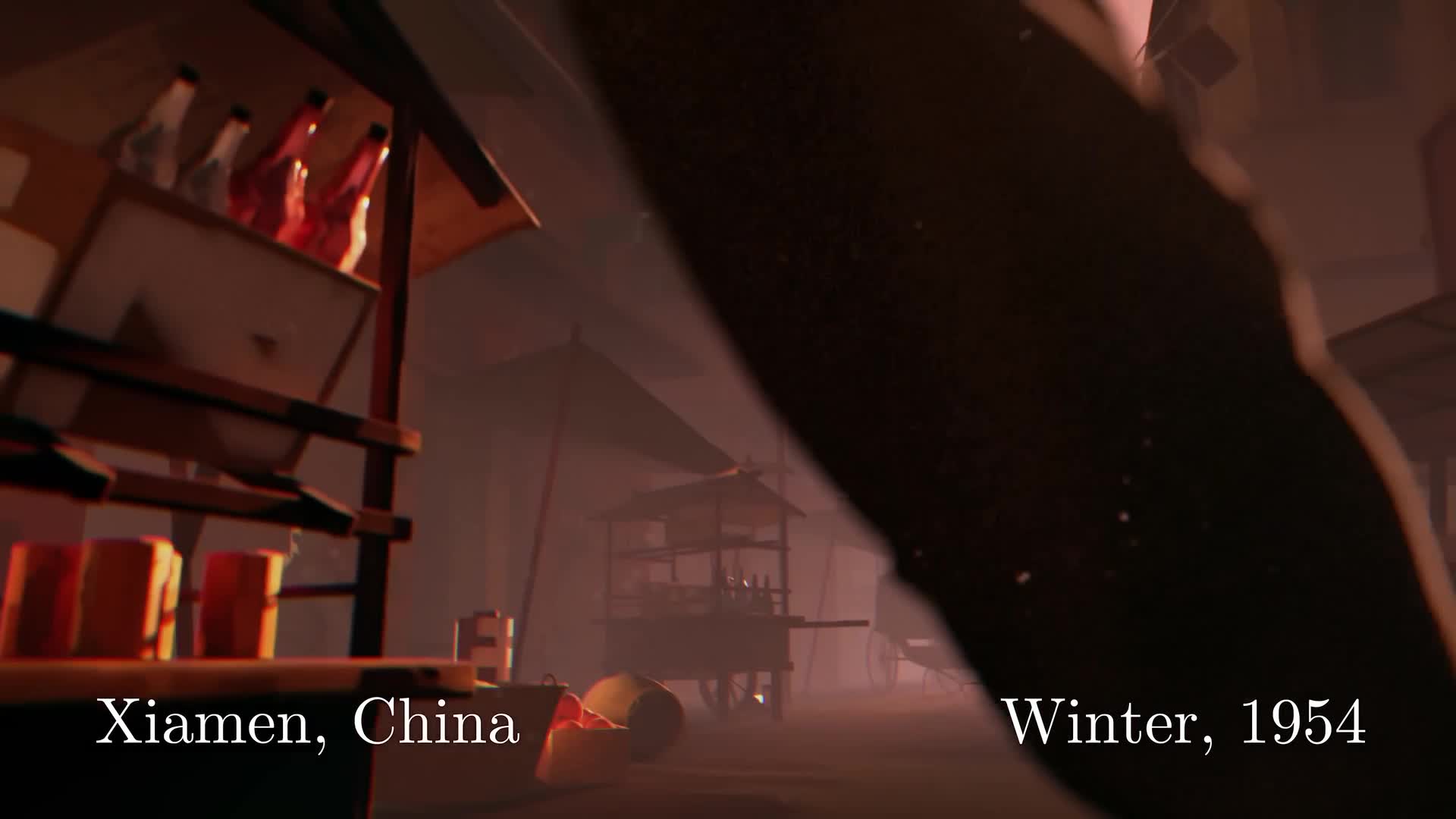
In Jiamen, China, in the winter of 1954, air raid sirens are sounded all over the city.
People scramble for cover as artillery shells are being fired in the distance.
The People's Republic of China is bombarding the nearby Kinmen Islands in an attempt to take over control from the anti-communist Chinese.
But troops on the islands fire back.
Soon, artillery shells are raining down on both sides.
Back in Xiamen, inside one of these shelters is 21-year-old Chen Jingrun.
As others are fidgeting, impatiently waiting for the explosions to stop, Chen is reading pages from a math book.
Because he's on a mission to solve one of the oldest problems in math.
A child can understand the statement, but the greatest geniuses in mathematical history have not been able to solve it.
In the year 2000, a publishing house even offered a 1 million prize to anyone who could solve the problem.
But for nearly 300 years, everyone who has tried has failed.
So the problem is this.
Can every even number greater than two be written as the sum of two primes?
So that's the problem.
So we can do some examples.
We can say, for example, 6.
That's an even integer.
So can we write it as the sum of two primes?
So those are numbers that only divide by themselves and by 1.
So for 6, it's just 3 plus 3.
And we can do more and more numbers.
So 10, for example, would be 5 plus 5. but also 7 plus 3.
There's one I want to do, one extra, which is your favorite number.
42.
42.
What makes it up?
37 and 5.
37, yeah.
But there's also a sort of nicer, more methodical way of writing this out, and it will help us build some intuition.
We'll start by drawing two diagonal lines.
I'm building like a pyramid, a pyramid of prime numbers.
So we're gonna start at the top.
We're gonna write down two, then we'll write down three five, and this is gonna be a good test of how well I know my primes.
Then we'll do the same on the other side.
Okay, and now what we're gonna do is we're gonna draw a line from each prime.
Can you see where this is going?
And where they cross is every sum?
Yeah.
Now we can start adding them.
So we get 2 plus 2.
4.
4.
3 plus 3.
6.
6.
You can see we're starting to get all these numbers.
The main point here is just as you go down, not only do you see all the even numbers appear, but they also seem to appear more frequently.
And it seems like it should always happen.
And of course, the conjecture is that it does always happen.
And that's known as the Goldbach's conjecture.
Chen's obsession with the conjecture goes back to his high school years, when his teacher stood in front of the class telling the students all about the sciences and said mathematics is the queen of the sciences, number theory is the queen's crown and the Goldbach conjecture is the pearl on the crown.
Shortly after, the teacher said, well, perhaps one day one of you kids will solve it.
And then the whole class burst out laughing.
Everyone except for Chen Jingwang.
He later said, I did not laugh.
I did not dare to laugh.
I was worried my classmates would know my vision.
But I never forgot this lesson to always remember the pearl on the crown and to never forget my aspirations or ideals.
And now, as air raid alarms are ringing, he's maintained his vision.
He's working on his math, trying to solve Goldbach's conjecture.
Christian Goldbach is a little-known Prussian mathematician who grew up in the early 1700s.
At first, he mostly studied medicine and law, only occasionally dabbling in mathematics.
But then in 1710, at the age of 20, he set off on a 14-year and over 4000 kilometer long journey to meet some of the greatest mathematicians alive.
In Leipzig, he met with Gottfried Leibniz, the co-inventor of calculus.
And in London he met with both Nicolaus Bernoulli and perhaps the greatest mathematician of all time, Sir Isaac Newton.
He then finished his trip around Europe before ultimately settling down in Russia at the newly formed St.
Petersburg Academy of Sciences where, in 1727, he met his most important connection, a 20-year-old math prodigy.
Can you guess who?
Leonard Euler?
Leonard Euler!
The two quickly became friends, bonding over a shared obsession with number theory.
Then, in 1729, Goldbach moved to Moscow.
But the two stayed in touch, writing letters to each other for the next 35 years, literally until Goldbach died.
It was in one of these letters on the 7th of June 1742 where Goldbach scribbled a line in the margin.
It was not the exact form of the conjecture which now bears his name, but something related.
It seems that every integer greater than two can be written as the sum of three primes.
Euler was intrigued by the proposition, but he thought the idea could be refined further.
It made sense to him that odd numbers might need three numbers to add together to make them.
But then he turned his attention to even numbers and he thought well, with even numbers, perhaps just two prime numbers would be enough to sum, to give you every even number.
In fact, as Euler wrote in his letter, this is how Goldbach originally framed the problem in person.
So Euler reformulated Goldbach's idea into two separate conjectures.
The first dealt with odd numbers and said every odd number greater than five can be written as the sum of three primes.
This became known as the weak Golbach conjecture.
And the second dealt with even numbers.
It said every even number greater than two can be written as the sum of two primes.
This became known as the strong Golbach conjecture.
They get their names strong and weak conjecture, because if you have the strong conjecture, then you've shown that every even number greater than two can be written as the sum of just two primes.
And then you can add three to each of those sums to get all of the odd numbers.
So if you can prove the strong conjecture, you get the weak one for free.
But the reverse is not true.
If you can prove the weak conjecture, you still don't get the strong one.
Now, after Euler reformulated these conjectures, he was so confident they were true that he wrote I regard this as a completely certain theorem, although I cannot prove it.
And he couldn't.
And for the next 150 years, almost no progress is made.
That is until in 1900, German mathematician David Hilbert addressed the International Congress of Mathematicians in Paris.
And there, he listed 23 of the most important problems for the 20th century.
Number eight on that list was all about prime numbers, including Goldbach's conjecture.
Goldbach's conjecture was back on the radar.
Only now, mathematicians started to look at the problem differently.
Let's take a look at our pyramid again.
One thing to notice is that this pyramid is symmetrical.
When two primes add to make an even number on the right side, those same two primes make an even number on the left side.
So to avoid double counting, we can look only at the right side of this center line.
And what we find is that for very small, even numbers like 4, 6 or 8 well, there's only one way to write them as the sum of two primes.
But for larger numbers like 20.
Well now, there are multiple different ways to write it as the sum of two primes.
And the further down you go, the more combinations you find.
So mathematicians started asking a new question, not just whether every even number can be written as the sum of two primes, but in how many different ways it can be done.
Let's call that number h .
For example, h is 1 because you can only write 4 as the sum of primes 2 plus 2, h is 2 because that is 3 plus 17 and 7 plus 13.
H is 4, and so on.
Now, so far, we're just counting up what the value of h should be.
But in 1923, two English mathematicians, G.H.
Hardy and John Littlewood tried to come up with a function that would estimate h of n.
To do it, they relied on one of the most important results from number theory, the prime number theorem.
This tells you that, on average, a large number in the neighborhood of n has about one over the natural logarithm of n chance of being prime.
So here's a crude version of what Hardy and Littlewood did.
They imagined this large even number and they set it equal to 2n.
So you could split it right down the middle at n.
Now they considered a pair of numbers, a and b, that together add up to 2n.
Where a is smaller than n and b is larger, they both must differ from n by the same amount.
Let's call it c.
Now, according to the prime number theorem, the chance that a is prime is one over the natural logarithm of n minus c, and the chance that b is prime is one over the natural logarithm of n plus c.
But here's the trick.
Most of the times we're talking about n's that are ginormous, that are super, super large, and if you look at one over l and n, that function would be something like this, where it basically it drops very quickly at the start and for large numbers it's almost constant, so that this c really doesn't affect it a whole lot.
So for most of the numbers We can sort of ignore the C in both cases and it becomes much simpler, which is just the chance of A being prime is about one over L and N, and a chance of B being prime is about one over L and N.
Now what's the chance that both are prime?
You're gonna multiply them together.
We're gonna multiply them together.
Still so far.
We've just looked at one pair, while in total there are about n possible pairs, n ways to add up two numbers to get to 2n.
So we can just multiply the chance of one pair being prime with the total number of pairs to find the total expected number of prime pairs, which comes out to about n over ln n squared.
And if we plot this, we find that the expected number of ways to write any number as the sum of two primes increases for larger and larger numbers.
Hardy and Littlewood.
They refine this a bit more, but essentially what they find, you know, is the exact same thing.
They just have like a correction factor in front.
But then this term is still the same.
The only problem is that this is just an estimate, not a proof.
And as they point out in their own conclusion, it is only proof that counts.
And that's about as far as they get for the strong Goldbach conjecture.
But on the weak one, they have more success.
It all comes back to a curious incident 10 years earlier in 1913.
We've invited Elmer from the YouTube channel Fern to tell you about it.
Hardy sits at his breakfast table when a strange letter arrives.
It's sent by a completely unknown mathematician from India, Srinivasa Ramanujan.
The letter reads, I'm now about 23 years of age.
I have no university education, but I have undergone the ordinary school course.
After leaving school, I've been employing the spare time at my disposal to work at mathematics.
Ramanujan writes that he's a poor clerk earning only about 20 pounds a year.
He's attached some formulas and is asking for Hardy's opinion.
The letter is over 10 pages long and is packed with over 100 theorems, many of them highly advanced.
Yet Ramanujan provides no proofs and very little explanation.
Hardy is astounded.
He has never seen anything like it.
Some are already known, others are completely new, unknown to the world.
And then there are results that seem impossible, like that the sum of all positive integers up to infinity is negative 1, 12th.
How did he come up with this?
Hardy shows a letter to Littlewood.
The two stay up until midnight going through the manuscript debating whether the mysterious author is a genius or a fraud.
But it sounded like Hardy felt these couldn't be crank results because you couldn't imagine them if you were just a crank.
They're too fantastical to be the work of that kind of second-rate mind.
Only a really phenomenal off-the-chart genius could have come up with them.
So Hardy writes back.
The rigorous and strict mathematician he is, he asks for proof.
Ramanujan, however, is nothing like Hardy.
He works on intuition, often guided by dreams.
He would just see the result.
Or, in some mystical versions of his own telling, he would say that his personal goddess Namagiri would come to him in his dreams and write the formulas on his tongue.
Wait, on his tongue?
On his tongue is the version I've sometimes heard.
But in any case, he planted it in his mind.
An equation for me has no meaning unless it expresses a thought of God.
Ramanujan never really learned how to provide proof to his theorems.
So Hardy urges him to come to Cambridge to explain them in more detail.
But there's a problem.
Ramanujan is a devout Hindu.
His faith forbids him from crossing the sea.
Then, one night, his mother has a dream.
A goddess appears and tells her to let Ramanujan fulfill his destiny.
Convinced by the vision, she gives her blessing, and so Ramanujan finally sets out for England.
In Cambridge, Hardy and Ramanujan start working together.
I mean, I'm going to get choked up thinking about it.
It's such a beautiful sentiment.
Trying to remember how hard he put it.
It's something like he thought, you know, on a scale from zero to 100.
You know, maybe he's a 10.
Littlewood is a 30.
Like Ramanujan is an 80.
Some kind of crazy thing like that.
So he knew that Ramanujan was special.
Didn't expect to get emotional for you, but this is what I do when I think about Ramanujan.
But his new life in England is harsh.
He's not used to the climate, he's not used to the food, and war is ravaging.
It will become one of the darkest chapters of his life.
If you want to know more about Ramanujan's struggles and what made him such a genius, there's an upcoming video on our channel, FIRN.
While Ramanujan struggled, Hardy and he did make a breakthrough.
Around 1917 they invented what's known as the circle method and used it to tackle different problems in number theory.
Hardy and Littlewood later developed this idea further.
And for the next hundred years.
This would be the main method to tackle the weak Goldbach conjecture.
But let's remind ourselves of the problem.
We're trying to prove that we can always write an odd number, large odd number as the sum of three primes.
Call it p1, p2, and p3.
But, just like before, we don't only want to know whether it's possible, but in how many different ways it can be done.
So Hardy and Littlewood imagined a counting machine of sorts.
As input, it would take all possible combinations of three prime numbers smaller than n.
For each combination.
It would add them up and check if that sum is equal to n And if it is, the machine increments a counter by 1.
But if not, the machine does nothing.
It goes on to the next combination.
Let's do an example.
Say n is 11.
Well, the machine first checks the primes 2, 2 and 2, adds them up to get 6, which is not equal to 11, so the counter stays at 0.
Next it tries 223, which is 7, so again it does nothing.
And it keeps cycling through until it hits 227, which is equal to 11.
So now the machine increments the counter by 1.
As it keeps running through primes, the counter increments only one more time for 335.
So in total, there are two ways to write 11 as the sum of 3 primes.
But how would you go about building this machine out of mathematics?
Because that is exactly what Hardy and Littlewood did.
Their technique is so ingenious, I wanna take you through it step by step.
It starts with the function e to the i theta.
This function just traces out a unit circle in the complex plane.
The angle theta determines how far around the circle you are.
Now imagine that theta is restricted to be some multiple m of two pi.
And since two pi is one complete revolution.
It doesn't matter if m is zero one two, three or any integer a vector from the origin would always point in the same direction, to the right.
But now Hardy and Littlewood multiply the angle by alpha, where alpha is just some number between zero and one.
You can think of it as a slider.
So if m equals one and you increase alpha from zero, well the vector slowly makes one full rotation.
If m equals two, the vector will move around faster and make two full rotations.
And this keeps going for higher values of m.
Now imagine taking all possible values of alpha simultaneously and then averaging out all of those vectors.
Mathematically, we can write this as the integral from 0 to 1 of e to the i 2 pi alpha d alpha.
So what happens?
Well, this vector cancels with this one on the opposite side, and this one with that one, and the same thing happens with all the vectors.
So averaging them, we get zero.
The same thing happens if m equals two or three or four.
This integral will give zero for all values of m, except a single case.
If m equals 0, then we have e to the 0, which equals 1.
So, no matter what alpha is, the vector always points to the right and averaging that will always give 1.
So this equation is very close to the machine we were trying to create.
If m equals 0, it returns 1, but if m is not equal to 0, it returns 0.
So all that's left to do is replace m with what we're interested in.
Specifically, is the sum of p1 plus p2 plus p3 equal to n?
We can rearrange that to get p1 plus p2 plus p3 minus n equals 0.
So if we sub in this expression for m, then every time the three primes add up to n, this value will be 0 and the integral will be equal to 1.
And every time the primes don't add up to n, this value will be non-zero, and so the integral will return zero.
But right now, this equation only checks one triplet of primes.
To check all possible combinations of primes smaller than n, we need to add a sum.
Since this will count up all the ways three primes can add to make n, we can call it h .
So in fact, let's try it out.
Put in n equals 11, compute this function, and it gives six, which is not the two we found before.
So what happened?
Well, we've simplified the logic a little bit, so we actually get some duplicates this time.
For example, the machine finds 227, but also 722 and 272.
Mathematicians correct for this when doing the real calculation, but for our purposes this machine is good enough.
So we've got our h of n, And if we can show that h of n is at least 1 for every odd number greater than 5, then we've proven the weak Goldbach conjecture.
But there are two issues with this approach.
The first is that we assumed that we know all of the prime numbers smaller than n, which is true when n is small.
But as n goes to infinity, we just don't know all of the primes.
The second problem is that, as the number of primes increases, the number of possible combinations explodes.
If n is 10001, there are 1229 smaller prime numbers, which means a total of 310144295 possible prime triplets.
Increase n to a billion and the possible combinations jumps up to nearly 22 sextillion.
And this trend continues.
So using this approach in a simple way won't work.
So Hardy and Littlewood came up with a smarter way.
They fundamentally reframed the problem by taking the sum inside the integral.
Rather than checking all possible combinations of prime numbers by brute force, they now analyze the collective behavior of all the primes at once.
To see how this works, take a look at the equation.
In the exponent is the sum of three primes minus n.
But adding in the exponent is the same as multiplying exponentials together.
So we can rewrite this as the product of four exponentials.
The first three of these are actually identical, because there's nothing to distinguish what we call p1 p2, p3.
They're all prime numbers drawn from the same set.
So we could just call this function s of alpha and n, and we could multiply it by itself three times or just cube it.
By doing this, h of n is now a function of just two things e to the minus i, two pi n alpha, which is just a complex number that you could compute, and this new function s of alpha and n.
But what is this function?
Well, let's do an example.
Again, say n equals 11.
Then s of alpha and 11 equals just a sum of four exponentials, each governed by its own prime number.
You can think of each of these exponentials as a clock, each with its own prime number that determines how fast the clock spins.
So two turns the slowest, three turns faster, five turns faster still, and so on.
But remember, this is a sum, so we actually need to add up all the clocks tip to tail.
Now watch what happens as we increase alpha.
All the clocks wind around at their own rates.
What we're interested in is not the behavior of any individual clock, but instead all of them together.
Since we've chosen a pretty small value for n, nothing too exciting happens.
But watch what happens if we pick a larger value for n, like 99.
Now there are 25 prime numbers that are smaller than 99, and hence 25 clocks in our sum.
Now as we increase alpha, all the clocks again wind around at their different rates.
It almost looks like a dragon's tail.
And for a while, everything seems kind of chaotic, circling around the origin.
But then, when alpha hits 1 over 6, the tail unwinds.
And suddenly almost all the clocks point in a similar direction and we get a large resultant value.
If we increase alpha further, the clocks cancel out again until we hit the next magic point, 1 over 3.
Here again, many clocks line up, and this curious pattern keeps repeating.
For the majority of values of alpha, the clocks cancel each other out.
But at a few special points, like a half the tail unwinds, the clocks interfere constructively and we get a large resultant value.
If the angle is 360 degrees divided by a whole number, you get some very particular behavior.
That's very predictable.
Those are the angles at which this function.
When you sum the primes, they actually go far from zero.
And what happens?
At a random angle, and you just start adding the primes up, it keeps changing which way it's pointing and the thing just bounces around.
So why is this happening?
Well, let's look at when alpha equals a half.
Here, what we're doing is multiplying each prime number in the exponent by a half.
In other words, dividing each prime number by two.
So let's do this for each of the primes.
In the first column, we'll write down how many times it can be divided by two.
And in the second column, we'll write down the remainder.
So 2 divided by 2 equals 1, leaving a remainder of 0, so we've just made one full rotation.
3 divided by 2 is 1, but that leaves a remainder of 1, so it makes one full rotation and then a half rotation.
5 divided by 2 is 2 with a remainder of 1, so it makes two full rotations and then a half rotation more.
Now we don't really care about the first column, because it doesn't matter how many full rotations a clock makes.
We only care about where the arrow ends up.
And that's fully determined by the remainder.
It's just the remainder times alpha.
So from now on, we'll just keep track of the remainders.
And what we find is that all of the other remainders are equal to one.
So all clocks except the first one point the same way.
This is because, when we're dividing whole numbers by two, there are only two possible remainders zero or one.
And since we're working with prime numbers, only two can have the remainder zero, because no other prime number is even.
Therefore all other primes must share the remainder one, meaning all those clocks end up making another half rotation, so they all point left and constructively interfere.
A similar thing happens when alpha equals a third.
Now each prime is divided by 3, so the possible remainders are 0, 1, or 2.
Again, 3 is the only clock that has remainder 0, so that point's right.
But all the other primes follow a special pattern, a pattern that makes the entire circle method possible.
The remaining primes distribute themselves roughly equally between remainders 1 and 2, which means all the remaining clocks are rotated one-third or two-thirds of the way around the circle.
Since these clocks are pointing to the left, again we get constructive interference.
And this pattern of constructive interference also occurs for other small rational fractions.
But for non-rational numbers you don't get these nicely restricted remainders, so the clocks are roughly distributed equally all over the circle and you get destructive interference.
Hardy and Littlewood realized they could use this.
Imagine taking this plot of the magnitude of the resultant arrow and wrapping it around a circle.
What they found is that the majority of the contributions come from very small regions of the circle, what they called the major arcs.
The rest of the circle only adds minor contributions, so they called these the minor arcs.
This allowed them to split up their calculation into two parts.
The major arc part gives you the main term for how many ways you can write a number n as the sum of three primes.
And the minor arcs just gives you an error term.
They then showed that if the generalized Riemann hypothesis is true, then the main term grows faster than the error term.
So eventually, for some large enough number, call it K.
This value will always be larger than one, and the weak Goldbach conjecture holds.
But there are two problems with this approach.
The first is that they assumed that a generalization of the Riemann hypothesis is true, which we don't know.
And the second is that they didn't actually specify that number k.
I mean, how big of a number do you need to get to before you can guarantee that all numbers larger than that adhere to Goldbach's conjecture?
Then we've got to wait until 1937, when Russian mathematician Ivan Finogradov proves the same as Hardy and Littlewood.
But he did it without the generalized Riemann hypothesis.
So, you know, assumption free.
It's one thing to just assume the Riemann hypothesis and say, oh, yeah, you can make some progress.
But Vinogrado's like, no, guys, you don't need the Riemann hypothesis.
You can really prove this stuff.
But again he gives some large enough number for which the weak Goldbach conjecture will hold, without specifying that number.
And so it's very unsatisfying.
Over the next 19 years.
One of his students did get that satisfaction when he could specify that number.
Do you wanna have any guess as to what the number is?
10 to the 50, 10 to the 80, 10 to the 3000, I don't know.
I was guessing things that are far too low probably.
Yeah, yeah, yeah.
It's about 10. to the 6.8 million.
Wow.
Okay.
It's huge.
But then, you know, from here on, people start working on this method more and they all use the same techniques.
In 1989, the number was brought down to 10 to the 43,000.
Next, it dropped to 10 to the 7,194.
And by 2002, it had dropped all the way down to 10 to the 1,346.
Now that seems so much smaller than what we had before.
But if you compare it to how many protons there are in the universe, which is 10 to the power 80, that's not something you can check by computer.
It's absolutely, absolutely hopeless.
Even if you turned the whole universe into a computer, you would still have no chance of solving this.
So it really needed to get dragged down.
This is roughly where the problem stood in 2005 when Peruvian mathematician Harold Helfgott became interested in it.
He was reading papers about the weak Goldbach conjecture and new techniques that were being developed.
So these were the cutting edge techniques at the time.
He was reading it and he thought, I can do better.
I'm having some ideas how to do better.
And I, you know it took me a couple of weeks to get better estimates, not to still, you know, strong enough to revolutionize everything, but to make real progress.
So he gets to work and within a couple of weeks, he's got better estimates than that in the paper.
So now he's getting more confident, like, okay, I got this.
Of course I was a bit naive.
I underestimated some difficulties elsewhere.
To solve the problem, he realized he needed to do two things.
One, get the computational number as high as possible.
And two, get the constant down as much as he could, which is where the difficult math comes in.
So over the next eight years, he attacked the problem from both sides.
Together with David Platt, he checked all numbers up to 8.8 times 10 to the 30 by computer.
And by refining his math, he slowly brought down the constant number k By 2013.
He gets the number all the way down to 10, to the 27, which is below the number that his computers had already checked.
So he solved it.
He wrote up his results in a paper called The Ternary Goldbach Conjecture is True, which is quite the mic drop title.
So, nearly 300 years after Goldbach's original letter, Havkot proved that every odd number greater than 5 can be written as the sum of 3 primes.
And as a result he also proved that every even number greater than two can be written as the sum of at most four primes.
This is because you can always just add three to all the odd numbers to get all the even numbers.
So was it a big deal?
Were people excited?
Yeah, it's a good question.
I feel like it is mostly an obscure problem.
I think, the strong one.
And this with both of these problems, like they don't have any direct application to the real world.
Because it's so simple, it has this massive wide appeal and everyone will kind of know about it.
It's also one of the oldest unsolved problems.
What did you do when you proved it?
Well, I put it on the archive like any normal person.
It was a big relief.
Given your success with the weak form of the Goldbach conjecture, how do you feel about the strong form?
I think that's hopeless for the moment.
If it were to yield during our lifetimes, I wouldn't bet on it.
In fact, I would bet against it.
See the reason the circle method works for the weak Goldbach conjecture is because this main term grows faster than this error term.
But that's not the case for the strong Goldbach conjecture.
The major arcs are no longer major.
The main contribution comes from the minor arcs, or at least as much of the contribution comes from the minor arcs.
So, to solve this strong conjecture, we need some fundamentally new technique or approach.
But we haven't found it yet.
The person who arguably got the closest was Chen Jingrun.
In 1956, Chen was recognized for his mathematical prowess, and a year later he became an assistant at the Chinese Academy of Sciences, where he spent the next 10 years working on problems in number theory, including Goldbach's conjecture.
By 1966, he hit a major breakthrough.
By using another approach, known as sieve methods, he proved that every sufficiently large even number is the sum of a prime and a number that's either a prime or the product of exactly two primes what we call a semi-prime.
It's a very learned and brilliant proof.
I think Andre Weil compared following his proof is like climbing along the top of the Himalayas.
You know, that you're way up high in practically the stratosphere.
It's such a sophisticated argument.
This was the closest anyone had gotten to solving the problem.
Elated Chen showed the proof to a colleague who suggested he should announce the result and then tidy it up before publishing.
But just as Chen announced his result, the country plunged into chaos.
In May 1966, Chairman of the Communist Party, Mao Zedong, declared that bourgeois elements had infiltrated the government and society and they must be purged.
This marked the start of the Cultural Revolution, a radical campaign to defeat perceived enemies of the party.
With support from Mao, militant student revolutionaries known as the Red Guard stormed institutions.
They burned books and turned on intellectuals.
Teachers, scientists and professors were subjected to brutal public spectacles known as struggle sessions.
They were beaten, humiliated and forced to wear towering caps and placards listing their supposed crimes like capitalist sympathizer or enemy of the revolution.
Across China, the pursuit of knowledge was replaced by fear and political conflict.
By 1968, 131 of the 171 senior members of the Chinese Academy of Sciences in Beijing faced persecution and many others lost their lives.
Chen was one of the targets.
He was forced into manual labor and made to live in a converted boiler room with no electricity.
The Red Guard insulted him, spat on him and beat him so badly that Chen often lost consciousness.
In one report, it was so bad that he may have tried to commit suicide.
He jumped off of a third story building and fortunately didn't hit the ground.
He landed on the second floor and got injured but didn't die.
Despite all of this, Chan kept secretly working on his math under the dim light of a kerosene lamp.
Then, on the 13th of September 1971, Mao's right-hand man died in a mysterious plane crash after supposedly trying to organize a coup.
His death shattered the illusion of unity in the party, and the Cultural Revolution began to lose steam.
But Chen faced a dilemma.
On the one hand, he wanted to publish his proof, but on the other, he was terrified of being criticized.
Unsure what to do, he turned to Luo Shengcheng, the head of the Mathematical Institute, who told him the result is sound.
You must publish.
And so, in April 1973, Chen published his theorem.
Three years later, Mao Zedong died and the Cultural Revolution ended.
Famous journalist Zhu Qi took note of Chen's story and wrote an article about his achievements and hardship.
The article was reprinted in China's most popular newspaper and read by millions.
The state that just 10 years earlier silenced Chen now celebrated him as a national hero.
His story was retold in schools, books, and films.
He even got an asteroid named after him in 1996.
And imagine if he hadn't done it, you know, if he hadn't published it, like all his work, his whole mission, his whole ideals, his whole vision, maybe no one would have known about it.
It would have just been a little line somewhere like oh, I've got this proof, but yeah, I'm not going to show it to you.
You know, but so often we like shoot ourselves down, whereas really do your best, and then put it out into the world and then let the world, sort of like, evaluate it.
And while Chen got incredibly close, he was never able to fulfill his ultimate dream to solve the strong Goldbach conjecture.
Perhaps one reason why it's so hard to prove true is because maybe it's not, maybe it's false.
But if it is false, then there's a very easy way to show that by finding a counterexample, a single even number that can't be written as the sum of two primes.
If Goldbach is false, it would be very easy for you to convince me that Goldbach is false.
Just find a counterexample.
That is the only way that you can convince me that Goldbach is false.
If Goldbach is false, then it's false because there's a counterexample.
And if there's a counterexample, then you can give me the counterexample and I can check for myself that yes, that's a counterexample.
In this pursuit, in 1938, a mathematician named Niels Pipping checked all numbers up to 100000 by hand.
But he didn't find a single counterexample.
Since then, modern computers have brought this number up to four quintillion, and the conjecture holds for every single one of them.
In fact, we can also use computers to check in just how many ways a different number can be written as the sum of two primes, which gives us this pattern.
It looks like a curve with tails.
It strongly resembles a comet, which is why this is known as Goldbach's comet.
It shows that as the number gets larger, there are more and more ways to write every even number as the sum of two primes.
And if we overlay our heuristic argument from before, we find that it matches up remarkably well.
The one way the conjecture could be false is if, for whatever reason, at some very large number, there's a conspiracy where this completely breaks down and it suddenly drops below that line.
Are there any examples where you suddenly have a big drop in the number of ways you can compose a number?
No, no.
Those asymptotics seem to hold very nicely.
There are no big drops.
So it seems like the conjecture should be true.
We've tested by brute force all the numbers up to 4 quintillion, and they all obey Goldbach's conjecture.
So you might think that we should have found a counterexample by now, or at least a number that doesn't follow this general trend we've seen
But on the scale of all numbers, 4 quintillion is nothing.
So we'll have to come up with some smart approach or fundamentally new way of solving this problem.
Now, as far as we know, solving Goldbach's conjecture doesn't really affect any other areas of math.
And it also doesn't seem to have any direct applications to the real world.
So you might think, why bother solving this problem?
Why not work on some big problem that we know is important?
But I think that misses the point.
What if the Goldbach conjecture turns out?
It is opening up a whole new part of the multiverse of mathematical ideas.
We don't really know because we don't have bird's eye view or the god's eye view of math.
It's what it looks like to us right now on the web of math.
So i i tend to dislike this picture of certain things are central and other things are peripheral.
People should do what fires them up, because if you do that, you'll be passionate.
You'll think about it all the time.
You'll do it when you're in the shower, you'll think about it when you're driving and you might do something remarkable because of that passion.
And if you're just doing something because you think it's important, I think you'll tend to be second rate honestly.
I like the modest view that we don't know what's necessarily important, but we do know what we love.
So work on that.
Goldbach's conjecture frustrated mathematicians for centuries.
And for a long time, it seemed like an unsolvable problem.
Many gave up thinking it was just too big to tackle.
But, as we've seen, it only takes a few incredibly determined individuals who reject the status quo to keep pushing towards a solution.
And it's not just big math problems.
Life is full of inconveniences that some of us just start to accept as unsolvable.
For me, shaving was one of these things the irritation, the razor burn, the cost of constantly replacing razors.
It felt like something I just kind of had to put up with.
But then I started using the Henson razor and I can honestly say it was a game changer.
I've been using it ever since we first started working together two years ago.
And now I don't go anywhere without it.
And it's not just me, many of you have shared your experiences too.
The experts from Henson come from the aerospace world and they applied the same obsessive focus to create a better shaving experience.
Their razor is made using CNC machines which are capable of achieving incredibly tight tolerances.
The razor blades stick out just 0.03 millimeters.
That means that the blade is perfectly supported.
So it maintains its precise 30 degree cutting angle and it reduces chatter, the tiny up and down vibrations that can cause skin irritation.
If you want a better shaving experience engineered by experts, head over to HensonShavingcom.
Slash Veritasium.
Use my code Veritasium for 100 free blades with the purchase of any razor.
Make sure to add both the razor and the blades to your cart for the code to take effect, and try the Henson razor for yourself.
I want to thank Henson for sponsoring this video and I want to thank you for watching.