This is Planet Money from NPR.
The federal government shutdown that just ended went about a month and a half.
Hundreds of thousands of federal workers were put on furlough.
Flights were being canceled because of a shortage of air traffic controllers.
People didn't get their food stamps.
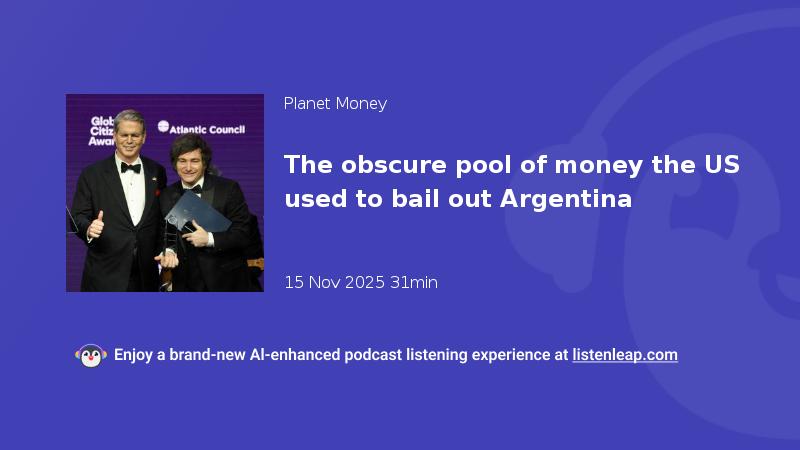
But last month, despite most federal spending being paused, Treasury Secretary Scott Besant announced that the United States did have 20 billion for Argentina to help that country through an economic rough patch.
We should say he is totally allowed to do this.
No congressional input required.
The reason Besant can just unilaterally make this move is this.
For the last 90 years, the U.S.
Department of the Treasury has had this kind of private slush fund with billions of dollars in it.
It is called the Exchange Stabilization Fund.
And mostly, it just sits there.
But Besson's announced on social media that he was putting it in action.
In what we used to call a tweet, now, I guess, a post, Besant explained that the U.S.
Treasury had started using the fund to buy up Argentine pesos and that the United States stood ready to swap 20 billion more US dollars for its equivalent in pesos.
What was your reaction to that?
Bold move, Mr. Treasury Secretary.
Bold move.
That is Brad Setzer.
He's a senior fellow at the Council on Foreign Relations and kind of the go-to expert on international financial flows.
Brad says, part of what makes the move so bold is that this swap of dollars for pesos amounts to basically a loan of billions and billions of dollars.
We're willing to take those pesos, but we don't want the pesos.
Argentina really, we're not doing this to get pesos.
The Argentines are doing this to get dollars.
Secretary Besant did a bunch of TV hits making the case for why the US was helping out Argentina in this way.
What we're doing is maintaining a U.S. strategic interest in the Western Hemisphere.
America first doesn't mean America alone.
Besant wants the U.S. to have a strong ally in Latin America.
And Donald Trump and Argentina's president, Javier Millay, seem to be pretty tight.
We've talked about Millay on the show before.
He is this very colorful character.
He's an economist who describes himself as an anarcho-capitalist.
Also, he has sideburns that make him look a little like half Wolverine, half lead singer of ACDC.
Millay's big project is cutting government spending.
He symbolically brandishes a chainsaw at his rallies.
I mean, Malay is very willing to cut public spending.
That's his political superpower.
Under Malay, for the first time in 14 years, Argentina has a balanced budget.
And inflation is down from almost 300% annually to closer to 30%.
Now, the timing of Besson's $20 billion offer was not an accident.
It came just weeks before this big congressional election in Argentina.
An election that a lot of people viewed as a referendum on Javier Millet's whole budget slashing experiment.
And remember, Trump and Malay, they seem to be buddies.
Trump wants him to succeed.
And Scott Besant was pretty clear that he hoped that 20 billion credit line would give Malay a boost.
Argentina has a hundred years of decline, and President Mele is working against history.
And he's done a fantastic job.
And I am sure that when we see the elections this month that he's going to do well, his party will do well.
Unusual, sure, to lend $20 billion to someone whose name you cannot pronounce.
But also, Argentina has historically not been the most responsible borrower.
It has not.
Argentina has defaulted nine different times on its debts.
It currently owes the International Monetary Fund more than 50 billion, more than six times the next closest country.
The rap on Argentina is that it borrows a lot of money and it never repays.
They haven't repaid the IMF loan they took out in 2018 and 2019.
They haven't repaid the swap from China.
They haven't repaid the IMF loan they took out earlier this year.
So for Brad, the U.S. offering to send Argentina $20 billion was, what did Brad call it?
Bold.
You know, it was very noticeable that Secretary Besant described Argentina as a model, a beacon.
And I thought, wow, we don't usually have to give bailouts to countries that are models and beacons.
This is the kind of stuff that puts a little flutter in Brad's financial flow nerd heart.
It's been a long time since we've had a high-profile bailout of a troubled emerging market economy.
It's been even longer since the U.S.
Treasury put the relatively small sums available at the Exchange Stabilization Fund at risk.
Secretary Besant, you've made my life interesting again.
Hello and welcome to Planet Money.
I'm Keith Romer.
And I'm Erica Barris.
$20 billion.
That's a lot of money.
20 billion would pay for about half of the total budget managed by USAID last year before the Trump administration shut it down.
It would pay for a full year of the FBI, DEA, ATF, and Federal Marshal Service combined.
But Scott Besant is allowed to offer that money up to Argentina all on his own because it comes from the Treasury's private slush fund.
Today on the show we will take a look at the long history of that obscure fund Scott Besant used to help out Argentina and try to figure out are we ever going to see that 20 billion again?
This message comes from Wealthfront.
It's time your hard-earned money works harder for you.
With Wealthfront's cash account, you earn a competitive APY on your cash from program banks, higher than the average savings rate, with free instant withdrawals to eligible accounts.
Go to Wealthfront.com slash money.
Cash account offered by Wealthfront Brokerage LLC.
Member FINRA SIPC, not a bank.
Funds are swept to program banks where they earn the variable annual percentage yield.
This message comes from BetterHelp.
President Fernando Madeira describes how BetterHelp Online Therapy has helped him.
For me, sometimes I just need to go and talk to somebody that is not going to judge me, right?
Is going to be there and going to listen to me.
And I can't start just saying, look, I'm not feeling right today.
It feels natural.
I love it.
To get matched with a therapist, visit BetterHelp.com slash NPR for 10% off your first month.
Let's start with a fun piece of trivia.
This is not Brad Setzer's first time on the show.
In fact, you were on the first ever Planet Money podcast.
We're calling it Planet Money.
Little known, little remembered fact.
Right here is our first ever podcast.
Dun-da-dum!
All right.
So today I'm going to talk to Brad Setzer.
Back then, we went to Brad to ask about China purchasing U.S. debt.
Today we're talking to him about that obscure little slush fund that Scott Besant used to help out Argentina.
Can you talk a little bit about how the exchange stabilization fund even came to be?
So it's one of these little tools, pools of money available for the US government when the world needs help.
But its original purpose was to kind of stabilize the price of the dollar relative to gold.
Yeah, back in the 1930s, the U.S. was still on the gold standard.
And during the Great Depression, a lot of folks were like, who knows what's going on with a dollar?
I trust gold.
And they would show up at the bank and literally trade in their dollars for gold at the official rate of around 20 an ounce.
But President Franklin Roosevelt did not want people burying gold in their backyards.
He wanted them out spending their dollars, getting the economy going again.
After all, there is an element in the readjustment of our financial system more important than currency, more important than gold.
And that is the confidence of the people themselves.
So FDR suspended the gold standard for nine months.
But the U.S. did eventually get back on the gold standard, at least internationally.
And when they did, they lowered how much a dollar was worth, kind of by a lot.
In order to keep this new value of the dollar stable, Congress gave the Treasury Department this little pool of money to help influence the market for the dollar, aptly named the Exchange Stabilization Fund, you know, to stabilize exchange rates.
The gold standard, of course, is long gone, but the fund stuck around.
Congress never took the money back, in part because it's useful for Treasury to have a fund that lets it act fast when it needs to.
It is the pool of money the U.S. uses to intervene in foreign exchange markets.
It's basically set aside for emergencies.
And it is rarely used, but when it is used, its effective use is important.
Yeah.
You can think of the fund as like sitting over in a corner of Treasury with a sign on it that says break glass in case of emergency.
Now the fund sometimes gets employed in complicated ways during giant economic messes like COVID or the global financial crisis.
But in currency markets, it's mostly used when some big world currency gets a little out of whack.
In the 1980s the fund was used to reset things between the dollar, the franc, the deutschmark and the yen.
In 2011, the fund was used to help out the yen after a tsunami hit Japan.
Usually, when the US intervenes, it buys the currencies of other advanced economies, not emerging economies.
Occasionally, the fund will loan money to emerging economies, but big loans to emerging economies almost always come from the IMF, the International Monetary Fund, not the Treasury Department.
Which is part of why Brad kind of sat up in his chair when he heard that Besant was going to use the exchange stabilization fund for Argentina.
Because of Argentina's long history of defaulting on its debts, it counts as an emerging economy, not an advanced one.
And in the Exchange Stabilization Fund's 90-year history there's only been one other time it's been used at this scale to help out an emerging economy.
A single time, just once.
In 1995, the United States offered to lend $20 billion to Mexico.
The Mexico story is pretty fascinating in its own right, but it's also useful as a way of understanding what Scott Besant is up to in Argentina.
So we're going to spend the next little bit looking at what happened the last time the US used the Exchange Stabilization Fund in this way.
For that, we reached out to someone who was very plugged in at Treasury back then, Jeffrey Schaefer.
Well, I had been kind of deeply involved with Mexico from the time I arrived.
Jeffrey started working at the Treasury Department during President Clinton's first term.
I was the Assistant Secretary of the Treasury for International Affairs when the Mexican government debt problems arose.
Jeffrey had worked on the NAFTA free trade deal and he'd been paying a lot of attention to what was going on with Mexico's currency, the peso.
How would you explain what the problem was in Mexico?
Well, the fundamental problem was, I think, an unrealistic commitment to an exchange rate that got more and more out of line with reality.
Erica, are you ready to do a little exchange rate explaining?
So ready.
The only correct answer is yes.
Yes, yes.
Okay, so towards the end of 1994, one Mexican peso was worth about 29 cents.
Like, you can think of that as the price of the peso.
But like anything else, the price of the peso would move up or down depending on how much people wanted it.
Following the law of supply and demand.
The Mexican government had committed itself to keeping the price of the peso high, which was great for Mexican consumers.
The peso was worth more.
So essentially, anything that was imported into Mexico was cheaper.
Also, it helped keep inflation down.
But the way the Mexican government was keeping the price of the peso high was by buying the peso themselves.
You can buy it with gold or you can buy it with foreign currency, in most cases dollars.
Yeah.
Like most countries, the Mexican government had billions of U.S. dollars in its reserves.
Think of it like a government bank account filled with foreign currency.
And whenever it seemed like the price of the peso was dipping a little, they would jump into the currency market and spend those dollars to buy pesos and keep the price up.
Which is fine if you have an infinite number of dollars to buy pesos with.
But the Mexican government did not have infinite dollars.
And it had taken out these complicated loans that it was essentially going to have to repay with dollars, not pesos.
We were watching the situation and...
To Jeffrey?
The solution was obvious.
Mexico needed to stop propping up the peso.
They needed to let the market determine the price to float the peso.
But the Mexican government didn't want to.
But then at the end of 1994, a new president, Ernesto Zedillo, took over in Mexico.
And he was open to a change in strategy.
He knew that Mexico needed to stop propping up the peso.
And he tried to let its value go down, gradually, in a controlled way.
But by then, it was too late.
The old. team just passed him off this untenable situation, and so it immediately blew up.
I got a phone call from my counterpart at the Mexican hacienda, which is what they call the treasury, saying that they had run out of money.
The exchange rate was falling.
They were going to have to let it go the next day.
So they had reached a point where they decided, we're going to let this currency just float.
We're not going to try to keep it.
Well, they were at a point where they had no choice.
They had no resources left to try to maintain it.
Now Jeffrey understood that there is a big difference between intentionally letting your currency devalue little by little and what was about to go down in Mexico.
Markets seemed to figure out that the Mexican government had already spent most of its dollars, which meant that there would be nobody left to prop up the peso.
The price of the peso would fall like a rock and investors would start pulling all of their money out of the country.
It would be like a bank run, but on an entire country.
And this wouldn't just be bad for Mexico.
If Mexico's economy self-destructed, it would be bad for the U.S. economy, too.
The two countries are very economically intertwined.
Plus, illegal immigration from Mexico, which was also a hot button issue back then, would have surged.
On top of all that, there was a risk of contagion to other emerging markets.
Investors could get skittish and pull their money out of those economies, too.
Which country's next?
Is it Argentina?
Is it Brazil?
Is it Peru?
Back in the U.S., Jeffrey and his boss were trying to figure out what to do about all of this.
Meanwhile, there actually wasn't a permanent secretary of the Treasury.
Bob Rubin had been nominated, but not yet confirmed.
And where is Bob Rubin during these conversations?
He's fishing somewhere in the Caribbean.
Why was he fishing in the Caribbean?
The last vacation before he takes over as the Secretary of the Treasury.
Eventually, Rubin gets back from the Caribbean.
And then on January 10th 1995, he gets confirmed and then sworn in at the White House the very same night.
President Bill Clinton is there.
Bob Rubin's wife is there.
And as soon as the swearing in was over.
His wife left, and we went into a meeting with the president.
So the swearing-in happens, and then Ruben is like, OK, bye, honey, I'll see you at home.
He said goodbye and sent Judy home, yeah.
They explained to President Clinton that they think the U.S. needs to bail out Mexico.
And the president very quickly agreed.
He said, this is going to be politically awful, but it's what we have to do.
Congress did agree that it was going to be politically awful.
Why do you want to intervene in Mexico at all?
Are we trying to prop up the Mexican government?
That would be wrong.
Why should I, as a congressman, vote to put American taxpayers at risk again and again?
Well, so then you said...
What is plan B?
Plan B is the Treasury Department's little private pool of money we were talking about before the Exchange Stabilization Fund.
The fund had started with 2 billion but because of interest it earned on loans from the fund and gains on currency held in the fund, it now had about 25 billion in usable funds.
How certain was everybody that this was a lever you could pull?
Well, I think there was certainty that it was a lever we could pull.
The question was, was it a lever that we wanted to pull?
For President Clinton going it alone without the backing of Congress and lending Mexico all that money was a huge political risk.
If we succeeded, if it came out right, it would not be...
By re-election time, a liability.
And if you failed and it didn't come out right, it would be a liability by election time.
Oh, yeah.
Like it could cost him the presidency.
For the folks at the Treasury, there was a second risk.
I saw somebody somewhere referred to the stabilization fund as a weapon you can only use once.
Well, our view was we could only use it once if we didn't get it back.
I mean, if we got it back, it showed it worked, then those resources would be available to use and the same situation arose again.
But in fact, you couldn't, you could only bail once.
Treasury did have the money to bail out Mexico.
But if Mexico couldn't pay back the loan, that was pretty much the end of the exchange stabilization fund.
So if there was another currency crisis somewhere, Treasury wouldn't be able to help.
But if they didn't use the fund, Mexico could melt down.
So they decided they had to pull the lever.
They were going to offer to loan Mexico $20 billion.
Now, if you were going to lend another country 20 billion, you do want to think through how you were going to lend that money.
Jeffrey said he took as a guide something known as Badgett's Dictum.
Walter Badgett, 19th century writer, early editor of The Economist.
And Badgett said, assuming that whoever you are lending to is solvent, a lender of last resort should follow three rules.
Lend freely at a penalty rate against good collateral.
So, lend freely.
That means lending more money than you think they're going to need.
And that is so that the market, which is in some sense acting in a kind of panic, is reassured.
It's reassured and it's willing to begin to come back in.
On top of the U.S.'
's 20 billion contributions from the IMF and others brought the number to over 50 billion way more than Mexico needed.
So that's lending freely.
Explain at a penalty rate like what's the reason to charge a little bit more than you would be charging normally?
Well.
One is to keep them from coming to you when they didn't need to.
But the other was to incentivize them to go back to the market as soon as they were able to go back and repay us as soon as possible.
The interest rate on the bailout was a lot better than Mexico could have gotten from banks and investors in the midst of this crisis.
But it was still pretty high.
And then finally, against good collateral.
What's what's that?
That means to have an assurance that you are going to be repaid.
Yeah, one part of the deal Jeffrey worked out with his Mexican counterparts was about collateral.
If Mexico did not make their payments on time, the US could claim the revenue the Mexican national oil company got from its exports.
It took weeks for the team at Treasury to settle on all the terms with the Mexican government.
Finally, they got the money flowing from the exchange stabilization fund to Mexico.
And then they waited for their bailout to show any signs of working.
And waited.
And waited.
The market just didn't look good.
The Mexicans, in terms of compliance with the program, that was fine.
But the interest rates were getting very high.
And the pesos continued to weaken, and it looked like it might not come together.
For months, the peso stayed in crisis.
And kind of so did Jeffrey.
Bob Rubin called me into his office and I was clearly very visibly showing the stress in my face.
And he said, Jeff, we're doing the right thing.
We've done the right calculations.
But that doesn't guarantee it's all going to work out.
And you have to be prepared to accept the fact that it doesn't work.
It did start to work out.
Gradually, the market changed its mind.
Investors started to get it into their heads that the United States wasn't going anywhere.
I think it was a matter of, in the end, of staying the course and the market would see we're still there and we're still putting the money out.
Mexico was ultimately able to come out the other side of its crisis.
And by October of 1995, they started paying the US back.
In the end, because of the interest Treasury was charging, the US made a profit on the loan of around a half billion dollars.
Jeffrey actually brought a photo into our interview from the day Mexico made its final payment.
And the president's shaking my hand, Bob Rubin standing in the background.
It's rare, I feel like, to get one's life achievements captured this precisely.
I hadn't realized there was a photographer in the room.
And then he got just the perfect moment.
Like.
This is the moment when the president of the United States said thank you for helping solve this crisis.
Yeah.
Jeffrey says he had been planning to leave government for the private sector for a while and this was kind of mission accomplished for him.
He left his job at the Treasury the next day.
So that's what it looks like when you lend 20 billion from the Exchange Stabilization Fund, and it works.
Next, we turn our attention back to our current $20 billion experiment in Argentina.
That's after the break.
As a leading threat intelligence company Recorded.
Future cuts through the noise with precision intelligence.
That's why top banks and governments trust them.
Because security leaders don't just react.
They foresee, spotting the signals that others miss, and acting before threats become setbacks.
Recorded Future.
Know what matters.
Act first.
This message comes from NPR sponsor, Zoom.
Work isn't just meetings.
It's calls, chats, docs, emails, calendar invites, events, and more.
And Zoom brings it all together on one platform.
Everything flows together so that you can finally focus on what matters.
With Zoom, ideas happen faster, projects move forward and your workday finally works for you.
Zoom is more than meetings.
It's a unified platform powering how people get work done.
Learn more at zoomcom, slash podcast and zoom ahead.
Okay, as of last month, the Exchange Stabilization Fund has now been used twice to extend a 20 billion credit line to a troubled Latin American economy.
In the 1990s with Mexico, and now in 2025 with Argentina.
And there are plenty of similarities between what was happening in Mexico back then and what is happening in Argentina today.
Argentina, like Mexico in the 90s, has been propping up the value of its peso by using its dollar reserves to buy pesos on the open market.
Argentina, like Mexico in the 90s, owes billions of dollars coming due within the next year that it doesn't have the dollars to pay for.
And as if that wasn't enough, Argentina is running a current account deficit.
In other words, there is more money going out of the country than coming in, like billions of dollars more.
Right.
There is no question that Argentina can use an extra $20 billion.
But does that mean it's a good idea for the U.S. to lend it to them?
We should say there are significantly more assets in the exchange stabilization fund than there were back in the 90s.
The vast majority of that is this weird kind of IMF not-quite-money called special drawing rights.
And it does look like the US has sent almost a billion dollars worth of special drawing rights to Argentina, which presumably Argentina uses to pay back a little bit of its IMF loans.
But for all kinds of reasons, what you can do with special drawing rights is just a lot more limited than what you can do with regular old currency.
And there's only about 40 billion in regular old currency and easily convertible assets in the fund.
So a $20 billion loan to Argentina would take a big chunk out of that.
We asked our financial flows expert, Brad Setzer, to help us evaluate the credit line for Argentina, using Walter Badgett's three main conditions for a lender of last resort.
Lending freely at a penalty rate against good collateral.
So Lending freely, essentially like if our goal was to stave off a liquidity crisis for Argentina.
Did we lend enough?
Do you think?
Probably not.
20 billion is enough to get you through the end of this year.
Take you probably through half of next year.
If you were lending something closer to $40 billion, I would say, yeah, that's probably enough.
So close, but not quite.
So it sounds like lending freely, it sounds like you're giving maybe a B or so?
Yeah, B plus.
Okay.
It's a big sum of money.
Brad says he gave Besant higher marks because of this extra move Besant made.
To prop up the peso, Besant used the fund to buy pesos on the open market.
It's estimated the Treasury bought more than a billion dollars worth of pesos this way.
That's pretty extraordinary.
A little risky, Brad says, but yes, also extraordinary.
And then the second piece add a penalty rate, you know, to avoid moral hazard, to encourage them to get out of this as quickly as they can and get back into the markets.
What grade do we give there?
Incomplete.
I mean, the financial terms of this loan have not been disclosed.
Might be at a penalty rate.
Might be at the U.S.
Treasury's cost of funds.
We just don't know.
Brad says, it is very unusual for a deal like this to get signed without some official statement laying out the terms of the deal or without requiring Argentina, in this case, to change its approach.
The U.S. never gives people unconditional support.
That's very, very unique.
The IMF did have some conditions attached to its most recent $20 billion loan to Argentina.
But so far, Besant hasn't indicated the U.S. is adding anything to those conditions.
We reached out to Treasury several times asking for the specific terms of the US deal, but we didn't get a response.
And then against good collateral, C. Gentleman C.
A gentlemancy.
That's, I mean, in my memory from college, a gentlemancy was, you didn't do that well on the paper.
Right.
Look, as far as we know, there's no collateral and no policy conditions beyond the IMF program.
And this is where I think perceptions differ.
I mean, a lot of people think you don't need to have conditions on a government like that of Javier Millet, which is really committed to running a balanced budget, to slashing public spending.
Slashing public spending is kind of Malay's entire brand.
His chainsaw's real.
So the argument would be you don't need conditions when the government wants to do this anyway.
But President Malay and his economic team didn't actually meet what I think is an important component of the IMF program.
They didn't meet the target to rebuild Argentina's foreign exchange reserves ahead of the election.
And so, to me, the missing bit of conditionality is really making sure that Argentina rebuilds its foreign exchange reserves, Because if it doesn't, Argentina could end up in an even worse spot than it's in right now sometime next year.
Brad thinks there is a path out of this trouble for Argentina, so long as Malay is willing to stop propping up the peso.
He's done the hard work on balancing the budget.
Important, significant, real financial accomplishment.
He has to complete the job.
And yes, you know, you kind of got to take a chainsaw to some of Argentina's import spending.
It seems like a sort of second chapter of austerity.
First was cutting the social services, cutting back the budget, and then now it is cutting the value of the currency that buys everything.
Yeah, look.
They've done half of what they need to do.
That's a big step.
They just need to do the other half.
But in an interview with the Financial Times last week, Malay made it clear he was not open to any significant weakening in the peso and that he was plenty willing to draw on the 20 billion from the exchange stabilization fund if and when he needs to.
If that happens, most of the fund's cash would be committed to Argentina, potentially for years, no matter what other crisis might come along.
If you liked today's show, we would like to ask you a favor.
Please rate and review the show in whatever podcast app you happen to be listening to us on.
It really helps other people find the show.
Today's show was produced by Luis Gallo.
It was edited by Eric Menel and fact-checked by Sierra Juarez.
It was engineered by Sina Lofredo.
Alex Goldmark is Planet Money's executive producer.
I'm Erica Barris.
And I'm Keith Romer.
This is NPR.
Thanks for listening.