The other day I noticed a little seedling growing a short distance from an apple tree.
It struck me that even though I was looking at two of the same plant, they had very little in common. Despite their shared goal of producing apples, time and maturity had given the tree a gradual but total transformation.
When you look at the seedling, you see the leaves.
But when you look at the tree, you see the trunk.
And such is the case for executive leadership.
The higher you climb the ranks of product leadership, your role centers more and more on providing support, stability, and balance so that every branch can grow.
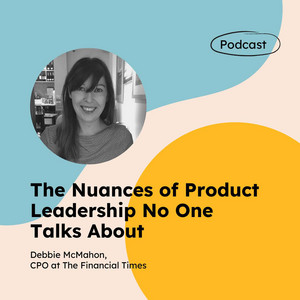
My guest today is Debbie McMahon, Chief Product Officer at the Financial Times.
And I have to say, I feel so privileged to have had this conversation.
Debbie shared her candid insights about how her role has changed over the course of her career timeline, particularly with respect to internal and external relationships, including the things no one tells you to do and the things you shouldn't do, even though everyone says you should.
She also shared her approach for keeping her scope of responsibility balanced and how intentional relationship building bears fruit.
Let's jump in. Oh, by the way, we hold conversations like this every week.
So if this sounds interesting to you, why not subscribe?
Okay, now let's jump in.
Welcome back to the Product Manager podcast. I'm here with Debbie McMahon. She is the CPO at The Financial Times.
Debbie, I'm so honored that you made time to join us today.
I am delighted to be here on a thankfully sunny afternoon here in London.
Oh beautiful. Okay, I'm jealous of your weather.
We had a snowfall last night, So, wow.
Okay. So can you tell us a little bit about your background and your journey to becoming the chief product officer of the financial times?
So, yeah, I've been the interim chief product officer at the financial times for about nearly six months now.
Prior to that I'd spent nearly three years at the FT as a product director, leading the B2C part of the business and also the, I guess we can call it content as a service part of the organization.
We only have one homepage, one set of adverts, etc. Yeah, that's my journey at the EFT. I'm loving leading the entire product organization.
It's quite different.
And I think we'll touch on that a bit today.
Before that, I worked in the BBC and before that on Universal Credit, which is a government program within the UK.
And that's where I started my product journey.
We know one of these slightly random, wow, how did I end up here?
But yeah, it happened.
Wow, yeah, it's incredible.
And I'd love to dig into it a little bit more.
Today we're going to be focusing on the ways that stakeholder management evolves as we climb the ladder of product leadership, which is a journey that you are very familiar with.
So to kick us off, I'd love to frame this discussion in the context of seeing yourself in the product, which is something that you kind of had mentioned before, it looks really different from one role to the next.
So what does it look for you across the different stages of your career?
Yes, it's really interesting, isn't it?
When I started out, I think I tried to remain as this sort of neutral party, you know, somebody who's like, you know, no, it's just, I don't really have a view.
I have no stake here.
What does the evidence say?
what do the stakeholders need, what does the business need, what do our customers are seeing, and you sit in this weird world in between.
And in the end you, like I think I realised that doesn't really work.
Sure, it probably works for most things, but ultimately it doesn't in the end work for everything because weight is your opinion, weight is this thing that also makes the product hang together like it has to be coherent, it has to feel like it makes sense, and if you kind of go with, oh, here's everybody else's view and I'm just collating and figuring out, you know, where the best opportunity is, like it's, I don't think in the end it's going to work.
Right now, as I'm in the CPO role, I've set my stall out super clearly and gone, oh I think I really cared about just now is how mobile first we are building our products.
Not just the end outcome but how we're building them and how that relates to the data and evidence of how people are using them and also the expedience that I want our customers to have. I want it to be a mobile -first experience.
It is all about me being able to go back and go, look, this is what's changed.
My current boss said it quite nicely a while ago, he's like, I always look at the start of the year and then look at the end of the year and go, what wouldn't have happened without me?
And for product people, sometimes that can be quite hard. And that's why I have this thing about you've got to see what is you and what is your contribution to the product in a way that also, like, sure, isn't just your opinion, but make sense.
The other thing that I'm super were banging on about just now.
Anybody in my team who does listen to this will be like yeah Mobile First we've heard that Debbie we know we're getting there but the buttons on my site are terrible they're all different sizes and colours and shapes and sorry Darcy but she knows and you know when I look at that I go no, that does not represent me, that's a thing that I care about and I go no that is not a good enough experience.
Sure is it the most important thing?
No probably not but it's a thing I'm going yeah let's do something about that because it's where I can reflect quality of the experience and how premium I want our experience to be back to our customers, but also to my teams. I've kind of talked about some of your team members, and I want to talk a little bit about relationships.
So, you mentioned before that the product engineering relationship is probably the most important one for product leaders.
How has that relationship evolved for you as you've transitioned from director role into CPO position working directly with CTOs?
Yeah, I cannot emphasize how important I think that relationship is.
Like we talk about stakeholders and how important as a product person is to work with stakeholders, like your engineering colleagues are not your stakeholders they're like your other arm is how I see it without them.
Neither of you can really get anything done which is actually quite unique I think.
When I started to think about roles, most people in the end can get stuff done themselves but PMs and engineers really can't.
Sure you could build stuff but what would you build?
And sure you could figure out what to build but how would you build it that just doesn't really, you know, two sides of the same coin.
And I guess the thing that I found really interesting is that I have had some really strong, I guess what I would call peer relationships in many different places that I've worked.
Alice, hi, Alice, who's my engineering director here at the Financial Times.
We had a really, really delivery focused relationship.
Yes, sure, we were all about our outcomes, what is it that we're trying to achieve and how are we setting up this organisation in order to succeed.
We had our top three priorities and our shared goals and every time we met we'd go through these three things, how are we orientating this group of 120 people to get this stuff done because these are the big outcomes we need to achieve.
What's super interesting is I move into the CPO role and I have this really strong peer relationship with Rebecca.
Hi Rebecca! Who actually interestingly used to be my boss in a previous world.
It's, you know, funny how things come around, isn't it?
That's amazing because I already know Rebecca well and we've got a good relationship together as individuals, but I sort of look around and go, oh, the things we're talking about now are quite different.
We're talking about who's going to deal with this particular vendor.
Do we care about this problem, rather than how are we going to get it solved?
We're talking about the size and scope of the different product groups, not the individual pieces of work anymore.
And it's not wildly different, but it is subtly different.
And I think getting used to that dynamic and thinking about the fact that that relationship was now not built on our need to get stuff done every day but it was more built on how are we running our portfolio and how are we running a set of products particularly since at the AFT and I know for some people this will be a wee bit different in if you're working in a single product just a giant single product, maybe that is a bit different but the AFT has some portfolio products that are very separate, you know they're not necessarily interacting with each other every day so the sort of interchange
between them is not really there and so our conversations are uh we could talk about this thing but it only relates to this one an area of the business, but we actually need to talk about the things that relate to all of them.
So much more about people, much more about what the overall shape of the organisation is, and interestingly, much less about the work, which in some senses is great, but in some sense is back to my previous point, you then need to find other ways to make sure that you, particularly as a product person, are represented through the work.
Yeah. Okay. So I want to dig a little bit deeper into this.
I think it's really fascinating how the scope and the nature of the work changes so much when you transition from one role than the next.
So let's talk a little bit about managing a delivery unit as the Product Director versus leading an enterprise function as a CPO.
What's the difference in the leadership approach?
And, you know, what are some of the technical differences of how your day looks?
Yes, it's so interesting.
I was just talking to one of my Product Directors about this yesterday, he was asking how I was enjoying the role.
And I talked a bit about this to him.
So saying, I feel like I used to sit here in a senior leader role in the organization.
But I knew what my, I knew what my scope was and it was all about getting stuff done.
Sure making good decisions and good outcomes but it ultimately was about getting stuff done.
When I moved into the CPO role I sort of did have this perception as oh I've just now got five delivery units.
We've got four product groups I've got five delivery units it's just about getting stuff done across five different things.
It'll be the same but bigger and more complicated.
Well like it really is not.
I find myself like a much greater amount of my time is on things that I guess I would say, are super consequential to people's lives.
Like, how much money are we spending on pay rises and promotions this year?
Are we upping the budget for training or are we not?
Are we moving people around and stopping doing some stuff and starting doing some other things which will change people's jobs?
That kind of very people, yeah, sure it comes with a product lens but it's a very very people -orientated and like the absolute purity of leadership.
But you know I've got 100 people, that's a lot of folk in the product and technology organisation of the FTE.
I think there's the 450 perms and another 100 contractors, it's a lot of people for us to as a sort of group make sure that we are supporting correctly.
But then what I've also found super interesting is, I feel that because my scope as a director, it was relatively broad, I had 12 teams, but I was able to be quite connected to the work, not involved in the detail, but I feel like I was able to impart those messages, so of get involved where necessary, help support unblock.
That's much, much more difficult a CPO role.
I think there's 28 teams now and as I said before there, some of them are very, very different, you're working in very, very different areas that are not necessarily connected to each other.
So finding the threads that you can pull on, that's why something like Mobile First is super powerful cause it's a thread that can work for everything.
But what I have found is, I actually end up diving into the detail, further into the detail than I did as a director on a tiny number of things.
I found that fascinating.
I'm like, most of my time I'm up here quite far away from the work and thinking about the organisation and how we work with the rest of the FD, which we will come onto later I think in more detail, but I've kind of gone, ah, for me to have the impact I need to, I need to set out.
There's always three things, anybody who knows me I'm slightly obsessed about things coming in threes.
So what are the three things?
And I've said here are the things at the start of this year, I've written them down, I've told all my team, I've told people who work for my team these are the three things that I really care about and I am going to get involved in.
And so we're doing some stuff on content transformation just now.
I was looking at the designs and kind of going oh I don't really want this white colour, really what we want.
And it was only afterwards that I kind of went, I would not have done that like six months ago I just wouldn't have been involved in that level of detail.
and it's super interesting, but it's on a tiny number of things.
It is literally three things, you can't do that in very many.
But that's sort of my way of both imparting again myself into the product, but also in keeping myself connected with where are we headed?
What is our strategy?
What impact do we want to have on our business and on our customers, while most of my time is spent over here in a completely different thing?
Yeah, I really love that insight on kind of balancing the macro and the micro.
You know, micro where you can make an impact that's significant, and then macro where your time needs to be disbursed.
So that's a really great approach. Another thing that I wanted to talk about more related to relationships is the importance of understanding the job of the stakeholder in front of you.
The stakeholder, or the arm, depending on who you're speaking to I suppose.
So can you tell me what that looks like and why you believe it's so critical to your role as a product leader?
Yeah, definitely. Like, I think gone are the days when product people could live in a vacuum and kind of go, oh, well, I care about this, like, that the customer is happy and the customer has what they need.
Like, no, that's not what we're here to deliver.
if you work in a commercial organisation or even a non -commercial organisation that has specific outcomes that needs to achieve like cost -cutting or revenue growth, you have to be able to contextualise everything you're doing with the business.
And it might be very commercial parts of the business, like we have at the FD where we're a subscriptions business and a sales business and an advertising business, or it might be slightly different parts.
So we also, our journalists are really important stakeholders for us because that's what we are getting out there into the big wide world, our product is our journalism and if you don't understand both how those people need to go about doing their jobs and I don't just mean if you work on internal tools.
Sure people will say oh yeah, yeah if you work on internal tools of course they're my customer.
Yeah great, amazing that's very important but even if you don't work on internal tools that is how ultimately your product is being delivered to your customers.
It is the journalists that are writing stories and they have to get those stories on to the site and that is essentially how your product is delivered.
Or it is through the marketing messages that are communicated or the sales person who is talking to an account manager at a business who may want to buy your product.
If you don't really understand how they're communicating to the people that they meet, what they say about your product, what feedback they get, and how they go about doing their business.
And also how they are measured and managed and what reporting they need, like you're missing a huge bit of the jigsaw.
At the end of 2023, we had a new product manager start in the retention area of our business.
And it was an area that we hadn't actually invested in a lot.
We had put a lot of energy over the previous couple of years into acquisition in discussion and an agreement with our colleagues in that part of the business.
But we were now going to invest a lot more in the retention side.
I asked that product manager to go and spend a lot longer as part of his onboarding with his colleagues in that part of the business and go to, not just the high -level trading meetings that we would already join, but go to their detailed weekly meetings, go to the discussions that they were having with their managers to understand what questions they were being asked and how they went about reporting and how they went about making decisions on spending their money and marketing campaigns.
And he came back with some fascinating insights that without that extra level of detail, we just wouldn't have gotten.
Including some stuff where it turned out that we were using different numbers to describe the same thing, which is clearly where some of the confusion that we'd had in some of those conversations previously had been coming from.
And you're like, wow, okay.
There's sort of no reason for that.
You know, it's just two different departments that have focused slightly differently and have ended up in slight...
no, not going in different directions, but just slightly parallel to each other.
That just reminded me of how important this is to really get under the skin of that person.
One of my group product managers went and observed an individual editing a newsletter not long after she joined because she was much more in the content part of the business and watching somebody spend nearly two hours and then nearly get to the end but get really badly interrupted by the environment they were in and then have to like go back like about 20 minutes into their work and just understanding, oh wow that's like the concentration and you know he's having to get a sense of the whole thing, you can't just do it bit by bit, and just understanding that gives us a world that we don't inhabit
was just incredibly powerful for her, but then of course she can also tell that story to me and to her colleagues, to help them understand.
And I think we're never going to do these people's jobs well sometimes.
Maybe we will, you know, who knows.
Some PMs do write really well and become journalists.
That's definitely true.
But the ability to have both the level of empathy, also the level of knowledge to be able to speak credibly I think is really important.
I'm glad you brought up empathy, because I want to talk also about external relationships, so obviously at the CPO level, that's another very critical aspect of the role, is to manage those external stakeholders as well.
How do you effectively manage relationships with folks like vendors, partners, industry peers, and still maintain a focus on internal priorities?
Wow! Don't open your LinkedIn, it's one thing.
Okay, that's bad advice, but like sometimes don't open your LinkedIn.
It is amazing that you put a job update, or you get a new job title and suddenly a million LinkedIn messages of wonderful lovely people congratulating you, but also of like a thousand vendors wanting to sell you something that you definitely didn't know you needed.
We get it at all levels, but like every time I've either moved jobs or gotten more senior it just gets more and more extreme.
So one thing I would say is for anybody out there who's trying to sell me something, I'll tell you if I need it.
Because that's the only way to handle it.
So this is one of the things that the CTO at the FD &I spend quite a lot of our time on.
Who is talking to who?
Let's one, make sure we're not duplicating because that is a waste of the small amounts of time that we do have, but also who is best placed to have these conversations in order to make sure that we are learning about the things we need to learn about, but also not just tag teaming and both of us going in and having conversations just because it's more comfortable.
It's like you have to see a lot of trust to each other and be like, that's fine, you ask my questions, you go talk to them.
And a lot of the time I say, Rebecca, the first thing we cared about is this tech good?
Because most of the time we're pretty clear in the customer outcome.
So you spend a lot of time there.
It's sort of the same within the organization itself.
So there, I think I would say that I have found it much more powerful to have that technology product and a lot of the time data relationships represented at the same time.
What I have found in the past is when you try and go, oh will you talk to this bit of the business and you talk to that bit of the business, you do end up sometimes in quite circular conversations and like that kind of being able to be there and be like, I don't mean we are your nited front against the organisation, but you know like we've spoken and discussed this, but you've got our combined view, but you've also got all of us to get our combined knowledge, information, questions, you know, we don't have to let go away and have another meeting because a more technical question was asked or anything
like that, I think that is quite powerful.
At the FT, we've got these things called pillar boards, which are ways of collecting those people, but also some of the really important stakeholders to also do the same thing with them.
We don't necessarily want to have the same question discussed or the same issue discussed with the editorial team and then with the ads team.
And then so how do we create forums where we can do this?
People can hear stuff, but they can also has questions, but they can heed each other.
It's not just, you know, always us giving out information and taking information back is that kind of like, oh, do you see that there's a bit of inconsistency here that your preference is for this?
But over here in this part of the business, their preference is for this.
And maybe we are not necessarily the people who should arbitrate, maybe, like, you two talk to each other.
I think the thing that I've also found really interesting is how do you make sure that as you're doing that, to your point about how do you then focus on making sure you're getting the work done and your teams a lot of it is about making sure that you're gathering the information you need to gather and you're finding time to impart it.
Every week I feel I learn again oh no you need to repeat things, repeat them, repeat them, repeat them more, repeat them more, repeat them again, repeat them again and that is a lesson that any of us can never learn enough because no matter how often you think you've said something you've never said it enough and for me it is a lot been about okay I've gone and learned this and maybe in previous roles in my career, because that imparting of information is not one of my strongest suits, I would often go, oh, yeah, great.
That's super important information.
I'll file that away.
And now I'm like, no, no, wait as my vehicle to go and tell that to someone.
I need to tell that to someone, maybe my whole team, maybe one specific person.
Who is it I need to tell about this?
And I do that after every conversation I have and go, right.
Who needs to know this?
There must be someone because it can't just be me.
And that as I've made that very conscious effort in order to make sure that that's part of the way I focus internally is by going, right now, I've told you what I've learned.
You can now do something with that because you're the person who can get something done.
I often can't. As you're telling me this, it's starting to kind of dawn on me the level of mastery that you have to have over your communication skills and the amount of empathy that that requires to kind of manage all of these different parties at the level and the depth of information that each of them need and be able to delegate.
This is fascinating to listen to.
And I wanna talk a little bit more about communication more in terms of almost emotional mastery or how do you show up for your team?
So, for example, there's a popular narrative around bringing your authentic self to work.
Ha ha. I know. I have views about this.
I have views about this.
Well, that's exactly what I wanna hear.
So what are your thoughts on bringing your authentic self to work?
Take me through your thought process around this narrative.
Yeah, yeah. What I would say is, honestly, no one wants you to bring your authentic self to work.
That is my hot take.
Now, of course, there's always an exception.
There's one in a million, there will be someone out there who's like, No, no, no, I want your warts and all, and that's the way I will be inspired by you.
But 99 .9 percent of people do not want that.
They don't want to know that you've got a headache, that you fell out your partner, that your car's got a flat tire.
where they have all those problems too and they are dealing with all those things and more they don't want to hear about yours.
You are their boss, that is why your peer relationships like the ways you get support and you know that kind of slightly lonely at the top thing that I'm sure we will touch on at some point is really true.
Like if you start offloading onto your team they're just going to be like, you're the one in charged if you can't sort of, what chance do I have?
The other thing I would say is people want to hear about, they don't want you to be perfect, they don't want you to be like a robot who's just like, I'm fine, everything's great, thank you, bye.
Nobody wants that either, so yes as with everything it's a wonderful balance you need to strike.
I do talk about the messes I've made and the mistakes I've made in the poor decisions I've made and people do want to hear about that, but really only after the fact.
They don't really want to hear about at the time and often they don't even want to heed about it in the times that it might affect them.
So I usually talk about I usually always do something on like some of the worst decisions I've ever made.
I am a human. Like I've made tons of bad decisions but it was from the previous job or the job before that because that gives people a level of confidence that like, oh she won't be so bad this time, she won't make those mistakes with us, we're in safe hands you know.
And of course they know that's not really true.
I always remember this time when I worked in Universal Credit and we were under a lot of pressure a couple of things had gone really badly wrong.
One of them really unexpectedly and it needed fixed really quickly.
It was days when we're all in the office so everybody is like kind of sitting around and we sat and my team sat in these two banks of desks and one of the women on my team turned to me and she was like, what are we gonna do, Debbie?
And I just went, like I was really think I was like, I don't know.
And that was like entirely the wrong thing to do in that moment because I could feel it, I could feel the kind of like, you know, the raising of shoulders the tightening of the this, of already slightly scared looks, becoming more scared and confused.
And sure nobody wanted me to lie and say oh let's just do this random thing but what they needed in that moment was reassurance.
They didn't need me to go go and see that in the toilet or go and see that did the other head of product or to my boss like that's all fine.
And afterwards when we got through that situation and we did figure out what to do in the end, like a couple of them came to me and said like we really hated you doing that don't do that again.
It was like horrible, because if you didn't know what to do what chance did we have?" and then we thought it was all going to be a disaster and it was not fixable.
And it's like, oh that is an interesting way of looking at this, which is about what people need from you in the moment and trying your best to give that, while still being a real human and not lying and not pretending things are better than they are, but also remembering that you bear more responsibility and it's your job to bait it, and when you need support you need go elsewhere and not give that to your team and expect them to support you back.
Sometimes they will just because of life.
Some day just go ask me in one of these interview questions like you know what would your team say about you and you know I actually hadn't really asked people directly and I thought of some stuff and then I went back to my team and actually asked them what would you say and they were like that you're the person that eats all the biscuits and never buys any.
And they were saying it funnily but it was true and I'm like this is a way you can all support me.
Great. You can buy the biscuits.
That is fine. I'm fine with that.
I don't need to buy the biscuits.
But in that sort of reassurance and that support, and also just in accepting that everyone's got stuff going on and problems, and you keep yours to you, but you need to take some of your teams away from them, because that is your job.
I love this insight.
And I love the anecdotes too.
They kind of really illustrate sort of how that balance looks in practice.
Obviously, you don't share all of your thoughts with your team, but some you do.
For example, your thoughts on the design and the like of those things that you do focus on.
So how do you approach delegating that?
How you delegate thoughts and preferences to other leaders rather than just delegating tasks, which we would have done probably in previous roles?
Yeah, definitely. I think the balance here for me is, where could the car crash versus where might the car just go on a slightly detour or wobbly journey.
That's why I'm always thinking about, which is what is the consequence of this choice?
What could happen here?
And if the car could crash, yeah I'm going to be more involved, and I'm not necessarily there delegating a task, but my approach to delegation will be like delegation with active support.
Like being there to be like, yeah this is hard, this is consequential, like what do you need from me?
Whereas the rest of the time you do just have to accept and don't sometimes grit your teeth and go, oh that's not what I would have done.
Oh no. But like that is okay because how can you possibly be in 28 places at once?
If you try to be in 28 places at once I guarantee you'll be in none of them and like that's not going to help, but it's also recognizing the strengths of your team and being able to go, oh actually this is something that this person is really good at.
So even if it is really consequential actually let me just let go and let them get on with it.
But over here this is something this person has never done before.
So how do I therefore make sure that whether it's a consequential thing or not, that I've given them enough support and given them the right tools in order that they themselves in that moment can both learn but also feel supported enough?" It's a really tricky balance.
It's a constant, like, oh have I gotten too involved in this?
Well maybe not, maybe not enough?
Oh, a bit more involved.
And again it was one of the conversations I was having with my project director yesterday was just asking the question of am I getting that balance right for you?
Like do you feel like I'm involved enough and giving you enough support?
Because there is a real risk that people feel ignored or just like, oh well, let's get on with it, you know what you're doing, you're a senior person and the answer appeared to be mostly yes.
But I think there's no easy answer and also the thing I've always got to remember is and all of us the more senior we get are what we want for ourselves and from our managers and our bosses is not necessarily what our people want.
I'm very much a kind of, nope, leave me alone, I've got this, please leave me alone.
I'll sort it out myself, you know, I would call a get your tanks off my lawn person as me.
No, like this is my space, just leave me but that's not how everybody else is.
And by doing that, by sort of replicating your style onto others without really examining what they need, you can end up with quite a mismatch between with people kind of going, ah, you've just left me alone, versus others who are like, oh yeah, this is exactly what want because I'm quite like you and it's you know, you've got to find that balance.
And a lot of it is, this is what I'm like as a leader and this would be what I would naturally do.
How does that work for you?
And just being honest about that.
We can't be everything to everyone.
Also how do you help your team use each other?
You know, if it's something that you are not great at, there probably will be somebody in that peer group who is good at it.
So how can you match them up and go, not always me, but how about you work with this person on that.
I think that's a really important piece that can really serve us well at any level to be really aware of the way that we are, and I think a lot of misunderstanding and friction can be avoided just by understanding our default ways of being and working.
I really appreciate how you incorporate that into the conversation.
You did mention, though, a little bit about being left alone.
Let's talk about loneliness at the top, the trope of it's lonely at the top.
What does that really feel like?
I think that we have kind of before entering an executive role, there's sort of a idea what that looks like, but in practice that it seems to me that it's very different than you'd expect.
What strategies have you kind of found effective for managing that sort of loneliness, and what does it really feel like?
Yeah, yeah. I think it is inevitable, like that trope just is true.
I think it is, but it doesn't have to be all bad everyone, it doesn't have to be all bad.
So I think for me, there's three things.
one it is what is that peer group and get yourself involved with your peer group, whether that be, you know, a group of product directors or whether it be your individual sort of peer engineer, you know, engineering director, whether it be the CTO and the CDO.
Like find at the FT we have a peer group that also includes the VP of cyber and the VP of portfolios and programs like that is a good group of people who are all very different as you can imagine, you're very different and leaning on them and being like oh you know more about finance than I do or Rebecca you're definitely better at talking to vendors than I am and just being really honest and sharing that load is definitely one thing.
Secondly it's figuring out for you as a human where your resilience comes from.
Some of us get it internally, I sort of draw strength from myself, others get it from others, others get it from tools and techniques like figuring out where your resilience comes from and what you need to do to keep it topped up.
For some people, that's about how you work, how you have breaks.
Loads and loads of different things.
But thinking about where you're drawing your resilience and keeping it topped up is really important.
And then third, make sure you've got releases outside of work.
Whether that be moaning to your friends, not about like confidential stuff, but you know, you can moan about like this was really hard and you know, like that kind of, you know, somebody who knows you as a person, and who can keep you grounded but also tell you you'll be doing great.
They don't know. But you know just that kind of thing that you need for some people, for some people it's their kids or their partner, some people it's going and doing exercise and being told they're doing a great job at exercise and like that, then translating that into their work.
But it's, you do need something that is helping you step a bit out of the environment but also remind you that you're a human, you're a real person, and you're doing great.
Inevitably, you will not be doing perfect, but you'll be doing great.
And as long as you're doing your best, that's all you can do.
This has been such a fascinating conversation.
I really appreciate, Debbie, the empathetic approach that you've shared with us today.
I want to thank you so much for some of the tactics and insights and anecdotes you shared.
This has been so valuable.
Where can listeners keep up with you online?
Please do message me on LinkedIn.
It's genuinely fine.
Just not if you're trying to sell me something.
You'll find me on LinkedIn.
I am not much of a writer, so I don't write much, but I do post about your work and the stuff that we do, both at the FT and also I have the occasional moan about equality of women and things like that.
So people will usually find that interesting.
So yeah, please follow me and reach out if there's something I can help with.
Although thanks so much for joining us.
Delighted to. Thanks for listening in.
For more great insights, how -to guides, and tool reviews, subscribe to our newsletter at theproductmanager .com slash subscribe.
You can hear more conversations like this by subscribing to The Product Manager wherever you get your podcasts.