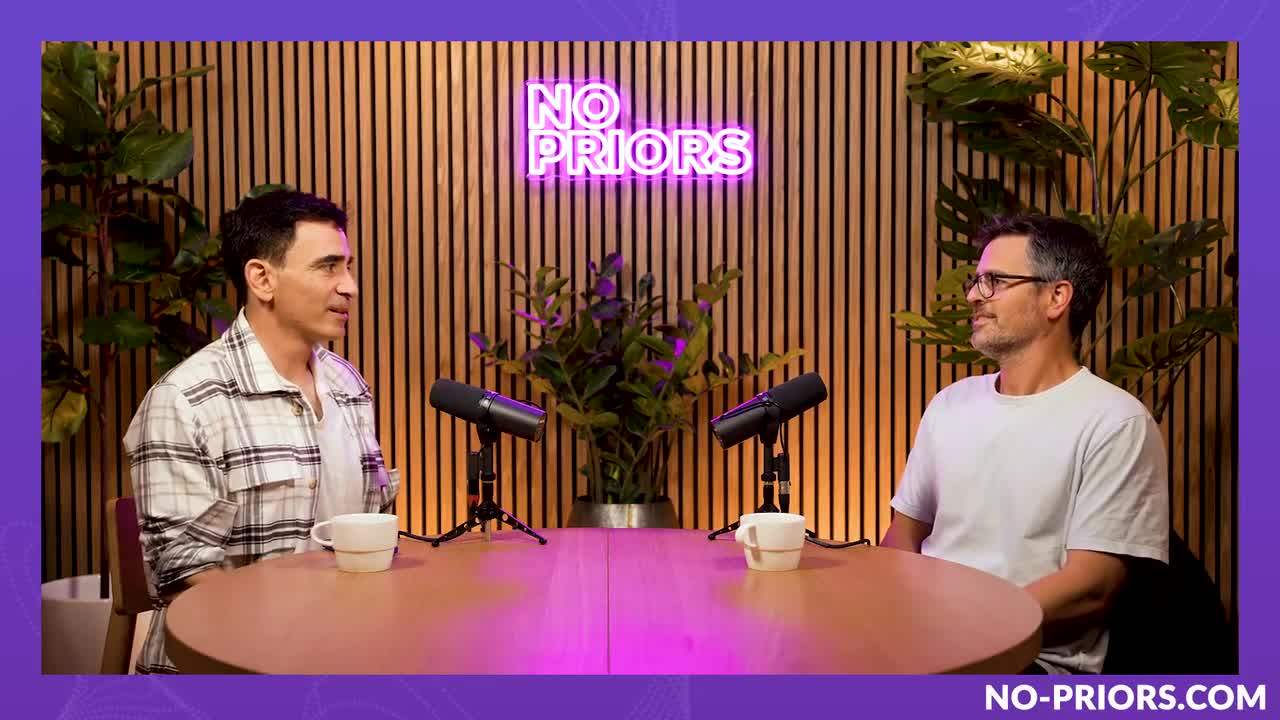
Today, on No Priorities, I'm joined by Zach Lloyd, the co-founder and CEO of Warp, a terminal product and AI tool for developers that allows you to do different sorts of coding applications.
Prior to Warp, Zach was at Google and he also started another company called Selfmade.
We talk about AI dev tooling, but we also end up talking about human consciousness, and how can you tell if an AI is actually sentient?
Zach, welcome to NetPriors.
I'm excited to be here.
Thanks for having me.
So you have a master's degree in the philosophy of science.
And if you're going to take a very different lens and abstract out of the coding world and all the things that we tend to think about every day, how do you think about this societally in terms of this big wave of AI that's hitting us right now?
And where do you think some of these really big societal impacts will be?
The way I think about the advances are it's kind of like we are distilling intelligence.
And so there are, I think, people who consider what's happening.
It's like they're like are we recreating people in some way?
Are we recreating consciousness?
But it's not that.
It's actually.
What's fascinating to me is how much intelligence you can get out of just like next token prediction.
And like, what does that say about the way that our minds work?
Something I'm always thinking about is like, is this how our brains are working?
Are we doing next token prediction?
And I don't think so.
Like I think that there's, going to be some further AI unlock.
There's actually a book about this that I think is really interesting called Blindsight.
It's like the sci-fi book where they separate consciousness from intelligence.
And basically humanity meets a space-faring civilization or civilization is overstating it a space-faring intelligent being that's not conscious.
What are the implications of that and how do you think about that and how do you communicate with that?
Are you basically saying that that's kind of your view of ai right now?
I think that's what it is at the moment.
It's like we've distilled intelligence or something that, like from like an instrumentalist or like functional perspective, is able to do things that we recognize as intelligence, but it's totally mechanistic.
I don't think anyone who's looking at this thinks that there's any aspect of consciousness to it.
I think that's like a very, confusing thing for people.
Because the classical test for this was known as the Turing test, right?
Totally.
And so the idea there is if you can't tell the difference between interacting with a computer and a person, then that computer effectively has met the intelligence bar of a person.
Yeah.
But in our interactions with this type of AI we're having very in some cases it feels like very deep conversations.
We're asking about relationships.
We're asking about all sorts of aspects of our own lives.
And it's giving very cogent answers.
Totally.
They make a lot of sense.
Yeah.
And so there's this interesting separation of again, consciousness and intelligence?
Right.
Is that how you interpret it?
That is how I interpret it.
And the Turing test is passed.
What's crazy to me is like, we just passed it and no one seemed to care.
So what do you think is the next test?
Or what is the right test?
Like, how do we actually test for consciousness?
God.
I don't know.
I don't have a good.
I mean, that's a super deep philosophical question that I don't have a really good answer for.
I mean, it should be mechanistic, right?
The Turing test was very mechanistic.
Yeah.
And I mean, there was other tests we had before, but we would consider super intelligence, right?
Can it beat us at chess?
Then it'll be super smart.
Can it beat us at Go?
Can it beat us at different things?
Video games, et cetera.
You know, like we keep coming up with new tests that these things pass.
And then we keep saying, well, it's not conscious.
What would you want to see from something which is like running a computer program to make you believe that it had consciousness?
Are you looking for certain behavioral characteristics?
Or is the problem that if you really understand the mechanism by which it's working, that you will never credit it as being conscious?
Which is crazy, because humans, at least my belief, is that it's also.
There's a mechanistic thing that's happening.
Now you're running some form of math in your brain, and it may also just be like matrix math and some sort of like series of compounded functions, which is basically all you're doing in a neural net, right?
Right.
You're just recursively compounding functions.
Totally.
So, you know, it's an interesting question because, if you look at memory as an example, is memory a predicate for consciousness?
Not really right?
There's people who've lost the ability, without exactly exactly, and these, these um models basically, are brought up, they are fed a stream of tokens, they output a stream of tickets and they're shut down yeah, and so it's an interesting question of is it?
You know, is there some sort of other modules that are missing here that would allow us to think of it as a conscious thing, Because it does reasoning?
It definitely does reasoning.
It does interpretation of language.
It does synthesis of language and ideas and knowledge.
I mean, I have a close friend who's doing a PhD in philosophy and he now says that conversing with GPT-5 is Better than conversing with a professor.
Better than conversing with his professor.
Oh, really?
I was just joking.
No, that's what he says to me.
He's like, GPT-5 gets it.
He's writing his dissertation, and he's like...
And that's crazy, but we don't, we don't credit it for consciousness.
And I actually think rightfully so because like, so what do you think is missing?
I think people would start doing more credit for consciousness if there was more of a like, a feedback loop where, if there was more of a sensory experience that was tied to it, as opposed to just like.
What do you mean by sensory experience?
Probably we're going to.
I would imagine the first thing we're going to credit is being more conscious or a little bit more robot-like honestly, where you have some sort of like live input from the world that you're reacting to.
But again it's going to have the same problem where it's like, as long as we know what it's doing, we're very unlikely to attribute true consciousness to it, which isn't fair.
But, like I actually don't know how we will know when there is a conscious thing.
Yeah, because it does raise interesting ethical questions.
Yeah.
Because the moment an AI is actually conscious, if you're doing certain things to manipulate it, to hurt it in a certain way, you know you're starting to get into these odd ethical straits.
Totally.
I do think, though, that some people, this distinction isn't a thing that they recognize.
And the way that you read stories, and we actually had this happen with Warp, where there was a person who thought that Warp's AI was, like you know, sentient or conscious in some way, had like a very strong reaction to it, which makes sense.
It's like if you don't know the like mechanistic underpinnings, then already people think of it as like being kind of conscious.
And that happened at Google very early.
It happened at Google three or four years ago, if you remember.
Right, I do remember this story.
There was an engineer who I think they were using Mina or one of these really early ChatGPT-like internal things, before Google launched anything and ChatGPT came out.
There was internal versions at Google and other places.
And, uh, you know, this person thought that the AI was conscious understandably.
So, um, yeah, that's very interesting question.
Yeah.
You've worked at Google.
You've run companies before.
You've started companies before.
You're now working on warp.
Can you describe what warp does and how it's different from other tools or companies in the in the world?
Yep, so Warp is what we call an agentic development environment.
It's grown out of the terminal.
The basic concept of the app at this point is it's a platform for telling your computer what to do.
You can sort of tell it in terminal commands, which is Warp's original product, or you can tell it in english and if you tell them english it launches an agent and the agents can do all manner of development tasks whether it's coding or setting up a project or debugging while your server's crashing and so it's a very like horizontal general purpose and i think unique interface for developing with agents And so a lot of the other coding tools out there are either just kind of a web interface or they're doing like a cognition or there's things like cursor and others where they're like an IDE as a starting point.
Yep.
Obviously Anthropic and Cloud have their own approach.
What do you, what do you think is the benefit of doing the terminal and starting there as sort of the launch point for a lot of these products?
The competitors are typically like VS code clones.
They all have a sort of ID centric approach or if you're taking a terminal centric approach like cloud code, the most common thing is it's just like a pure text based terminal app.
The advantage of being at warps layer is like you get the command line interface but we're the outer app.
And so we can do things with the developer experience in the UX.
Like we can have editing features where we think it's appropriate.
We can build like a code review interface.
And so we have complete control, but still the terminal first approach.
Yeah.
And you folks have been growing really well.
Like so you're close to a million MAUs.
You're doing something like a million in new revenue every seven to 10 days.
Outstanding growth.
Are there specific features or use cases or things that are really driving this adoption?
I think the biggest thing was moving into the coding market, to be honest.
For a long time in Warp's history we were known as the AI terminal, which is cool and like.
We supported terminal use cases really well, like how do i do this thing with docker or git?
But the action is encoding and, like most development activity, one way or the other is touching a code base, and so we really started to inflect when we launched a great coding agent, which was like three, four months ago, honestly.
So that's been the biggest change.
And how do you think about the different parts of the coding market?
There's vibe coding, there's professional code, like they're all, there's all.
Just one thing is are these separable things, or i think it's pretty separable?
So for warp, our target is pro developers building software that's economically meaningful.
So we really want to focus on actually people who are using agents to build kind of hard apps, apps that might like go into your Mac doc or be pinned as a Chrome tab, as opposed to vibe coded apps, where I think it's more of a long tail play.
And so I do think, by the way, it's awesome that anyone can code at this point.
But I think if you look at where most of the value is in the software market, it's not in those long tail apps, it's in like a relatively small number of apps that are super heavily used.
And that's my background.
Like I you know I've worked on one of those apps Google sheets and, just like I, have a lot of passion in terms of helping people build real apps.
It's much harder by the way.
Like.
I think it's relatively straightforward at this point for a good agent to, like you know, with relatively few prompts, build like a web app.
It's much harder to apply these agents successfully to pro code bases.
So that's where we're focused.
So I guess one really interesting macro question for me is where is all this heading?
And if you look at it, ChatGPT launched in November of 25.
Excuse me, November of 22.
So three years ago or so.
At the time, there was predictions that AI would take over the world and we'd be running down the light cone, and within five years, everything will change and human activity would be subsumed by AI.
And there's the old saying in technology that less happens than you think in three years and more happens than you think in five years.
And as you think forward, in terms of all these different tools and all these different use cases and vibe coding versus professional coding and the role of a software developer, where do you think we are in two, three years?
Yeah, so the way that I'm thinking of it is there's sort of three phases here.
For most of my career, we were in the world of developed by hand, is how I talk about it.
So my workflow then was I would open up a code editor, I would find files I want to change, I would type some code, I'd have some assistive features and then I would go back to the terminal and I would type commands to build that code.
And I think we're switching away from that to something like develop by prompt, where I start most of the coding tasks that I do right now by prompting an agent, and that agent does some work.
And I think there's a third phase, which is like automated development.
Honestly, I think that's like kind of the bigger market here, and why people are so excited about this space is you can actually use these agents to automate some parts of the software development process.
And so that's like know cognition does that we're moving into this space cursor as background agents.
Um, the rate at which this stuff will happen is like not super clear to me.
Actually, like the, the most recent iterations of the models, in my opinion, were not as big of a step change as like, For instance, when Sonnet 4 came out.
That was a really big step change in coding capability.
I think there's gonna be a mix of interactive and automated pieces of development for a while.
I would guess, I don't know, it's so hard to know.
I think within a couple years you'll have everyone working by prompt and you'll have some slice of development tasks that are Just like in the background, like a server error comes in or a new ticket, a user report comes in.
Something is automatically done, but I don't think it's going to be everything.
I'd be very surprised.
So you don't think there's a point at which all of coding activity just becomes agents doing it, and then there's like a human who's kind of giving high level directions, like a product manager kind of thing, or an engine manager, and maybe i mean honestly maybe, like i think that i think it'd be silly for us not to like, build the infrastructure to enable that.
I just don't i don't know the time frame, but i do think we're going towards something like that.
What i what i really don't think though, is like engineering expertise is going to become devalued, sure.
So i think it's actually, in the short term at least, it's more important to know what you're doing as an engineer than it ever has been.
And why do you say that?
Is it because you need to correct errors that the agents are making?
Is it because things may be architected in a way that isn't scalable?
Is it something totally so it's like.
It's like the agents.
You can think of them kind of as junior engineers.
So if you didn't have someone who was senior watching them, you end up in a situation where these agents will make code that creates bugs.
It could create security issues, it can cause your code base to become really unmaintainable, and so there's actually like a premium right now on these senior engineer skills, where you can architect, where you can review code, you can make sure the system doesn't degrade.
And so again, I would be, if I were like early in my CS career I would be racing towards building that expertize where you don't want to be, I think, is like someone who is just like perpetually in the junior engineer state, because I do think that's at risk.
And then how do you think about different security tools?
Does that say, for example, there's tools like socket or snick or others who are basically looking at you know, whether code has or uh, open source packets or other things have vulnerabilities in them, or they're looking at different aspects of um security holes for code in general?
Do you think that just becomes part of these coding tools or do you think there will always be this sort of standalone companies?
I'm just sort of curious how the overall it's it's an awesome question.
So I think tools like that become more important.
I think anything that does like either automatic security analysis or automatic verification i think actually like languages like rust, things that have stronger guarantees around safety by default, where you don't need to rely on like a human reviewer, become more valuable, whether those things like get integrated or bundled into the coding agents.
I actually don't have a strong take on.
I'm curious if you have a take.
But no, I think that the actual fundamental problem becomes more important.
Yeah.
What do you think is bundled?
What's that?
What do you think is bundled?
What sorts of tools do you think?
Because there's this whole world of dev tools.
Yeah, and there's a security aspect of it, but there's lots of others.
There's design related things there's there.
You know there's a huge spectrum.
Yeah, what do you think just gets just becomes part of coding tooling.
I think there's going to be a class of tools where you sort of start from the front end.
This would be things like Lovable or Bolt or Replit or maybe even Figma Make, if you're coming from the design side.
And you'll have like an all-in-one platform for build an app or even honestly build a business, put payments in it.
It's kind of like the evolution of either a Shopify storefront or WordPress or Squarespace or something like that.
So I think that's all gonna be bundled.
More on, like the core pro developer side.
I can't tell if it's going to be a world of like MCPs and integrations and like all these tools, sort of interplay.
That's one approach.
Or it's going to be more like there's enough alpha and like You put all of these things together.
And I think Warp is a little bit more like this.
Like we're trying to build a single pane of glass, for instance for doing like local agents and remote agents.
And if you get a way better developer experience through the bundling, I think that that approach could win.
But I don't know.
Like MCP, I think, is a pretty valuable approach as well.
But it's not perfect, because you end up like with this sort of secondhand data coming into all these tools.
Yeah, it's really interesting because if you look at different industries early in the industry, things tend to be fragmented often not always
And then late in the evolution of an industry, things get bundled.
And then, when there's a technology disruption, things debundle again and you have point apps and then they start bundling.
And that's just kind of like the cycle of technology in some sense.
Some things that are vertical right now, I actually think will.
For instance, agentic code review.
Take that.
To me that should be part of a holistic agentic development platform, not so much a standalone thing.
So I think some of these verticalized apps there's just going to be, if you've gone through the trouble of building like a really, really excellent coding agent, which Warp has invested a ton in this that coding agent should be reviewing code.
It would be weird to plug in some other thing that needs to relearn all the context, the rules, the coding convention.
So I think there are definitely some things that will be bundled.
Makes sense.
Yeah Shreya, and my team has put together this matrix of companies versus features in the coding market.
And there's a lot of these sort of like single feature companies.
And it almost feels like all these things should consolidate into a small number of players over time, just as they iterate through the product.
I think so.
I think and I think the core technology is like the harness.
So the thing that sits around the model and, like I know, the model companies are also investing heavily in this and then it's like the context.
And so, if you have the rich context in your system, you're going to find a lot of vertical applications where, like I think, security checking is an interesting one.
Code review is definitely one.
Anything CI related.
You're probably not going to want to use a bunch of different systems.
How do you think about it in the context?
If I look at other historical technology shifts, the operating system or the platform often subsumes the biggest apps into itself.
So for example, Microsoft OS, Eventually, they just bundled Windows on top of it.
And those were the four main apps that were being used the most on Windows.
And similarly, gaming was the other big app.
So that's why they started Xbox and Microsoft.
If you look at Google and vertical search, they eventually integrated all the vertical searches into Google directly.
And so, in the context of AI, one could argue that if the foundation model companies follow the same approach, They should bundle, or at least attempt to bundle, some of the biggest use cases.
The clearest big use case today is code.
Totally.
And we already know that Anthropic has launched cloud code.
OpenAI almost bought Windsurf.
It always had early coding stuff.
Microsoft, which we know, are building some of their own models.
Obviously have GitHub and Copilot and all that.
And so do you think eventually those become some of the... fiercest players in this market?
Or how do you kind of view forward-looking shifts in the market and where some of this functionality goes?
I mean, I do.
And I think they're clearly trying to do that playbook right now, where they are seeing like okay, If you consider them platforms and they're looking at what are the most valuable applications that are being built on top of the tokens.
They are moving aggressively into coding with Cloud Code and Codex, which definitely is like as a startup, is a little bit scary, for sure.
The question is, do they have that distribution advantage that, say, Microsoft had?
If everyone's using Windows or everyone's coming to Google for the front door, I think it's pretty easy already to add on the first-party app in place of the ecosystem.
I don't know that that exact same dynamic holds for coding right now.
The front door is kind of like.
Honestly, it's still like a native app that someone downloads on their computer.
So that'd be the terminal or the IDE.
At the moment, yes.
I think controlling that is actually a really interesting front door.
The other front door, which feel like honestly, they're not executing that great is GitHub, where all the source code lives.
That would be the locus of doing all this stuff that I think makes the most sense.
But right now it's a weird dynamic where we have people who are running Cloud Code within Warp and we warp is sort of the outer app in that situation.
So i don't know, you know, the other thing that i i hope happens from our perspective is that there's a lot of competition at the model layer and that the sort of like intelligent tokens become a bit more of a commodity.
Right now the models have a bunch of sort of like pricing power because like there is a real delta between using the frontier model and using like the open source model.
But if at some point the models are good enough where coding is sort of I think of it as like solved, it's like good enough, you don't need to be using the frontier model.
Then it's like yeah, maybe they have an advantage just from brand and scale.
But I think the advantage is not as entrenched as something where it's like literally the front door, like facebook or google or windows uh provides those other platforms.
That's a really good insight in terms of the way that you launch an activity or application then drives what you use.
Yeah, and so the quite the hard part is often switching people off.
That and that's one of the reasons i think people think open ai has a strong competitive position in the consumer world is because it's a default behavior for a lot of people right now is just start ChatGPT and use it for something which is different from the model layer, where there's more switching.
I think in consumer, ChatGPT has a huge advantage.
Once that behavior is default.
Even if Cloud is maybe better, I don't know if it is or not.
Everyone knows ChatGPT.
I don't know if you saw OpenAI Dev Day yesterday, but they're clearly doing this platform play within ChatGPT now, where it's like you have apps within ChatGPT.
I'm sure they'll use that data to sort of subsume or take over whatever the best first party integrations are.
So they're definitely doing that on consumer.
For developer, I don't know that that same dynamic is there.
What made you decide to focus on terminals?
We started talking years ago when you first started doing Warp.
And even then I think you had really interesting ideas about how to rethink the terminal and how to use that as a launching point for all sorts of things.
Could you explain that thinking and how it's evolved over time?
Yeah, so the basic insider thing that got me excited about Warp to begin with is you have this tool that is pretty much a daily use tool for every developer.
It's that and the code editor.
And the terminal itself is something that really hadn't changed much in the last 40 years.
It's a tool also where it's like, if you get good at it, you can really get a lot done.
If you use it, it works across all these different parts of software development, not just code writing.
On the flip side, from my perspective, not a good product.
Just like hard to learn, hard to use, hard to remember commands, super intimidating and just like kind of like a gatekeeping vibe around it as well, in my opinion.
And so the original concept with Warp was like let's build a better product there and see if people will like using it.
The business concept has evolved a ton.
Like the original business concept was like building a collaboration platform, which is like We've just changed our model to be an agent platform, because it's like way more demand for that than a collaboration platform around the terminal.
But the sort of core insight that this is an important tool, it's crazy.
It's actually kind of invalidated through all these agentic things that are very terminal first.
You know, one thing that you mentioned I thought was interesting is that at some point, the model layer may commoditize in terms of its coding abilities.
Yeah.
How far on that asymptote do you think we are?
How close to that do you think we are?
I don't know.
I think that increasingly the limit that we see is context.
And like the reasoning capabilities of the models are pretty impressive.
The problem is like Understanding an entire code base or understanding sources outside of the code, or literally just understanding user intent, are challenging problems.
I still think there's probably much more to do on the model side, but I don't know.
Is the short answer.
And do you think that, from a model capabilities perspective, you've hit a point where, to your point, it feels like certain aspects of the models are slowing down in terms of the benefits or outcomes of further investment of certain types at least i i think so.
Like, if you take, like sonnet, four to four five, and we're big partners with anthropic they have great models like that was like a few percentage point increase on SweetBench for us.
And we've invested a decent amount to be one of the top agents on SweetBench.
And when we went from 3.7 to 4, it was a much more significant boost.
So, again, that's like not...
I don't know what that means about the total underlying trends.
I think something with GPT-5 was somewhat similar.
Certainly an upgrade.
And GPT-5, I think, is actually pretty much on par.
It has a different feel to it and higher latency.
But it didn't feel, to me, as much of a step change as some of the upgrades before.
Makes sense.
What other areas of the AI dev world are you excited about?
So I'm really excited about not just the interactive piece of agents, the way most people are working today, but what can you do if you can program against these agents?
And so, for instance, It's like if you have a version of Warp that's headless, for instance, you can put it in CI and you can start to do crazy things where it's like OK, every time someone updates the code, make sure the documentation stays up to date.
It's like, that's very annoying for a developer.
And so allowing developers to automate parts of their job that they don't like doing, I think is like a big capability.
And then from a business perspective, just like automation is a better place to be than productivity enhancement,
Like one of the challenges with our business I think with a lot of the coding businesses is just proving the ROI.
And there have been these studies that show you know you deploy this stuff on real code bases.
It's kind of unclear if it's actually having an impact.
Whereas if you get something that's more outcome oriented or more just like an automation, I think it's easier to prove the ROI.
And then you're also not limited by time spent behind keyboard for doing this type of stuff.
So, from a business perspective, I'm very excited about like what's unlocked if developers can program these agents.
Well, that's fascinating.
Thank you so much for joining us today on NoPriors.
Thank you for having me.
This was great.
Find us on Twitter at NoPriorsPod.
Subscribe to our YouTube channel if you want to see our faces.
Follow the show on Apple Podcasts, Spotify, or wherever you listen.
That way you get a new episode every week.
And sign up for emails or find transcripts for every episode at no-priors.com.