We are living in interesting times, a turning point in history.
Are we entering a dark authoritarian era?
Or are we on the brink of a technological golden age or the apocalypse?
No one really knows, but I'm trying to find out.
From New York Times Opinion, I'm Ross Douthit and on my show, Interesting Times, I'm exploring this strange new world order with the thinkers and leaders giving its shape.
Follow it wherever you get your podcasts.
From the New York Times, I'm Michael Bobaro.
This is the daily news.
For decades, white South Africans ruled with an iron fist, overseeing the country's cruel system of racial oppression.
So why is President Trump now welcoming them to the U .S. as victims?
Today, John Eligo on how the MAGA movement became obsessed with Afrikaners.
It's Monday, May 19th.
John, welcome back to The Daily.
Hi. Good to be here.
I don't know if you remember this, but the last time we spoke was four years ago, almost to the month.
because in the middle of the interview, my wife began to give birth to our son.
She went into labor and we did not finish the conversation.
Hopefully, we don't have that problem again this time.
No, no, no chance. So, onto the topic again.
Jon, since taking office, the Trump administration has really systematically shut down the programs that designate and bring refugees into the United States from around the world.
And then, a few days ago, the White House made a pretty big exception to that, but I want you to just start with the shutting down process for just a moment.
Yeah, so essentially when Trump came into office, we know he had this flurry of executive orders that he signed, and among those executive orders was an order that essentially suspended the refugee program.
So, this is essentially a program where you have people who are in war -torn places like Sudan, or who've been driven from Sudan, people in the Democratic Republic of Congo, where there's an ongoing war for decades now.
Tens of thousands of Afghans who had been approved, they had been screened and they've been ready to come over to the US to be resettled.
Right. But by suspending the program, you essentially stop all that.
And can you remind us what President Trump's rationale was for doing that?
His broad rationale is that hey, this is something that threatens the interests of the United States.
So they've talked about how bringing in refugees who are not properly vetted for security reasons could come in and harm the country.
And there's also been talk about economically what it could do to the country, that the country could be overburdened and overwhelmed with foreigners, and that can really hamper the country rather than help it.
Right. And I think that brings us to this very surprising scene we saw just a few days ago.
Yeah. So even though Trump suspended this refugee program.
It is such an honor for us to receive you here today.
This is the land of the free.
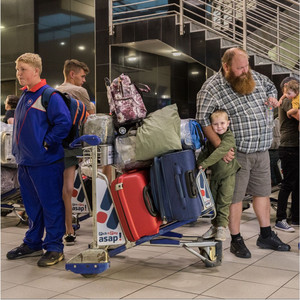
We had dozens of refugees arriving at Dulles Airport, and they certainly did not look like all of those who'd been suspended from coming.
I know you've gone from a long flight.
I cannot believe there are babies and children who are actually so well behaved, this is much better than mine, are.
So these were white South Africans, specifically Afrikaners, who are an ethnic minority in South Africa.
Many of us, our families, have had a journey not that different from the journey that you are embarking on today.
My own father was born in Europe and had to leave his country.
They had a lot of luggage, all their belongings.
They came into an airport hangar and they were given this big reception by some of the top officials in the US government, welcoming them here.
We look forward to after this, to be able to spend a little bit of time with you and get to talk to you guys.
So thank you guys. So about a month after Trump signed that executive order suspending the refugee program, he signed another executive order that essentially allowed this group of Africaners to come to the United States and refugees.
So essentially what Trump was saying was that they can open the refugee program for this small group of white South Africans, but them alone." So what's the story of how this group of white South Africans somehow becomes the single exception to President Trump's deeply skeptical relationship to refugees?
The one group that gets through?
Well, let me tell you a little bit about the Afrikaners, Michael, because it goes back a long way.
So, back in 1652, Jan van Ribeck was a Dutch settler who sort of started the colonial settlements of what's now South Africa.
And over time, these Dutch settlers as well as other settlers from Germany, from France, and parts of Europe would come in, and out of that would sort of rise, this new ethnicity called Afrikaners, which is a mix of these various European settlers who came and settled there.
And pretty early on, with the locals who were already in South Africa at the time, there were clashes, right?
I mean, there were fights over land, there were struggles and tensions.
And the story gets even more complicated over the years as the British come to South And while the British took a lot of the economic power in the country, the Afrikaners amassed political power.
And so then came elections in 1948, which black people were not allowed to participate in.
And in that election, an Afrikaner led party won control of the government.
And once they took power, they created a system that we all know today, that system of apartheid.
So, Afrikaners end up becoming the group that enforces the really brutal rules of segregation that come to define South Africa.
Yes, Michael. So they essentially form this government that relegates black South Africans, the majority population, to essentially sub -human status.
They kick them off their land, they force them to live in these ramshackle townships that got no resources, oftentimes didn't have water or electricity or anything like that.
Their movements, the movements of the black majority were very tightly controlled.
They needed special passes if they wanted to go into cities or towns.
The areas with the most arable farmland.
Those were not areas where black people were allowed to settle.
Those were areas that the white population was able to take over.
And this system ruled for nearly 50 years until the early 1990s, when you started to see much of the world turn against the system.
And you started to see this sort of crumble and the Afrikaners had to sort of give way to the Black majority.
And what does that look like for the Afrikaners who have amassed so much power to have to give it up?
So toward the end of the apartheid system, there were vigorous negotiations over what the Afrikaners would give up, what they would keep and what black people would get.
And essentially, what was negotiated at the time was a system in which black people would get their political power.
But through those negotiations, Afrikaners were not really forced to give up their economic status.
they were not forced to give up land.
Essentially, it was a relatively peaceful transition.
Hmm, yeah, it sounds like they're treated surprisingly well given the circumstances of what they had inflicted on the majority that's now suddenly in power.
Exactly, and to this day in South Africa, you will hear one of the big criticisms about Nelson Mandela who was the hero of the anti -apartheid movement as much as the world knows him, is that he did not do enough to aggressively force a change that you essentially had the system where a small percentage of white people held most of the wealth.
Where you had this large population of black people who were still in poverty and did not have much wealth at all.
Even after apartheid.
Exactly, exactly. And Mandela's whole thing was that he wanted to avoid a civil war.
He wanted to build a country in which everyone could coexist alongside each other, right?
So you had this transition where the idea was that you sort of allow everyone to have their own piece of society.
Now from the beginning, you had this great fear among white South Africans, right?
That things would go horribly wrong, that they would be hunted in the streets and that they would have to migrate, run out of the country and leave very quickly.
And you did indeed have white South Africans who left the country, But there was no mass confiscation of white -owned land.
There was no mass firing of white people.
That never happened.
So how do these Afrikaners, who are largely being spared major dislocation and change, how do they ever qualify as refugees in the eyes of the United States?
They seem like the exact opposite so far in the story of refugees.
Yeah, I think you have to look at what it's like to give up power, right?
So you have, yes, Matt Mandela is framing it as, you know, building a nation together.
But part of that is having to do practical things in order to ensure that a population, the black majority had access to opportunities that they didn't have before.
So that meant looking at things like affirmative action to ensure that companies are hiring black people.
And then there was of course the issue of land, and this is one in which the government tried to say to the white landowners who owned almost all of the land, hey, we'll pay you if you can give us some of that land so we can redistribute it to our black population, to people who've worked on the land and lived on the land for years, but never got a chance to own it.
So it was called a willing buyer willing seller program.
And how much do the Afrikaners end up being willing to sell the land?
There was a degree of selling, but not nearly as much as I think the government wanted.
And so you take that over time.
And what you see is that there's these flash points happening around land.
And what are some of those flash points?
In the mid to late 90s, shortly after the end of apartheid, you start to see this uptick in murders on farms. And this is where we really see the foundations of this arguments that Afrikaners are persecuted people.
Seven murders in the last decade in a radius of 30 kilometers and the killings continue.
In February, armed robbers stormed this farmhouse and opened fire.
They want our guns, they want our money, and they want our land.
What you had was essentially a lot of violence in the country as a whole.
And as part of that violence, you had murders happening on farms. A lot of Black South Africans have felt that the pace of change, the pace of ownership of land has not changed quickly enough.
The white minority which took our land by force.
You must say enough is enough.
We are taking the future into our own hands.
So there have been clashes over that, right?
It was here that three of Bowbola's attackers grew up and lived.
It's a desperately poor community, dependent on the jobs provided by farmers.
You see things where there are communities around some of these farms, where people who are still living in shacks and living in poor dwellings might just go and invade land.
They live in this squatter camp with hundreds of others who are jobless and landless.
Here, criminals have become role models.
Automatically, those things kind of become racialised, right?
And they've become seen as sort of a broader effort to target white people, to target white farm owners, and to take the land from them.
They are left wondering at the motive for the attack.
Was it an opportunistic robbery or race -based violence?
We haven't done anything to anybody right way.
So you have this population that has just lost power.
and they'd already been thinking that the black majority was going to come after them at the end of apartheid.
But now you see this increase in violence on farms and it's just like for many Afrikaners, their worst fear is coming true.
But I think it's important to note that the police statistics show that there is not and has never been mass killings of white farmers.
In fact, the farm murders account for only a very tiny percentage of the overall killings in South Africa.
And on top of that, if you look at who is killed on farms, they tend to be farm workers or the people who are living there, and those people tend to be black.
But even so, this fear had taken hold among Afrikaners.
And this is when we really start seeing their journey toward identifying as a persecuted people begin to play out.
And how does that get on the radar of Donald Trump?
So, over many years you had Afrikaners who were going around the world and lobbying.
They were writing reports, laying out their calculations of how many people were getting killed on farms. they were creating lists of what they called quote unquote race laws which are you know laws that they felt were essentially discriminating against white people and they got that message around to as many people as they could and eventually they made their way to Washington where in 2018 some prominent Afrikaner activists appeared on Tucker Carlson's show.
Mm, traditionally, a pretty useful gateway to Donald Trump's brain.
Yeah, exactly. We've got an exclusive investigation for you tonight.
The president of South Africa, Cyril Ramaphosa, has begun...
Tucker Carlson essentially ran a segment saying Afrikaners are having their land taken, that they are victims of reverse discrimination.
I thought the whole point of the new South Africa and the reason the rest of us were ...to see it, in 1994, take shape...
...is because it rejected racial discrimination...
...and yet the government is now embracing it!
Or am I missing something?
And that they are the ones who are being persecuted.
How should the US administration respond...
...to this human rights tragedy that we're watching unfold?
The administration needs to make it very clear that it is both immoral...
...because it targets a specific group of people...
...and I thought we were beyond that.
And sure enough, just hours after Tucker ran that program on his Fox News show, President Trump tweeted about Afrikaners.
And in his tweet, he said he was ordering the then Secretary of State Mike Pompeo to investigate the mass killings of Afrikaners and the seizure of their land.
So these were sort of the two big talking points that had formed the basis of Afrikaner lobbying to say we're a persecuted people.
That we're getting killed on our land and we're getting it taken away from us.
And now suddenly the most powerful man in the world was endorsing those two theories.
And if you think about it, this is the perfect thing to capture Trump's eye because if we look at his ascendancy to the presidency, part of his whole pitch was to be this president who would ensure that the forgotten white man would be taken care of, right?
That we would fight back against this demographic shift, these demographic changes, these brown people coming into our country and invading our borders.
And so Trump's presidency, and his whole political identity has always had an element that has really spoken to the folks all around the world who embrace these sort of theories, these feelings that white people are under threat, and so here he had an example.
South Africa could now be the example that he points to and says like this is what could come for us here in America.
We'll be right back.
This podcast is supported by GoodRX.
Stop seasonal allergy symptoms in their tracks with GoodRX.
Pay as little as $15 for common allergy medications.
Plus, find savings on everyday prescriptions for you and your family.
Pets, too. GoodRx compares prescription prices at over 70 ,000 pharmacies and instantly finds discounts of up to 80%.
GoodRx is not insurance and may beat your co -pay if you do have it.
Stop allergy symptoms before they start.
Go to GoodRx .com slash The Daily.
I'm Julian Barnes. I'm an intelligence reporter at the New York Times.
I try to find out what the US government is keeping secret.
Governments keep secrets for all kinds of reasons.
They might be embarrassed by the information.
They might think the public can't understand it.
But we the New York Times think that democracy works best when the public is informed.
It takes a lot of time to find people willing to talk about those secrets.
Many people with information have a certain agenda or have a certain angle, and that's why it requires talking to a lot of people to make sure that we're not misled and that we give a complete story to our readers.
If The New York Times was not reporting these stories, some of them might never come to light.
If you want to support this kind of work, you can do that by subscribing to The New York Times.
John once Donald Trump picks up on the story of the Afrikaners, and once he begins to see them as a potential cautionary tale for white people in the United States.
What does he end up doing about it?
Well, nothing happened in that first term, to be frank.
As was the case often in his first term, he had sort of the more savvy operators around him who were able to sort of rein in his impulses.
But as we know, he got back into office in 2025, started his second term.
and shortly after he came into office, the president of South Africa, he signed into law a bill that would essentially allow the government to take privately held land without providing compensation to the owners.
Mm -hmm. And as you can imagine, this, a lot of Afrikaners see as a way that the government will directly be able to target their land and take it from them.
Now, in reality, the law is not that aggressive.
What do you mean? It's meant for the government to take land in the public interest. So one government minister said it was akin to eminent domain in the US.
And most legal experts say that this would be very rare that they would take without compensation.
It would most likely be in cases where there's land just sitting there in disrepair, where the owner is not doing anything to take care of it.
The owner has abandoned it.
And it's just, you know, lying foul, right?
they say that's sort of the most sensible case in which it would happen, and that this would not be something that would be used to go after Afrikaners and push them off their land and get black people land ownership.
But... Mr. President.
When Trump hears about this law, he talks about it in ways that don't have any of that nuance.
The terrible things that are happening in South Africa.
He talks to reporters saying that in South Africa, they're doing terrible things.
They're taking away land, they're confiscating land, and actually they're doing things that are perhaps far worse than that.
And those statements just really send the whole Trump orbit into overdrive against South Africa.
South Africa is a deeply corrupt, criminality -filled state.
The country seems to be falling apart.
And then President Trump in the past month has basically said the same thing.
And it's shocking to a lot of people, I think, how bad it is and how just how racist it is.
South Africa's president Cyril Ramaphosa has had a chat with Elon Musk, the billionaire who was born and brought up there accused South Africa of having openly racist ownership laws.
Elon Musk, who's one of Trump's close advisors, who is from South Africa.
You have him posting on social media about this land law and then asking the government openly like, why do you have racist laws?
New Secretary of State Marco Rubio, writing on X, South Africa is doing very bad things.
Marco Rubio, the Secretary of State, turning down an invitation to go to a G20 meeting in South Africa, you know, citing this law.
And then it ultimately sort of, like, peaks in this moment in February.
...and order slashing aid to South Africa and directing his administration to develop a plan for resettl - Where you had Trump issue an executive order that cut all aid that the U .S. was giving to South Africa.
Wow. And then he said he was offering refugee status to Africaners.
And he cites this land law as one of the reasons.
And in his executive order, he says that the land law, quote, "...
follows countless government policies designed to dismantle equal opportunity in employment, education and business, and hateful rhetoric, and government actions fueling disproportionate violence against racially disfavored landowners." Mmm, by which he means white Afrikaners.
which he means white Afrikaners.
They happen to be white.
But whether they're white or black, makes no difference to me, but white farmers are being brutally killed and their land is being confiscated in South Africa.
He also calls them the victims of, quote, "'ungust racial discrimination." So what this does is essentially, it opens up a pathway now for refugee status for someone to come to the US as refugees.
And in this case, it's specifically Afrikaners who can come to the U .S. as refugees.
So after he signs this executive order, this effort to get Afrikaners in America, it proceeded with stunning speed.
Usually it takes years to get refugees into the U .S., but three months after this executive order is issued, we have the first Afrikaner refugees, 59 of them lined up at the airport in Johannesburg, waiting to get on a flight to the US.
John, the inevitable question here would seem to be how much has this decision by the President and those around him truly been about the circumstances of Afrikaners in South Africa and the threat level against them?
Because of this land law, because of everything else we've been talking about?
And how much has it been about circumstances within the United States?
The perceived threat level against white citizens here.
In other words, is this about the tale of the Afrikaners or that cautionary tale that Trump and those around him feel it represents to white Americans?
Or is it both? I think, by most objective measures, the facts on the ground in South Africa do not match up with the way Trump has described the situation there for Afrikaners.
Obviously, there are cases, like we've said, where Afrikaners are killed, and there is a sincere perception I believe, among many Afrikaners I've spoken with, that they are targeted, that they are treated unfairly.
That is a sincere belief that I think a lot of them do have. That said, when you look at Trump's attention to this issue, it seems very much motivated by domestic circumstances in America.
If you listen to people in Trump's orbit — We're required to pretend this isn't happening, but it is happening.
Everybody hates the whites and wants them to die.
Where does that come from?
There's a firm belief that South Africa represents sort of the worst nightmare for America.
DEI creates America into an open -air prison that if you're white, you can never escape it.
You have to constantly apologize.
And it's like, by the way, if you want to live in that type of country, go to South Africa.
Many of them will point to South Africa and say South Africa is the example of what America will become, if we allow these diversity, equity and inclusion policies to just run rampant.
to go down this immoral path will inevitably end you in a place where they're not yet arrived in South Africa but they're well on their way.
And that path ultimately is a path of grotesque, genocidal violence.
So by targeting South Africa, Trump builds points with his base in the US which very much frowns upon any sort of legal measure or any sort of initiatives that even have a whiff of trying to address racial injustice in a way that makes it seem like it's discriminating against white people.
I wonder if, within the Trump administration, this feels akin to taking their domestic values, which they have been very firm about, like you said, rolling back diversity initiatives across government and even the private sector, and putting those now at the center of US foreign policy.
And saying if this is going to be central to how we treat domestic policy, this will be central to how we treat our relationships across the world.
In the US government, Trump's administration has said that explicitly that they were cutting funding for programs that they believe further these issues of DEI, you know, diversity, equity and inclusion.
So, undoubtedly what you're saying, Michael, is the case in terms of that they are sort of putting their own judgment and their own values on what they see as happening in South Africa.
And I'll also note, when you talk to South Africans, you know, whether that be government officials or, in just some cases, ordinary South Africans, that for them is what feels like a frustrating thing is that even if you want to accept that in America, maybe some of these initiatives, these laws and policies don't stack up.
they're saying look, we have our own unique history here, a history where most people still have a living memory of apartheid because it's only 31 years ago.
That legacy is so baked in here that we clearly have to do things to change that.
And that we also have a majority Black population, an 80 % Black population that continues to struggle, that continues to suffer.
And so our context is a little bit different.
Because in reality, these are simply not analogous societies.
Yeah, for a lot of Black South Africans to see Afrikaners being labeled as the persecuted people in their society, it just is shocking and flies in the face of their reality, as they describe it.
A lot of black South Africans will say, you know, life here continues to be very difficult.
Unemployment is very high.
Crime is really bad.
When people do find jobs, you know, the wages aren't very good.
They don't have stable housing.
So, the truth is a lot of Black South Africans, if they had a chance to go to the U .S. as refugees, they probably would love to take up that offer.
But there is no such offer.
But there is no such offer.
And I think a lot of Black South Africans, they feel that for the Trump administration, this is not about how much someone is suffering, but it's about the type of person they want in their country.
Thank you very much and thanks ladies and gentlemen, for coming out here this afternoon.
And as the deputy secretary of state said when the Afrikaners arrived, This would be in the interest of the United States.
Some of the criteria are making sure that refugees did not pose any challenge to our national security and that they could be assimilated easily into our country.
He said that they feel that they will assimilate well in the U .S. And ultimately that makes it no longer about, you know, persecution, about who fits the image that this administration wants to see in the country.
We wish them well. We welcome these people to the United States and to a new future.
Thank you very much. And that image is somebody who's white.
Somebody who's white.
Well, John, thank you very much. Thank you Michael.
We'll be right back.
This podcast is supported by Saatva.
Spring cleaning can be good for your home and your mind.
It can boost your mood, sharpen your focus, and fuel productivity.
Another way to do all that?
Sleeping well. voted best luxury mattress by sleepfoundation .org every Satfa is handcrafted for a great night's sleep and they cost far less than retail save $600 on $1 ,000 or more at Satfa .com slashnyt here's what else you need to another day on Sunday Israel began extensive ground operations in Gaza involving tens of thousands of soldiers officials said the operation has multiple objectives to force Hamas to release the dozens of Israeli hostages that it still holds to pressure the group into a new cease fire or to force it to finally surrender.
Israeli officials say that the new campaign will be carried out gradually in stages and that it could be stopped at any moment if a deal is reached with Hamas.
And former President Joe Biden has been diagnosed with metastatic prostate cancer, an aggressive form of the disease that has now spread to his bones.
But Biden's doctors said that they believed for now that his cancer could be effectively managed.
Today's episode was produced by Nina Feldman, Mary Wilson, Shannon Lin, and Sydney Harper.
It was edited by M .J.
Davis -Lin and Lexy Diao, contains original music by Alisha Ba Itub, Rohi Nimisto, Marian Lozano, and Pat McCusker, and was engineered by Chris Wood.
Our theme music is by Jim Bründberg and Ben Landsberg of Wonderland.
That's it for The Daily.
I'm Michael Bobaro.
See you tomorrow.