Discussion keeps the world turning.
This is Roundtable.
Hello, welcome to Roundtable where we serve up piping hot debates on the issues that sizzle in China and beyond.
I'm Niu Honglin.
What drives progress in the Global South?
Increasingly, the answer comes from young people who are reshaping development from the ground up.
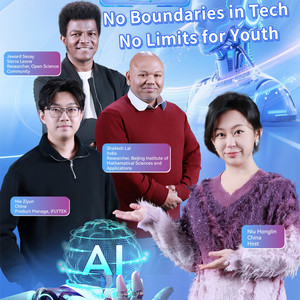
Today we welcome the last episode of our special series Global South Next Generation Voices and Visions, where we invite three young scientists from the Global South countries.
One builds open science tools for communities that need them the most.
One explores the universe through the language of mathematics.
One ensures AI applications work for real people speaking different languages and living different lives.
Together, we examine how technology innovation is influencing global development and global governance.
Time to enjoy the show.
Hello, welcome to Roundtable's special series, Global South Next Generation Voices and Visions.
I'm Niu Honglin.
Every technology begins as a question.
What if machines could hear like humans?
What if mathematics could reveal patterns we couldn't see?
What if the Global South didn't just use technology, but built it, defined it, and gave it purpose?
Our guests today carry these questions to their work.
Today we're going to discuss technology but, more importantly, we're going to see how young minds from the Global South define science itself in a different way.
Allow me to introduce my guest today.
We have Nie Ziyun, project manager of AI translation software with iFlytech.
Welcome to the show.
Hello.
Thank you.
Hello.
And we have Jawad Sisay.
He is from Sierra Leone.
He's a computer science graduate from the Beijing Institute of Technology and currently a machine learning research member of the open science community at Cohere Labs.
Hello to you.
Hello.
Hi.
And also we have Shalekh Lal from India.
He's a scientist and machine learning researcher from the Beijing Institute of Mathematical Sciences and Applications.
Thank you.
Thank you all for coming to the show.
I am very excited because today I get to talk to three young scientists who are very talented in your line of work, too talented that I cannot even begin to describe what you do.
So how about you do that for me yourself?
So Ziyun, how about you?
We start from you.
Can you explain to us exactly what is the project that you're doing and maybe some fun projects that iFlytech is doing currently?
Okay, so I want to share some technologies that we always want to do, like speech technology, computer vision and natural languages processing and connective intelligence.
I think since Aflatech started back in 1999, we always believe in developing these very key technologies.
And, I think, the most exciting thing I want to share.
This year we have launched our SparkX1 model, the first deep reasoning model trained entirely on China's own computer infrastructure.
And so as for breakthroughs, I think Spark X1 performance, as well as top international models, were 10 times smaller.
I think that's a huge leap in efficiency.
That's what I want to say.
When I first hear about iFlytech, I think it was because of the speech-to-text function of it.
And later on you still focus on language-related technology, but it has already from only Chinese to English, to a lot of different languages and to the kind of languages that we do not understand and go to different places in the world, and now we're also looking at in the field of medical related diagnosis and helping, aiding different doctors from anywhere.
So I am curious to know more about your story.
But allow me to First now move on to our two guests.
Jawad, I know you're an AI scientist and you have a very exciting project going on currently.
Yeah, so currently at the same time specializing in AI while doing the work.
So my research is in two-fold.
For example, I have the one that I'm doing in school, which has to do with autonomous agents, large language model-based agents.
And I have another one which has to do with similar area related to language, but usually vision-based research.
So what we're doing, for example, at Cohair Labs, we're trying to expand most of these state of the art models out there to be able to have cultural values that exist in our community, for example.
So much of that work has been done related to vision based models at the moment.
But in twofold, that's basically what I do.
I specialize in the field, at the same time studying in it and, at the same time, doing some work at Kohel Labs.
So, after you're done with your project, your AI model would be able to differentiate different culture element, would be able to look at the picture and identify which cultural background it's from and maybe describe it.
Yeah, that's one goal, actually.
But the most important goal for us is to also have our native speakers back home be able to use these models in their daily lives.
For example, in agriculture, to be able to chat with this model.
Let's say you take a picture of a plant and say you want to know the status of that plant.
We have that in our lives now?
Yeah.
So something like that we hope will be used later on.
So that's our vision is to make sure that these models can be used by native speakers in our home countries.
So you're helping AI to be able to see the world, that we understand it, and then explain it.
Yeah.
How about you?
Because I know you're not only a scientist, but also working in mathematics.
Mathematics?
I fail mathematics and I think mathematics fails me all the time.
So it's not the kind of subject that I find very easy.
But according to our previous conversation, I believe you can explain the world with mathematics.
So how about something that you're trying to explain currently?
What are you trying to do now?
Actually, I would say that mathematics is really the language in which science is spoken.
But more importantly science, which is what we use to explain the world around us, is not really a thing we do.
It's an approach to looking at what we are seeing and trying to understand what we are seeing.
So, for example, something that's really surprising, if you have one molecule, or two molecules, or three molecules, they're or four, five.
That motion is extremely difficult to analyze physically.
If you have a billion billion billion, billion billion molecules, that is actually extremely easy because it is the air around us.
Is that right?
But that is very easy.
I mean you know what will happen if you turn on a fan.
You know what will happen if you do certain things, and that is because There's actually a simplicity in how lots of things together arrange themselves.
And what is extremely exciting is that well, what's a lot of things that arrange themselves to do something today.
Well, neural networks, human minds.
They are filled with these tiny, tiny, tiny neurons.
And that's very hard to kind of unpack.
But if you say that well, let me forget about what each neuron is doing, at least at some pathological level.
But let me forget about that and let me see what the system as a whole, what is it doing?
How does it behave?
What happens if I poke it here and it does something there?
That is actually a really, really powerful way of looking at AI, which comes directly from physics, which comes directly from this idea that there is simplicity in the whole which is not there in its constituent parts.
So that's one of the things which we are looking at now to use say, physics ideas to help AI.
We are also using AI to help our physics ideas.
That's another story that we are working on.
It sounds very theoretical, but I kind of get what you're saying here.
That is, we're trying to look at the world from a perspective of the AI and having AI looking at the world from our perspective, so we can somehow communicate in a way that we can understand AI better and having AI helping humans better.
Because I think that's the final goal, isn't it?
Is having the technology improving lives all around the world.
And that is why, no matter what kind of projects you're currently working on, at the end of the day, we all hope the application of it can benefit people around the world.
Take iFlytech, for example.
We see iFlytech working on recognition for a really long time and medical diagnosis.
And you mentioned SparkDesk already and I'm curious because yes, it's helping me a lot, helping my daily work, but you also wish that it can help people all around the world.
But while you're taking your technology, your application, your projects to overseas, do you encounter unexpected challenges?
Do you feel like having the applications growing in different soil can result in different flowers and different fruits?
Yeah, as you mentioned, I think AI technology has indeed reached human level performance in some tasks.
And even in some situations, I think it's much better than me.
But our final goal isn't about outperforming humans or chasing pure technology breakthroughs.
It's about making AI practical and useful tools to help people connect with each other and break down barriers.
So as for challenges, I think and about it because today our topic is about the global source.
And so our first step in these countries is tackling language and cultural differences.
To solve these problems, we launched our Spark multilingual large language at ICEN Expo in this September, which is specially designed for multilingual languages like Thai, Malay and Vietnamese.
And also we're using our translation tools like, as I mentioned before, AI translators and apps to help Chinese business to work smoothly with their partners across Aisin.
And actually it's very hard to get one thing in one day, right?
So we need to step to step to solve all these questions.
Before our conversation I talked to Jawad a little bit and you were being very, very moderate about what you're doing.
You're saying that you're only recognizing or helping AI recognizing different patterns, helping it to have visual recognition over a cultural element.
But what you're doing is helping a relatively niche language.
By saying niche, I don't mean to diminish your culture and language.
I'm just saying it's not many people speak it like Chinese or English.
But it is a real problem and it's a real issue in China as well.
In China, I think we have, if I remember it correctly, over 130 different dialects, not to mention there are more accents.
So preserving these niche languages and these local cultures is as important in China, in any other countries as well.
That's why I am asking the question to you, all of you as well, that is in the process of helping AI understanding the mechanism and understanding human culture, human emotion, hidden meanings humor irony, all these things.
Is it about the structure?
Is it about coding or is it more about database?
To point out, like I mentioned before, so the code can actually be the same.
So the language doesn't have much, how do you call it, much to do with the code.
So you can have, for example, you can have a model being trained in one language.
And let's say we want it to support another language.
You can use the same code that you used to train the previous model, just with an additional layer of data.
So much of it has to do with the data at some point in time.
But in language, for example natural language processing, there's one additional layer when it comes to language models, which we call tokenization.
So there are certain languages that has different kind of encodings.
So during tokenization you would need maybe to write some code that can, or maybe train a tokenizer that can learn some of these patterns in this particular language.
So that maybe might be the only additional layer.
But at a fundamental level, the training code can be the same for different languages.
And all you need to do is to just structure your data well and train the model.
Are we saying that it doesn't really matter?
What are the cultural backgrounds, what are the context?
As long as we're able to find out the right database, to organize the right database, to put them into different sections and give it to AI, it will be okay.
Do you all agree with that?
Yeah, I agree with that.
As long as you have a well-structured data, Like data in terms of high quality in language, then you can train a model to learn.
Even the smallest model can be able to learn something from that data.
Data quality is very, very important when it comes to training these models.
Definitely putting my understanding about AI to a next level.
We all agree with each other.
We're on the same page here.
I believe.
I'm asking this question because you work in different fields, you're from different countries, but because you work in the area of scientific research and development, you have the same basic understanding.
And I'm curious is that because of the nature of science or is it because that you talk to each other through summits, on forums?
You communicate with each other all the time, and you communicate with fellow scientists in your fields as well?
So do you usually go to these kind of science related forums and summits and international conferences and do you feel like it's It's necessary?
It's important.
It's a good occasion to go to as a scientist.
You go to conferences because you say that you go to a conference and you say I have this fantastic idea.
Somebody from the audience says, no, you don't.
Actually, they say that, OK, I have some questions about your fantastic idea.
What about this?
What about this?
What about that?
And even though we are all scientists working in the same field, we have different ideas, motivations.
And when you interact with those questions.
Some of them are cooperative, some of them are adversarial, but when you interact with those questions it's remarkably helpful towards refining your own ideas.
So in that sense also these kind of Global South initiatives where people can come together and discuss things I think I wouldn't even be able to call them important, because I cannot imagine a world in which they do not exist and things are able to work.
That is the communicating part.
You talk to each other, you inspire each other.
How about when you cooperate with each other, people from the Global South countries?
We're usually seen as places with a bit more challenges and a little less advances.
But I don't know if that's the case in the scientific world.
I don't know where we are globally.
To be more precise, there must be in some areas that we're being really good at and there must be some areas that we're working together, and definitely there must be some areas that we still need a little bit hard working to catch on.
Can you paint that picture for me?
So let's say in terms of collaboration, which is very essential in scientific research, for example.
So what you need is what I believe most global South nations are facing today.
It's not that these issues of limited resources, limited compute or not having enough funding and stuff like that.
They are all there.
The only main problem is how fragmented all of these things are.
So I think what we need more is shared infrastructure and shared ambitions in order to be able to solve our problems.
Because, at a fundamental level, when you come to look at some of these issues, they are so common among us, among our nations, that we can actually innovate through similar realities, as opposed to just having abstractions.
So I believe If we try to foster more how do you call it?
Joint research programs, for example, or let's say exchange programs, for example, between schools and something like that, and we try to unify ourselves in that way and be able to come up with useful research ideas just like you mentioned going to conferences, that's another way we could do some of these things we eventually will be able to stand out there amongst the world.
Yeah, and I want to add one thing.
I think collaboration is quite important because, on one hand, it can amplify great ideas and, on the other hand, it can make sure that resources can follow to where they are needed most.
I think that's quite important.
At the same time, I'm going to bring about a question that is a little bit practical.
Let's call it practical.
That is, doing research, developing large models or training models, or finding out applications that didn't used to exist and put it into the real world for people to use it.
All these requires money.
It requires funds.
We know that in 2024, research and development investment exceeded 36 trillion yuan that is about 500 billion US dollars in China, and it ranks the second in the world with 200 almost 250 billion invested in basic research.
We mentioned importance of basic research and also I've also got information, very interesting information about China is now home to over 5000 hundred high-tech enterprises and in 2024, 524 companies from the Chinese mainland were listed among the world's top 2000 industrial RD investors.
And bear with me.
Industry now produces about 90 of notable models, yet academia still contributes much of the most cited foundational ML research.
So I'm curious what is your view over the investment, to start with the government investment in RD.
Do you think it's important enough?
Or do you think it's significant enough?
Because we all know it's very important.
And second is how do you view the different roles between scientists working in industries and scientists working in scientific institutions in the academia world?
In terms of funding, especially when it comes to AI.
Much of the money goes into compute because it's very expensive.
We use specialized computers to train models.
These GPUs, they are not cheap.
So much of that money goes into compute.
For the area wherein you have let's say you have the government provide some kind of funding.
That's actually good, that's helpful.
But what you need the most is talent, because where there is talent, then money will come, investors will come.
So I believe the key aspect first is to ensure that we have a strong talent base.
And once that is available, then everything else will eventually fall in terms of development, in terms of building, state of the art, models and so on.
So, yeah.
The reason I'm asking about money, as well as what are some barriers, is because I feel like, when it comes to especially the research ability and also application ability of the Global South countries, we ask what are the major challenges?
We want to know is it effective scientific collaboration across the Global South?
Is it that we are lack of funds or lack of data access to data or maybe compute power?
What can we do to bridge the barriers, to make things work better, for example?
Actually you already mentioned that one of the major overseas projects iFlytech did was in Africa and many of the projects happened and you help local people.
And China as a country has established a SciTech cooperation relationships with more than 160 countries and regions and signed 119 intergovernmental SciTech cooperation agreements, and all this would definitely help the foundational situation in different places to be better, to find their places in the development of technology.
And I'm curious to know because you work in the area.
I can only do research on the internet, but you are working in the field and you talk to other fellow scientists.
Do you know any real examples of technology helping local people bring up the livelihood of you know, the community?
I think, like the real challenges we need to face, like resource gaping or like funding shortages or collaboration barriers, are not isolated issues.
I think these things might could reinforce each other.
So if we really want to solve these problems, we might need, you know systematic, more systematic approaches to solve it, like a source platform or, you know, or like equal partnerships, so answer.
So back to your question and so what we do to really help local people.
So, as i said before, and we launched our spark, multilingual language, especially in some South Asia languages like Malay and Thai and so on.
And I think sharing technology is just about building trust.
Our final goal is to truly help these users.
So we have built a full ecosystem of translation tools, including hardware and software, like AI translators, like AI translation earbuds and iFlightTrans application and simultaneous interpretation systems.
Also like transcription and translation systems in meeting.
So all these products I mentioned before form what we call iFlightTech AI Translation Matrix.
And these products are helping more and more people and companies to communicate with each other better and solve their real practical problem.
So we use AI all the time.
But some people maybe they are more familiar with the knowledge so they can find a better model for them.
For some other people we're working or living in remote areas they lack the knowledge, they lack the access to all the information.
Maybe they cannot perform as well even with the help of AI.
So in that sense I'm worrying about equality in the future.
It can with the fast development of technology, of ai.
Definitely we can make the world a better place by helping everybody having access to information, to technology, but it can also be possible that those who are already smart intelligent, having access and having resources would have more access, more resources.
So do you think are there any effective solutions or effective strategies or right path for technology or technological development to reduce inequality in different communities and different countries and different groups of people?
I think what you say is a genuine concern.
And this is not something that is unique to AI.
Anytime there's a new technology, it tends to bring a lot of people at the same level.
It also tends to exacerbate inequality.
For example, you could use your technology to make a really fast sports car for one person to buy.
You could also use it to make a really good bus service for connecting people who might otherwise find it really impossible to move for their own economic interests.
Both things are possible.
I think this is something which has to do more with our values as a society than AI in general.
In order to, for example, fight inequality in technology.
One of the best solutions I am in full support of is open source.
So we are in you open your research and allow people to actually to learn from what you've done, and not just open it like just give out the weights or give half of what you've done, but to open it fully end-to-end, so that people can actually reproduce these models.
And that's one way you could help say stop, how do you call it technological inequality in that particular area.
Actually I have to admit that AI technology might make social inequality worse but I
That's why we see it as our very important responsibility to handle and solve it, especially like companies like us.
So I think we are working on this in two main ways.
The first is we are making our technologies more accessible.
For example, like speech recognition for minority languages.
We infer that elderly people can communicate with devices just using their voice.
Or formerly like real-time speech-to-task technology.
We can help people like hearing-disabled to know this world.
And the second is we focusing on bringing our key technologies into some very important areas in society, like education and healthcare.
Through our smart classroom solutions, we are delivering our high quality education in the rural schools.
And with our AI like medical assistant, everyone can get a reliable and professional report or healthcare support anytime, anywhere.
So I think that's what we want to do.
And as a company, as Affiliate Tech, our really, really role is to actually build these bridges to solve all these problems.
You might say some things are genuinely transformative, like space programs.
So you might say that why does somebody in the Global South need a space program?
Actually, you know, is it just a vanity project?
Actually, it's not.
You need the space program so that you can look at weather data.
That weather data helps you organize your agriculture.
It helps you move people away when there are going to be environmental disasters.
So what looks like a vanity project is actually something crucial to the well-being of these people.
So in that sense actually, it is really important.
I mean to go back to the kind of questions you're asking about the global south.
It's really important to have these things developed amongst ourselves so that you know The people who need it are the people who build it.
I think you're totally right.
China has its very own AI-related weather forecast large model.
And also, by the way, we call them very beautiful romantic names, like the teacher or the master of rain, or the ones who's flying up.
These are the masters, the names of the AI models.
And I believe you're right.
It ended up having something to do with social value, collective social value, with policy, with government strategy.
What are the direction we're moving towards?
But at its core.
It's also very important that scientists like you are discussing these questions, because you are the one who is really doing the groundwork, leading the scientific development.
So let's end up with this question.
I'm curious about that is what is your final or biggest vision for the global south scientist community?
What do you think that in five years or in a decade that we can, we can move to as?
What is the future forecast in in your world for the global south communities?
For me personally, i hope to see, especially from where i'm from.
I hope to see young people from my part of the world to move away from just merely being users of these imported technologies and be able to actually be creators of them in the first place.
So I would love to see, let's say, Global South nations be pioneers in research, in engineering, in science.
And I think if we have structures that actually push this kind of agenda forward, the next generation of young people will not just join the future, but they will actually change it and they will shape it in a way such that the following generation will also benefit.
The stories of technology was often told from top to down.
It's like it's shifted by a few established hubs or centres.
That's why I hope in the coming future, especially youth from the global source could really shift this role like from being a follower or a student to becoming a true shaper or rule maker.
So that's, I think, quite important.
Maybe one day we can do that.
And, as we mentioned before, through collaboration we can build a thriving and win-win ecosystem for the tech professional.
Technically speaking, science and technology is just another tool that we're building.
And human beings have been creating, crafting tools for thousands of years.
And if we can master all the other ones, no reason we cannot master this one as well.
You're listening to Roundtable.
That was the last episode of our special series, Global South Next Generation Voices and Visions.
Over the course of the past week, we had the privilege of talking to young representatives from all walks of life.
Through first-hand accounts and practical examples, the series explores the opportunities and challenges facing young talent in the Global South and how their work contributes to broader South-South cooperation and China-Global South partnerships.
So if you have enjoyed the stories of these young innovators, changemakers and visionaries shaping the future, let us know in the comment area or send us an email to roundtablepodcast at qqcom.
We'd love to know about your thoughts.