Hey everyone, hope you're having a great holiday break.
For the next week, we are running some of our favorite shows from this year.
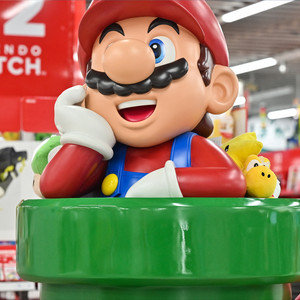
Today's episode is about how Nintendo became a gaming juggernaut.
N.P.R.
In the world of consumer electronics, being number one is usually an advantage.
Like, if your product has the newest tech, the most features, the fastest processors, chances are people will line up to buy it.
Sometimes, though, it pays not to be number one.
Take Nintendo.
Earlier this month, it released its latest console, the Switch 2.
Now as a piece of video game machinery.
The new Switch is nowhere near as powerful as its competitors like the Sony PlayStation or the Microsoft Xbox.
And yet, when the Switch 2 was released a little over a week ago...
Gamers in New York camped out on the sidewalk outside a Nintendo store for hours just to snag one.
She's been here since 1230.
Oh my god.
So much longer than I thought.
I've been here for now 18 days.
And me and my buddy Chris and or Chicken Dog have been planning this for two years.
Chicken Dog is such a great name.
Anyway, despite the hype around this new product, today's episode is not about the Switch 2.
Because we think that the story of Nintendo itself is a lot more interesting.
This is the Indicator for Planet Money.
I'm Adrian Ma.
And it's me, Aileen Wong.
Today on the show the business strategy that transformed Nintendo from a tiny Japanese toy company to a global brand that includes games and movies, and even theme parks, and how Nintendo reinvented the video game industry by not being number one.
This message comes from Capital One.
Capital One offers checking accounts with no fees or minimums.
What's in your wallet?
Terms apply.
See CapitalOne.com slash bank for details.
Capital One N.A., member FDIC.
This message comes from Mint Mobile.
Starting at $15 a month, make the switch at MintMobile.com slash switch.
$45 upfront payment for three months.
Five gigabyte plan equivalent to $15 a month.
Taxes and fees extra.
First three months only.
See terms.
The story of Nintendo begins long before the invention of video games.
In 1889, a guy in Kyoto Japan, named Fusajiro Yamauchi started making these things called Hanafuda cards, basically playing cards that were often used for gambling.
And for several decades, playing cards are Nintendo's whole business.
Hanafuda cards, Western-style playing cards, Disney-themed cards.
But by the 60s and 70s, the company also branches out into making kids' toys.
Meanwhile, in the U.S., a new form of entertainment begins to explode in popularity.
Video games.
At first you have to go to an arcade to play video games, because there are these bulky, six-foot-tall machines.
But by the mid-70s the arcade experience starts to move into the home, with companies creating the first at-home video game consoles.
One console made by Atari was an especially big hit, selling hundreds of thousands of units in its first year.
Joost van Droijnen is a professor at NYU where he teaches a class on the business of video games.
And he says, Atari's success caught the attention of other companies who were like hey, we can do that too.
Companies like General Electric that come out with their own devices.
You have Emerson Radio, Fairchild.
You have Coleco with ColecoVision, one of the more famous ones.
Bandai comes out.
Mattel comes out.
RCA has its own device.
So you just have a host of manufacturers all creating their own version of what they think is a home console.
Some of these names like Fairchild or Emerson Radio, you may have never heard of them.
And that's because within just a few years, this booming industry would self-destruct.
Yeah.
By 1983, the market had become saturated with new consoles and games, a lot of which, according to Yost, were just plain bad.
I mean, janky and confusing or frustratingly difficult to play.
And eventually, consumers just got fed up.
And they walk away from it, which leads to this collapse in consumer demand and revenue.
And therefore, of course, it cascades throughout the ecosystem.
In less than a year, consumer spending on video games fell by some 90%.
Companies lost hundreds of millions of dollars and laid off employees.
And by 1985, it seemed clear that this home video game console was just another passing fad.
Then came Nintendo.
See, Nintendo had been off in Japan developing its own video game devices which, when you think about it, is sort of a natural extension of its toy business.
And in October 1985 it brought its latest machine to the United States, a little gray box called the Nintendo Entertainment System or NES.
When Nintendo came to the U.S., people thought they were nuts.
Like, this was the most counterintuitive thing to do from a business strategy perspective.
Why would you run towards a burning building?
And, you know, and that's exactly what they did.
But Yost says Nintendo had a plan.
It entered the U.S. with a three-pronged business strategy.
One, they told retailers, listen, you don't have to pay us up front.
Just pay us when you sell a console.
Two, they had a high bar for what games they would sell for NES.
So only games they thought were really good would make the cut.
And three, and this sounds pretty obvious, but they focused really hard on making games fun as opposed to frustrating for users.
We're going to have magazines around this.
There's going to be a Nintendo club around this.
There's going to be a hotline that you can call if you're stuck, so that you don't feel like you just spent.
30, 40, 60 bucks of your money and you're off on your own and whatever.
Go figure it out.
It never occurred to me to call the hotline when I got stuck in Double Dragon.
My whole childhood could have been different.
Just like banging your fist against the wall.
You're just like throwing the controller at the TV screen.
Well, this strategy worked even if I did not call the hotline.
The NES would go on to sell some 60 million units.
With that success, Nintendo essentially hit reset on the whole industry.
And everybody else was walking away.
Nintendo was walking towards the games industry and rebuilt it.
To use a business school term, Yost says Nintendo's NES found product-market fit, that sweet spot where the right product meets strong consumer demand.
And eventually, more companies like Sega and Sony would bring their own consoles to the U.S. market.
If Nintendo hadn't succeeded like it did some argue, the video game industry as we know it today might not exist.
In the decades since, Nintendo has released lots of different devices.
Some were hits, some were flops.
But one thing has been consistent, Yost says.
And it's that Nintendo has never been about making consoles with the best graphics or the most cutting-edge technology.
And so Nintendo has never been one to compete on technology, even though the rest of the industry has.
And for that reason to differentiate itself, it's always really leaned into limitations of technology.
One of the company's head game designers named Gompei Yokoi, called this philosophy lateral thinking with withered technology, which sounds a little funky, but a good example of this idea in action is the Nintendo Wii.
Oh, the Wii.
We still have ours.
We do?
I mean, you do?
Yeah.
Yeah, you should come over and play it sometime.
Well, I don't know if it still works.
We should plug it in and see.
Released in 2006.
The Wii was a console with simple, childlike graphics, and its controller used very old technology infrared beams, like the kind that come out of your TV remote.
But the Wii designers repurposed this withered technology in a novel way, allowing users to play tennis or golf or boxing simply by moving their arm.
And the result was a very family-friendly gaming system.
You could play with anybody else in your house.
I used to get my ass handed to me in Wii Tennis by my mother-in-law.
But they managed to take a low-tech approach and make it fun. for a broad range of players.
Yost also says this lower-tech approach meant Nintendo could manufacture consoles for less and sell them for a lower price.
So theoretically, more people will buy them.
For Nintendo fans.
This sort of cheap and cheerful ethos is something that has always distinguished the brand from its competitors.
That's true for Jamal Michelle, who writes about video games for publications like the New York Times.
Without saying it, Nintendo is selling a culture.
A culture that includes characters and merchandise and a whole community.
But also, Jamal argues, a certain aesthetic experience.
The best sort of analog or comparison I could draw up would be like video game consoles to film directors.
For the Xbox, I think of Michael Bay.
Huge explosions and special effects and stuff like that.
In Nintendo, I think the most appropriate is definitely Wes Anderson.
From the aesthetic and the softness.
Yeah, there's like a coziness to a Wes Anderson film.
Yeah, and I think the cozy vibe Nintendo leans into.
I don't want to constantly have to be in a fight.
And so Nintendo lets me just chill out.
I think this whole episode could be summed up as like the business case for coziness.
I love that.
And you know what?
I hope Chicken Dog is feeling real cozy.
This episode was produced by Corey Bridges and Ella Feldman.
It was engineered by Kwesi Lee and fact-checked by Sierra Juarez.
Kate Kincannon is our editor and the indicator for production of NPR.
Hey, it's Waylon Wong.
We're almost at the end of 2025.
It's been a tough year for NPR and local stations.
But despite the loss of federal funding for public media, despite attacks on the free press, we're still here for you.
With your support, NPR will keep reporting the news.
And here at The Indicator, we'll keep explaining how the economy affects your life at home, at work, in your community and around the world.
And of course, we'll do it in about 10 minutes every weekday.
If you're already an NPR Plus supporter, thank you so much.
We see you and we're so grateful for you.
If not, please join the community of public radio supporters right now, before the end of the year at plusnprorg.
Signing up unlocks a bunch of perks like bonus episodes and more from across NPR's podcasts.
Plus you get to feel good about supporting public media while you listen.
Visit plus.mpr.org today.
Thanks.