You know, one of the things I love about history is how much the little details matter.
A small shift, a different decision, a single overlooked fact can change the course of events.
And I think about that when it comes to how we present ourselves to the world, too.
The details matter.
The right piece of clothing can completely change how you walk into a room.
And this fall, I've been finding the right pieces of clothing at Quint's.
Fall is here, so it's the perfect time to refresh your wardrobe with pieces that feel as good as they look.
Quince makes it easy to look polished, stay warm, and save big without compromising on quality.
They've got all the elevated essentials for fall.
100% Mongolian cashmere sweaters starting at just $50.
Perfectly tailored denim.
All the prices that honestly feel too good to be true.
Personally, I've been eyeing their wool coats.
They look designer level, but they cost a fraction of the price.
Here's how they do it.
By partnering directly with ethical, top-tier factories and cutting out the middlemen, Quince delivers luxury, quality pieces at half the price of similar brands.
It's the kind of wardrobe upgrade that feels smart, stylish, and effortless.
And I'll just say, my quince sweater polo has already become a fall staple.
It's warm, it's versatile, and it just makes me feel put together without really trying.
So keep it classic and cozy this fall with long-lasting staples from quince.
Go to quince.com slash history for free shipping on your order and 365-day returns.
That's q-u-i-n-c-e dot com slash history to get free shipping and 365-day returns.
Quincecom slash history.
A cancer diagnosis changes everything.
At Kansas City Proton Institute, we combine expert physicians with advanced proton therapy technology.
Our cutting-edge imaging and high-intensity proton beams target cancer precisely while minimizing damage to healthy tissue.
That means better outcomes, fewer side effects, and faster recovery.
If you have prostate breast, head and neck or brain cancer, proton therapy may be a better option than traditional radiation therapy.
Get a The History Channel original podcast.
History This Week, September 27th, 1986.
I'm Sally Helm.
You're a kid in the mid 80s.
You just got home from school or from playing wiffle ball in the streets with your friends.
And you do what most kids do when they come home.
You turn on the TV.
Will it be you?
Will your family be the first to witness the birth of the incredible Nintendo Entertainment System?
The first NES ad, I believe, that aired in America, has these kids in a living room and there's this egg.
That is Jeremy Parrish, author and co-host of the Retronauts podcast.
So, the egg.
This egg.
The egg. that emerges from like behind their TV console that it cracks open.
The first to play with Rob, the extraordinary video robot.
He follows the commands you put on screen so you get to the dynamite before it explodes.
This is a commercial for a new thing called the Nintendo Entertainment System.
Today, it's launching nationwide.
And you would know it as a video game system.
That's what it is.
But the commercial makes clear it also includes this weird extra element, Rob.
The robot operating buddy, which was actually almost entirely useless.
It was just like a little toy robot that would sit next to your game console.
And basically it would watch the TV.
And it would respond to certain triggers, like when there were flashing patterns of light.
It would respond by moving left, right, up, down.
Yeah, you're playing a video game and this little robot is like opening and closing its claws sometimes.
So why did Nintendo even have Rob?
It created this value proposition, like, oh, it's a video game, but also it's a cool toy.
That's really appealing.
The Nintendo Entertainment System, the first to move video action off the TV screen.
The first to move video action off the TV screen.
This early Nintendo commercial.
The weird thing about it is that it's really going out of its way not to talk about the video game part.
The approach that Nintendo took was basically to obfuscate any mention of video games.
It was not a video system.
It was the entertainment system, the Nintendo Entertainment System.
And that is for a reason.
In 1986, video games are seen as a fad that had already died.
Just a few years earlier, the US had experienced the video game crash.
The market imploded after being flooded with low-quality games and too many gaming consoles.
Plus, there had been a recession.
But in Japan, video games never died, and Nintendo had become a massive success.
Now, they're trying to do something that seems impossible.
Sell video games to a bunch of people who think they don't want them.
But Nintendo is sure that if people just try out the new system, including a brand new game, they're going to be hooked.
Today, the national launch of the Nintendo Entertainment System in the United States.
How did Nintendo turn a dying industry into its own entertainment category?
And how did two plumbers, maybe from the Mushroom Kingdom, maybe from Brooklyn, lead the way?
Nintendo started out in Japan in 1889 making a more analog kind of entertainment decks of playing cards.
They were a successful business doing just that alone.
But in 1959 They struck a big deal with Disney, which allowed them to brand their playing cards with characters like Mickey Mouse.
It goes well.
They sell 600,000 packs that year alone.
Nintendo president Hiroshi Yamauchi says, huh, seems like the kids market is a good place to be.
So Nintendo launches a toys and games department.
They experimented with a lot of different product ideas and merchandise lines.
They had a knockoff Lego line called InBlock.
The Ultra Hand, like a little telescoping grabber thing.
My favorite is a toy car called Lefty RX.
This is the 1970s.
Remote control cars are expensive.
Nintendo wants to make one that's cheaper, that more families can afford.
But to do that, you got to cut corners somewhere.
And the idea they came up with was, what if it could only turn left?
And then they brand it that way.
Lefty RX, making it a feature.
They created a really cheap product that was very successful.
I kind of feel like, yeah, the Nintendo approach has always been sort of like that.
You know kind of looking to weird, unconventional ideas in order to sort of catch people's attention.
Nintendo also experimented in the bowling space.
There had been a huge bowling craze in Japan in the late 60s.
And then, as so many fads do in Japan, that just went away.
And they saw an opportunity there because there were all these.
You know, bowling alleys are big spaces and space is at a premium in Japanese cities because there's so little arable, livable land in that country.
And they said, why don't we do something with this?
The Nintendo president, Yamauchi, had read a newspaper article about shooting competitions in Japan.
And in these empty bowling alleys he has the company develop what will come to be called the Laser Clay Shooting System.
A light gun installation where you could shoot virtual skeets basically, and they would project skeets and ducks onto the wall.
You use these plastic guns to shoot fake ducks in a former bowling alley.
And that was actually doing pretty well for them.
And then the OPEC oil crisis hit.
There were a lot of plastic parts involved in this whole venture.
And plastic is made of oil.
With the oil crisis, nearly all of Nintendo's orders were canceled.
And the company found itself millions of dollars in debt.
President Yamauchi has another idea.
As you may be starting to gather, he's kind of an idea machine.
One of his designers is quoted as saying Yamauchi instinctively knew if a new idea would sell.
But he's a tough boss.
That same designer recalled that he never sought a second opinion.
And now with these oil issues, Yamauchi is like, okay, Plastic is a problem.
Let's use less plastic by just shrinking the product down.
The company takes this system that's the size of a bowling alley and puts it into an arcade game cabinet.
You know, the big metal thing that sits in an arcade.
The game is called Wild Gunman.
After the eyes flash on the screen, shoot.
Other Nintendo arcade games follow, and the company starts exporting them to the United States.
They're having some success, and Yamauchi decides, let's keep going.
He turns to his son-in-law, Minoru Arakawa, and says you're going to lead a brand new division Nintendo of America.
And remember, Yamauchi is an intimidating guy, never asks for a second opinion.
Arakawa is much more laid back, collaborative.
He wears jeans in the office.
In this new assignment establishing Nintendo's foothold in America.
It is a huge opportunity for his career and to impress his father-in-law.
But Arakawa is basically starting from scratch.
It was very, very small at the beginning.
It was basically a warehouse in Brooklyn that would receive shipments of arcade games from Japan and then send them out through the distribution networks in the US.
But in 1981, Nintendo of America makes a disastrous error.
It starts with a non-Nintendo game, Space Invaders.
This is one of the first games where you not only move left and right, but you also shoot.
You play as a spaceship zooming across the bottom of the screen, targeting these advancing aliens.
It's also the first game that gets progressively harder the longer you play.
It's a huge phenomenon and suddenly every video game company is making a Space Invaders clone, including Nintendo.
Theirs is called Radar Scope.
And it is a smash hit in Japan.
So Minoru Arakawa, president of Nintendo of America, orders 3000 arcade versions of the game for the US market.
But by 1980, when that arrived, that fad was really dead and Space Invaders clone, just felt antiquated.
It takes nearly four months to send over the 3,000 arcade units from Japan.
And by the time they arrive, American gamers have moved on.
Nobody seemed interested in Radar Scope.
2,000 of the 3,000 units sit unsold in the Brooklyn warehouse.
Arakawa had completely misread the market.
That right.
There was going to be the end of Nintendo of America and probably Nintendo Corporation Limited back in Japan.
Like, that could have bankrupted the company.
Arakawa calls his father-in-law, Yamauchi, in a panic.
And the Nintendo chief says, we can fix this.
We just need to take all of the Radar Scope cabinets and turn them into something else.
So they scrambled really fast to come up with a new game.
They give the task to a young designer.
Shigeru Miyamoto.
Miyamoto is only 28 years old.
He's an industrial designer.
This would be his first video game.
But he already has a philosophy.
He doesn't want to make another shoot-em-up game.
He wants to tell a great story.
A story with characters, which is a bold idea.
The only character in video games up to this point is Pac-Man.
Miyamoto's character is going to be Popeye. the 1930s sailor cartoon.
And the plot?
Popeye would work his way up through a construction site to rescue his love, olive oil, from the evil Bluto.
Except...
Nintendo doesn't end up getting permission to use Popeye and his friends.
So Miyamoto reimagines the game.
Bluto becomes a giant gorilla who's escaped from his cage, Donkey Kong.
Olive Oil becomes the damsel in distress, Pauline, in a slinky red dress.
And Popeye becomes a construction worker with blue overalls and a red hat.
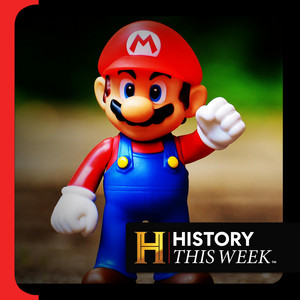
Jumpman, who would later be renamed Mario.
He's the hero trying to ascend this construction site to save Pauline.
It had a sort of a narrative progression as you move up through the four levels.
You're moving toward the top of the construction site and eventually sort of corner Donkey Kong and his abductee at the top of the building and then pull out the pins holding up the girders.
He collapses and The lady does not, luckily, and everything is happy and the day is saved.
The game is called Donkey Kong.
They stuck those into the unwanted radar scope machines.
As a replacement, printed up a bunch of stickers that they could put over the side art of the machines and distributed those.
And this game is much more than a Space Invaders clone.
It was a massive hit because, for the first time, Nintendo was not making a game that was just the same thing you had already seen, just a clone of someone else's work.
It was something genuinely new.
In their scramble to fill these cabinets and fix this space invader's mistake, they've invented something much better.
Nintendo sells over 60,000 units of Donkey Kong to arcades around the country.
It's a sensation.
Parrish remembers it himself.
I ate Donkey Kong cereal.
I had a Donkey Kong sticker book.
My brother had a Donkey Kong Jr. plush.
So we were right there in the thick of Donkey Kong mania.
Donkey Kong cereal is part of this complete breakfast.
You love the crunch.
Nintendo keeps the momentum going, first with Donkey Kong Jr, and then another arcade hit, Mario Bros, giving this heroic construction-worker-turned-plumber a backstory building out his world.
It introduced Luigi, Mario's brother, for the first time.
It put Mario back to being a hero after Donkey Kong Jr, where he captures Donkey Kong at the end of Donkey Kong and then takes him back in a cage to the circus or the jungle or whatever.
In Donkey Kong Jr., you play as Donkey Kong's son trying to rescue his dad from the evil Mario.
But Mario Brothers kind of put Mario back on the side of heroes.
He's beating up turtles and crabs and things, but it's to keep the sewers clear of you know monsters, to keep the city safe, I guess.
By 1983, Nintendo is dominating the U.S. arcade market.
Donkey Kong, Mario, Luigi, the characters are coming together.
But they're still not in people's homes.
And a crash is coming.
Americans are about to turn against.
They do not always show up on time, but when they arrive you notice an individual confident in their contradictions.
They know the rules, but behave as if they do not exist.
Muteen, the new fragrance by Miu Miu, defined by you.
Hi, I'm Nancy Cartwright.
You may know me better as the voice of Bart Simpson.
On Simpsons Declassified, we're diving into the mysteries that keep The Simpsons forever young.
Have you ever wondered how The Simpsons regularly predicts future events?
Who better to ask than the show's creators, performers, and writers, the celebrity guests?
Be sure to follow and listen to Simpsons Declassified wherever you get your podcasts.
Mint is still $15 a month for premium wireless.
And if you haven't made the switch yet, here are 15 reasons why you should.
One, it's $15 a month.
Two, seriously, it's $15 a month.
Three, no big contracts.
Four, I use it.
Five, my mom uses it.
Are you playing me off?
That's what's happening, right?
Okay.
Give it a try at mintmobile.com slash switch.
In 1983, the video game market crashes in the United States.
Just a lot of factors suddenly caused that whole market to collapse.
Jeremy Parrish says.
For one thing, there's a recession in the early 80s that crashes the US economy.
But also, the market was flooded with games. and many of them weren't that fun.
There was not really a press and certainly no internet so people could say, what's a good game?
So you'd go to the store, you'd find something that had an appealing box and say okay, and it turned out to be terrible.
The manufacturers of home video game consoles didn't have control over what games people made for their platforms.
And some of the games were not the most exciting fare of all time.
There was a game called Lost Luggage, where you try to find your luggage at the airport.
A game where you play as a little girl trying to hold up a bunch of spinning plates, called Dishaster.
In terms of sales, it was a dishaster.
And there was this famous E.T. game that was super hard to play.
You kept accidentally falling into pits, which took way too long to climb out of.
People hated it.
Thousands of unsold copies ended up buried in the New Mexico desert.
By 1984, the U.S. home video game market is basically nonexistent.
Customers have decided that this product is just not worth it.
In Japan, on the other hand, this market was thriving.
It was just like the sudden flood of game consoles at the same time that the US market was imploding.
Nintendo was having great success bringing its arcade games into the home game format.
Donkey Kong, Donkey Kong Jr., Mario Brothers, even a version of Mahjong.
And Nintendo president Hiroshi Yamauchi thinks We can still do this in the US.
He tasks his son-in-law, Minoru Arakawa, head of Nintendo of America, with developing a new console just for the US market.
Nintendo's testing proved that kids still really loved video games, wanted video games.
Certainly, I was a kid at the time.
I did not stop going to arcades and putting my quarters into machines just because the console market had crashed.
Arakawa comes up with an idea.
Basically, sell people video games without them realizing it.
Give them something that doesn't seem like a video game console.
So they design a new console, a two-toned gray box.
There's nothing on the outside to indicate that it has anything to do with video games.
It looked a lot like a VHS deck.
It was the entertainment system.
It was not a video system.
Nintendo Entertainment System.
The Nintendo Entertainment System.
The NES.
And the games to go with it, they are also in disguise.
They made them much bigger and filled them with empty space so that they could be in boxes that would sit on the shelves and look almost exactly like VHS tape sleeves.
I mean, if you line up VHS tapes in the cardboard sleeves with NES games, they look exactly the same on the shelf.
It was a very calculated move to say like oh no, this is part of your television entertainment system.
This is going to sit alongside your VHS deck and it's going to be a part of home entertainment.
It's the summer of 1985.
The holiday season is fast approaching and Arakawa is under pressure from his father-in-law to deliver something to market.
So he arranges some consumer testing of the new Nintendo Entertainment System.
Behind one-way glass in a building in New Jersey, he watches as a group of young boys plays the redesigned NES.
And they hate it.
One eight-year-old reportedly blurted out this is st.
The video game crash hangover is still very real.
These kids would rather play games in an arcade.
Arakawa calls his father-in-law to tell him about the miserable results.
He says that he's ready to give up, abandon the NES project altogether.
And Yamauchi basically responds, pull yourself together.
Remember, this is the man who believes in his instincts.
And he tells his son-in-law, quote, ignore them.
Try to sell the system in one American city.
Then if it fails, it fails.
But we must get it into the hands of the customer.
That is the only test that matters.
Meeting new people just got way more fun because now you don't have to do it alone.
With Tinder's new double date feature, you and your bestie can match together.
Tap the double date icon to see profiles built for two.
When two pairs match, the group chat kicks off.
Scope the profiles, send memes, flirt a little, maybe plan a hang.
It's always better when you're in it together.
Try the new Tinder double date.
Explore all the possibilities.
Tinder.
It starts with a swipe.
Download Tinder today.
When Sweet Tarts dared to combine sweet and tart, they thought, why stop there?
Why not create other exciting and unexpected combinations, like rainbows and ropes, or fruity and gummy, or chewy and more chewy?
That's why they created fun and tasty treats like Sweet Tarts Twisted Rainbow Ropes and Gummy Halos.
When you dare to combine, it's sure to blow your mind.
Sweet Tarts.
Dare to combine.
Visit SweetTartsCandy.com to shop now.
Eczema isn't always obvious, but it's real.
Taking Eblis achieved itch relief and clear or almost clear skin at 16 weeks.
And most of those people maintain skin that's still more clear at one year with monthly dosing.
Eblis Libricizumab LBKZ.
A 250 milligram per two milliliter injection is a prescription medicine used to treat adults and children 12 years of age and older who weigh at least 88 pounds or 40 kilograms, with moderate to severe eczema.
Also called atopic dermatitis that is not well controlled, with prescription therapies used on the skin or topicals, or who cannot use topical therapies.
Epgliss can be used with or without topical corticosteroids.
Don't use if you're allergic to Epgliss.
Allergic reactions can occur that can be severe.
Eye problems can occur.
Tell your doctor if you have new or worsening eye problems.
You should not receive a live vaccine when treated with Epgliss.
Before starting Epgliss, tell your doctor if you have a parasitic infection.
Searching for real relief?
Ask your doctor about Epgliss and visit epgliss.lily.com or call 1-800-LILY-RX or 1-800-545-5979.
In the late summer of 1985, Minoru Arakawa convenes a group of 30 Nintendo employees.
He calls them his SWAT team.
He leases a windowless warehouse in New Jersey.
It's between a railroad and a cemetery.
This is going to be their base of operations.
And then they spent basically the next year trying to convince retailers like hey, we've got this really cool video game system.
You're going to love it.
And retailers all over America said...
Absolutely not.
But then Arakawa makes these stores an offer they can't refuse.
Look, we've got this product.
Give us some premium space for the holiday and there's zero risk.
If you don't sell these things, we'll buy them back at cost.
You're not going to lose any money on this, but you might stand to make some money.
And so.
Starting in New York City store by individual store, Nintendo Entertainment Systems hit the shelves.
And Nintendo tells the stores to advertise, again, not the video gameness, but the entertainment.
Which includes Rob, the robot operating buddy, that little guy that sits next to the console and waves his arms around.
Rob did not exist for the sake of gameplay.
It didn't exist for the consumers.
It really existed for retailers and parents to say, like, here's a thing.
A thing that's not a video game. it's a toy.
Rob is like a video game Trojan horse.
There is one game that specifically uses Rob.
They also include a little gun and a game to go with it.
But there's another NES game that will prove to be much more important than either of those, even though it barely gets any promotion at all.
You know it was kind of untested so they weren't quite sure if it was the right play to kind of push that, promote that.
That game, super mario brothers people saw it in motion and said oh that's, that's really good.
It was an extension of the donkey kong world, still featuring mario, designed by that same brilliant designer, shigeru miyamoto, and it really brought video games to a whole new level.
To me, super mario brothers, you know, as someone who was there, it was really a game that pushed beyond what people had seen in a home system before.
It had, you know, this huge world that has 32 levels, which already that's a lot.
Donkey Kong had four.
It just felt expansive.
It felt huge.
And then, as you started to play, you started to experiment, or you had your friends tell you hey, you could do this.
Or you read in a newsletter or something.
Like, here's all the things you can do.
You could duck into pipes and find hidden rooms.
You could find hidden vines in secret blocks that would rise into the sky and you could take those up to bonus stages.
There were hidden secrets, like if you land on the flagpole at the end of the stage at a certain time, you'll see fireworks.
How does that happen?
Why does that happen?
It was just like these mysteries that weren't explained and just drew players in.
And it's not too big of a burden to just jump back in after you die and to keep playing.
Nintendo has managed to sneak video games into people's homes.
The company slowly releases the NES across the United States from 1985 through the middle of 1986, making that same pitch to stores.
We know video games are dead, but if you stock the NES, we'll buy back the ones you don't sell.
The gamble works.
And on September 27, 1986, the NES officially releases across the entire United States.
By the end of the year, Nintendo has sold over a million consoles.
And by this point, they don't have to hide what they're up to.
They don't have to pretend that this is just another toy.
No gun, no robot, but it did come with Mario.
I had one friend who lived just down the block from me and I would stop at his place, you know, probably every other day after school and we'd hang out and play Super Mario Brothers.
And to me, that was just like, this is a totally new... totally incredible video game experience.
Like, this is why I need to own an NES.
Nintendo had single-handedly brought America out of its video game crash.
You know, it could have been a fad.
It could have gone away.
But the NES itself, I would say, spearheaded a massive revival of video games, console video games in America.
And it's just been a kind of a continuous thing for the past 40 years.
Nintendo learned another important lesson from the crash.
Don't let the market get flooded with games that nobody wants.
There was just no filter for the garbage.
And Nintendo stepped in and said OK, we're going to be the filter, created a security system where only games authorized by Nintendo could run on that system.
If you're a company that wants to make a game for Nintendo to this day, you have to go through them.
Minoru Arakawa ends up running Nintendo of America until 2002.
His other major achievement?
Helping bring Tetris to the Game Boy.
His father-in-law, Hiroshi Yamauchi, also remains the president of Nintendo until the same year 2002, after guiding the company to video game domination.
But Jeremy Parrish says that even today, despite Nintendo's complete pivot towards video games in the mid-1980s, it still feels to him like a toy company at heart.
Yeah, I mean, Nintendo created an accessory and game setup for Switch that was made of cardboard.
It's still very much that same company.
I think they are.
You know it's a business, but at the end of the day I do feel like more than any other company, especially the companies that make hardware, when I pick up a Thanks for listening to History This Week, a Back Pocket Studios production in partnership with the History Channel.
To stay updated on all things History This Week, sign up at historythisweekpodcast.com.
And if you have any thoughts or questions, send us an email at historythisweekathistory.com.
Special thanks to our guest, Jeremy Parrish, media curator at Limited Run Games, producer of NES Works and co-host of the Retronauts podcast.
This episode was produced and sound designed by Ben Dickstein.
It was also produced by me, Sally Helm.
For Backpocket Studios, our executive producer is Ben Dickstein.
From the History Channel, our executive producers are Eli Lehrer and Liv Fidler.
Don't forget to follow, rate, and review History This Week wherever you get your podcasts.
And we'll see you next week.