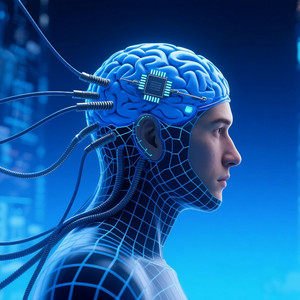
Discussion keeps the word. China just laid down a bold marker in the brain tech revolution.
New national guidelines set hard deadlines for BCI breakthroughs. for just a couple of years from now, by 2027.
They're looking at faster neural chips. advanced signal decoding and seamless brain-device integration.
There's no speculation, just concrete targets.
We'll examine what's really driving China's neurotech surge.
Hello there. We are live from Beijing. This is Roundtable.
I'm Steve. And for today's show, I'm with Niu Honglin. and you should first on the program China has taken a major step towards advancing its brain computer interface or BCI industry with multiple government authorities jointly releasing a new set of guidelines aimed at accelerating innovation and development in the field.
The plan outlines ambitious goals including achieving key technological breakthroughs by, as I mentioned, 2027, strengthening core intellectual property, and fostering industry-wide collaboration between research institutions and also private enterprises.
But what exactly do these guidelines entail?
We're going to find out. And how do they build on China's recent BCI advancements from mind-controlled robotics to breakthroughs in neural signal decoding.
The push itself signals China's determination to become a global leader in next-gen neurotechnology.
Yuxuan and Yehong Lun, good afternoon to you both.
We talked about this on the show before.
And I think it's worth, though, a little bit of background information because this is kind of a heavy, difficult to understand topic.
Very. Yeah. BCI, as you mentioned, Brain Computer Interface. creates a communication pathway between the brain's electrical signals and also external devices and also This term is generally divided into two categories, non-invasive BCI and invasive BCI.
So invasive brain computer interfaces obviously require like surgical implantation of electrodes directly into the to acquire neural signals, right?
And these BCIs offer high accuracy when catching signals. but because they must like implant it surgically, um they can like carry lower safety higher cost and also risk of immune and healing responses that can cause signal degradation and also If sometimes even loss of your signals.
And one typical example is the U.S. company Neuralink.
That's Elon Musk company. Yes, and they are operating a lot of these invasive BCIs.
And in early 2024, Neuralink founder Elon Musk announced that the first human patient implanted with a Neuralink brain chip had fully recovered, which is kind of, you know, the transition of BCI technology from theoretical research to practical application.
Yeah, that was a big moment in the timeline for sure.
Yes, and this is much more complicated than the way we express it because we talk about electric signals from the brain to the brain and controlling your body, but it's really complicated if you go deep into it.
For instance, the human body contains about 100,000 proteins, many responsible for sensing external stimuli.
For example, the visual system relies on three types of photo, receptor of these type of proteins received to red, green, and blue light and a different level of strongerness of that protein reaction leads to your brain reacting as the kind of picture you see.
So that is the basic idea about the so-called electric signal.
And I don't know if you've had this experience during a nightmare, for example, you would have a sense of weightlessness. during nightmares and it feels very, very real.
And that essentially is a brain misjudgment. meaning that with the right signal to your brain, even if you're not in the situation of a weightless situation, you still feel it.
And that is how this kind of interface would be able to stimulate if used correctly. stimulating these feelings would require strong external stimuli without, well, And yet even a roller coaster cannot completely replicate that authentic experience, but BCI would be able to do so if used correctly.
And the key point here is to correctly and precisely stimulate the kind of electricity signal that brain can understand or brain can send out.
When we learned about, or I think when people hear the term BCI or brain computer interface.
I think the immediate reaction is, what you said before you should.
An invasive surgery where a chip is implanted to the brain.
A cable is sometimes connected to the person's head and brain signals are sent to an outside device.
Right. Which is very it's a very futuristic and very intimidating thing to think about.
But the definition of BCI now is changing these days, and there's been a lot of advancements.
And it's not just necessarily about invasive procedures anymore.
And we're going to learn all about this today.
All right. So let's come back to China then, shall we, and learn about the developments here.
What happened? So as you mentioned, not all of the BCIs are about...
Getting chips into your brain. So non-invasive BCIs collect brain activity information through... like electrodes, sensors and also other devices placed on the Sculp.
Although the signal quality is relatively lower, they are easy to operate and highly safe.
So in July, the newly added non-invasive BCI adaptation service fee item in the project guidelines issued by the National Health Care Security Administration of China is intended to cover services required for continuous device adjustments when this type of technology is used in like clinical practice and this means that in the future no clinical BCI surgeries will become much more affordable which is Also, in my view, one of the main purposes of what we're discussing today, the developing adoption of BCI products across sectors.
Yeah, exactly. And that's why the new guidelines have been put in place, right?
Because we're seeing now that there is an expansion within the industry to various sectors.
So there needs to be some sort of. guidelines, I guess, is the perfect word, put in place to be followed.
So what are the guidelines exactly? So this guideline is issued by the Ministry of Industry and Information Technology and also six other government departments.
And this is kind of a two-step development goal, and it has been proposed for 2027 and 2030. with some key tasks and detailed measures laid out to further promote the high-quality development of the brain-computer interface industry and accelerate the cultivation of a new track for future industries.
It has also set a roadmap saying that breakthroughs would happen from 2025 to 2027.
And today are talking about cultivating two to three global leading enterprises from 2027 to 2030 and building a comprehensive ecosystem post 2030.
Yeah, I think I'm one of those people that when I hear BCI, I just think, you know, people who need it, people who don't have the use of their arms or their legs people who can control screens with their minds, but it's now moving into various sectors like industrial manufacturing, for example. consumption, for example.
I'm confused by the industrial manufacturing aspect of this, though.
How does that apply? Yeah, so promote BCI applications in the areas like industrial manufacturing is something that people are doing by integrating them into, let's say, R&D production and also operations to create a kind of life machine, industrial machine, metaverse to develop advanced equipment and robot control solutions.
Okay. And more specifically, I can tell you like in areas like high-risk sectors like hazardous materials nuclear mining and power supported by safety platforms and detect and warn of some scenarios like hypoxia, poisoning, and fainting, and also some extreme environments such as deep sea, space in high plateaus and cold regions, lower operation thresholds and enable human-machine interaction to boost efficiency in these kind of complex tests.
Fascinating. So there you're not talking about a chip implantation.
You're talking about wearable technology that sends signals from information happening inside your body to outside devices to warn of potential hazards.
Yes, that kind of a reminder or warning in advance is really critical when people are in these kind of environments. yes and for regular consumers no I'm not talking about now but maybe you know know sometime in the future we would be able to wear an arm or wristband equipped with multiple Electrodes that can detect nerve potentials on the skin which can be processed to accurately and in real time identify which finger moved. which means that we would be monitor or the method would be able to monitor nerve signals And that is also part of the BCI technology.
It can offer high sensitivity with minimal intrusion, meaning that the gamers out there.
When you're playing a real-life VR or AR game, a simple move of your hand would reflect on the action of the avatar you are controlling.
Or not even moving anything. Thinking about it. brain yeah with your thoughts exactly yeah I looked that up this morning and I didn't know that that this was I didn't know that there was a connection between the gaming industry or just the entertainment industry and BCIs at all.
But yeah, the way that people interact with games in a virtual world is going to be changed forever.
I can't even imagine. what that's going to look like.
But an example again of the industry spread now that we're seeing with BCIs for sure.
So with these tasks, you mentioned there's goals for 2027.
There's goals for 2030. By 2030, the country is looking to strengthen its economy. its innovation capabilities significantly with BCIs.
They're looking to establish a safe and reliable industrial ecosystem.
They're looking to cultivate two to three globally influential leading enterprises as well.
So that's kind of the roadmap that they've laid out laid out for themselves.
But within that roadmap, what type of tasks, specific tasks are we looking at? arms first of all boost basic like hardware and software research including like striving for breakthroughs in making BCI chips used to collect and process neural signals as well as ultra low power and high performance communication chips to enhance the transmission of brain signals and reject interference.
So the guideline also calls for research into like novel products such as What I mentioned ultra low power implantable chips while improving the performance of well-established products such as deep brain simulators and and cochlear implants.
Yeah. So the cochlear implants. Yeah. So those would be, so for the implantable chips, Yes, for the cochlear implants, those are external, right?
And they're also looking to upgrade the non-implantable devices too. in-ear, ear-worn, for example, to forehead mounted devices.
They even have hair clip style products.
So they want to see improvements there. Also things like the systems in helmets and headsets and glasses and headphones and other electronics.
I guess the helmets, that would be part of the industrial market. that you were talking about before.
And with all of these advancements, they're looking at things like more precise control I think a faster response so there's no real time lag for users.
And also a longer battery life too, I would think. are calling the year 2025 as the inaugural year for brain-computer interfaces because, well, at least here in China, We talked about the new policy, but at the same time this year, we are already looking at a lot of foundation being laid.
For example, if we take a look at the overall picture of BCI, We want to take a look at the research, at the application, as well as the policy, the policy being the latest policy for sure.
From this area of research aspect, we see according to Ministry of industry and information technology, global BCI patents have been increasingly continuously reaching 47,000 by early 2025 with over 15,400 patents from China.
And also there has been or have been several milestones and interesting ones here in China as well, for instance, June 2005, a team from the Chinese Academy of Sciences and Huashan Hospital carried out the first invasive BCI clinical trial in China. and a quadruple amputee implanted with the device was able to play chess. racing games and control computer touchpad with two to three weeks within two to three weeks. and when it comes to policy on top of the one that we've been discussing giving a guideline, a roadmap of how the industry would develop.
A very encouraging one I found was that earlier again this year, Hubei province issued a medical service price standards for BCI, providing a basic for healthcare insurance reimbursement. making the initial steps toward BCI inclusion in medical insurance, which is essential for people who are really in need of this technology.
That is one of the potential criticisms of this.
It's not a criticism of the technology itself.
It's that is this type of thing going to be only available for... for the rich or not.
So that would deal with that issue. There's policy in place to... for the market approval process.
Things are going to be receiving companies are going to be receiving and products too. favorable policies when it comes to that.
Also, foreign enterprises and institutions, they are encouraged to set up research and development centers or or even manufacturing facilities here in the country.
That's the foreign institutions and then the domestic institutions, they're supported to participate.
Conversely, in international conferences as well to show what they've learned and what strategies they have as well.
All right, so this sounds like a brand new thing, but it's not, Yusha.
This goes back decades, as a matter of fact.
Actually, the development of BCI technology has not been explosive. you know, but rather like gradual and cumulative.
In the 1960s scientists began exploring the connection between like brainwaves and computers by recording EEGs.
Let me do this. Electrolyne sand flood grams.
We'll take it. Well done. Yeah. and performing simple analysis of brainwave signals and then they attempted to interpret bring activity and achieve basic interaction with external devices.
And at this stage, BCI technology was still immature.
And in 1973, computer science professor Jacques Vidal first introduced the term brain computer interface in an academic journal.
And by the 1990s, with advances in computer technology and neurosciences, researchers conducted preliminary experiments enabling the brain to control external devices.
And in 1998 scientists successfully allowed a monkey to control a robotic arm using brainwave signals.
And at this stage, devices and interfaces were still bulky and signal decoding accuracy was limited, but these efforts provided valuable experience for later improvements and by 2000 the widely recognized concept of BCIs was formally established.
And now today, BCIs have become one of the most prominent research directions in neuroscience and brain science.
Yeah, it's been a long, long road and scientists and researchers have been working on this longer than we realize, back to, you said the 1960s, right, is when things really kicked off here.
China started its research a little bit later, right?
It wasn't back. in the 80s or 90s. I think it was a little bit later for the BCI Tech to come to the country.
But there was a report published from the PBC School of Finance that showed Tsinghua University in 2023 –
China had attached much more importance, I think, to the tech at that time, and it's really elevated the topic to a national strategy in just the last few years.
So where are we now in China? What's the current situation or the latest developments of BCI Tech?
Yeah. And there's been so many like research teams working on it and the market has been developing so fast.
Xinhua News Agency reported that research data from market research company CCID Consulting revealed that China's BCI market was about 3.2 billion yuan or about 446 million US dollars in 2024 and it is expected to that by 2028, the market will reach more than 6 billion yuan or 856 million US dollars with a compound annual growth rate of more than 17% from 2024 to 2028.
So it is a like, speedy, fast growth when we're looking at the whole market here in China.
Yeah, and that growth rate that you mentioned of about 18% is the same growth rate that we're seeing globally, too.
The World Economic Forum put out a report last year and they said that the market was expected to grow at almost exactly that same rate. which to me suggests that there's a lot of cooperation and collaboration going on if we're seeing similar growth rate statistics. in all the countries around the world.
And speaking of which, there are about 200 healthcare companies tapping into this technology.
They're researching its role in treating different serious diseases like epilepsy and Parkinson's disease, cognitive impairment and other neurological diseases as well.
So there's a lot of work going into this.
What about some recent developments? What are some of the impressive things we've seen as of late?
We've seen a lot of very impressive cases.
For instance, March this year, there is this Beijing brand number one or Beinao number one.
It says that it has achieved the world's first fully implanted wireless high density Chinese language BCI trial.
And with that, a 67-year-old patient would be able or regained. the communication via brain-controlled typing post-implant and that Not only that happened, this technology granted its own reimburse code by the country's healthcare insurance system, clearing the final hurdle to commercialization for this specific technology.
And besides that, there's also, I think, December last year, there's also of a decoding of the Chinese language and with the decoding of the Chinese language, these implementation would help not only patients but also other type of users.
And there's also been a case of a 19-year-old epilepsy patient playing video games and sending WeChat messages one week after the operation.
Wow. Within a week. Within a week. Tech companies are getting involved as well.
There was an article published from Business Wire.
There's a category defining brain computer interface company called Synchrom.
And they released the first ever public demonstration of an individual, a person using an iPad, controlled entirely by...
And that's a display of Apple's built in. accessibility features and then the new BCI HID protocol.
The HID part of that is Human Interface Device.
So this is moving into areas of the world that we didn't maybe expect. to see it just just yet I think and that is what I have been thinking because if we think about BCI of course, it helps you to be able to like you shouldn't has mentioned in very early stage of the conversation to be able to touch the things that are poisonous. so that you receive that signal.
And at the same time, it helps the brain to send out signals maybe because of some problems in the body. your brain can no longer control your limbs, control the feeling and movement of it, and now BCI helps doing that. it does not stop just there.
For instance, implanting signal boards to stimulate brain regions for depression treatment is also proved to be very effective and the traditional drugs have less effectiveness there.
And at the same time, improving attention and learning efficiency, this has been used with U.S. military. developing helmets to boost soldiers' cognitive abilities.
That's already meddling how people think and how they concentrate and how they see the world.
And the final stage I can think of is that we can direct brain connections, have direct brain connections, enabling instant sharing of thoughts heralding profound change beyond the metaverse.
We can link our brains together Technically speaking, with the right technology, that can also happen.
But... No, thank you. Exactly. I was I was just going to ask, like, would you like to do because I was like, I think a lot of us watch the Black Mirror. new series and There's been like you can like buy a subscription and But when the subscription gets expensive, you have advertisement in your brain giving you all of these ads when you're just talking to people.
Or it triggered something like that. And that is why 2024, the Ministry of Science and Technology here in China issued ethical guidelines for BCI research emphasizing preventing enhanced BCIs, from diminishing human judgment, interfering with autonomous cognitive actions,
This is there, but we're looking at the policy, we're looking at the possibility, and probably we're looking at a result of the technology developed to the stage.
And all these complicated issues definitely need to be further talked about and further decide on.
Yeah, I mean, the technology and what they're able to achieve. is really beyond impressive.
There was another example that kind of blew me away.
There was a group of Chinese researchers and clinical neurologists they had a big breakthrough as well in BCI technology.
They enabled 10 people to communicate these really complex Chinese sentences through their thoughts alone, which is impressive, right?
So... were seeing that it's getting even more impressive than it was before. there's a lot of investment in this as well.
So when all of these things are coming together, when you have the advancements in the technology, you have this the spreading of the technology into various sectors.
You have government policies put into place to kind of guidelines as a roadmap to make sure that the industry is headed in the direction that it's supposed to be, then you're seeing a lot of investment too from... from various spots, even maybe surprising places.
There was an article that was put out not so long ago.
It was reported in the Financial Times. Sam Altman, you know Sam Altman, the OpenAI co-founder?
He plans to invest in new brain and computer interface venture called Merge Labs.
And the report said that OpenAI, they're looking to provide the backing, the money to this Merge Labs project. as it's raising more and more money.
And I thought, why OpenAI? Why is Sam Altman getting involved in this?
Well, their interest stems from the potential to advance AI capabilities and improve human computer interaction.
They're looking to explore new avenues for learning and communication, and BCIs could allow for more direct and efficient data transfer between humans and AI professionals. potentially accelerating AI development and leading to even more sophisticated AI systems. for those companies who are working on new materials, such as flexible electrodes,
These can improve device compatibility with the brain for sure.
And those who are learning about or the research team learning about Moore's law, it can drive up trust. the size of the chip, making it smaller and smaller and also improve the performance, enhancing comfort and efficiency. those who are studying communication technology such as 6G, it would enable faster and more stable data transmission.
And those who are studying neurosciences, they can review the brain's complex neural structures providing theoretical foundation for BCI.
So even though we're talking about one technology, it's actually all of these technologies combined together.
Yeah. And also another background is that, you know, our brain has like billions of billions of neurons, each connected to like tens of thousands of others.
And that's a lot of connections and honestly, we still understand very, very little about how it all works.
And that is why maybe some, we mentioned the tasks that we are going to take. and a decoding complex brain signals is very tricky and combining different types of brain data is even trickier.
And that is why in some ways like AI and all of these high technologies being used to improve the accuracy and speed and smarter software systems are being developed to, you know, so different devices and algorithms can work together more smoothly.
We might, we probably will get to the point where that data transmission is instant, right?
Just like a thought in your head is it happens instantly.
Yeah. And that'll be a good time for hackers.
Yeah, exactly. So what did we talk about?
I said before that one of the... may be concerns here is that this is going to be for the rich and only for the rich, but that's not the only concern here, is it?
Yeah, no, no, no, not at all. For instance, now we're only concerning about those stealing the important information in our computers.
And with that happening, if in the future, 10 years later, might would have to watch out for hackers stealing our thoughts.
That's crazy. And also brain tapping, this attack compromises an individual's confidently by interpreting signals transmitted from the brain during the signal acquisition phase.
And also, there are so many things that can go wrong, all linked to the fact that when we decode, successfully decode and also come up with the signals that can directly be inject injected to our brain.
And if that process is decoded, then those who have the technology would be able to attack that.
Also the language models too, right? So if the user's thoughts are misinterpreted, Right?
Sure. If the message isn't relayed properly... then there's potential harmful outputs there as well.
But with all the things that could go wrong, we still can't. ignore the fact that the advancements are absolutely mind-blowingly impressive and they keep coming at us as like fastballs from a baseball pitcher.