I'm Anna Martin, the host of the Modern Love podcast. In every episode, we peek into an intimate corner of someone's life and learn about what love means to them.
You know, I can tell you 35 years with another person, I've never spent that much time with anyone else either.
So we both kind of said, I love you pretty fast. My advice is that it's okay if it's hard. You can listen to Modern Love wherever you get your podcasts.
From the New York Times, I'm Rachel Abrams, and this is The Daily.
After the Supreme Court overturned Roe vs. Wade, abortions in the United States actually went up.
In part, that's because of a novel legal strategy that ended up pitting blue states against red states.
Today, my colleague Pam Belluck explains the strategy and the two cases that could take it apart.
It's Tuesday, May 27th.
So Pam, we haven't talked about abortion on the show for a while.
And in the years since Roe vs. Wade fell, the country has kind of splintered into states where abortion is banned and states where abortion is not banned.
And that has just sort of been the state of play, that everybody has their own state laws that they have to abide by, but in reality, as you have been paying attention to and covering, there's actually been this showdown brewing that now looks poised to end that whole order that we've maybe grown a bit accustomed to in the last few years.
And a lot has been happening during this time beyond the different ballot measures that we've been hearing and different state laws and things like that.
One of the major developments has been these new legal protections called shield laws and they have become both one of the biggest legal developments in the abortion access space and also a major reason why women in states with abortion bans are still able to get access to abortion.
Okay, so let's talk about SHIELD laws.
First of all, what are they?
So almost immediately after Roe was overturned, you have conservative states, red states, putting into place abortion bans that were and are very strict.
So they make abortion illegal in almost all cases, there are a few exceptions.
and they have penalties for anybody who is providing abortion, helping people travel for an abortion.
To states where it's legal.
To states where it's legal, exactly.
And this raises some legal questions for providers in blue states.
Are they putting themselves at risk if they provide abortion to a patient from a red state with an abortion ban?
When the Supreme Court draft opinion was leaked showing that Roe versus Wade could possibly be overturned the state legislature here in New York acted immediately.
Welcome back. Another step in making California a sanctuary for abortion.
Oregon lawmakers are working on a bill that would further protect the right to abortion in Oregon.
Senate Bill 1 ensures a woman's right to choose an abortion in Hawaii protects healthcare workers.
So what starts to develop are these laws which basically say, if you provide an abortion to a patient from a state with an abortion ban we will protect you.
Hence, shield law. Exactly.
And how exactly do these shield laws say they would protect the providers?
So a shield law is basically a cooperation blockade.
So it says here in our shield law state we will not cooperate with another state that is trying to sue or prosecute a resident in our state who isn't involved in an abortion.
So that's really starkly different from the way states usually do cooperate.
And usually, you know, one state files charges against somebody in another state and the state where that person is will extradite that person, will share records, will respond to subpoenas.
but under shield laws, abortion providers and people involved in providing abortions to people from red states are protected, and the officials in those shield law states are required not to cooperate, not to extradite.
So even though these providers are doing something that is legal in their state, those states are being extra cautious, right?
They're basically saying saying, hey, don't worry, we are not going to let you get into trouble.
So the first shield law that passed protected providers who served patients who traveled from states with abortion bans to the blue state.
But of course, providers in blue states who were making abortion available to people who came to them were only serving part of the need for abortion access.
A lot of women seeking abortions can't travel for one reason or another.
It's expensive, it's very time consuming, and there's also explaining to everybody around them in their community why are you suddenly leaving the state for a few days.
Right, it's not just like money and time and childcare, which I guess is maybe a form of money and time, but it's also about privacy.
Who needs to be involved in this process?
Who do you have to tell?
Who needs to know about something that is, for many women, very deeply private?
And for many women, there is an easier and more preferable pathway to getting an abortion, and that's through abortion medication early in pregnancy.
And this has become a much more common way of getting an abortion, so much so that even before Roe was overturned, more than half of abortions in this country were being carried out with abortion pills.
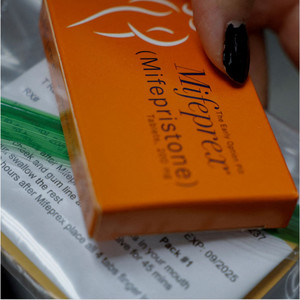
Those pills, just to be clear, are the drugs Mifepristone and Misoprostol.
Right. And before the pandemic, the FDA had regulations that required patients to go to a doctor or another abortion provider to pick up the Mifepristone, the first drug, in person.
And that, of course, was limiting for people.
Not everybody can go to a clinic, not every doctor is a certified prescriber.
But during the pandemic, the FDA started to change those rules and allowed the medications to be prescribed by telemedicine, without seeing a doctor, and mailed to wherever the patient was.
So, after Roe was overturned, there was a realization that you could send abortion pills in the mail to any state, including states with bans.
And that's why several states start to adopt either new shield laws or amended shield laws that explicitly say that they will protect an abortion provider who is prescribing and sending abortion pills through the mail to patients in states with bans.
So instead of providers just treating women who come to their states where abortion is legal what you've described is abortion providers essentially bringing the abortion to these women in their states where abortion is not legal.
And I think that sounds pretty risky for the providers, no?
It's definitely riskier for the providers, for sure.
I think these types of laws are really unusual and they really haven't been tested.
So it's a question whether they will ultimately stand.
And I think that's why you don't see that many abortion providers doing it.
It takes a kind of special personality and somebody who's comfortable with that level of risk.
Many of these providers are people who are kind of more advanced in their careers and maybe their children are grown and they just feel like they have a little bit less to lose.
Usually some of them have kind of protected their assets and put them in trust. but still they are absolutely taking a lot of chances and they know that, they're well aware of that.
I mean, they go into this eyes open because they are really very committed to providing this access and they see it as a really important avenue and it has become that.
SHIELD law providers are now sending probably more than 10 ,000 pills a month to women in states with abortion bans.
I know, Pam, that we've said on the show before that since Dobbs, abortions have actually gone up, which feels kind of surprising.
Is this the reason why?
This is part of the reason.
And these shield laws have put red states in a situation where they are trying to figure out how to stop these medications from flowing into their states.
And for a while they've been looking for cases that would allow them to try to challenge these shield laws.
And eventually they found it.
We'll be right back.
I'm Brian Rosenthal.
I'm an investigative reporter at the New York Times.
My dad is a scientist. My career has been devoted to scientific teaching and research. I remember growing up, I didn't fully understand what he was doing every day, but now that I work as an investigative journalist, I do understand.
So you have to start with facts.
From those facts, a hypothesis appears, and then you work on trying to test that hypothesis.
I do the same thing, obtaining documents, printing the data, and I talk to as many people as possible to get to the bottom of the story.
The New York Times does not publish until we can prove that something is true.
The best scientists are able to do that deep work, because they receive funding from their university from the government.
We as journalists depend on funding from subscribers.
You can support that type of work by subscribing to the New York Times.
Pam tell us about the case that you mentioned before the break.
The one that anti -abortion activists have been waiting for.
Who was involved? What was it about?
Yeah so it's actually two cases from two different states.
They just happened to involve the same New York doctor, Dr. Margaret Carpenter.
Dr. She has been a long -time reproductive health provider, and under SHIELD laws, she's been prescribing abortion pills to patients in all 50 states.
A New York doctor faces a penalty after allegedly prescribing abortion pills to a Texas resident.
Tonight Attorney General Ken Paxton is suing a doctor in New York who prescribed - This is one of the first challenges of the so -called SHIELD laws, and it sets up a fight between Texas and New York.
So, the first case is actually a civil suit that was brought against Dr. Carpenter and that suit accuses Dr. Carpenter of prescribing and sending abortion medication to a 20 year old woman in Texas last summer.
And it says that after the woman took the pills, she asked her partner to take her to the emergency room because she was bleeding.
Now it's worth noting that medication abortion is very safe and that bleeding is part of what happens during a medication abortion process because it is the pregnancy tissue being expelled.
And so it's not that uncommon for women to wonder if they're bleeding at an appropriate level.
And there apparently her partner learned that she was nine weeks pregnant and he suspected that she wasn't just having a miscarriage.
mortgage, so he went back to their home and he found the medications with Dr. Carpenter's name on the prescription and he reported this to the Attorney General's Office.
In a statement, Paxton said, in Texas we treasure the health and lives of mothers and babies.
And so in December of last year, the Attorney General of Texas sued Dr. Carpenter for basically violating Texas' abortion ban.
And so, under the shield law, Dr. Carpenter and her lawyers did not respond to the civil suit.
They didn't show up in court.
They didn't file any sort of response.
And so, as a result, a judge in the case has ordered a fine of about $113 ,000 and also issued a permanent injunction that says Dr. Carpenter is prevented from sending abortion pills to patients in Texas again.
So Dr. Carpenter's strategy is essentially trust the S .H .I .E .L .D.
Law and ignore what's happening in Texas.
So what is Texas' strategy to get her to pay the fine?
Right. So this is where the showdown with the S .H .I .E .L .D.
Law is being set up, right?
Texas judge issues a punishment and now Texas wants to enforce its punishment.
And so this spring, the state of Texas goes to New York, to the county where Dr. Carpenter lives and it tries to file a document that says we are asking New York to compel Dr. Carpenter to pay up and to honor the injunction.
and the New York clerk says, hold up.
No. We are not even accepting this court document from you.
We're not even going to let you establish a case number here.
We are just you know not having it under the shield law.
We have a little surprise to hear that a local clerk would know about this law and also be able to like unilaterally stand up to a judgment like this.
Should I be surprised or is that just ignorance on my part.
Well it's definitely an unusual thing for a county clerk to be doing in most cases, but in this situation, New York has been one of the states that has really made a big deal out of their shield law and their determination to protect abortion rights in this way and so they have educated and trained officials across the state to be ready if something like this comes across their desk.
In this case, the county clerk was ready and said, sorry, we are stopping you before you even reach the courthouse door.
So right now, we have a legal standoff, right?
We have a civil judgment in Texas that Texas is not able to enforce.
And what about the other case against Dr. Carpenter that you mentioned?
What's that one about?
Yeah, so, that case is from Louisiana, and it's a criminal case that was brought in January of this year.
And in that case, a grand jury in Louisiana indicted Dr. Carpenter on charges of providing abortion -inducing drugs.
And as with the Texas case, we really don't know a lot of details about the Louisiana case.
The description of what happened is coming directly from authorities in the states themselves.
So it's just worth noting that they are painting a picture of how these cases unfolded in a particular way and we don't independently know if what they're saying is accurate.
What the district attorney in Louisiana has said is that there was a teenager, someone under 18, her mother helped her order abortion pills.
It turned out that Dr. Carpenter was the prescriber and mailed those pills.
And the district attorney says that the teenager was sort of pressed by her mother to take the abortion pills.
And then at some point the teenager called 911 and was taken to a hospital.
We don't really know why.
And that's where authorities learned that she had taken abortion pills.
Let me be clear what this case is about.
This is about a case in which a minor in Louisiana got drug -fed.
Dr. Carpenter has been indicted for providing this medication.
And the mother of the teenager has also been indicted and has pleaded not guilty.
Her mom conspired with New York doctor to get a chemical abortion pill in the mail and enforce that minor to take it.
There's only one right answer in this situation, and it is that that doctor must face extradition in Louisiana where she can stand trial and justice will be served.
So when one person in one state is indicted by another state, then that state that's indicted them, tries to extradite them, tries to get them to come in and face the criminal charges in court because otherwise that case can't proceed.
You know, criminal cases different from civil cases.
The defendant has to be there.
So if she doesn't show up and they don't try to force her to show up, then it won't proceed.
Louisiana has done that.
They've issued an extradition warrant which as you've told us is going to be hard to execute from a blue state that has a shield law.
Exactly. Louisiana has changed their laws that has no bearing on the laws here in the state of New York.
New York's governor Kathy Hochul has made this a real strong point.
I took an oath of office to protect all New Yorkers and I will uphold not only our Constitution, but the laws of our land, and I will not be signing an extradition order that came from the governor of Louisiana.
Not now, not ever. She said, no way, no how we are not sending Dr. Carpenter to Louisiana.
So that's where the case stands at the moment.
Again, sort of a standoff.
It's possible that Louisiana will try to go to a New York court and challenge New York's refusal to extradite, but they haven't done that yet.
But it certainly sends a chilling shot across the bow to all the other shield law providers who are doing this.
I actually want to ask you about that shot across the bow thing because I'm really curious how people in the abortion access space are interpreting what's happening with these two Because in both of them it feels like at least for now New York SHIELD Law is kind of standing in the way of Texas and Louisiana prevailing, but as you've said the anti -abortion activists are trying to use these cases to challenge the SHIELD Law in New York.
And so I'm curious, what is the next step for Texas and Louisiana to potentially continue to challenge this?
Yeah, I think most people expect that there will be a next step, that these are supposed to be test cases to basically try to undercut the protection of SHIELD laws.
So most people expect that Texas and or Louisiana will keep pursuing this.
They will end up in federal court, possibly the Supreme Court, and they will try to say that the SHIELD laws are unconstitutional and there may also be a challenge to the question of whether a state can decide not to extradite someone who's been criminally charged in another state.
So basically, this is going to end up as a showdown where this whole concept of shield laws, which is largely untested, will end up being run through the mill of the federal courts and we'll see if they're allowed to stand.
On what basis will the red states even try to challenge these laws?
So, there are a few different legal arguments that the states can use, but the one that What seems to come up the most often is that the Constitution requires states to basically respect each other's laws.
They have to cooperate with each other.
And in this case, the provision that they cite is called the full faith in credit clause.
I mean, I understand that, right?
Because the alternative would probably be chaos, like if states could just pick and choose what other states laws they were going to respect.
So I do wonder what do blue states say in response to that?
Well, there are exceptions to the full faith and credit clause, and one of those exceptions is that if one state has a really deeply held public policy objective, that public policy objective overrides a contradictory law in another state.
That's going to be one way that the legal argument is going to play out.
There could be others.
I would expect lawyers on both sides of this argument to be very creative and to think of lots of different legal and procedural routes once it comes to federal court because that's what we've seen with other abortion cases.
I realize that SHIELD laws are not at the Supreme Court yet and they would take a really long time to wind their way there, but if they do make it in front of SCOTUS and if SCOTUS does decide that SHIELD laws are unconstitutional, I wonder what happens to Dr. Carpenter, and I also wonder what happens to abortion just generally across the country?
Well, you know, of course, we don't know exactly what would happen to Dr. Carpenter, but the charges and the cases against her could result in jail time, steep financial penalty and preventing her from continuing this work.
And if we were to see these shield laws get struck down by the Supreme Court, then things will be different.
Certainly some providers who are sending abortion pills to states with bans will stop doing that.
Others will probably continue, even though they'd be taking even greater risk than they're taking now.
And the abortion landscape in America that's already been rewritten after Roe was overturned is going to be rewritten once again.
And I think we're going to see even starker divisions between States with abortion bans in States that protect abortion.
But even if the Supreme Court upholds the legality of shield laws, that doesn't mean that the practice of sending abortion pills to states with abortion bans is just going to continue without additional ways to challenge it.
So you're likely to see anti -abortion advocates looking for new ways to try to stop access to abortion pills, and you're likely to see abortion rights advocates looking for new ways to try to protect and expand access to abortion pills.
Pam, when the Supreme Court overturned Roe v.
Wade, part of the idea at the time was that they would just send back to the states this decision about how to handle abortion.
So if states wanted it to be legal, they could make it legal.
If they didn't want it to be legal, that was up to them.
And that would settle it, was the thinking.
And you do have a patchwork of laws as a result, but what you also have are states kind of openly fighting with each other too.
And I just sort of wonder if you anticipated that.
Yeah, I think a lot of people who were watching this subject and familiar with it, also anticipated that this would happen because, you know, when you think about it, there just aren't very many types of medical care that differ so dramatically from state to state.
So it always seemed like it was going to be problematic to have one state try to ban abortion and think that that would somehow prevent women in that state from having access to abortion.
And I think what we're seeing now this really fierce division between states was something that a lot of people foresaw.
Pam, thank you so much. Thank you.
We'll be right back.
Here's what else you need to know today.
Over the weekend, President Trump called for an end to the war in Gaza, capping off a week of sharp rebukes from some of Israel's closest allies since the war started more than 18 months ago.
In Israel we've been talking to them, and we want to see if we can stop that whole situation as quickly as possible.
The shift in tone from the president, and countries including Germany, Britain, Canada and France, indicate that Israel's strongest partners are beginning to lose patience with Prime Minister Benjamin Netanyahu.
And British police arrested the driver who crashed into a crowd of people celebrating Liverpool's Championship Soccer Club on Monday, seriously wounding two and sending dozens to the hospital.
Authorities confirmed that the suspect was a 53 year old white male, and they asked the public quote not to speculate on the circumstances leading up to the collision.
Hundreds of thousands of people had gathered to celebrate Liverpool's victory in this year's Premier League, the top of English soccer.
Today's episode was produced by Alex Stern, Will Reed, and Diana Wynne, with help from Mary Wilson.
It was edited by Devon Taylor, with help from Lexi Dio, fact -checked by Susan Lee, and contains original music by Diane Wong, Pat McCusker, and Dan Powell, and was engineered by Alyssa Moxley.
Our theme Music is by Jim Brunberg and Ben Landsberg of Wonderly.
That's it for the Daily.
I'm Rachel Abrams. See you tomorrow.