This is Planet Money from NPR.
Well, tell me, who is this Darlene George and how did she make all this stuff happen?
Oh, my God.
Well, Darlene George is a regular young lady from Brooklyn, New York.
Darlene George is talking to Susan Sharon, a local public radio reporter at Maine Public Radio, who interviewed Darlene recently.
How old are you?
I'll tell you that off the record.
Oh, well, I'll tell you too.
Okay, thanks.
Susan is talking to Darlene because Darlene has kind of a remarkable work situation right now.
Darlene is a grants program coordinator at a local health center in Maine.
So I monitor, scout and look for grants, making sure we stay within regulations, guidelines of each grant.
She gets paid a salary.
She's not hourly.
But she generally tries to work seven to five-ish.
But if I am needed before the fact, I'm there.
If I'm needed after the fact, I'm there.
If I have a project I'm working on and it entails me working on a Saturday or Sunday, guess what?
I'm doing it.
That's my job.
Is it hard to do your job, you know, with the distractions and the noise around you and that sort of thing.
Well, what I will say is that I couldn't be more supported if I was on the outside.
The outside.
This September would make two years I've been working completely full-time.
From your cell?
Yeah, from my, yeah.
Well, we don't call them cells.
We just call them our rooms.
From your room, sorry.
Right, because we don't have, like, slamming doors.
Darlene works remotely from prison.
She is currently incarcerated.
I have a 40-year sentence.
I have been in here for 16 years.
And I think my earliest release date is in 2040.
2040.
So with good time, I'm quite sure that'll dwindle down a little bit.
Darlene is serving 40 years for murder.
And Darlene's job.
It is not a prison job job, like you know, working in the prison library, though she has done that too.
She works for a company on the outside, a regular non-prison company.
Do your colleagues that you interact with at the job, do they know that you're... Absolutely.
Absolutely.
100%.
Yes, they do.
Darlene does her job remotely from the main correctional center where there may not be a lot of slamming doors, but there are still prison guards and prisoners and all the regular prison rules.
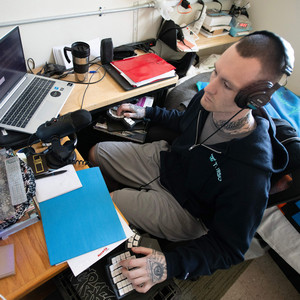
I literally, I work from my room.
So I have all my equipment in my room.
There's a sign that I put out on the thing that lets people know I'm Zooming, I'm in meetings.
Please don't, you know, don't knock.
Like, of course, if they do their checks, they walk by, they know exactly what I'm doing.
They can see me, I can see them.
And now Darlene's pay in this job...
It is not the like 63 cents per hour you get for working as a prison cook or the 7 an hour that incarcerated people get for fighting active fires in California.
Darlene doesn't work for free like prisoners do in seven states.
She's not paid minimum wage.
Can I ask you how much do you earn for your job?
Are you comfortable telling me that?
I'll tell you off the record.
Darlene gets paid enough that she would rather the other people in the prison not find out how much exactly.
And Darlene is not the only pretty well-paid remote worker behind bars in Maine.
My name is Preston Thorpe.
Can you share anything about what you're getting paid?
I'd prefer to keep my salary private, but I can say that it's definitely like what you would expect to see for like a senior level software engineer in the US.
Can I say that you're making into the six figures?
Is that accurate?
Yeah.
Okay.
Is that okay to report?
Yeah, that's okay.
Yeah, he makes six figures.
Hello and welcome to Planet Money.
I'm Sarah Gonzalez.
And today on the show we have this great reporting from Maine Public Radio's Susan Sharon about a new experiment in prisons remote jobs paying fair market wages.
Maine was the first to do it and three other states have followed.
So today how this kind of standard thing of having a job and getting a paycheck works in a restricted place like prison?
What it's like for the workers, what it's like for the employers who choose to hire them, and how the prison system is handling this new prison economy that has emerged.
Susan, thank you so much for joining us, for sharing the story with us.
Well, thank you so much for your interest in the story and for having me.
You did the thing that we love at Planet Money, which is you followed the whole thread.
Thank you.
Such great reporting.
Susan Sharon is the local public radio reporter in Maine who spent time in prisons interviewing remote workers and the people who choose to hire them while they're incarcerated.
And she says this whole remote work thing all started because of the pandemic.
The growth of remote work happened kind of as a result of COVID.
Some people in prison were taking college classes.
The educational classes they were taking suddenly moved online, and that sparked this idea.
It sparked this idea that maybe incarcerated people enrolled in college could, you know, take laptops into their cells with them and do their college classes online, like all the other students in the world on the outside were doing right.
And things kind of expanded from there.
The remote work is an outgrowth of prison education.
There are people in main prisons that have gotten their bachelor's degrees, master's.
I think there are several PhD candidates now.
So what are you going to do with these people?
It's like, yes, they get their education, but some of them may be serving several years.
So what's next?
Well, how about some better work opportunities?
The thinking was kind of like if a person in prison is allowed to have a laptop in their cells all day and night to do homework and take online classes, couldn't they have a laptop in their cells to do real outside world jobs better and get real outside world wages?
Now, not that many people have gotten this opportunity.
In all, since this whole thing started, just 45 people in Maine prisons have been able to get remote jobs.
Typically, you would not get a job because you're incarcerated, so.
Preston Thorpe is the one making six figures which, by the way, is double what the corrections officers who guard him make.
And it's been a game changer for Preston.
He said it's hard enough to get a job when you have a criminal record, let alone while you're still inside.
And now I feel like my life has a purpose.
There's no situation right now that would cause me to do something where I would risk losing my job, my computer,
Preston is 33 years old and he told Susan Sharon that he's always been a computer guy, a computer nerd, he said, since he was 13 years old.
It's kind of what got him in trouble later in life.
He talked to me about... buying drugs on the dark web and selling them.
And, I think, the second time he was convicted because he had a powerful synthetic opioid, much more deadly than fentanyl, capable of killing lots of people.
Preston is about nine years into his 20-ish year sentence.
He used to be in a different prison in a different state and he says he got in a lot of trouble there, so much so that they transferred him to Maine.
Like, we need this person out of our custody.
And when he got to Maine, Preston started seeing... possibilities, school, picking up coding again.
And he did super well, so well, no issues.
And eventually he got a remote job as a lead principal engineer for this nonprofit that pushes for education in prisons.
And because Preston had a laptop, you know, in his cell all day and all night that he could use for certain approved things, Preston started contributing to this big open source coding project.
Basically, this company was going to attempt to rewrite this database, called SQLite, in Preston's favorite programming language.
Those that understand what that is will understand, right?
It's the most prevalent database on the planet.
It's on every cell phone, every computer.
Anyone could contribute to this open source project.
And Preston became a top contributor over and over again.
Preston was one of around four or five people who was in this very exclusive category of people who both stayed and did very high quality work.
Glauber Costa is the CEO of Turso, which was the company attempting this big rewrite.
And when he saw what Preston was contributing, he was like, who is this Preston dude?
So he looks him up on GitHub.
And that's how we found out, hold on a minute, this guy is in prison.
So eye-popping for sure.
When I read his profile, I couldn't believe it was real.
I mean, I couldn't believe it was real.
And then two weeks later, I just sent him a message.
Glauber assumed that communication with Preston would be impossible, but it turned out that Preston could do video calls.
I then find out that he's part of a program that would allow him to have a job even in prison.
Now, I don't offer him anything.
It's one of those things where, like you, don't want to date your friend because you're afraid of destroying the friendship.
So I leave him be.
But over time, all the engineers at Turso were like, we need to hire Preston.
When can we hire Preston?
And eventually Glauber's like, you know what?
Yeah.
We knew the prison thing was the only thing stopping us.
And when I found out that we could actually work around it, I said, look, why wait?
Why wait?
Let's just do it now.
Glauber actually opened a position for Preston specifically.
But there was one big hurdle to clear.
Glauber's company, Terso, is a tech company.
They deal with confidential data.
So they have all these data security compliance rules.
So Preston had to pass a background check.
This would be the hardest part of the process.
This is like, OK, we're going to run a background check on Preston.
And obviously, it will come, you know, he's in prison.
He's done something.
Glauber's asking their security consultants, like, how do I work around this?
I'm about to hire a guy in prison.
He said, you're about to what?
I go...
I'm about to hire a person in prison.
We're going to run a background check.
What do we do?
Turns out that the background check only checks the last seven years.
And Preston has been in prison for nine years.
So he is actually our cleanest background check.
He doesn't have a parking ticket.
And his background check is cleaner than mine.
Out of the fact that, you know, I have a parking ticket, he does not.
Preston is now a senior level software engineer at Turso.
And...
Glauber has gotten a lot of pushback for hiring Preston at all over anyone else.
Oh, this is a job that would have been given to another person in America.
And for me, it's like, look, I'm not giving a job to a person like that.
I actually opened the position for Preston.
People have accused Glauber of turning to prison labor because it must be cheap.
We were accused the other day of just exploiting prison labor.
So that means they're exploiting.
Preston has paid market rates.
Yeah, but Preston does put in a lot of hours.
The two things that he has that other software developers don't have one of them.
A lot of free time right.
Because he has no other form of entertainment.
And I think the other thing that he has that is very fantastic is this will to do better.
Preston says he works constantly, but it is self-imposed.
I kind of made a promise to myself that I would take advantage of every hour that I had here and started looking at it like an opportunity to make something of myself.
And Preston has done something kind of remarkable with some of his earnings.
He bought a house from prison.
I did.
Yeah, it's not super glamorous, right?
It's a manufactured home, but...
Yeah, it's across the street from my parents.
So when I'm able to get out, I should be able to live across the street with my family.
After the break, what people in prison get to spend their salary on on the inside and, of course, what they have to spend it on.
There's a list.
All right.
Will you say your name and title for me?
Sure.
Randall Liberty, Commissioner of the Maine Department of Corrections.
Liberty?
Yes.
Really?
Really.
I mean, like, I run prisons and my last name is Freedom.
And I was a soldier, too.
And yeah, so that's a topic of discussion sometimes.
Are you over it?
Yeah.
Okay, let's move on.
Randall Liberty runs prisons in Maine and it was his decision to allow incarcerated people to have remote jobs.
Susan Sharon also spoke with Randall, but we called him up ourselves too to talk about the economics here.
Now Randall says remote work all started when this college in Maine called Colby College reached out to Randall.
They asked me if one of my residents that was incarcerated at the Maine State Prison could be an adjunct professor from the prison.
This person was getting his master's degree.
He was a hospice worker working with people who were dying in prison.
He was a canine trainer.
He was discipline-free.
And so after some consideration, Randall allowed it.
Yeah.
What was this inmate's name?
This is a— Do you not like to say?
Well, the challenge with that is there are victims.
And it was a serious crime.
We got a 40-year bid.
It was a home invasion.
And serious bodily injury happened to a young person and to her parent.
Like with a gun?
Machete.
Okay.
That's why we don't talk about it.
Yeah.
And that's one of the challenges with this, right?
Yeah.
Randall has decided that the opportunity to do remote work is on the table for anyone, regardless of how serious their crime is, as long as they have no issues in prison and have at least a GED.
Maybe a backstory to note here is that before Randall was a soldier and a sheriff and a prison commissioner.
Randall grew up with a dad who was in and out of prison for burglaries arsons, other things.
As a result, we all suffered.
I mean, we grew up in a very difficult environment, my brothers and I.
So Randall has personal experience with incarceration and visiting his dad in prison in Maine.
Not only was he incarcerated, but I guarded him at Somerset County Jail for three months.
You were like the corrections officer?
I was the corrections officer.
I was 21 years old.
And not only was I in the same jail with him as an officer, I was in the same unit.
So I'd go upstairs, and there were 15 people in that unit, and Dad was there.
And it'd be, good morning, Dad.
Good morning, Randy.
Could you hug him?
I wouldn't hug him because it wouldn't be appropriate.
But it was always good small talk.
Have you been in secret one time?
No, no, no.
You're a role follower, Randy.
Have to be.
And frankly, there was no training at the time, and so I would literally ask him, what do I do now?
And he'd say, it's time for count.
And I'd say, okay, line up for count.
I know, it's ridiculous.
Very father-son dynamic.
That's my story, you know.
Randall is the first to say that those experiences shaped the kind of prison commissioner he ended up becoming.
And in thinking about allowing remote work in prison, Randall thought about how this would affect the victims of crimes, if there were victims involved.
He thought about how it could affect the people incarcerated, the people they left on the outside, like their children, their aging parents.
And how this whole new prison economy would even work.
The first person to get this opportunity, the adjunct professor, ended up making $27,000.
And he had donated $1,000 to his local church and tithing in the community.
He paid for breaks for his mother so she could get the car inspected.
He paid for tuition for his nephew to go to college.
How do you know how he spends his money?
Do you have access to his bank account?
Yes.
All monies that are earned by residents.
They all go to their internal accounts at the main Department of Corrections.
Yeah.
The employer does a direct deposit to not the employee, but to the Department of Corrections.
So if they want to use their money, they put in a request to the finance department at the Department of Corrections saying like I want to buy a house, I guess, or pay my child's college tuition.
And then a check is sent out to the outside.
It can take like a week to release the money.
Now, in terms of how people can use the money inside prison, they can't buy access to much except better snacks, better food in their cells, few other perks.
Can they buy like, you know, a TV?
Yes, they can buy a game station.
They can buy, you know, any of those sorts of things.
So Preston Thorpe, who's making six figures, is his cell, just like Game console TV, all the best snacks.
Preston would certainly have those things in his cell, in his room, and he has a laptop.
And Randall really gets pushback over all of this.
Some people say that prison should be punitive, that people shouldn't get these perks or all this money.
To those tougher on crime people, Randall says, well, what if they owe victims money?
There are times when somebody that has an addiction issue has done 30 or 40 burglaries before they're caught and they owe 100000 in restitution to the victims of crime.
If somebody's doing the time and they have the opportunity to do remote work and make fair market wages, they can pay that debt down.
Victim restitution.
If a person in prison has a remote job, they need to pay off whatever debt they owe to victims.
Randall made a list of priorities for where the money was going to go, and victim restitution is number one.
There's also court fees and fines.
So usually, when people all over the country are arrested and put in jail or prison, when they walk out they walk out with a bill.
They might have to pay for the stenographer, the judge, the arrest itself.
If they have a job, they can chip away at that debt while they're still in prison.
25% of their salary goes to victim restitution.
And once that's paid off, then 25% goes to court fees and fines.
You know, so we don't capture the whole paycheck and make it a frustrating experience for them.
If people have children and owe any child support, that comes out of their paycheck too automatically before it even gets into the hands of the Department of Corrections.
Same with all the state and federal taxes.
Taxes come out.
And then they also pay 10% of their salary to room and board.
And then 10% goes to like a savings account for when they get out.
And then the remaining money sits in the account of the residents who do as they wish.
Last year, Randall says people working remote jobs behind bars earned about $400,000.
That's gross income.
The Department of Corrections says full-time workers earned between 40000 a year to more than 90000.
But then some get a full benefits package too, medical, dental.
I have individuals that are receiving health care for their families while they're incarcerated.
I have some that have a retirement, 401k, tuition reimbursement, paid vacation.
Randall feels like he's been really thoughtful about how he's prioritized everything.
You know, obviously I have to talk to both sides of the aisle.
We have to have a conversation about the benefit to the community, the benefit to survivors of crimes and you know victims of crimes that are owed money.
And I say to them if you're a fiscal conservative, do you have any opposition to Preston or anyone else you know paying for their families, feeding their children, paying their mortgages, or would you rather have them be on the state?
On the state.
So remember that room and board thing.
The Department of Corrections takes 10% off everyone's salary.
So letting people in prison work generates revenue for the prisons.
Some advocates argue that there are too many prison fees and that the state shouldn't take so much of their salary, because people are already paying for their crimes with incarceration.
Some lawmakers in Maine recently said that they want to study the impact that these fees can have on prisoners.
Like, could this new economic model create some weird incentives?
Last year, Maine prisons collected about $40,000 in room and board fees off of these remote workers.
That's good.
It's not, like, phenomenal, right?
No, but it's a contribution.
Randall had to ask for permission to charge room and board, and the legislature landed on 10%.
Can you see a future where so many inmates or residents are doing remote work and people over time go?
Let's take 20 of their salary 30, 40.
Do you think about whether that could happen?
Yeah, it could happen.
That is what's happening in Alabama, for example.
In Alabama, certain people in prison are allowed to leave the prison every day to go to work in person at McDonald's Burger King.
And in general, the workers from prison there get like $7 an hour.
But the Alabama Department of Corrections takes 40% of their salary.
Alabama makes hundreds of millions of dollars in the cut they take from workers in prison.
Actually, about $450 million a year.
So some people and some economists argue that there is like a half a billion dollar incentive to keep people in prison working and maybe a disincentive to grant people parole if they're up for release.
So, with that context in mind, I'm just curious if, like for those who might hear this and go like, I can see a version where you know it becomes more I don't know exploitative potentially.
Not on my watch, you know, not on my watch.
We have no interest in balancing the budget on the backs of residents.
We know that the people in our care are there for mental health issues, for substance use disorder poverty neglect trauma, learning disabilities.
And in my opinion, those are not the people we should balance on their backs.
Okay.
There were a couple of bills in the Maine legislature where the Department of Corrections is asking to increase the fees that you're allowed to charge people in prison.
Mm-hmm. who do remote work, right?
So what are just, okay, do you want to just tell me what you're asking for?
Yeah, so we currently have no funds for technology.
Okay, basically the Department of Corrections asked the legislature to let them charge a fee if people want a laptop in prison.
We believe that if people have access to remote work, there should be some ability for them to pay for that, like we do.
On the outside, all of us pay our technology fee, right?
And internet fee.
What kind of fee are we talking?
I don't have the bill in front of me, but it's a small amount.
It's like hundreds of dollars or like $1,000 or multiple thousands?
No, no, I think it's $10.
It's very small money.
Oh, like a small fee.
Yeah, very small money.
Well, it could be $10, but it could be up to $35.
And this is per month, okay?
So the fees, even in Maine, are growing.
But Randall was adamant that his Department of Corrections is not going to tack on a bunch of other new fees for remote workers, that it's just that laptop fee.
But what if once, you're not the commissioner of the Department of Corrections?
Like, do you worry about?
Like oh, am I opening the door to?
That's the challenge.
I have 14 months.
In 14 months, a new prison commissioner comes in.
See, this is what I mean, Randall.
This is what I was talking about when I was like, but then you leave and then what happens?
What we try to do is try to create programs and have proof of concept with data.
And when we have 65% of individuals returning to custody, we need to do better.
You know, the taxpayers need a better return on investment.
And in Maine, we currently have a 21% return to custody rate.
This works.
Sure.
I could see that the next person would say like, oh, this is working well.
We're going to continue it.
But like, we're gonna charge way more.
We're gonna charge what Alabama charges, a 40% fee.
And then people walk out with nothing again.
And it's like the same thing.
That's the perverse incentive structure that I think about.
Yeah, so I do get that.
I can tell that to people locally here in Maine and try to set that example of maybe a better way of doing corrections.
And for me, what we're doing is consistent with treating people that are incarcerated and with dignity and respect.
Currently, there are just 27 people in Maine prisons with remote jobs.
And it tends to be people with degrees like Darlene or unique skills like Preston.
So some say Maine will never be like Alabama, where thousands and thousands of prisoners generate revenue for the state, because not everyone will have the skills and not every employer will want to hire people who are incarcerated.
However, Randall can see a future where maybe incarcerated people without a super special skill can have a good, paying remote job too, like working at a call center.
If you're interested in other episodes about the cost of incarceration, the economics of prisons, we have linked to a bunch of episodes in our show notes.
Go check them out.
And if you're a fan of Planet Money...
Thank you so much for continuing to host this excellent podcast.
I've been a listener to NPR for a long time and thoroughly enjoy them.
This podcast is particularly enlightening as well as entertaining.
Traven, we love to hear it.
Thanks for the nice words.
Today's episode of Planet Money was produced by Sam Yellow Horse Kessler, with some reporting help from Vito Emanuel.
It was edited by Jess Jang, fact-checked by Sierra Juarez and engineered by Robert Rodriguez with help from Patrick Murray.
Our executive producer is Alex Goldmark.
Special thanks to Mara Sanchez at Alliance for Higher Education in Prison.
And of course, extra special thanks to Susan Sharon for sharing all of her reporting with us.
I'm Sarah González.
This is NPR.
Thanks for listening.