This week on Up First from NPR News.
Funding ran out for the Department of Homeland Security and Congress went home.
DHS does a few important things, like secure the airports, or the coasts, or the president.
Now their funding is uncertain.
And what does this say about the way Congress works or doesn't?
Follow us for the latest each morning on Up First on the NPR app or wherever you get your podcasts.
You're listening to Shortwave.
From NPR.
Hey, short wavers.
Camila Dominovsky here, filling in for Emily and Regina.
The 2026 Winter Olympics are underway in Milan and Cortina.
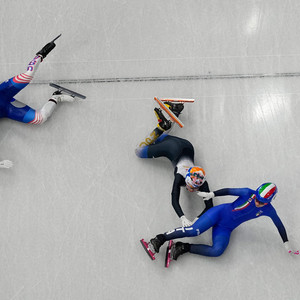
And I don't know about you, but I know I'm holding my breath watching them fly down mountains on skis or slip and fall on the ice.
So I can only imagine how the athletes must feel competing with the whole world watching.
And yet I feel like, no matter what we do, whether we're attempting quadruple axles on the ice or just showing up to work we all experience pressure, right.
Doing an interview on the radio could feel as stressful as that person trying to get the gold medal for their figure skating, competition or whatever event they're in.
It's subjective, right?
So for me, it could be the same thing as... an Olympian in their, you know, gold medal event.
Vikram gets me.
Vikram Chib is a biomedical engineer and neuroscientist at Johns Hopkins.
His lab studies performance and how the brain responds to rewards.
And he says reward is baked into basically everything humans do.
And that could be getting a gold medal, right?
Or it could be, you know, reaching for a cup of water.
The stakes just vary a lot.
So today on the show, what happens in athletes' brains when those stakes are at their highest?
And what science tells us about how our brains respond to rewards, pressure and millions of people watching you strive for gold.
You're listening to Shortwave, the science podcast from NPR.
This message comes from NPR sponsor, NetSuite.
Every business is asking the same question.
How do they make AI work for them?
The possibilities are endless.
No more waiting.
With NetSuite by Oracle, you can put AI to work today.
NetSuite is the number one AI cloud ERP trusted by over 43,000 businesses.
This isn't another bolted-on tool.
It's AI built into the system that runs your business.
If your revenues are at least in the seven figures.
Get the free business guide Demystifying AI at netsuitecom.
Slash shortwave.
On NPR's Wildcard podcast, Oscar nominee Wagner Mora on keeping his values on his path to success.
There were moments where I was like, oh, I really need that money right now.
You know, but I'm like, I can't do this.
I can't do that because otherwise I'll be miserable.
Watch or listen to that wildcard conversation on the NPR app or on YouTube at NPR Wildcard.
All right, we are talking to Vikram Chhib, a biomedical engineer at Johns Hopkins University.
You have studied people's brains to understand how they respond to rewards like gold medals or whatever your own personal gold medal is.
And you've also looked at what happens, what's going on when people feel tired.
And I wanted to ask you to tell us about that.
Like what's actually happening in the brain when we are fatigued?
Right.
So there are different types of fatigue that you could have, right?
There's cognitive fatigue.
Maybe you're sitting at your desk and you're doing a lot of spreadsheets or something, right?
Or writing.
And then there's physical fatigue, which is running, walking up a long flight of stairs, things like that.
And what we found is that there are areas in your brain that are involved in sensing your internal state.
And when those areas interact with motivational areas.
That's kind of what gets you to feel fatigued.
So you sense that your body can't produce any more output, any more effort, whether that's cognitive or mental, and that gets you to sort of shut down and feel tired.
And does that fatigue...
Does it look different inside the brain when the stakes are higher or lower for somebody, when that reward is more on their minds?
Yeah.
So we haven't directly looked at higher or lower stakes.
What we do know, and what we're starting to see, is that offering a little bit of reward can push you out of that fatigue state a little bit.
So reward can sort of counteract the cost of effort that you have to do.
So you can think of any action that you're doing as like a trade-off between the effort costs that you're putting in and the reward you're getting out.
So if I boost up that reward a little bit it might motivate me more to overcome some of that feeling of fatigue and do the task that I'm set out to do.
Right.
So, like thinking of Everybody at the Olympics right now, maybe an athlete might be totally exhausted, but if they know that if they push a little more they could win gold, maybe they're more likely to actually be able to overcome that fatigue.
Yeah, that's right.
So like you would think about like a speed skater, right?
You see these people getting their Olympic records or gold medals, right?
And You know, they've for four years, they do their World Cup events, you know, and they do OK.
Right.
Sometimes they they they break world records.
But you see a lot of Olympic and world records broken in in the Olympics.
Right.
And so what one one way to think about that?
I mean this is just speculative.
Could could be that like OK, that added, that little added reward pushes them beyond Olympics, their limit.
That makes perfect sense, right?
You have this offering of a reward and you sort of do something superhuman.
You can do better than you've ever done before.
What about the flip side?
What about when Olympians choke and they mess up on something that they've been able to do before?
Just fine.
Is that related to mental fatigue or is there something else going on?
Well, we've sort of looked at that in terms of um the heightened reward aspect of it as opposed to the fatigue aspect of it.
So what we've done is we've kind of set up these like like choking scenarios in the lab where we, where we use incentive, and the incentive we've used is money.
So we pay people like a lot of monies.
We tell them, okay, you're going to do a single trial, like of a, of a skilled motor task.
Um, essentially playing a video game.
And on certain trials, we're going to give you $100 to do this trial.
And what we find is that people do.
You know, as the incentives increase, you know 25, 50 people get better.
And when you give them $100, they tend to choke under pressure.
Their performance goes down.
And we looked in the brain when that happened.
And what we found was that there's this area deep in your brain that's responsible for reward processing that called the ventral striatum.
Ventral striatum?
The ventral striatum, yeah.
And so it activates when the rewards are high, and it actually tends to deactivate when you have potential losses.
And what we found was that what would happen is, when people were playing a task and really high incentives were on the line, they would begin.
They would see that incentive.
They'd be like, oh wow, I have a hundred dollars to win.
They would see that really high incentive and And they would view it as a loss.
They would get worried about actually losing the really high incentive.
And that worry about loss was related to how they choked under pressure.
So the people that tended to worry more about that loss tended to choke under pressure more.
They essentially reframed this positive thing a hundred dollars as, oh my gosh, I could lose that a hundred dollars.
Right?
So it's in their mind, right?
Now what's interesting is, the ventral striatum not only does reward processing, but it also does motor processes as well.
So it initiates motor action.
And so what we think is that there was some crosstalk between those reward signals, or those worry of loss signals, and the motor signals.
And that's what got people to do poorly when the stakes were high.
Yeah.
So if you're thinking that you might win the gold medal, that's great.
And if you're thinking, oh my God, if I mess up, I don't win the gold medal and I lose, then suddenly your brain can't work the same way.
Yeah.
So essentially it's like a reframing. right?
So your brain is reframing that incentive and that reframing can get you to do poorly.
Now we've also found that if you train yourself to reframe the task in a different way and say to yourself okay, I'm going to go into this trial and I'm not going to think about this individual trial,
I'm going to think about the portfolio of all the trials I have to do.
So like, For example, the portfolio of all the races I have to skate.
If you do that, you don't focus on that loss as much.
And you see less brain activity associated with this fear of losing.
And you tend to do better under pressure.
So cognitive reframing can sort of get you to overcome that, that choking behavior, or at least we've seen that in the lab.
Yeah, yeah.
You mentioned the ventral striatum.
Are there other big parts of the brain that are at play when someone's under pressure or having performance anxiety going on, that you look at?
Yeah, so you can think of the reward areas.
So ventral striatum, nucleus accumbens, prefrontal cortex, those areas respond to reward.
So the brain sort of activates when the rewards are very high.
You can also think about the motor areas if we're thinking about Olympic sport.
So you know, motor cortex is an area that's responsible for coordinating your arm movements and your leg movements, or the cerebellum.
That's another motor area.
But you can also think about sort of cognitive areas, because some of these events are very, you know, cognitively taxing.
For example, like you see people doing curling, right?
You know there's a lot of strategy and mental effort into saying like how do I place this rock in the right place, right?
And so you can even think about working memory areas or prefrontal cortex.
Again, that not only does reward, but does sort of higher order cognitive function.
Yeah.
And, you know, I'm watching them do it on TV.
What is?
What does attention from other people do to someone's experience of trying to do a difficult task?
Like having millions of people watch you on live TV as you're taking your shot.
Yeah.
So, you know, that can be another incentive, right?
Social approval is an incentive.
And so we've actually done studies in the lab where we've put people in the scanner, had them be watched while they're doing different tasks.
And It's very similar to the reward scenario that I gave you before, right?
A couple people watching you can get you to boost your performance and actually like enhance performance a little bit right.
But we've seen, you know, when crowds are really big.
We haven't been able to do this in the lab because I don't know how to get here.
But when there are a lot of people in the crowd, right, that social incentive can be really high.
And in the same way that the reward value, when it's really high for just monetary rewards, can get you to do poorly, that can happen in the social context as well, right?
And we see that time and again.
So a little, a medium-sized reward, a few people watching, really helpful.
A lot.
A giant reward, a ton of attention like, can actually make it really difficult to do something.
Olympians have to be able to compete with the most pressure that I can imagine.
So what can the rest of us learn from them in our, maybe lower stakes, personal gold medal events today?
How do we shift our focus, reframe our thinking so that we can do better under pressure?
Yeah, I think using these cognitive approaches is helpful.
Thinking about things in terms of the big picture, as opposed to smaller events that you get really myopic about and then worry about doing poorly on them.
I think you have a big event happening.
You have to give a big presentation at work, for example, and you worry about it for days and days and days.
Whereas you could just think to yourself like oh, I'm going to have, you know, a bunch of presentations over the year.
And like, it's okay if I don't do as well on this.
I can sort of, I'll have other chances to do well.
So I think reframing is something that we can do to get us to do well when the stakes are high for us.
All right.
Awesome.
Well, thank you so much for coming to chat about the Olympics and pressure and rewards with us.
This is something I know I'm going to be thinking about as I watch the rest of the games.
And fingers crossed that those athletes can keep their mind on the big picture.
All right.
Great.
Thank you for having me.
If you liked this episode, follow us.
It really helps the show and means you never miss another episode.
Also check out our episodes on Sled Head, a condition affecting bobsleigh and skeleton athletes, and the physics powering the cool feats of other Olympic sports, like ski mountaineering and the ski jump.
This episode was produced by Rachel Carlson, edited by our showrunner, Rebecca Ramirez, and fact-checked by Tyler Jones.
Kwesi Lee was the audio engineer.
I'm Camilla Dominovsky.
Thanks for listening to Short Waves from NPR.
This year on ThruLine, NPR's history podcast.
For generations, an American quest has shaped the world.
Life, liberty, the pursuit of happiness.
Now, 250 years in, what is that pursuit really about?
Join us each Tuesday for an essential new series America in Pursuit from ThruLine on the NPR app or wherever you get podcasts.
I'm Jesse Thorne.
On Bullseye Yahya Abdul-Mateen II and the most surprising thing he learned after receiving one of the highest honors in acting.
I'm so grateful that it happened at that time because it did not make me happy at all.
We'll get into that and his many roles playing various superheroes and villains.
That's Bullseye.
Find us in the NPR app at MaximumFun.org or wherever you get your podcasts.