Hey there, good luck project listeners, so I want to share something special with you this week.
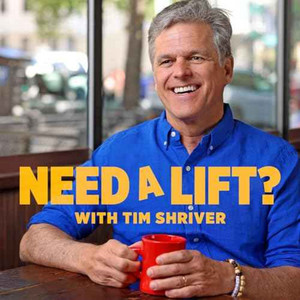
It is an episode of a podcast that I'm really enjoying called Need a Lift.
It's hosted by Tim Shriver.
So Tim has spent years of experience working as an educator and with athletes and leaders of the Special Olympics movement around the world.
And through his work, he's found that really the best way to build community to connect people is at the soul level.
And that is why his podcast Need a Lift features guests who have transformed painful moments in their lives into purpose through spiritual rituals and practices.
Guests like bestselling novelist Ming Jin Lee talking about why she creates complicated characters who hold the secret to our transformation or writer Simon Sinek on why idealism belongs in the workplace and Olympic athlete Michael Phelps and his wife Nicole talking about the importance of cultivating
an inner life in competition, mental health and in their marriage too.
Need a Lift is truly the antidote to the hatred and despair that we are all just exhausted of hearing, giving us hope that change is possible.
In this episode, the office's Rainn Wilson explains how we can quiet the world's chaos and deal with our collective sense of overwhelm by believing in something bigger than us.
Okay, here comes the preview.
You can hear more Need a Lift episodes wherever you get podcasts.
I'll never forget a kind of a mystical, transcendent experience I had when I was maybe 12, where we were at a Baha 'i youth gathering and we'd been doing like some service work and we were all sleeping outside and it was a clear night and just all of these stars and thinking about them, how distant they
were and how beautiful they are and feeling the presence of the divine in my life through the stars.
I'm Tim Schriver and this is Need a Lift, a show where each week I get the privilege of talking to people who give me reasons to believe in us.
A few years ago, I met a classmate of my mother, a classmate she knew and she was friends with before World War II when she was in high school.
It was Sister Dorothy Bell and she had stayed at the school my mother attended her entire life and the school had grown and had become co -ed and she was like the icon of the campus.
Everyone saw her, everyone talked to her, everyone approached her, everyone smiled when she came by and everyone came up to me and said how much they admired Sister Dorothy and I asked her, why aren't all these students, why they admire you so much Sister Dorothy?
Why aren't they interested in religious life?
Why don't they become nuns the way you became a nun?
What do you think has changed?
Are they missing something important?
Are they missing religion?
And she said, oh no, when I was a young woman to search for God meant to search for perfection.
And so women like me thought we should become nuns because that's how you search for perfection.
But today, she said, all these young people, they're searching for unity and you don't have to become a religious sister to search for unity.
In fact, you have to be out in the world.
The search for unity is all about building relationships and connecting with something bigger than yourself, all these young people, they're still searching.
But they're looking in the world, out in their relationships, amongst their friends, in the work they do, in nature, they're looking for God there.
And I thought to myself, what a beautiful way to characterize the challenge of our time.
So many of us lonely, frustrated, discouraged about the future.
So many of us don't feel that unity is possible but their sister Dorothy reminding us, we may not have confidence in it, but we're hungering for it.
We're wondering what it means, where it is and how we'll know if we ever achieve it.
Today's guest is Rainn Wilson.
And the way I see it, Rainn is also looking for unity in the world and Rainn wants you to join him.
You probably know Rainn as Dwight Schrute from the office.
Through concentration I can raise and lower my cholesterol at well.
Why would you want to raise your cholesterol?
So I can lower it. Dwight is an eccentric assistant regional manager, he's a paper salesman at Dunder Mifflin.
He loves karate and justice and has this undying sense of mission for the company.
Today Rainn is here to make a pitch that we need an undying sense of mission to the divine.
That we need to recover our spirituality if we're going to get through all the challenges both within and within our country.
That was so good. Really?
Yeah, you had me. It was fantastic.
I'd like to start by asking guests this question.
Do you have a ritual or a practice that helps you feel more connected to your spirituality, something that you do daily or regularly to keep you grounded?
Yes I do, Tim. You can't see it but right outside this window here is a little bench.
And I won't say every morning but I'll say five mornings a week.
I go out first thing and I sit on my bench and I pray and I meditate somewhere between 15 and 25 minutes every morning and it's kind of a sacred ritual for me, it grounds me, it connects me to purpose and enriches my day and my days just a little bit better because of it.
You know when you work out?
You feel like I hate working out, I really don't want to work out but then you do work out and your day's kind of better and you go, wow, my day's better because I worked out and I didn't want to and yet it has a payoff and a spiritual practice is similar for me.
You meditate and you pray.
Many people, you point out, meditate and completely different people pray but very few people pray and meditate.
Can you say how those work together in your practice?
In my mind, America is so bifurcated right now that half of the country meditates and doesn't pray.
Usually in kind of blue state, liberal America that have a big issue with God and church and religion, there's a lot of meditation going on and not a whole lot of prayer and then in other parts of the country, they might not have as difficult a time with God or faith but perhaps there's not as much
kind of meditation.
To me, the two go hand in hand.
Prayer is beseeching.
It's reaching out. If your heart is a satellite dish, it's sending a radio signal outwards and if it's the same satellite dish, meditation is receiving from the universe, from getting in touch with yourself, from your deeper self.
There's a dialogue that's happening.
It's kind of a yin -yang dialogue between prayer and meditation.
And you write a lot and think about a lot, obviously, Dwight, this issue of spirituality.
You talk about spirituality a lot in your book.
Wait, did you just call me Dwight?
Sorry. It's fine, it happens all the time.
I expected more of a Shriver.
Honestly, of a Shriver, I expected a little more.
You can use it, I swear.
It's funny. I know, I'm sure you don't mind.
So it seems like you almost grew up with this connection between the spiritual experience or the soul, the transcendence, the ineffable, and the concrete, the communal, the joining together.
You grew up in a house that your family invited strangers to come in and the Jehovah's Witnesses would knock on the door and they'd be invited in and they'd be having pancakes in the living room.
I'm kind of curious as to how you would characterize the story of your spiritual journey as a child, if you will, the origin story of your soul experience.
Great question, Tim.
Wonderful. I love having this conversation.
This is just so delightful.
It's my favorite kind of conversation to have in the world.
You too. I grew up a member of the Baha 'i faith.
Baha 'is believe in all of the world's religions.
Growing up Baha 'i meant a lot of things.
It meant we had all kinds of books on the shelves, Buddhist books, Sufi books, Sikh books, Hindu books, the Bhagavad Gita.
We had people from different faith traditions at our house.
There was a lot of singing.
There was a lot of like sometimes we would literally sing kumbaya.
It was very diverse, so Baha 'is really seek to create unity and diversity.
It was amazing. Learning a lot of amazing Baha 'i teachings about the unity of humanity, and we're all one beautiful rose garden, and all of the faiths come from one God and our expressions of the divine, and women and men were equal, and social justice is important, and the list goes on and on.
Arts were very much incorporated.
So that's kind of the story of my soul in a way, was that kind of upbringing.
The other story is my family was unhappy and dysfunctional, and I think this happens to a lot of people of faith, you know?
You hear the story all the time.
It turns people off to religion in a lot of ways because there's an inherent hypocrisy, and there wasn't my family.
My mom left when I was quite young.
I stayed with my dad.
He got remarried. They were very unhappily married, and so we would go to Baha 'i gatherings and be singing kumbaya and talking about love and unity, and there was really almost no love and unity in my family life, my home life.
So that created this kind of disconnect that, you know, had some negative ramifications when I got older, and is also part of my spiritual journey.
So there was that kind of frisson between those two elements, and I'm sure a lot of people can relate.
Are there moments in your childhood where you were looking at those books or listening to the songs or watching the convenings and hearing the prayers, where you can kind of place, whoa, my soul was alive in that moment, or alternatively, when you felt the sadness of the lack of love in your home, as
you described it, or other painful things where you felt your soul was really hungering for something?
Wow, I love how your brain works, and your heart.
I experienced both of those things, Tim.
I'll never forget a kind of a mystical, transcendent experience I had when I was maybe 12, where we were at a Baha 'i youth gathering, and we had been doing like some service work, and we were all sleeping outside, and I was looking at the stars, and it was a clear night.
I'll never forget this, just all of these stars, and thinking about them, how distant they were and how beautiful they are, and I just felt in my heart like a connection to God's majesty and power and beauty, and I remember just being swept away in it and praying and thanking God and feeling the presence
of the Divine in my life through the stars, through the beauty of the stars, and I remember times of just colossal sadness and disconnect at my parents fighting at their disunity, at feeling such low self -esteem that I was absolutely miserable through big chunks of my childhood and chunks of my teenage
years, and you know what, guess what, Tim?
That's what being a human being is all about, isn't it?
You have the highest highs and the lowest lows, the most transcendent experiences, and the tragic traumatic ones as well, and I wouldn't trade it for anything.
Like a lot of us, as you grew up, you hit your 20s and maybe it was the pain side of the ledger, or maybe it was the youth side of the ledger, or maybe it was some combination of other factors.
You decided to reject God, you rejected religion, you thought, I'm out of here, I'm done with this.
Was there a moment that was the tipping point for you that was like, I'm done?
Yeah, it was ridiculous.
It was a ridiculous moment.
I moved to New York City to be an actor, I went to NYU, I was very excited, I went to this great acting program, I was 20, 21 years old, living in the village, I was getting to be an artist, I was this nerdy, dorky boy from suburban Seattle, living in New York in the late 80s, and this was my dream
come true, and I kept trying to get in touch with the Baha 'i community in New York, and they wouldn't like write me back, just before email, so I had to write a letter, like, can I have a newsletter?
You have to get a newsletter to find out where and when the gatherings were, think about that, it's crazy.
It's even before fax machines, Tim, pre -fax machine.
Smoke signals. Yeah, basically.
And then I got a letter from them, oh, you've been appointed to the Baha 'i Youth Committee of New York City?
And I had just lived there for, like, six months.
I hadn't even met anyone, I was like, wait, what?
I'm on a youth committee?
What does this mean?
And it said, not only that, like, you're the convener, here's their phone numbers, you need to call all the youth and, like, get them together and have a meeting.
I'm like, I mean, I'm in school for acting, like, that's not what I want to be doing, and I called them, and I finally said, like, okay, here's where we're going to meet, and then I went to go meet them, and no one showed up.
And then that was it for me, that's the straw that broke the camel's back, I was like, I'm done.
The meeting with no shows.
That's it. It was a bunch of no shows, and I'm not blaming the Baha 'is of New York in 1988, but, you know, there's organizational dysfunction, and that comes with the territory with any cause or religion or nonprofit that you're working with, and at that point in time, I was not wanting anything to
do with God or morality, I just wanted to be an actor and have a, I won't even say, like, a debauched life, it's not like I had dreams of, like, you know, drugs and sex and rock and roll, but I didn't want to be thinking about anything religious, I just wanted to be an actor in New York City, and so I
just jettisoned anything and everything to do with religion, and I said, let me just, I'm going to try and be an atheist for a while, so I spent a couple years just trying to be an atheist.
And then at some level, you write so honestly, you know, you bottom out, nothing's working.
Um, life isn't working, you know, there's a moment, or I suppose a period there where you hit rock bottom.
Can you share a little bit about what that was like and how spirituality then returned to your life when you found yourself unable to manage on your own, so to speak?
Yeah, I mean, I did have problems with drugs and alcohol and sex and anything else someone can get addicted to, but it's not like I bottomed out and passed out in some ditch somewhere, and it was a multi -year process of just being miserable and just, like, I thought I was living my life to my wildest
dreams. I was an actor in New York, I was getting work, I had an agent, this was beyond my wildest dreams, and I was miserable, Tim.
I had trouble sleeping, I would wake up at 3 in the morning just feeling terrible about myself and like, what does it all mean?
And I, my soul was wracked.
I don't even know why there wasn't, there wasn't anything specific.
I was going through a lot of anxiety attacks, I was, um, had depression, and I was just struggling, and I realized now that what I was going through were a lot of mental health struggles, especially the anxiety attacks, the panic attacks.
We didn't have lingo in the 90s for, you know, mental health crises, so there wasn't a podcast to listen to, or a wellness app, or, you know, a YouTube channel, or even a self -help book to help you with it, so I turned to the only path that I knew at the time, which was a spiritual one, and thought,
well, maybe I've jettisoned religion, maybe that's why I'm so damn unhappy all the time, even though I'm living life as an actor, and I have an awesome girlfriend, and apartment, and van.
I had a great van, Tim.
That's very important.
It is. It's an important part of youth.
Um, so that's when I started rethinking my relationship with God, and that's when I started kind of exploring more, because I think it's the most important question we could ever ask in our lives, is, is there a God or not?
And because either the universe, Tim, is a beautiful kind of meaningful, uh, physical expression of the divine, and we have souls, and then our souls continue on this journey beyond time and space toward our creator, either that's the the world, or it is still beautiful, but ultimately meaningless.
And we're a random assemblage of molecules, and you and I happen to be having this conversation right now over this technology, and connecting our hearts and souls.
And then when we're 80 or 90, the lights go out, and that's it.
And that's the end.
And whatever meaning is whatever meaning you find along the way.
And there's plenty of people that ascribe to that.
I tried to ascribe to that.
I can't really get with it.
It just doesn't make sense to me on a gut level.
So that was the question and the journey at the center of kind of my mental health path.
You know, one of the teachers I've spent a lot of time following is a monk who's recently died named Thomas Keating, and he says there are three false programs of happiness.
Approval, security, and control.
These are the programs of the ego, approval, security, and control.
And it sounds like part of what was going on for you was that those pieces of the puzzle, your approval, your becoming a star, your security, you've got the van, your capacity to control things, you're an individual living the life in New York City that somehow it wasn't enough.
Yeah. I love that, by the way.
I'm totally stealing that.
Occasionally, I'll quote Thomas Keating, but yeah.
You're good at quoting people.
You say right at the beginning, I got a lot of good quotes in this book, and you are right.
Normally, when I read that, I think I was going to be boring somebody just telling me what other people say, but you weave them into a beautiful tapestry.
So hats off to you.
Oh, that's very kind.
Thank you so much. I appreciate that.
And I have a whole bunch more for my next book.
I keep it on my Notes app.
Do you keep quotes on your Notes app too?
I do keep quotes on my Notes app.
All right, let's have a Notes.
I've taken many from your book that are now in my Notes app without attribution, including some from you, not just from other people you quote.
Tim, that's amazing.
I'm going to throw your way from my next book, Sneak Peek.
Okay. Here's one from Sri Aurobindo, a Hindu guru.
By your stumbling, the world is perfected.
Here's one from Thomas Merton.
Prayer should be the activity in which you are most yourself.
Ooh, write that down.
I want to write that down.
Bob Marley says, you never know how strong you are until being strong is your only choice.
Here's another one, Hafez.
Pulling out the chair under your mind and falling into God.
There is nothing else fun to do in this world.
That's beautiful. You're listening to Need a Lift.
We'll be back after a short break.
This phase of your life, if you go back to this moment of shift when you first decided no more Baha 'i youth group meetings for me and then things got a little dicey and you sort of naturally evolved back to asking these big questions.
They were all centered in you as an artist, right?
You're an artist by gift, by training, by vocation.
And part of what you learned was that art and faith don't have to be like on two ends of a spectrum.
They can actually be much more integrated, that faith is a part of the practice of art.
Can I read this quote from Abdul Baha that is in your book.
And he's writing to a young painter.
And he writes, I rejoice to hear that thou take us pains with thine art.
For in this wonderful new age, art is worship.
The more thou strive us to perfect it, the closer thou wilt come to God.
What bestowal could be greater than this that one's art should be even as the act of worshiping the Lord?
That is to say, when your fingers grasp the paintbrush, it is as if thou wilt at prayer in the temple.
Oh, it's one of my favorite quotes of all time.
Thanks. It was so nice to hear you read that.
It feels to me like that's sort of what you started to practice acting in a new way in this phase.
Is that fair? I would say I had a new understanding of what I was doing as an actor.
I don't think it shifted how I acted, or even the choices I made as an actor.
But I was in this kind of weird conflict where I'm like, Hampling Dwight, he's this annoying paper salesman on a sitcom.
And yet I'm interested in God, these two things seem to be at odds.
But then I realized, no, you know, and then one of the great aspects of doing the office was that it brought a lot of solace to people's hearts.
It ended up being a service.
We didn't get into it to be a service.
I didn't go, oh, Timothy, I want to play Dwight Schrute so I can make people laugh.
And if they're going through dark times, they can find some illumination in the denizens of Dunder Mifflin.
It wasn't like that at all.
I just wanted to be on a funny show, you know, and do good work, and buy a house.
So - And keep the van.
And keep the van. It's so important.
But art and faith are really synonymous, you know?
I think Thomas Merton is a great actuary of, I don't know, I don't think that's the right word, but in his poetry and in his devotion.
Yeah. Funny story about Thomas Merton, I got to sleep in his hermitage.
In his cottage? In his cottage out in the woods in Kentucky.
I knew a guy who knew a guy who knew a monk, and they snuck me in.
And he's like, I know you're a Thomas Merton fan.
I think I know that monk, and I'm going to call him and say you didn't sneak me in when I was down there now.
No, they don't sneak anyone in.
I'm not even Catholic, bro.
They let up a high sleep in Merton's cottage.
You do write about being in a class at one point, where you had this experience where you realized that underneath all, you know, the bad acting was driven by a fear of rejection.
And I wonder if you can describe that a little bit, because it sounds like not just a transformation of your craft, but a transformation of your spirit.
Did I read that right?
Yeah, I mean, you make it sound much more profound than I intended.
But that is, you know, going back to your Keating quote, approval seeking has been one of my greatest albatrosses.
I think it exists for every actor.
I mean, there's something about being an actor, like, I want to be on stage and I want everyone looking at me and I want to pretend to be people and I want them to notice me.
There's an essential kind of approval seeking in acting itself.
I know very, very few actors that are completely immune to approval seeking.
But if there is an element of like, please like me, please love me, and you know, I'll be the clown.
I hope you love me.
And that comes from, you know, living in a fractured home as well.
But I had to get over that.
And, you know, finally did with a lot of therapy, but it took a long time.
And then Hollywood itself is a very toxic environment to be in.
You know, it's a big popularity contest and it's all about status.
Hollywood is a place that prizes these qualities of success, approval, glamour, glitz.
It's a machine of the aspirational hopes of people.
I mean, people will consume it endlessly with the hope that we could all participate in some small way, that maybe one day we could be on the red carpet or that rich or that successful or that admired or that thing, you know, get those great seats at the restaurant or the upgrade on, you know, like
we all are told in the religion of our culture that that's where we want to land.
And so many people, I think you're an example of this, come close to saying it almost ruined your life.
Yeah. As a person so committed to the spiritual life, help us, most of us who think Hollywood is where we would be most happy, reconcile why that doesn't work.
I will say that for a lot of 20 somethings, when they ask young folk what they most want, fame is number one on the list.
Why is that? Well, fame hits all of the human survival buttons.
What do we need? Humans need shelter, they need security, they need sex, and they need kind of social status.
And when you have fame, you have money and people love you and your needs are taken care of.
So all in one fell swoop.
You can be Instagram famous and then have all of those things taken care of.
But what that doesn't cover is kind of meaning and connection and love.
And Hollywood tends to bring out the worst in people because fame and money and status is really hollow and brings out kind of the worst in people.
Jim Carrey talks about it so well.
I remember him winning the Golden Globe once and he goes, well, this ought to do it.
Now, I'll finally be happy.
Now I'll finally, here it is.
Look, it's in my hands.
And everyone laughed, because he knows, we know that the awards mean nothing.
He's like, oh, I got a Golden Globe.
Well, I don't have an Oscar.
Did you ever feel like you were an outsider in that culture?
Like you're out there in that whole world where most people are talking about all the words fame and money and status.
And it seems to me like you're like an outlier in that world.
Have you ever felt that way?
Have you felt like that people think like, ooh, rain's coming.
Let's like weird. Like, it's not going to be fun.
Yeah. And a number of different reasons.
So first of all, I'm a dorky, weird guy.
I was a Dungeons and Dragons playing.
I was on the chess team.
I played the bassoon in suburban Seattle.
And I'm just weird looking.
So I never felt a part of anything.
Anyway, I didn't feel a part of anything.
When I was at Shorecrest High School in Seattle, I felt left out and like a misfit.
So I certainly felt like a left out misfit when I came to LA and working in Hollywood.
And then on top of that, you have this actor who's really interested in spirituality and talking about it with Oprah and doing podcasts about it.
And I created this company called Soul Pancake that made these inspiring, uplifting videos.
And a lot of them were about spiritual themes and people didn't know what the hell to do with like, here's a comedic actor on a sitcom talking about like God and the soul and faith.
Like it was really disconcerting to a lot of Hollywood.
And I'm sure it adversely affected my career.
I'm sure that people are like, no, no, he's, he's just too weird.
We don't want him in our, in our projects.
But I gotta be me, Tim.
I have to kind of find my authentic voice and my authentic voice is like, I'm a weird, funny actor.
Hopefully I'm a good actor and I can get better.
And I'm also interested in sparking spiritual conversation about personal and social transformation.
And we're continuing the conversation and some people just want me to be Dwight and some people want me to shut up about spirituality and that's fine.
Do you still feel sometimes like a misfit and like a person who's left out?
I think I will always feel that way.
And that's okay because that's life and I'm blessed in so many ways.
So you pitched a show, you say if you have a great sizzle, you have a couple of episodes mapped out of the notorious GOD.
And everything you're describing, the hunger, the mental health crisis in the country, the lack of common purpose, the fracturing of our identity, suggest that we're missing a piece.
The missing piece is God and you went to Hollywood and you pitched it.
Can you tell us about, you're walking into the meeting and you've got your pushing play with your sizzle reel and you look around the room and after the sizzle reel shows, what happened?
Well, I'll go back a little bit before I pitched the notorious GOD as a TV show.
And that was on my company SoulPancake, we had a show called My Last Days.
And it was about lessons that we confined in life from people at the end of their life.
So in a sense, it's a show about dying, but really it's a show about living because it's about gratitude and passion and joy and connection.
This was a hit show for us.
Some people would write to us and say, I watch an episode every single day to remind me why I am alive.
So we went and said, well, that's a prayer.
That is a prayer. And we pitched this around to the various studios and I'll never forget, we went into MTV and we pitched My Last Days as a show to MTV.
We show them the sizzle reel.
They're all crying, three grown women with tears pouring down their cheeks, having seen the pitch and the sizzle reel.
And in through their tears, they're like, we could never make this show.
Because it's about death and TV is about advertising.
And what is Downy Paper Towels or Toyota going to advertise with a show that's talking about people dying?
So it's the same thing that happened with Notorious GOD.
I knew no one would take it, but I was like, I want to make a show about God.
There's redefining God in the modern world.
How do we redefine God through the movies like The Matrix?
Or what's an atheist church like?
Or how can we go to different cultures and explore what God is?
We pitched it all around and I'll never forget the rejection we got from Netflix is that it was too controversial.
God is too controversial.
Oh, I see. The topic is too controversial.
Partisan. Yeah, it's partisan.
It's like, what faith are you talking about?
So you can have reality shows.
There's a new one on Peacock called From a Couple to a Thruple.
So you can have From a Couple to a Thruple on Peacock, but you can't have a show about God.
And that shows you a little bit about the truth about Hollywood.
Now, that was five or six years ago.
Maybe things would be more open now.
I'm thinking about pitching it again, actually.
You have made this not just a change in your life, but you've adopted this as a mission.
Yeah. You went looking.
You didn't just sort of say, okay, I'm going to go back to the Baha 'i youth group.
You went on a mission, which people would say that are huge fans of yours from your office phase of your life.
That's very Dwight.
Dwight, he wants to organize everything.
Yeah. So talk about what is the spiritual revolution, Rain.
So a spiritual revolution is using spiritual tools for social transformation.
This means transforming oneself, certainly, in one's heart through prayer and meditation and study of holy texts.
But more importantly, it's reconceiving and reconfiguring social systems along spiritual lines.
Because right now, those systems are built along the very worst characteristics of humanity, of competition and one -upsmanship and aggression.
So we need to question systems themselves and start to reinvent them.
How do we do this? We do this at the grassroots.
We start it by building coalition on a very small level and letting it radiate their from.
So if we are going to start this spiritual revolution, who's the organizer?
Is there like a Dwight version of the organizer here?
Like the person who's going to make sure that the safety rules are being followed or the team is being marshaled in some collective direction to pursue the goals as you articulate them?
Let me put it this way.
When my dad brought in one time a bunch of, like, Jehovah's Witnesses into our house and was talking to them about the Bible, he asked them about the kingdom of God.
And he said, what do you believe about the kingdom of God?
And they were like, well, we believe that there'll be thunder and lightning and the sky will open and there'll be clouds and then out of the clouds will descend a city of gold and silver and there'll be angels and trumpets.
And that'll be the kingdom of God and the saved people get on the kingdom of God and they'll float away and everyone will be left behind.
And they said, what's the Baha 'i version of the kingdom of God?
And my dad said, well, it's kind of similar.
There's going to be thunder and lightning and the clouds will part and there will be a cloud that'll descend and angels, trumpets will blast.
But instead of a city, down from the sky will fall some bags of cement, some shovels, some bricks, some two by fours, and a piece of paper will fall to the ground and it'll say, kingdom of God on earth, build it yourself, kid.
Mm hmm. So I think that's what it's about.
It's whether you're atheist or theist, we really want to build the kingdom of God, a kingdom of fairness and justice and love and mutuality and respect.
And that all sounds kind of hippy dippy on paper, but I really believe we can do it.
You know, when you write about the spiritual revolution, I have to tell you that my little, you know, our little mighty team says, Oh my God, this interview is going to go on forever because everything that Rain writes is the same thing you say, Tim, only he says it better and he's got better quotes
than you and he's farther along than you are.
But one of the things that the spiritual revolution language is distinctive in your version is that you talk a lot about the us, that the practice of the spirit of prayer, of connection to the divine, that these practices are inviting you into a relationship, into a re -ligamenting as you point out,
the re -connecting with others, that spirituality isn't just me, my quest, my peace, my center, my health.
It's about us. Can you say how you came to that insight?
How do you invite people into a collective, if you will, spirituality that doesn't turn them off?
That's such a good and important question.
Abdul Baha from the Baha 'i Faith has a staggering quote from a leader of a world religion at the time.
He said, if religion is a cause of disunity, it were better that there were no religion.
So you have a religious leader saying that if religion causes disunity, it's better just not have any.
He even says, irreligion is to be preferred.
And that's where we're at right now.
We're in irreligion, because religion has caused so much disunity.
It's judgmental. It's corrupt.
It has caused wars.
It still causes wars.
I mean, look what's happening in Gaza right now.
Two of the most peace -loving religions on the planet are at war.
I mean, the list goes on and on.
So it's very understandable why we're at the place where we're at.
But as I say in my book, and here you can put this in your quotes app, we seem to have thrown the spiritual baby out with the religious bathwater.
So, you know, Western civilization has kind of rejected religion, but in the doing we have lost that beautiful truth of spirituality.
And spirituality has an essence to it that's about community.
I talk in great length in the book about the early centuries of the Christian church.
And the greatest human experiment on the planet happened in the first two, 300 years of Christianity, which was if you accept Jesus Christ as your Lord and Savior, and you believe in the Father and the Son and the Holy Spirit, and some version of that, you are welcome, and we are family, and we will include
you. And at the early church gatherings, there were Pharisees, and there were, you know, Romans, and there were slaves, and there were Samaritans, and there were, you know, working -class people and centurions, and everyone was gathered in an open tent, beautiful place in prayer and in praise, and for the first
time in human history, it didn't matter your caste, it didn't matter your gender, it didn't matter your background or your tribe.
There was a new tribe that was gathered under this, the auspices of Jesus.
Not only that, there would be a flood or an earthquake or a famine somewhere, and these Christians would gather and help those people out, even if they weren't in their tribe.
This was revolutionary.
It was groundbreaking.
This had never happened before in human history.
What do you mean the Galileans and the Samaritans and the Egyptians are working together to help out the Tunisians where this flood happened?
That's crazy talk. So, ultimately, this is what humanity needs, and it's much more than spirituality, simply as a remedy for anxiety in some kind of individualized practice.
There's something about this joining of, you know, joining of oneself to another, which you write about as like, you know, in the context of falling in love, but there's something about opening yourself to the rest of the universe, if you will.
Another mentor of mine talks about the universal pattern being birth, death, and resurrection, that we all, everything participates in this pattern.
But it's a pattern that only makes sense when you look at the big picture.
If I'm going to be practicing this in a revolutionary way, you know, as part of a revolution.
Yeah. I don't know exactly, Tim, to be really honest.
I don't know exactly.
I have a couple of points that I make that I stab out at.
One is I think it has to happen at the grassroots.
So, I think it has to happen at a cul -de -sac or in a church basement or at a school or at a local park where different people, different backgrounds, faith traditions, skin colors, classes come together and find where the need is and help serve that need.
I want to ask you about something I feel very strongly, which is that our country and both young and old have been sort of sucked into an experience of becoming cynical.
It was the one thing I didn't grow up with.
I grew up with a lot of challenges and problems in my family and in the country.
But you talk about we need to take on cynicism and despair.
How do you sell that?
Well, I'll tell it with a story.
And it's about one of the keys to a spiritual revolution is about fostering joy and fostering hope.
I had this great acting teacher, Andre Gregory, who was the subject of the film, My Dinner with Andre.
And he was an amazing teacher and thinker.
And he would meet with all of his students.
And I took this workshop with him.
And he said, So Rain, what's going on?
What are you what are you thinking these days?
And I was like, Andre, I'm so depressed and I think the world is shit.
And I just don't think things are going to work out.
I just don't know. And he was a very, very old man.
Then he's still alive.
So he's got to be 130 years old.
But I'll never forget this.
And this is an absolutely true story.
He grabbed my arm hard, he squeezed it, he looked into my eyes, and he was like, don't you can't do it.
If you stay cynical, if you say pessimistic, they win.
Because you'll stay cynical and you'll stay on your couch and you won't do anything about it.
You have to keep hope alive.
You have to believe that change is possible.
Otherwise they win.
They win if you stay cynical, you need to get out there and believe and make a change.
And he was like, Now get out of there.
And he like kicked me out of his apartment.
And I stumbled out on this cobblestone West Village Street and the sun was shining.
And it changed something in my heart.
I was like, he's absolutely right.
We have to believe that there's a possibility for hope and change and try and encourage and inspire that it changed my life.
It literally changed my life.
That one minute conversation.
You write in your book that maybe God is less a what and more a how.
How God is showing up in your life and in your conversations is a beautiful thing.
Thanks for that extraordinary conversation.
Thanks, Rainn Wilson.
Thanks for having me.
That's actor and comedian Rainn Wilson.
You can listen to Rainn every Tuesday on his podcast, Soulboom.
And that's available wherever you listen to podcasts.
And we'll also link to Soulboom in this episode's show notes.
As we've been making this show, our team has started to notice that there are moments of lift like all around us.
So we started recording them and sharing them with each other.
Hi team standing outside by the passenger pickup at the Charlotte Airport, waiting for my friend to pick me up.
And I just saw the sweetest thing, which is two people reunited.
They weren't like romantic partners.
They were friends. It seems like maybe family members and hugging each other so tightly and with such glee and joy and jumping up and down.
And I can't remember the last time I've seen that and it was really beautiful to watch.
And they held on to each other and hugged for literal like 20 seconds.
I was counting in my head.
It's kind of amazing.
So that's my moment of lift today.
I wanted to share it with all of you.
That's our executive producer, Lily, sharing her moment of lift this week.
And we'd love to hear yours in real time.
Just pull out your phone and record a short voice memo talking about your moment of lift.
And then email it to us at Needleift at biggerpicture .us.
That's Needleift at biggerpicture .us.
We'd love to hear from you.
And we'd love to share your voice on the podcast.
Needleift is a production of Bigger Picture and the team creating Needleift is Andrew Mangino, Dan McIntosh, Emma Munger, Kendra Hannah, Liliana Maria Percieris, Shanice Tindall, Theo Balcom, Veronica Rodriguez and Yoay Shaw.
And our theme music was written by Andy Ogden and produced by Tim Lauer, Andy Ogden and Julian Raymond.
So that was a preview of Needleift.
You can hear more Needleift episodes wherever you get podcasts.