Today's episode is sponsored by Norton Young Readers, publishers of In Praise of Mystery from US Poet Laureate, Ada Limon and Caldecott Honor winning illustrator, Peter Seese.
A transcendent picture book featuring the poem that will travel into space aboard NASA's Europa Clipper, In Praise of Mystery celebrates humankind's curiosity, asks us what it means to explore beyond our known world, and shows how the unknown can reflect us back to ourselves.
In Praise of Mystery is available wherever books are sold.
You're listening to Brains On, where we're serious about being curious.
Brains On is supported in part by a grant from the National Science Foundation.
This past summer, Brains On producer, Rosie DuPont met up with 13 year old, Jaden, at his house in California.
I can hear you. I can hear you too.
Yay. Are they excited for the podcast?
Jaden is very good with computers.
He's also blind. So he uses sound, touch and voice commands to control his computer.
Hello, podcast. Hello, podcast.
I'm saying hello to this podcast.
Rosie and Jaden sat down together at his computer so he could give her a tour of his favorite game.
When I open this up, the game starts.
Now this is the home screen of the game.
He uses a special tool called a screen reader to help him play.
It's a computerized voice that describes what's happening on screen, and it can be really useful for people who are blind or have low vision.
Connecting, log again.
Milka is surviving the wild message of the day.
Jaden's favorite game is called Survive the Wild.
It's an online multiplayer survival adventure game.
He listens to the game through his headphones and plays using his keyboard and trackpad.
196 thirst. You are not tracking anything.
In the game, Jaden has to chase and capture animals, make tools, and figure out how to survive outdoors.
Jaden has lots of other interests, too.
He loves Harry Potter and listening to pop music.
When I grew up, I wanted to become a singer, you know, like Taylor Swift and Ariana Grande, and like a blind singer.
Like, imagine what people might think.
Do you wanna sing a little bit of a song?
I have to praise you like I should, or think about me every night.
Oh, isn't that sweet?
I guess so. See, you see, baby, I know that stop me espresso.
Jaden's sharp sense of hearing helps him in many ways, and he's joining me in the studio today to talk about how he uses sound, touch, and a tool called a white cane to navigate the world.
You're listening to Brains On from APM Studios.
I'm Molly Bloom, and I'm here with Jaden from El Monte, California.
Hi, Jaden. Hi, Molly.
Today, we're talking about the ways people who are blind or have low vision navigate the world, and we're going to focus on a special tool called a white cane.
You have a white cane, Jaden.
Can you describe it for our listeners?
I have a white cane, yes, and my white cane is foldable, and at the bottom, I have a rolling tip, which is shaped like a marshmallow, but I just call it a rolling tip.
So, how tall is the cane?
Is it taller than you, shorter than you, and where does it come to, like, on you?
It's chest height. So, where do you keep your cane when you're not using it in a case?
It's on a belt, and I'm wearing my belt right now, so my cane is with me everywhere.
Nice, so it's always sort of like, if you're not using it, it's in your case on your belt, so it's always nearby.
Yes. Cool. And is there anything you've done to, like, personalize your cane for yourself, or just kind of just how it is, like, when you got it?
I had a keychain holder from my cane, but it broke, so my cane is now plain from this week, so I'm actually kind of sad.
Oh, man. Yeah, I need a new keychain holder.
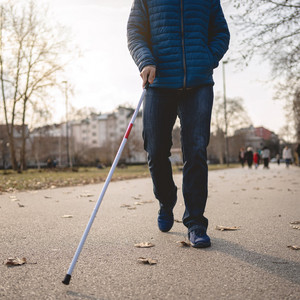
So, if our listeners have not come across a white cane before, they're long and thin, kind of like a bunch of markers stacked on top of each other.
They're lightweight, kind of like a fishing rod, and usually white, with a handle at one end and a special tip on the other.
People who are blind or low vision use white canes to get information about the world around them so they can get around on their own.
They do this by rolling or tapping the tip of the cane along the ground.
My cane makes different sounds and vibrates as I move it on the ground.
This information can tell you what kind of space you're in or what type of surface you're walking on.
And there are all different types of white canes.
Because people want their canes to give them different information about the world.
Like me. What in the what?
Who are you? I'm Zane, from the Epic Computer Game, CaneQuest 3000, where you use white canes to navigate and capture tiny yodeling aliens trying to ransack the universe.
Whoa, cool. Want to play?
Sure. Welcome to CaneQuest 3000.
We've got lots of tiny yodeling aliens to catch, so let's get moving.
First, let's pick out a white cane to use.
And remember, you could always use your cane bucks to swap out my cane later in the game.
Hmm, okay. What are my options?
How long do you want it to be?
White canes are longer than your average cane and they're designed to fit the person using them.
Most of them come up to the middle of the chest, but some are longer.
That's right. The longer they are, the farther they reach out in front of you, which gives you more information about the path ahead.
So how tall do you want my cane to be?
Chest height or chin height?
Chin height. Sweet deal.
Let's talk materials.
White canes can be made out of aluminum, which is what soda cans are made out of, fiberglass, which is used to make things like surfboards, cowabunga dude, and carbon fiber, which can be used to make skis and tennis rackets.
Game, set, match me with the material you want.
Carbon fiber. Radical choice.
Next up, let's talk about the shaft.
That's basically the long skinny part of the cane.
There are stiff straight canes that are very sensitive.
There are also canes that fold up.
They're less sensitive, but portable.
Check it out. I carry mine in a holster on my belt when I'm not using it.
Ooh, seems very handy.
Especially if you're chasing a bunch of yodeling aliens.
But let's go with a straight cane.
Nice. Let's pick out your cane tip.
So many options. Yeah, we've got cane tips that look like baseballs and even some that are shaped like mini flying saucers.
But I always start the game with one of the classics, a rolling marshmallow tip or a pencil tip.
Rolling marshmallow tips are shaped like a marshmallow.
They can roll in any direction.
And the pencil tip is very pointy and hard and makes your cane super sensitive.
You get so much information about the ground.
It's almost like walking barefoot.
You could really feel the texture of what you're stepping on.
Yeah, let's go with a pencil tip, Zane.
Dunzo, let's go. First task, use my cane to figure out where the heck we are.
I'll start exploring by using a cane technique called the two point touch.
That's where you tap your cane two times in a row as you walk.
Listen to the sounds my cane makes.
These sounds will tell me what kind of surface I'm walking on and what kind of space I'm in.
Any guesses? Sounds like a hard surface.
I'm thinking tile? And there's an echo which makes me think Zane is walking down a big empty hallway.
Then we must be in the castle of Gorgonzola.
It's a massive old castle overgrown with these gigantic flowers oozing stinky Gorgonzola cheese.
And you know who's obsessed with Gorgonzola flowers.
The tiny, jostling aliens.
This way. Hear that?
I hit something with my cane.
White canes help identify objects that might be in the way.
I'm gonna tap it again.
What does that sound like to you?
A wooden door? Let's see if you're right.
I'm gonna reach out here and see if there's a door knob.
Bingo, onwards. Oh, I'm stuck.
The pencil tip in my cane just got caught in a crack in the ground.
I need a different cane tip.
I'm gonna use my cane bucks to give Zane a rolling marshmallow tip.
Great idea. The marshmallow tip won't get stuck in cracks or crevices.
Awesome. With this cane tip, I'm gonna switch things up and use something called the constant contact method.
That's where you sweep your cane back and forth across the floor.
Sort of like a windshield wiper.
Marshmallow tips go great with the constant contact method because they glide so easily across the ground.
Okay, hold up. The ground here is real bumpy.
My cane is hitting a dip and bump every few steps.
The tiny, jostling aliens.
There they are. Let's catch them.
But there are so many and they're yodeling so enthusiastically.
Don't worry. We'll just use my Super Satchel.
It's filled with extra stinky Gorgon's old cheese.
Here, aliens, hop in.
We got him. Woo -hoo, high five.
Take that, tiny aliens.
Congrats, yo. You just beat level one.
Brainz, Brainz, Brainz.
CaneQuest 3000 was pretty cool.
Yeah, it helps me imagine moving through space with different white canes.
Everyone's experience moving through the world is a little different.
So we invited another guest on the show to talk about her experience.
Phoenix is 15 years old and blind.
She's also a long time Brainz on fan and has been listening since she was six.
Hi, Phoenix. Hello.
We are so happy you're here today.
Hey, Jayden. So Phoenix, I know you're very musical.
You have perfect pitch.
You play the Irish tin whistle and you also sing.
So do you sing in a group or more on your own?
I sing in a choir as well as by myself.
What's the name of your choir?
The St. Cecilia Singers.
I'm also in a choir, so I love singing with choirs.
I love the harmonies and stuff.
So what does it mean to have perfect pitch?
Perfect pitch essentially means that I can name any note that is played and I can sing any note.
So if we just said G sharp, you'd be like, no problem.
Okay, can I hear G sharp?
Ah. Beautiful. So Phoenix, Jayden also loves music and singing.
So I'm wondering, the two of you, what is like your song of this season?
Like what has been your favorite song you've listened to recently?
Recently I listened to a lot of new songs, Sabrina Carpenter, Good Graces.
I think a lot of things on the radio.
Ariana Grande. Oh yes, we love Ariana Grande.
I wish I could sing Ariana Grande's whistle note.
Well, that was pretty close.
I'm impressed. Phoenix, how about you?
What have you been listening to lately?
I've recently just been listening to Rosanna by Toto a bit too much.
Nice. Both of you have excellent taste in music.
Thank you. So we have been talking about white canes and I'm curious about your relationship to your white cane Phoenix.
When did you first get it?
I got received my first white cane when I was two.
So essentially as soon as I learned to walk, I received my first white cane.
So like Jayden was talking about earlier, I guess you need to get sort of different sizes of canes as you grow.
Do you like still have your first baby cane?
I do, I have all of the canes I've ever owned.
So I've got about 12 canes.
That's so cool. Yeah.
So basically you can't remember a time before you used a white cane probably.
No, I cannot. When you change to a new cane size, do you kind of have to relearn things or is it easy to just sort of slip into the next one?
Nope, you don't have to relearn anything.
One of the biggest indications that you need a new cane is that you get lazy with it.
Usually for me, if my school wants me to get a new cane, I'm being measured or they're just like, oh Jayden, you're getting too tall for this, so.
They don't like measure me, they just give me two inches longer.
Except for the fact that I begged my O &M instructor for a 58 inch cane because I like chin height canes.
What's an O &M instructor?
O &M instructor is a person who teaches you orientation and mobility.
So teaches you how to use a cane, teaches you how to navigate.
So like in the video game we got to choose between chin and chest height canes.
So it sounds like for you, Phoenix, you prefer a chin height.
Actually no, I prefer a nose height cane.
Oh, okay. I'm crazy, I'm crazy, I love long canes.
Nose height? Yeah. Oh my gosh.
What is it about a longer cane that you like?
So I can walk a lot faster with a longer cane.
So you're like able to tell what's happening further away from you.
Yes. So you don't have to go, I see.
That makes a lot of sense.
And so how about you, Jayden?
Do you remember when you first got your first white cane?
I remember the first time I got my white cane, I was at my old school before I moved, and I was like, is this, what is this?
I think this is someone else.
Here you go, you can take it back.
How old were you when you got your first white cane?
I was five. So you were not quite as young as Phoenix was when they got their white cane, but you've both got a ton of experience with them.
We'll hear more about your experience with white canes after the break, but now it's time for the here it is.
What do we think? Jayden, what is your guess?
Aliens, lasers, space.
So let's hear your guesses, Phoenix.
This sounds like the lasers from Star Wars.
So I'm guessing it's someone doining a big old wire.
Ooh, okay. I'm going to guess, a slinky, sort of like a big old wire, but a curly big old wire.
Well, we're gonna hear it again.
Get another chance to guess and hear the answer at the end of the show.
So stick around. We are working on an episode all about sneezing.
Every sneeze is unique from big loud honkers like a true to tiny little squeakers like itchy.
So we want to hear from you.
If your sneeze had a name, what would it be?
Record yourself doing your favorite sneezing impression and tell us what you'd name it.
So Phoenix and Jayden, I'm wondering if you have a sneeze you'd like to demonstrate for us and what you would like to name it.
Sure, sounds like this.
Making a mouth sneeze, I think?
I love it. Okay, so Jayden, do you have a sneeze you'd like to do?
Ooh, I like that one.
So what would you call that?
What would be a name for that kind of sneeze?
Good morning, I'm sneezing sneeze.
Delightful. Listeners, record your sneeze name and sound and send it to us at brainson .org slash contact.
While you're there, you can send us your mystery sounds, drawings and questions.
Like this one. How do butterflies get their designs?
You can find answers to questions like these on the Moment of Um podcast, a short dose of facts and fun every weekday.
Find Moment of Um and more at brainson .org.
So keep listening. Brains On Universe is a family of podcasts for kids and their adults.
Since you're a fan of Brains On, we know you'll love the other shows in our universe.
Come on, let's explore.
Here we are in Brains On Universe.
Home to my favorite podcasts.
Brains On. Smash Boom Best.
Forever ago. I found one.
Forever ago. The history show hosted by Joy Dolo.
It was the early 1800s.
Beethoven was busy composing new symphonies, steam powered trains were brand new inventions, and a British naturalist named William Swainson was exploring the jungles of - What a great show!
Need born forever ago?
No! Listen to Forever Ago wherever you get your podcasts.
Brains On. You're listening to Brains On.
I'm Jayden. And I'm Phoenix.
And I'm Molly. Today we're talking about ways that people who are blind or have low vision get around like white canes.
We learned that white canes are tools that help people who are visually impaired move through the world and navigate it independently.
They provide information in the form of sound and touch.
And there are lots of different types.
It all depends on what you're looking for.
Some fold up and have a rolling marshmallow tip like mine.
Others don't fold and have a pointy pencil tip that's very sensitive to touch.
And you can sweep them back and forth like a windscreen wiper or tap them on the ground.
There are also smart canes which have extra features like sensors and GPS.
The sensors can help warn people of low hanging objects in their path like tree branches, and the GPS on a white cane is a lot like the one in your car.
It comes up with directions to a location and reads them out loud.
So Phoenix and Jayden, I'm wondering, would you be interested in using a smart cane?
I'm interested in using a smart cane because I love technology and I want one.
I really want a smart cane.
How about you, Phoenix?
Would you be interested in using a smart cane?
No. Firstly, very, very expensive.
Secondly, I think that using a smart cane makes a blind person very, very dependent on technology and the blind person needs to be able to navigate without said technology.
Say it breaks, say you drop it in a puddle.
Too much hassle. Interesting.
I can see both perspectives.
A smart cane might be a cool, useful tool in certain situations, but there's always the risk of becoming dependent on it.
And was there ever a time when you were like, I don't want to use this white cane, Jayden?
Yes. So Phoenix, you say yes.
And Jayden, how about you?
Was there also a time when you didn't like it?
I'm not sure. Maybe, maybe.
So Phoenix answered yes right away.
So let's hear from you, Phoenix.
Tell me when you weren't in the mood to use it.
Okay, so there's a phase that a lot of disabled people go through where you kind of refuse all the stuff that's gonna help you out.
So my phase was when I was about seven and I refused the cane, refused O &M, refused Braille, because it made me feel really alienated from everyone else.
So and how old were you, would you say when you sort of got over that phase of being like, I don't wanna do this, it makes me feel different and alienated?
Honestly, probably about last year.
Oh, okay. Was like really when I just accepted it.
And so how would you say things change for you when you accepted like, this stuff is here to help me?
Everything's gotten a lot easier.
I actually read Braille now, which is nice and I write on my Perkins.
Can you say what a Perkins is?
A Perkins is essentially a mechanical Braille typewriter.
It is very fun. I get to go bang, bang, bang.
And Braille is a system of writing where each letter of the alphabet is made up of raised dots and you feel the dots with your fingers to read.
So yeah, and actually the script that we gave Jayden for this episode is in Braille.
I don't know if they made up with a Perkins machine.
No, they would have made it with an embosser probably.
Yeah, that was always thinking.
So I would like to know what would you guys say is the trickiest thing about using a white cane out in the world?
Let's start with you, Phoenix.
Okay, I am paranoid about this now is breaking the cane is always a big possibility.
And so now I keep a spare cane in my backpack because I managed to break two this year.
And Jayden, how about you?
What do you think is the trickiest thing about using a white cane out in the world?
I don't want to be mean about this to other people at my school, but they don't move out the way.
They just stay there.
They just stay there.
And then when I'm walking, I'm like, oh, sorry, excuse me.
Like, sorry that you're getting whacked.
I think that's a really good point to make.
And I think that's helpful for people to know.
Like, so if you see someone walking down the street with a white cane, what would you say you want them to do?
Like, what's the best thing for someone?
Should they just get out of the way?
They should either get out of my way or if they see that I might need help, they can ask, like, oh, can you tell?
Is that the same advice you would give Phoenix?
So to recap the advice, if you are moving confidently, you want to be left alone.
You're like, I'm good.
Just get out of my way so you don't break my cane by accidentally stepping on it.
Yep. Yep. And then if you're standing there maybe not moving, not looking confident, maybe looking a little lost, then perhaps say, oh, do you need help?
Yep. So Jayden and Phoenix, when you're moving through the world, are there things you'd like sighted people to know about your experience?
No question is a stupid question, unless you're asking how many fingers you're holding up.
That's really good advice.
What about you, Jayden?
What would you like people to know?
Don't just grab onto me because that's what I'm a bit scared of.
Maybe just ask me first if I need help before doing it.
People just sometimes grab you and try to help you without asking first?
Yes. Oh, that's quite annoying.
Yeah, don't do that.
Ask people. So do you have any last thoughts about navigating the world with white canes?
Oh, there's actually a song that the New Zealand Blind School wrote.
It's all about canes.
It's called White Cane Day.
It's the White Cane Day song.
Oh, you guys wrote that?
Yeah, we wrote that.
When we need to find our way, when we need to navigate, when we need eyes on the ground, but we can't see to get around, we still want to be independent without stumbling all around.
There is one solution that we found.
It's a long white thing that looks like a stick made of metal and string with a rubber grip.
My guide to get me from A to B.
It's my white cane and helps me to see.
People who are blind or have low vision use lots of different ways to navigate the world.
One way is to use a white cane.
White canes are long and thin and have a bunch of different tips.
They give you lots of information about the world in the form of sound and touch and help you get around independently.
The point is, if you're blind or have low vision, there are lots of tools available to help you explore the world on your own.
That's it for this episode of Brain's On.
This episode is written and produced by...
Rosie DuPont. Edited by...
Shayla Farzan. And...
Sandin Totten. Backchecking by...
Jess Miller. We've got production help from the rest of the Brain's On universe team.
Molly Bloom. Nico Gonzales -Whistler.
Ruby Guthrie. Joshua Ray.
Mark Sanchez. Lauren Humpart.
Charlotte Traver. Anna Weigel.
Anna Goldfield. And...
Aron Woldeselassie.
We had engineering help from Sean Campbell, Doug Jerry, and Derek Ramirez with Sound Design by...
Rosie DuPont. Original theme music by...
Mark Sanchez. Beth Perlman is our executive producer and the executive's in charge of APM Studios, our Chandra Kavati and Joanne Griffith.
Special thanks to Lap and Robert Hook, Kyra Mays, Madeline Hernandez, Karen K.
Esquivel -Mays and The Braille Institute.
Brain's On is a non -profit, public radio program.
There are lots of ways to support the show.
Subscribe to Brain's On universe on YouTube where you can watch animated versions of some of your favorite episodes.
Or head to brainson .org.
While you're there, you can send us mystery sounds, drawings, and questions.
Okay. Jaden and Phoenix, are you ready to listen to that mystery sound again?
Yes. Yep. Okay. Let's hear it again.
Jaden, what is your guess?
Do you have any new guesses?
Lasers, video games, aliens, spaceships, probably aliens, something related to space.
Yeah, maybe Yodeling aliens.
Maybe. Maybe. They're all from Switzerland.
What do you think, Phoenix?
And I still think it's the same.
It's a wire. I think.
Doing in a wire. All right, I'm ready for the reveal.
Me too. Let's hear it.
That was the sound of a slinky on the table.
A slinky? Slinky on the table?
Oh my gosh. I've never gotten a mystery sound right, I swear.
So a slinky is basically a wire.
So you were right too, Phoenix.
I'm giving you credit as well.
So slinky is a wire that's been coiled up into like a swirly, whirly shape, and you can kind of bounce it back and forth between your hands.
It makes kind of that noise when you wiggle it around.
That actually sounds like a spaceship, oh my gosh.
Ah, so cool. Nice work, both of you.
Now it's time for the brains honor roll.
These are the incredible kids who keep this show going with their questions, ideas, mystery sounds, drawings, and high fives.
Elizabeth and Jack from Newton, Massachusetts.
Rhett and Dawson from Brantixville, Pennsylvania.
June from Lincoln, Nebraska.
Abby and Chelsea from Swamp Scott, Massachusetts.
Flo and Penny from Derby United Kingdom.
Eleanor May from San Antonio, Texas.
Naomi from Rockville, Maryland.
Ray from Honolulu. William from Houston, Texas.
Erin from Staunton, Virginia.
Horatio and Lila from Phuket, Thailand.
JJ from Plymouth, Minnesota.
Azarra from Boston.
Sophie from Philadelphia.
Ella Marie from Prospect Heights, Illinois.
Maurice from Lawrence, Kansas.
West from San Francisco.
Ray from Chi -i -e Taiwan.
Alex and Lucy from Charlotte, North Carolina.
Lila, Brooke, and Knox from Fayetteville, Georgia.
Daria and Ari from Irvine, California.
Briggs from Amarillo, Texas.
Emily, Katie, and Cora from Vail, Oregon.
Clifford from Cleveland.
Connor from Las Vegas.
Zara and Rohan from Monroevo, California.
Shwishti from Copenhagen.
Ayan from Irving, Texas.
Rosie from Virginia.
Oliver from Vancouver.
Josephine from Lakeville, Minnesota.
Frasier from Scotland.
Benjamin from Lexington, Kentucky.
Lily from Golden Valley, Minnesota.
Jack from Lakewood, California.
Dom from Los Angeles.
Sophia from Odessa, Florida.
Chloe from San Francisco.
Kavya from Perth, Washington.
Julie from Waco, Texas.
Nikita from Tampa, Florida.
Vincent from Colossa, Densariya, Spain.
Cam and Bri from Lincoln, Nebraska.
Aida, Claire from Spring, Texas.
Chris from Maryland.
Joby from Buffalo, New York.
Nora from Greenville, Wisconsin.
Declan from San Francisco.
Katie from Waukesha, Wisconsin.
Caleb from Comox Valley, British Columbia.
Lorenzo from Maine.
Aviana from San Diego, California.
Connor from Warsaw, Indiana.
Koshfi from Poway, California.
Summer from Arcadia, California.
Jack from Fairport, New York.
Manasui from Georgetown, Ontario.
Peter from Chicago.
Sechum from Bury, Ontario.
Zeke from Rutland, Vermont.
Magnus from Missouri.
And Savannah from Raglan, New Zealand.
["Rain, Shire, or I Fight?" by & K .A .I .T.
& K .A .I .T. & K .A .I .T.
& K .A .I .T. & K .A .I .T.
Thanks for listening.