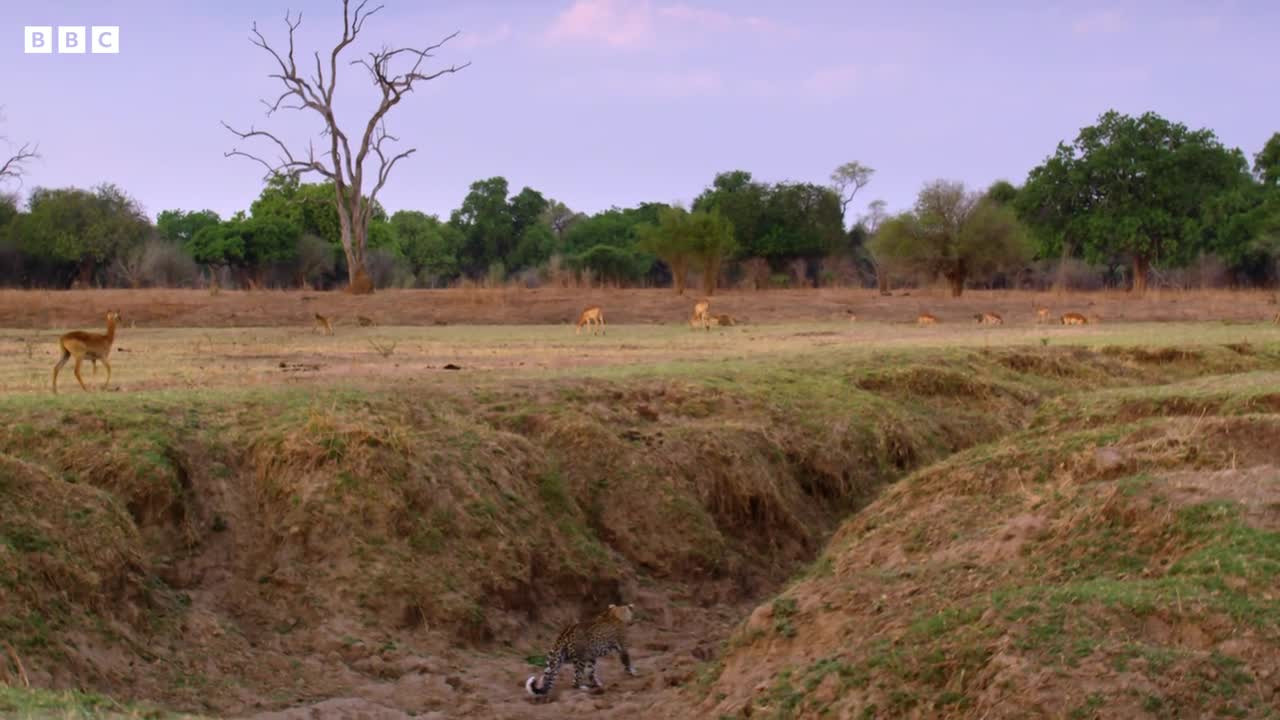
But leopards are the most versatile of all, the big cats adept at finding cover in the most unpromising places.
The steep walls of the gully are now her cover for an ambush.
The male puku is close enough, but he's too big to tackle.
She needs to slip past him without being seen. he'll blow her cover.
Slowly does it.
To succeed here, she needs to find prey grazing close to the edge or, better still, in the gully itself.
Success would have staved off hunger for a week.
But while there's prey around, there's hope.
Peeking over the top is a risk, but it's the quickest way to find a new target.
A burst of speed of 65 kilometers an hour, and it's all over in less than six seconds.
Except it isn't.
Dazed and disorientated, the impala makes a miraculous escape.
It's called Darwin's bark spider, and the female has a remarkable strategy.
Like a real-life spider woman, she sprays strands of silk in one long, continuous flow.
The threads fan out like a sail and drift on air currents blowing across the water.
Every few seconds, she crimps the strands together to stop them spreading too widely.
The breeze will do the rest, blowing the threads into a single line and a 25-meter bridge.
Now she must reinforce her bridge because her web will hang from it.
But there's something bouncing the line at the other end.
Another Darwin spider is trying to take advantage of her hard work.
She must deal with the intruder head on.
The cut line is an inconvenience, but no more than that.
With hooks on the tips of each leg, she gathers in the thread.
It won't go to waste, as she'll eat it later.
When it's all reeled in, she sprays again. out streams another 25-meter bridging line.
How a spider no bigger than a thumbnail can produce so much silk so quickly has baffled scientists.
And it's no ordinary silk.
It's the toughest natural fiber on the planet, tougher than steel.
And it needs to be tough to span the wide river.
With the bridge taut and the ground anchor in place, it's time to construct her trap.
These spiders can build the world's largest orb webs, up to two meters wide.
A few hours from the first spray of bridging line, the job is done.
Now her strategy is simple.
Sit and wait.
And there's one final bout of silk production.
Shrink wrapping her food for later.
At this time of year, polar bears, on average, succeed only once in 20 hunts.
If the hunter is skinny like this one, that may not be often enough.
All she can do is keep trying.
To prevent her scent betraying her, she makes a wide sweep to get downwind of the seal.
Getting close.
She's now right behind the seal.
Incredibly, she caught the seal underwater.
It's only small, but even so its blubber alone will contain 100000 calories, enough to sustain this bear for a week.
And in that time, she might even catch another.
But this can't go on forever.
As summer continues, temperatures are rising.
Each hunt requires more energy, draining the bears of their reserves.
Food is so hard to find this far north that a wolf pack must search hundreds of square kilometers if it's to be successful.
And success means raising the next generation.
To do that here, the wolves must work together.
So the young are raised not only by their parents, but by their aunts and uncles as well.
Together, they try to ensure that each pup reaches near adult size before the snow returns.
A growing pup needs more than just a few leverets.
The wolves need bigger prey, and to catch that... they must hunt as a pack.
Adult hares may be easy to spot, but they're far from easy to catch.
They run at 60 kilometers an hour.
To catch one, the wolves work as a team.
Check, check, check.
One of them gets close enough to bite the hare's tail.
But a hare can change direction in an instant.
If it can continue to sidestep and jink, it may ultimately outlast them.
Finally, it gets away.
For the next hare, the whole pack gives chase.
Now numbers count.
The lead wolves keep up the pace.
Others run on either side so the hare can't change direction.
A tiny meal for a whole pack.
To help her in her quest, she's equipped with three superpowers.
First, an amazing approach to getting about.
Portia is a jumping spider.
Able to leap up to 50 times her own body length.
Nowhere seems beyond her reach.
Next, her second superpower, superb eyesight.
Essential if she's to distinguish her prey in all this clutter.
Because her prey doesn't stray.
Portia is a spider-eating spider.
This raises a few problems.
Her lunch is three times her size.
Packed with venom... and surrounded by a sticky trap.
Mission impossible?
Not at all, because of her third superpower.
Portia is a genius.
She can map her world in three dimensions and formulate a plan of attack.
She can have an idea.
The web builder is blind.
It won't have a clue that she's coming. right on target and safely behind those fangs.
But a mind as active as Portia's can always do with more brain food.
Here, there's no anchor point for the abseil.
But Portia has another idea.
Instead of going to the spider... she will bring the spider to her.
She plucks the strands to imitate struggling prey. drawing the spider in... to its death.
The army ant.
This may look like a ball of a million individuals, but make no mistake, the colony acts as one.
A superorganism with a sensory system of two million antennae.
A skeleton made from the living bodies of workers.
A defense system of soldier ants, ready to act at any sign of danger.
A digestive system processing piles of food deep inside.
Even a coordinated system for dealing with all the waste.
These are insects that, by working together, transcend individual size.
The colony can search the entire jungle. and flush out its wildlife.
Each day, it sends out a silent probe into the forest in quest of food.
It doesn't use scouts like other ants.
Instead, a vast search party pushes into virgin territory.
Seeking out the signs of anything alive.
They spread out along a 10-meter front, sweeping across the forest floor.
To find prey, the ants must first touch it.
The irony is that this, the most successful hide-and-seek player in the forest, is almost completely blind.
It distinguishes the living only by their movement.
As long as an animal remains still, it is safe.
But the slightest twitch will give it away.
Within seconds, the prey is pinned down.
Within minutes, it's torn apart at its joints.
The more the prey struggles, the more the ants engage.
Right across the raid front, prey of all sizes are driven from their hiding places.
Even wasps must abandon their homes when the ants arrive.
Everything alive in the path of the raiders, overwhelmed by sheer numbers.
Their cover blown.
Escape seems impossible.
But these particular fish have a unique ability.
They're flying fish.
With an extra thrust from their tails, the flying fish get airborne once more.
With a good wind, they can glide for hundreds of meters.
But this is just what the frigate birds have been waiting for.
When frigates join the hunt, the flying fish are literally caught between the devil and the deep blue sea.
If the flying fish get too much lift, they become easy prey for the frigates.
If they dive to evade attack from above... they could fall into the mouths of the Dorado.
Even when more sea lions arrive, they can't seem to break down the sardines' coordinated defenses.
With a shoal this big, the sea lions need to isolate a smaller, more manageable group of fish.
But with so few predators, the fish still have the advantage.
All the sea lions can do is keep the sardines at the surface and wait for others to join them.
Their arrival changes everything.
Tuna attack from below, cutting off the sardines' escape route down to deeper water.
Next to appear, shearwaters.
Excellent flyers, but also surprisingly agile underwater.
With so many predators attacking from all sides, the advantage starts to shift away from the sardines.
As the fish pack ever tighter, their shoaling strategy now makes it easier for the hunters.
Copper sharks.
They've scented blood in the water.
Surprisingly, perhaps, the predators never attack one another.
They work together to corral the ball of fish, taking turns to grab a mouthful.
Common dolphins.
As the shoal gets ever smaller, each sardine scrambles desperately to hide in the middle.
But now there's no escape.
A brooder's wail finishes off the feast.
Tons of sardines devoured in less than an hour.
The Namib Desert, one of the most exposed places on Earth.
As the sun climbs high, everybody takes cover from the extreme heat.
Everybody except the hot rod ant.
As others take refuge, their day is just beginning.
Cleaning out the nest. the sand can reach a scorching 70 centigrade.
The ants' long legs raise their bodies above the surface, where it's 10 degrees cooler.
But if they stand still, they will fry.
They must keep moving or risk the same fate as their quarry the creatures that have collapsed from heatstroke.
Too deeply buried, but a good place to cool off.
Foraging decisions must be fast.
Too big?
Perfect.
Back to the nest before they also die. but they've strayed into a minefield.
Each of these strange cone-shaped pits is a death trap.
With a brutal predator at its center.
Here lie antlion larvae, tiny ambush predators with venom-filled pincers.
Some ants manage to escape, but the antlion has other tricks.
Flinging sand into the air, it creates an avalanche.
In this cone of death, the walls are so angled that the sand slips beneath the ants' feet.
As boulders rain from the sky, escape seems almost impossible.
Lions will normally avoid hunting in such heat.
But they're also opportunists.
The lions will need to bring him down quickly before they overheat.
Even away from the herd, a bull is a formidable opponent.
It could gore and kill a lion.
Close to overheating, they finally succeed in bringing him to the ground.
But the massive bull is not giving up.
Against the odds and the full weight of the lions, he regains his feet.
And it is now that the tables turn.
The lions are exhausted.
After a 20-minute struggle, only the bull has the energy to finish the fight.
In such exposed and extreme conditions, the challenge for predators and their prey is at its most intense.
Northern Australia has the highest tides in the tropics, which expose vast areas of shoreline.
And here lives a truly extraordinary species of octopus.
Octopuses are marine animals.
They live and breathe underwater.
At low tide, most octopuses will be imprisoned in their rocky pools.
But this is no ordinary octopus.
It's the only one specially adapted to walk on land.
It pulls itself along using the hundreds of tiny suckers that line its arms.
Hunting for crabs, it walks from pool to pool. apart from a rather startled fish.
This one is empty.
So the octopus moves on. a rock pool may seem like a safe refuge.
But the octopus's suckers enable it to move just as stealthily in water as out of it.
¶¶
Nowhere is safe when this octopus is around.
Hunting is only possible for three hours around low tide, when the mud banks are exposed.
Razor-sharp oysters cover much of the shore.
Beaching here could be lethal.
The hunters need to find a stretch of shoreline with just the right slope.
Too level, and the dolphins risk stranding.
Too steep, and they can't force their prey from the water.
Working as a team, the dolphins surround the fish, driving them towards the shore.
Attacking in perfect synchrony, the dolphins create a bow wave.
It carries their prey onto the muddy banks.
Other fish eaters profit from their daring.
Herons and gulls follow every hunt.
To get to the fish first, the dolphins drive themselves high up the bank.
But if they go too far, they risk a stranding.
To prevent fish escaping between them, the dolphins all beat themselves on the same side.
Always the right.
But this has a cost.
Each time they grab a fish, they also take in a mouthful of mud.
The grit gradually wears down their teeth. but on one side only.
In time, these teeth get so worn down that older dolphins can no longer hunt like this and must find other ways to catch fish.