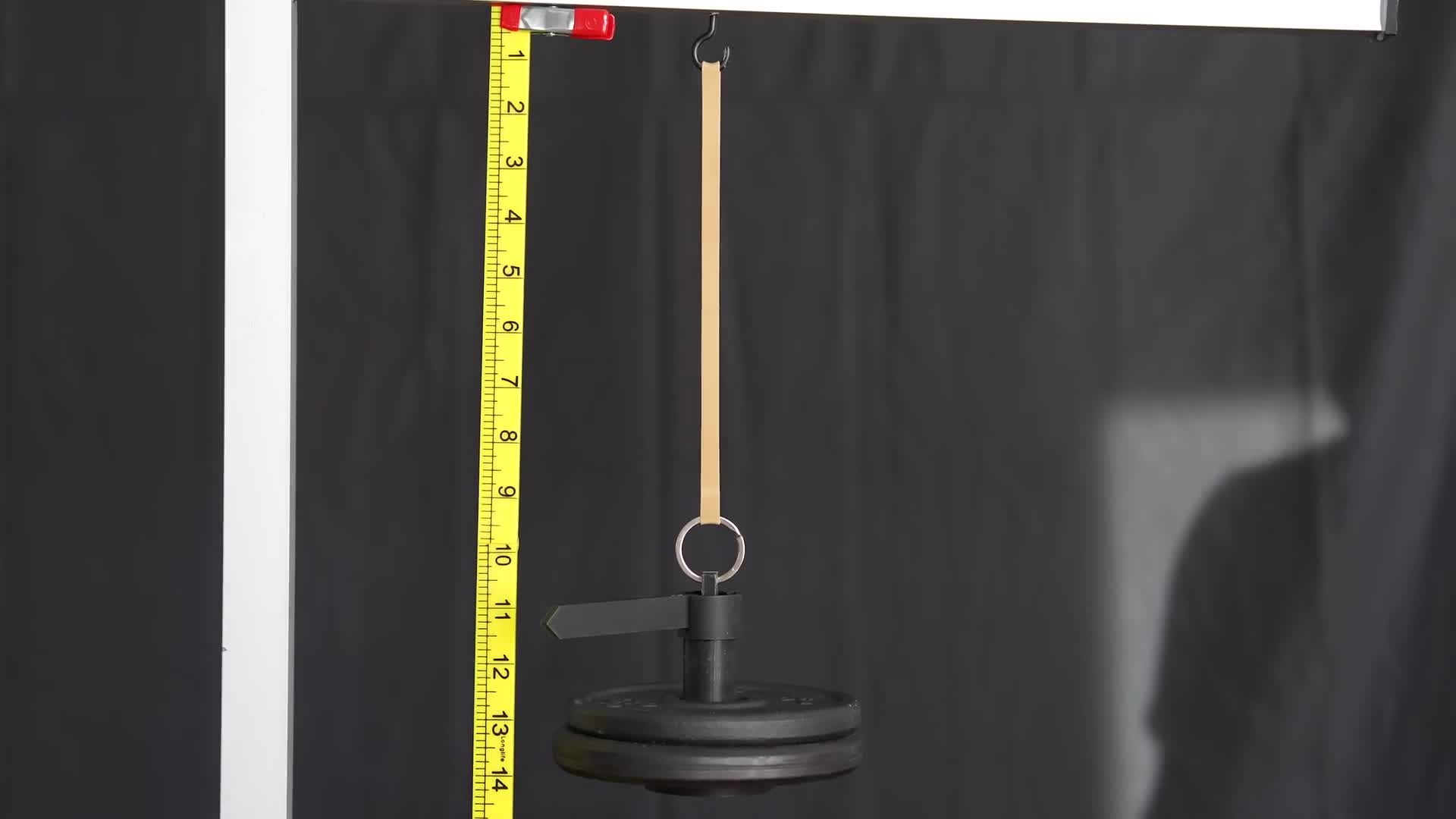
What happens if I heat up this rubber band?
When you heat materials like glass or plastic, the atoms vibrate faster.
They get slightly farther apart, and this reduces intermolecular forces.
So the material gets weaker.
Under tension, it stretches.
But when I heat up this rubber band, the opposite happens.
It actually pulls more strongly.
The rubber band contracts, and the weight goes up.
So why does this happen?
Well, rubber is unlike any other material.
It's waterproof.
As it's breaking, it actually becomes tougher and it can stretch up to 10 times its length and bounce back.
No worse for wear.
These properties have made it essential for modern life.
It forms the tubes and seals that carry our gas and water, the belts that drive our motors and the tires on our cars, trucks and planes.
Even trains use rubber in their suspension systems.
It's a perfectly engineered material.
But we didn't invent it.
All of our most durable rubber still comes from a single natural source.
This tree.
It's a source at risk of being wiped out.
And if that happens, the results could be devastating.
You're talking about a complete global societal meltdown.
This could be considered a national security issue.
You wouldn't think that we're so dependent on this thing.
Well, we are.
And most people don't know that.
They're waiting for a disaster to happen.
Rubber comes from the Brazilian rubber tree.
As early as 1600 BC, Mesoamericans cut the bark to release this milky white liquid now known as latex.
They noticed that if they let it dry, it turned into this stretchy, waterproof, solid lump.
To see this in person, we sent Veritasim producer and mechanical engineer, Henry Van Dyck, to the Akron Research and Development Laboratory, where they specialize in all things rubber.
In just all these racks, even though they look solid, they're all flowing right now.
Really.
If you look behind one of these racks, you can see these are actually dripping.
Oh, wow.
They're flowing slower than we can perceive.
Unprocessed rubber is not the rubber we're used to.
It slowly flows and can't maintain its shape.
So how do you get this weird material in the first place?
Well, just underneath the bark are special tube-like cells that carry the latex.
Floating around inside are lots of isopentenyl pyrophosphate, or IPP.
This is the building block, or monomer, of rubber.
In fact, IPP is found everywhere in nature, including inside you.
Huge amounts of us are dependent upon that little molecule.
We make short-chain rubber in our livers.
It's called dolicol.
You're busily making rubber, you are a rubber factory.
What do you mean?
Why am I making rubber?
It's essential for cell membranes.
Special builder enzymes grab these monomers to build this long chain with over 10,000 monomers.
They build a polymer.
This is rubber.
So I get students to think about if this is a carbon atom.
And then I've got my next carbon atom along the chain next to it.
Yeah,
And then I've got my next carbon atom.
How many do we have to make up the whole length of the chain?
Well, we've got tens of thousands, hundreds of thousands of carbons along the backbone.
You start going kilometers in distance from end to end if each atom is the size of this tennis ball.
But the polymers aren't stretched out from end to end like that.
Instead, they're all coiled up.
If you imagine the room that I'm in right now and I had the first ball here in the middle, the chances of the end of the chain leaving this room is quite small.
So after you've dried out the latex, you're left with raw rubber, a jumble of all these polymers.
And this is why it's flowing, because over time, all those polymers slowly slide past each other.
Now, when you pull on the rubber and let go, it bounces back.
So why is this?
At room temperature, rubber's polymer chains are constantly vibrating and bumping into each other.
And other smaller molecules like air molecules or trapped water molecules also jostle around and bump into the chains.
Now, when you stretch rubber, these chains straighten out.
As you're doing this, those chains are still being bombarded by these smaller molecules.
So when you release that stress, there's nothing holding those chains aligned anymore, and the constant bombardment from the smaller molecules and the other chains kinks those chains back up.
So the rubber snaps back to its original size.
And if you heat the rubber up, well then everything is vibrating faster, and so the chains are going to get kinked up even more, so the rubber pulls back stronger.
This is why, when you heat up rubber, it shrinks.
Rubber bands.
Fascinating to think that when they're sitting on an old package of papers for a long time, holding those papers together, it's done by a perpetual pounding pounding, pounding of the atoms against these chains to hold it, trying to kink them and trying to kink them.
But there's also another reason why rubber is so stretchy.
If you zoom in on a chain, you'll see that the monomers are attached to each other on the same side of the double bond.
This is called cis-attachment, and it affects how the chain folds.
On each monomer, there are three single bonds that can rotate to be at an angle or in line.
But these carbons with two hydrogens take up a lot of space, so it's favorable for at least one of these bonds to be at an angle.
That makes the polymer wiggle in and out like a folded ribbon.
So when you pull on a piece of rubber, first all the polymers line up, but then each chain also unfolds.
The wiggle makes rubber extra stretchy.
But this state is very rare.
All three bonds lined up is only one possible arrangement for any monomer.
And one polymer usually has thousands of monomers.
So after you release the stress, the chain goes from an improbable state completely aligned to a more probable one with wiggles.
The chain itself bounces back.
This is where rubber gets its elasticity from.
So natural rubber straight from the tree is already stretchy.
It's also waterproof, since all those chains are just a bunch of carbon and hydrogen atoms, which are hydrophobic.
But as we've seen, it eventually loses its shape.
Plus, if you stretch it too much, it breaks quite easily.
So we need to do more to get the rubber we're used to today.
Early Mesoamericans improved the rubber slightly by mixing the latex with juice from the tropical morning glory, a local flower.
And they used this to form sandals, bottles, and balls.
But for the next 3,000 years, to the rest of the world, rubber was little more than a curiosity.
Then in 1770, a piece of natural latex made its way to English chemist Joseph Priestley.
And he took this piece and used it to try to erase pencil marks.
He noticed that it easily, quote, rubbed them away.
In the following decades, people started exploring other applications.
Up until then, people used to waterproof fabric with oil, wax, or tar.
But some oils were extremely flammable and prone to spontaneous combustion, and wax or tar would eventually crack with movement.
Similarly, there were no real good flexible materials at the time.
Leather was the best option, but it had little give.
Rubber had the potential to fix all those problems.
So for the next 50 years, the use of rubber exploded.
In England, people made waterproof clothing.
And by the late 1820s, the rubber craze hit the US, when everyone wanted their own pair of Brazilian waterproof boots.
Factories sprang up all across the country to make new rubber products, including one New England factory called the Roxbury India Rubber Company.
In the spring of 1834, things were looking great for the company.
The previous fall, they had sold over $20,000 worth of goods, rubber coats, shoes, and the like.
But as the summer came around, problems started to emerge.
They used to rubberize the fabric to make it water resistant, which was fine, until you sat down on a wooden bench on a hot day and you stuck to it.
See, all natural rubber has a critical weakness.
It's extremely sensitive to temperature changes.
It melts when it gets too hot and it freezes and becomes brittle when it gets too cold.
This made the coats and shoes practically useless during the hot summer, so customers returned their items en masse.
Then things went from bad to worse.
One day, the Roxbury manager visited the warehouse.
When he opened the door, he didn't see their newest products.
Instead, he was met with a foul smell and a molten, gooey mess that covered the entire warehouse.
In fact, when we ordered some raw rubber, we were in for a similar nasty surprise.
Oh, that is disgusting.
The summer heat melted their rubber products and they started rotting.
The sludge stank so badly, the manager had the employees secretly bury it at night.
But later in that horrible summer, the manager got a visit from a man named Charles.
Charles' previous business had gone bankrupt and he was deeply in debt.
He stumbled upon a rubber life preserver and he thought he could make a better valve.
He pitched the Roxbury manager on his new design, hoping to pay back his lenders.
The manager was impressed, but couldn't buy Charles' work.
He showed Charles the warehouse full of rotten rubber.
Rubber had potential, but in its current form, it was just too problematic.
However, he said if anyone could figure out how to make rubber stable in a wider temperature range and non-sticky, well then that person would stand to make a ton of money.
So Charles was determined to become that person.
But when he returned home to start his experiments, he was met by an angry creditor who threw Charles into debtor's prison for unpaid loans.
Charles asked his wife to bring him raw rubber and her rolling pin.
There, in his jail cell, he started adding different compounds into raw rubber.
If rubber was naturally sticky, then why couldn't you add dry powders to absorb that stickiness?
So he tried adding magnesia and he got a smooth, non-sticky rubber.
But over time, the stickiness returned.
After his release he tested the wear and tear of his rubber compounds by walking around in all rubber outfits.
His hands were always covered with gum elastic.
He playfully said that the only way to rub rubber off was by rubbing more on.
Some mixtures showed promise, but eventually they'd all rot into a sticky mess.
So he kept borrowing money to fund his experiments.
But because his mixtures all eventually failed, he ended up in debtor's prison so many times that he jokingly called it his hotel.
But Charles refused to give up.
When a friend told him rubber is dead, Charles replied, I am the man to bring it back.
In the summer of 1838, he met Nathaniel Hayward, a businessman and inventor.
Hayward had done his own experiments with rubber.
At one point, he laid out a sheet of rubber and sprinkled on sulfur powder.
And when he let this sheet set in the sun, he noticed that it hardened and had a smooth and non-sticky surface.
But eventually, it would still melt in the heat and freeze in the cold.
He offered his process to his previous company, but it was so horribly smelly that they rejected it.
But Charles saw the possibilities so he helped Hayward get a patent and then he bought it so that he could use it in his own experiments.
Then, one day in the winter of 1839, Charles accidentally dropped a piece of rubber mixed with sulfur on a hot stove.
When he went to scrape it off, he found that instead of melting, it had charred and hardened.
His daughter later said.
As I was passing in and out of the room, I casually observed the little piece of gum which he was holding near the fire.
And he was unusually animated by some discovery which he had made.
He nailed the piece of gum outside the kitchen door in the intense cold.
In the morning, he brought it in, holding it up exultingly.
He had found it perfectly flexible as it was when he put it out.
So he had made a new rubber with completely different properties, one that seemed to be temperature resistant and much stronger.
In fact, we're going to test out unprocessed rubber against rubber processed in this way.
Okay, so this is uncured rubber and I'm going to see how far I can pull it.
Uncured rubber is very soft and stretches really far before easily breaking.
It's going to hurt.
We need to cure it.
What does it smell like to you?
Smells like a barbecue.
This smells like a barbecue.
The smell of rubber does not seem to be natural.
Like it smells very chemically like it was made in the factory.
Yeah, so when I was in the factory and I saw the natural rubber, it smelled just like a barbecue.
The reason is they take the sap from the rubber tree, which is latex, and then they smoke it.
They're smoking it?
Yeah.
Like you'd smoke some salmon?
Yeah.
They smoke the rubber sheets to get rid of excess moisture and to preserve it by getting rid of the bacteria.
This gives most natural rubber a sort of brownish color.
So, step one, add the rubber.
One at a time.
Next, you add several powders, including sulfur.
Everything is mixed and heated to get a much stronger rubber.
Just pull it straight off.
Now at 393 kilopascals.
The uncured rubber broke after extending just under 900 of its original length.
At the same stress, the cured rubber had only stretched around 5%.
It eventually broke at 14.1 megapascals, after stretching nearly 600% of its original length.
So what was it about sulfur and heat that changed the properties so dramatically?
Well, chemically, sulfur powder is just rings of eight sulfur atoms.
On the hot stove, the sulfur ring broke apart into smaller pieces.
And now those sulfur atoms or sulfur chains have free bonding sites, so they look for places to attach.
What likely happened is they grabbed onto a carbon atom from a rubber chain, breaking its double bond, and attached itself.
Then, with another free bonding site, it grabbed onto a carbon atom from a different rubber chain, breaking its double bond and linking the two rubber chains together.
This cross-linking forms flexible bridges of one, two, or even more sulfur atoms in a row.
Now, think about what this does to the rubber.
Instead of each chain being loose and slippery like spaghetti, they're tied together in a flexible but connected network.
So now, if rubber sits out in the sun on a hot summer's day, the tight bonds prevent it from melting.
And in the cold the crosslinks make it harder for the rubber to fully freeze, so it's less brittle and harder to break.
And when you pull on the rubber, the chains stretch just as before.
But as you release it, everything returns to its original position because it's all connected.
So the crosslinks make the rubber stronger, more resistant to temperature changes, and more elastic.
In fact, by tweaking the number and properties of these crosslinks, you can change the properties of rubber.
If you have a lot of cross links, all the rubber chains are bound tightly together, so the rubber becomes harder and stiffer.
Great for things like shoe soles and tires that need to be durable, but still a little flexible.
If you have shorter crosslinks, each link is harder to break, so the rubber is more resistant to heat and weathering.
This is useful for seals and insulators.
And if you have longer crosslinks, the rubber chains can move more freely, so you can stretch it more before it breaks.
That's perfect in the medical field for soft and flexible applications.
So the crosslinks are essential to stabilizing rubber.
When Hayward sprinkled sulfur powder on rubber sheets, the heat from the sun did cause some crosslinking, but only on the surface.
When Charles kneaded in sulfur and then heated the entire mixture, the crosslinks grew throughout the entire sample.
So now, the results were much better.
Eventually, this process was called vulcanization after the Roman god Vulcan, who was associated with heat and sulfur in volcanoes.
Over the next five years, Charles perfected his method of vulcanization, and then he patented it in 1844.
With this, he transformed rubber from a curiosity into a material of endless possibilities.
Little did he know that he actually wasn't the first to discover it.
The Mayans or the Aztecs created rubber.
Were they also vulcanizing rubber?
They actually were.
In fact, Charles' discovery was very similar to what the Mesoamericans had been doing for thousands of years.
They'd taken the juice from the morning glory, which contains sulfur, mixed it with natural latex and then, by laying it out in the sun, it would heat up and actually naturally create the cross-links that he discovered in his kitchen.
Why did the Europeans, like, why did they have to reinvent the whole thing?
Why did they just ask them?
Well, they hadn't even noticed, I don't think.
No.
In the decades after Charles' invention, tons and tons of products were invented or improved with rubber.
Richard makes bold claim he could cross Pacific in this outfit.
The inflatable bicycle tire arrived in 1888, the first rubber gloves for medical purposes in 1890 and the first car tire in 1895.
And all of this was thanks to Charles' invention.
But despite almost single-handedly transforming the rubber industry, he never made much money.
I mean, he spent thousands of dollars defending his inventions in patent disputes.
And when he passed away in 1860 at the age of 59, he was over $200,000 in debt.
That would be around 7.7 million today.
About 38 years later, American entrepreneur Frank Sieberling founded a tire company and decided to name it in honor of rubber's inventor, Charles Goodyear.
Today, the Goodyear company makes 189 billion a year in revenue and it's the third largest tire manufacturer in the world.
For the past 100 years, tires have consumed the most natural rubber out of any application.
But vulcanized rubber alone isn't strong enough and would wear down quickly, lasting only around 8000 kilometers.
So in the early 1900s, car and tire companies started experimenting with additives, including something called carbon black.
So in natural rubber, we got carbon black.
Reinforcement.
Which is going to add the cross-linking.
This doesn't do the cross-linking.
No, it doesn't?
So this is the reinforcement and filler.
This makes it durable and resilient.
Nowadays, passenger car tires last about 100,000 kilometers.
Carbon black is what gives them their color and durability.
But carbon black has another benefit.
It conducts electricity.
That's hugely important because as you're driving down the road, you're charging up the vehicle.
If you didn't dissipate that static charge, then you get a shock when you earth the car, when you touch the car.
But later some companies wondered if they could reduce rolling friction by using a different additive.
So they tried silica instead, making a whitish looking tire.
But silica is a poor conductor and rubber itself is an insulator.
So now, as the car moved, it would slowly build up charge.
As you go to refuel the car, you have a highly charged, static electricity charged vehicle.
You put an earth conductor, the fuel hose, into the tank.
You create a spark in the tank, car explodes.
There's a very vital characteristic of tyres is that they should be conductive.
The other benefit is if you're in a thunderstorm, And you're struck by lightning.
The lightning will hit the car.
It will act as a Faraday cage.
It will completely protect you and it'll dissipate down to the ground.
So people have stuck to using carbon black for most of the tire and only a little silica in the treads.
And since Goodyear's invention, we've made over 70 billion tires.
If they were stacked on top of each other, they could go to the moon and back 21 times.
And almost all of these tires needed natural rubber.
But fueling the rubber boom came at a price, especially early on.
In the late 19th century, the Amazon region supplied over 90% of the world's rubber.
But wild rubber trees were often separated by hundreds of meters.
So, to keep up with growing demand, rubber barons began to exploit natives, killing roughly 40000 people in the Putumayo region alone and likely over 100000 across the wider Amazon region between 1879 and 1911.
The humanitarian activist Roger Casement, said that it was first called India rubber because it came from the Indies and the earliest European use of it was to rub out or erase.
It is now called India rubber because it rubs out or erases the Indians.
It is one of the most appalling instances of genocide and sickening ill-treatment of native peoples.
But other countries like England weren't happy with Brazil's monopoly.
So in 1876, the bio-pirate Henry Wickham managed to smuggle 70,000 rubber seeds back to England.
The British Empire planted these seeds all over Southeast Asia, which had a similar climate.
Only now, instead of having just a few rubber trees here and there, they made farms of acres and acres of nothing but rubber trees.
These plantations produced far more than the Amazon.
Brazil's share of the rubber supply dropped from over 80 in 1907 to 16 just over three decades later.
By the mid-1930s, over 90% of all rubber came from the British colonies in Southeast Asia.
And two-thirds of that rubber went into making car tires.
One of the largest car manufacturers at the time was Ford, which made an average of 15 million cars every year.
And Henry Ford wasn't comfortable with England's monopoly.
So in 1928 he bought 10000 square kilometers of land from the Brazilian government to build a utopian town.
He called it Fordlandia.
It had Cape Cod cottages, a hospital, swimming pools, a golf course, and little red fire hydrants.
It was an American city in the middle of the Amazon.
It could house 10,000 people, all working to plant millions of rubber trees.
Ford Plantation is a successful enterprise, a tribute to skill and science.
But in the early 1930s, things started to go wrong.
Every morning the workers would wake up, walk to the line of rubber trees and they'd notice black spots.
Just a few at first, little specks on the undersides of the leaves, like flecks of soot.
But by the afternoon, they'd spread to cover the leaves entirely.
And the next morning, the leaves were falling off.
Shortly after that, the tree died.
Every day, another row of trees was infected and dying.
People who've seen it say it looks like a fire front.
You have the infected trees and it's green on one side and black on the other.
And you see that black line move day by day.
You could virtually watch it move, leaving dead trees behind it.
The trees were infected by the South American leaf blight, a fungus native to South America.
This blight ruined the 36 million rubber trees from Ford's plantations by the early 1940s, turning it into a disaster.
When planting his rubber trees, instead of separating them by hundreds of meters, like they were in the wild, he planted them several meters apart, 200000 of them.
They're all touching, their roots are touching, their leaves are touching, their branches are touching.
And so it's just like a plague runs straight through the plantation.
Ford tried relocating the project to a town downstream Belterra, planting another 16000 acres with rubber trees.
But these two all died.
Ford's son eventually abandoned the project in 1945.
The Fordlandia buildings still stand in Brazil, abandoned.
And to this day, there is no cure for the leaf blight.
The blight is so fatal to rubber trees, they can't grow in plantations in their native country.
That's why South America makes up less than 2% of the rubber supply.
Over 90 comes from Asia, which is why it is so essential to prevent the spread of the leaf blight to Southeast Asia.
Virtually all of the rubber trees in Southeast Asia came from those seeds Henry Wickham stole, and newer trees are just clones of the old ones.
So the farms are essentially just one big monoculture.
As a consequence of that, we are particularly prone to potential outbreaks of funguses and things like that.
If you get a fungal infection in Malaysia, then you would end up dramatically reducing global production of rubber.
So what's the outcome if we were cut off from rubber?
If SAL gets established in Southeast Asia and you lose natural rubber, then you're talking about a complete global societal meltdown.
You're left now with making synthetic rubber tires at the most.
Worst case, they can't make them.
You can't make a truck tire.
You won't have any airplanes.
But the real potential is urban famine.
Over 50% of the world's population is in cities.
How will you move food into the cities to feed them?
But something like this did wipe out a large part of the rubber supply just six years ago.
In 2019, two different diseases jumped from palm trees to rubber trees in Thailand.
In six months, these diseases had spread across seven countries and a million acres of trees.
And the next year saw a 10% drop in production.
And the only reason it didn't destroy more trees was because of a different outbreak that we all remember.
COVID comes in early 2020.
It stopped the spread of these diseases as a byproduct of trying to stop the spread of COVID.
If COVID hadn't hit there, how far would that have gone?
How many more millions of acres would have in effect, been killed or seriously compromised by these two leaf blights?
Granted, it's hard to predict what would happen if we ran out of natural rubber.
Some say the impact could be catastrophic, grounded planes, failed railways, even famine.
And any disruption to the oil supply chain would send shockwaves through synthetic rubber products.
But oil is such a polarizing and politically charged topic, deeply tied to global power struggles and hidden incentives, that it's hard to know what's truly at stake.
That's why we specifically asked Ground News to sponsor this video.
They gather news sources from around the world in one spot so you can read about the same issue from different perspectives, with the context needed to separate facts from politics.
For example, Iran controls a single strait that handles roughly 20% of the world's oil.
What happens when they threaten to close it amid US strikes on their nuclear sites?
Well, on the topic, USA Today ran oil hits five month high after US strikes key Iranian nuclear sites.
But the New York Post led with US stock surge after restrained Iran attack on US base.
One headline warned of a looming energy crisis, the other, stock market rally and strategic restraint.
It's the same event, but completely different conclusions.
In times of uncertainty, knowing who is telling you the story and why, is just as important as knowing what actually happened.
Ground News helps you do that by showing you the split headlines and surfacing stories hidden from your usual news feeds due to bias through their Blindspot feed.
In fact, the Nobel Peace Center called Ground News an excellent way to stay informed, avoid echo chambers, and to expand your worldview.
And I agree.
If we want to properly understand the crises affecting us here at home and around the world, we need better tools.
And I can't recommend Ground News as that tool enough.
So visit groundnewsbe or scan the QR code here to subscribe for a 40 discount off their Vantage plan, but only with our link groundnewsbe.
I'd like to thank Ground News for sponsoring this video, and now, back to rubber.
We take natural rubber for granted in a huge number of different products.
So if you take a typical car, there's something close to 250 to 300 rubber components within the car.
You would have a nightmare trying to re-engineer all of those out of synthetic materials.
If we were to lose natural rubber and just rely on synthetic rubber, would it still be possible to do those applications?
This has happened in the past.
If you think about it, all of these synthetic polymers come from that initial thought process that we can't get natural rubber.
We have to create other stuff.
It's a national security issue.
That's wild.
You're just like, oh, it's a tire.
But think about it.
If you don't have tires, you can't move a military.
Yeah, yeah.
The obvious question is, if natural rubber is so great, why can't we just replicate it in the lab?
And that's the exact thing that the US tried when, during the Second World War, Japan cut it off from roughly 97 of the world's natural rubber supply.
Modern wars cannot be won without rubber.
What then happened was an enormous investment by the US equivalent to 111 billion in today's terms into synthetic rubber and growing alternative natural rubber crops.
That's roughly a third of the Manhattan Project.
It was a complete gamble, but the four big US tire companies were able to improve and manufacture a synthetic rubber called styrene butadiene in less than three years.
Unlike natural rubber, styrene butadiene is made from two monomers, roughly 25 styrene and 75 butadiene.
Both usually come from crude oil refining.
The monomers are dispersed in water and combine into long chains in a random arrangement.
Then the rubber is vulcanized.
Now, compared to natural rubber, it doesn't wear down as quickly under friction, but it has a much lower tensile strength.
In 1942, the US used 99.6% natural rubber and 0.4% synthetic.
But in 1945, it was practically reversed at 14% natural and 86% synthetic.
Now, almost 70% of all rubber consumed is synthetic, and the most common one is still styrene butadiene. but there are some things that natural rubber is just better at.
If you think about airplane tires, it's absolutely incredible that they're up there at umpteen degrees below zero before they start coming to land.
And then you've got this huge weight of the airplane on these dinky little tires that increase in temperature enormously over an incredibly small space of time, and only natural rubber can do it.
So airplane tires are essentially 100 natural rubber and you can't land if you've got synthetic in the tire.
So what can natural rubber do that we just can't replicate?
Okay, what I want you to think about is you start to stretch it.
This first movement, it's very easy to stretch that bit, that first bit, very simple.
Now, think about how much force you're using to continue to stretch it.
Yeah, it gets harder.
It gets harder and harder and harder and harder.
And then eventually you'll get to a break point.
But what's happening, why it's getting harder is that the rubber is getting stronger as you stretch it.
As you stretch the polymers, they start to align and stick together through weak intermolecular forces called Van der Waals forces.
When they are packed tightly enough, the polymers freeze together in thin sheet-like crystals aligned in the direction you stretch.
And as you keep pulling, more and more polymers join the crystal structure.
Each crystal acts as a new crosslink, making the rubber harder and stronger.
That ability to form crystallites prevents tear.
So if you have crack propagation, it hits a crystal and can't go any further.
In a sample without a crack, the stress is evenly distributed.
But if there is a crack, more load flows right to the edge, so the rubber stretches more.
That area forms more crystals, so it becomes harder to break.
The crystals stop the crack growth until a threshold is reached, and then it breaks.
This is what makes natural rubber so durable.
It's self-reinforcing under stress, stopping cracks in their tracks.
Crystallization is what makes natural rubber so good for tough applications.
The plane can weigh 500, 600 tons.
So if you think about that, each tire is taking 20 tons.
And it's coming from a very cold temperature up there.
It's minus 50, minus 60. depending exactly how high you've been flying.
And you go from zero rotational speed to quite fast, very fast, and you generate a lot of frictional heat really quickly as well.
There's a reason why they make tires for planes out of natural rubber, and that's because it's a really demanding application.
And the crystallization helps a huge amount preserve those tires and help them last.
One study notes that experiment has shown that no detectable crack propagation occurs in rubber undergoing crystallization until the stress is so high as to generate abrupt, catastrophic fracture.
Oh, that was fast.
And then eventually you'll get to a break point.
And you finally overcame it.
When you pull on a rubber sample, you're applying a stress.
The polymers realign and the wiggle unfolds, so the piece deforms and gets longer.
The per unit change in length is known as strain, and we can plot this on a stress-strain curve.
Lots of materials are elastic around low stresses.
You stretch it a little and the spacing between atoms changes.
But when you remove the force, it goes back to its original shape.
But eventually you hit a stress where there is permanent deformation.
That's called the yield point.
The material can't go back to the same shape after.
And if you keep going, it will fracture.
The stress drain curve for rubber is a little weird.
It starts out stretching very far with very little force.
That's the easy part.
But then as you keep pulling, the stress shoots up really fast.
So stretch it fast.
What do you notice?
It's a little warm, maybe?
It's hot.
It's gone up in temperature by 10 degrees.
That section where it gets really hard to pull it any further and it gets hotter.
That's right where rubber starts to crystallize.
The rubber warms up because as those new bonds form, they release a bit of energy as heat.
Then, if you keep stretching it, you get to the point where the crystal can no longer hold it and it breaks.
But something strange happens if you stop right before that fracture point.
Then, the rubber bounces back, but on a lower curve.
Keep it stretched.
Keep it stretched.
Wiggle it around.
Now relax it.
Touch two lips.
What do you got?
Now it's much cooler.
Yeah, yeah.
So you went from crystallization phenomena.
You stretched it.
You crystallized it.
That's an exothermic reaction.
Wow.
OK.
You then allowed it to cool down to room temperature in the stretch state.
And you relaxed it.
And you dissolved the crystals.
How do you dissolve the crystals?
You've got to take energy from somewhere to dissolve crystals.
You cool the rubber band down.
The reason the two curves are different is because it takes more energy to align the polymers than it does for the polymers to curl back up.
And this energy difference is exactly the heat that's released over a full cycle.
We've seen that natural rubber is built using these building blocks, but the technical monomer is actually isoprene, which looks like this
It's the same atoms, but with some groups and bonds moved around.
So the technical term for rubber is cis-1,4-polyisoprene.
And we've actually been able to make synthetic cis-1,4-polyisoprene.
You can take isoprene and polymerize it.
So it should behave exactly like natural rubber, right?
And that one is the closest, but it doesn't perform nearly as well because it's not structurally as perfect as natural rubber.
See, there are two ways for the monomers to attach.
In natural rubber, they attach on the same side, the cis attachment.
The percentage of cis in the molecular chain that nature can provide is really accurate.
It's 99.99%, something of that sort of scale.
But with synthetic rubber, it's easy for monomers to attach on the opposite side of the double bond.
That's the trans attachment.
But now there's more room for them to lay flat.
They don't have that extra wiggle, so they stretch less and don't crystallize very well.
And when you make the synthetic equivalent, it's pretty good, but it's 98% cis-polyisoprene.
There is, you know, one or two percent is going to be trans-polyisoprene and therefore isn't cis-assertible for crystallization and it's not as good and has not the same strength properties that natural rubber would have.
In a tensile test, a synthetic rubber also stretched to around 600 before breaking, but it only took around 91 MPa compared to over 141 MPa for natural rubber.
But there are a few areas where synthetic rubber is actually better than natural.
Under low stress.
Where crystallization doesn't happen, natural rubber loses the advantage, so synthetic is preferred for the tread of passenger car tires for better abrasion resistance.
Nitrile rubber, a synthetic rubber used for gloves, also blocks harsher chemicals from passing through.
So in polyisoprene, we used to see, let's say in chemotherapy agents, maybe 80, 90% permeation.
In nitrile, we see maybe 10, 20.
Wow.
So it's much better.
That's huge.
That's huge.
For a cancer center worker, that's huge.
Nitrile gloves were developed in the late 1980s during the global AIDS pandemic, in response to the growing latex allergy.
Surprisingly, gloves weren't required for every single procedure until the CDC published a mandate to prevent HIV transmission in 1987.
After, the demand for gloves went from 300 million to over 36 billion by the end of the 1980s.
Well, dozens of new latex glove factories sprang up to meet the demands.
Typically, after a mold is dipped in latex, the glove is leached and lots of proteins from the tree are just washed away.
But then they got rid of that step.
This meant that all of those soluble proteins were left in the glove.
So when nurses or doctors were putting on or taking off these unleached powdered gloves, they would disperse all of those proteins into the air.
The nursing staff were breathing those particles in, breathing that dust in through their entire shifts and into their lungs.
And the patients.
You've got these gloves with loads of proteins washing that around in your innards.
Thousands of people were exposed enough to become allergic to latex.
In the early 90s.
If you've had four surgical procedures, you almost certainly have type 1 latex allergy.
If you've had 10, you do.
So eventually manufacturers received enough complaints that they started leaching again.
But by then it was too late.
Even if something's been properly leached.
If someone has that type one latex allergy, they're still gonna react to it.
Nitrile gloves help combat that allergy, but for long surgeries some doctors still prefer the softer and more comfortable glove that comes from natural latex.
So Dr Cornish has been working on alternative natural rubber from the Waiuli plant which doesn't have the proteins that people are allergic to.
This plant can grow in desert climates and it makes a stronger, softer rubber than even the Brazilian rubber tree.
Not only does scaling up Guaiuli help with the latex allergy, it's also a safeguard in case the blight ever makes its way across to Southeast Asia.
Transportation healthcare, construction there are so many industries that are dependent on natural rubber.
There are regulations around South American leaf blight control and it's difficult to get a direct flight from Brazil to Southeast Asia, but not impossible.
It seems short-sighted to leave the industry vulnerable to one bad flight.
For a material that only became useful around 200 years ago.
It's now hard to imagine life without it.
When Henry Ford developed Fordlandia, he didn't consult a single rubber tree expert who could have told him about the blight.
So let's not make that same mistake again.