This is Alcatraz Island.
The Rock.
Home to America's most infamous prison.
It longs to it as a symbol of confinement and inescapable fates.
But it's also a place of radical change.
The site of perhaps the most important event in modern Native American history.
More than a protest.
It was a catalyst that helped bring the relationship between the American government and Native nations into a brand new era.
One that we're still feeling the effects of today.
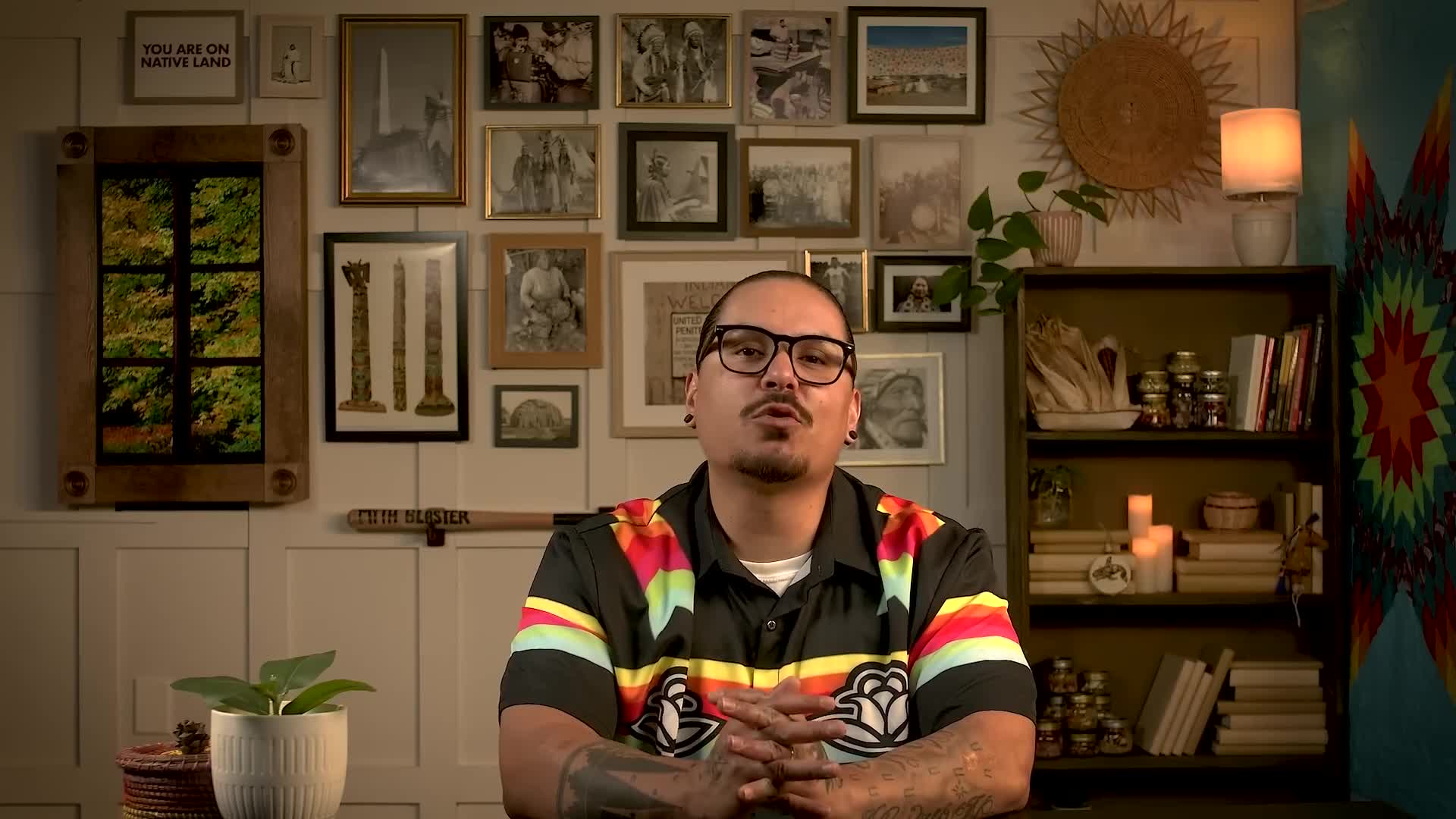
Hi, I'm Che Jim, and welcome to Crash Course Native American History.
In previous episodes we covered a lot of friction between the US government and Native American peoples.
There were broken treaties and forced removal to reservations, the attempted elimination of native cultures through assimilation and allotment, efforts to repair things that fell short, like the Indian Reorganization Act of 1934, and then sweeping reversals of previous agreements with the termination era.
Things were pretty bad for like centuries.
So by the 1960s, tensions were high between Native nations and the US government.
Native groups like the American Indian Movement and Red Power Movement had risen up to try to make change.
Power to the people.
And in November 1969, a group of Native Americans calling themselves Indians of All Tribes took over and occupied Alcatraz Island in the San Francisco Bay for 19 months.
That's over a year and a half.
Side note Alcatraz Island was originally home to the Muwekma Ohlone tribe for about 10000 years before the Spanish discovered it.
Richard Oakes, one of the group's leaders, said in a statement the choice now lies with the leaders of the American government to use violence upon us as before to remove us from our Great Spirit's land, or to institute a real change in its dealing with the American Indian.
Basically, the ball is in your court.
And here's the thing.
It worked.
A year after the occupation began, then-President Richard Nixon announced plans for a sweeping new policy for dealing with Native nations.
One that would return power to tribal authorities and reaffirm Native sovereignty.
It was time to enter our self-determination era.
This period, which began in the late 60s and continues to this day, is defined by Native American activism.
Activism pushing for the honoring of previous treaties, more autonomy over how we're governed and more control over resources on tribal lands.
In other words, activism pushing for the ability to self-determine.
Solid name.
But before we dive into the good of this new era of federal Indian policy, let's zoom out a little.
For decades, the US government had entrusted itself with the welfare of Native nations, a relationship that was established by treaties and policies and reinforced by Supreme Court cases.
The bulk of that trust relationship was maintained by the Bureau of Indian Affairs, or BIA.
But many Native nations had never stopped fighting for their inherent right to self-govern.
And while protest movements like the occupation of Alcatraz helped to finally push policy forward, self-determination had been a goal of many tribal leaders for years.
Like in the early 60s, the Zuni Nation of what's now New Mexico found a legal loophole that allowed them to take more control over critical community services typically handled by the BIA.
By replacing federal employees with elected tribal leaders, the nation gained more say in its own governance.
Nixon actually pointed to the success of the Zuni in his speech calling for self-determination, saying quote In 1975 Nixon's proposal became a reality through the Indian Self-Determination and Education Assistance Act.
And as of 2024, self-determination remains the driving policy behind U.S. tribal relations.
We determine ourselves, thank you very much.
But what does this actually mean for Native Americans?
Basically self-determination allows Native nations more control over social services like schools, first responders and healthcare clinics.
The federal government still maintains oversight and the process is convoluted, to say the least, but it's no longer fully in charge of these essential parts of tribal communities.
The federal government is also required to consult with Native nations any time they plan to propose a policy that would directly involve them.
Or take education.
For over 100 years, the government ran or outsourced Indian boarding schools that focused primarily on erasing Native culture and absorbing Natives into American culture, a process called assimilation.
This was often accompanied by physical, sexual, and emotional violence.
There's much more on this in episode 12.
But in the era of self-determination, most tribes were able to take over governance of BIA-run schools, radically altering the way Native youth were taught.
That meant ditching the old assimilation tactics and turning tribal-run schools into places of community and healing.
For example, in what's now Oklahoma, the Riverside Indian School once forced Native students to cut their hair and punish them for speaking their languages.
Today, Native students there are learning about their history and culture, participating in traditional dances and songs and wearing customary clothing like moccasins and ribbon dresses.
Some of the former students have even returned to serve as teachers, helping to undo the harm of the past.
And while the school is still technically operated by the BIA thanks to self-determination laws, its day-to-day operation is run by local Native administrators and teachers.
Core subjects are also being filtered through a native lens thanks to this new structure.
Like using the teachings of Yupik elders.
In Alaska, some schools have connected their math curriculum to cultural knowledge by teaching about geometry using a traditional salmon rack.
By combining culture with context, students are able to better connect with abstract mathematical formulas.
And many tribes are finding that teaching in native languages or using native cultural touchstones actually reinforces other areas of learning.
At the Rock Point Chapter of the Navajo Reservation in what's now northern Arizona, all classes are taught in the native language of Navajo.
Children learn everything from math to grammar in the language of their ancestors.
It's part of the recent effort to revitalize the Navajo language.
And not only does it do wonders for the language itself, but researchers found that the students at Rock Point scored higher in math compared to kids on other reservations.
They even scored higher in English.
Other steps were taken to protect Native children during this period, too.
Like in 1978, just a few years into the era of self-determination, Congress passed the Indian Child Welfare Act.
This made it easier for a Native child to be placed with a relative tribal, foster agency or other member of their Native nation.
It was passed in response to a congressional investigation which found Native children were removed from their homes at much higher rates than non-Native children.
Often, they were placed with non-Native families in non-Native communities.
And arguably, there's no better resource for Native children than their families and tribes.
Children raised by relatives are far more likely to live in a stable environment and more likely to be employed or in school by age 21, and they're less likely to be unhoused or incarcerated.
But before you go thinking that the self-determination era is all glitter and roses, there have been – and still are – issues.
Remember, during the previous era of termination, lots of Native nations lost their federal recognition, which meant the federal government ended the nation-to-nation relationship they had with those tribes, which also meant they could no longer apply for funding and grants through the new policies,
So not every tribe gets to experience the positive effects of self-determination.
And then there was corruption and fiscal mismanagement within the BIA itself.
In the 1980s, George H.W.
Bush's administration organized the Special Committee to Investigate American Indian Affairs.
And in 1989 it released a report that found quote fraud, corruption and mismanagement were pervasive within the BIA as well as within tribal governments themselves.
In the intervening years, Congress passed a number of amendments to the original Indian self-determination law designed to address some of these issues.
Passed in 1988.
One amendment further protected the ability of tribes to contract and manage federal programs for themselves and to use funds as they deemed necessary.
Other later amendments established tribal self-governance as a permanent program within the Department of Interior and the Department of Health and Human Services .
These amendments gave tribal leaders more oversight in the way funds were actually being spent on tribal programs, which is what they should have had all along.
So, that brings us to today.
It's now been over 50 years since Native activists sailed into the waters of the San Francisco Bay and claimed an island prison as their own.
In 2015, one of the original occupiers, Johnny Bearcub of the Assiniboine and Sioux Nations, spoke at the 45th anniversary gathering.
Alcatraz was the beginning.
It was also giving permission to everybody in Indian Country that it's okay, you can stand up for your rights.
In the years that followed, plenty of Natives heeded that call, pushing the US government toward a more just relationship with Native nations, and that work is ongoing.
For example, the National Association of Food Distribution Programs on Indian Reservations consults with the US.
Department of Agriculture to advocate for better access to fresh and traditional foods.
That includes increasing tribal control to source healthier options in the food packages serving Native communities.
Because here's the thing, self-determination policies have done a lot for Native nations.
They've given us more control over our tribal governments, allowed us to provide education to our youth through cultural contexts, and helped keep Native children with Native families.
But they haven't been a cure-all.
There are still unrecognized treaties, unceded lands, and legacies of injustice.
But the good thing is, there are still people willing to fight for a better world.
And who knows?
Maybe in the years to come, we'll find another path forward and we'll enter a brand new era.
In our next episode we're going to explore some of the ways modern federal Indian policy impacts natives today.
And I'll see you then.
Thanks for watching this episode of Crash Course Native American History, which was filmed at our studio in Indianapolis Indiana, and was made with the help of all these nice people.
If you want to help keep Crash Course free for everyone forever, you can join our community on Patreon.