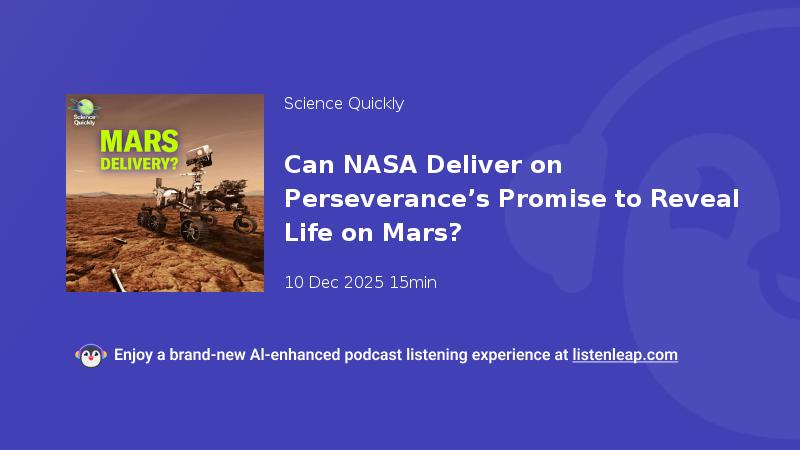
For Scientific American Science Quickly, I'm Kendra Pierre-Lewis, in for Rachel Feltman.
In July of 2020, NASA engineers sent a rover named Perseverance hurtling into space.
And in pictures it kind of looked like the diminutive robot in the Disney Pixar film WALL-E, just much, much larger.
Perseverance, however, has spent its nearly five years on Mars focused on a very different mission.
Instead of collecting trash, Perseverance has roamed the Red Planet, collecting rock samples with the goal, in part, of finding potential evidence of life on Mars.
The plan is to send the samples back to Earth, where they'd undergo further study.
But that project, known as Mars Sample Return, is hanging on by a thread.
To walk us through what's happening.
We are joined today by Lee Billings, a senior desk editor here at SIAM.
Thanks for joining us, Lee.
Kendra, it's great to be here as always.
You know, I think.
To begin, can you tell us broadly about the mission that Perseverance was tasked with completing on Mars?
Sure.
Perseverance landed on Mars in early 2021.
It was launched in 2020, and it was a follow-up to Curiosity, another NASA Mars rover.
But the point is, is that But Perseverance's goal?
It's kind of the apex of planning for something called Mars Sample Return, which has been going on for decades, back to the 1990s, even back to the 1960s, if you look back on it.
And the whole core idea is we can study rocks better here on earth than we can on mars, because it's hard to lift or build a huge wet lab on another planet.
It's easier to bring smaller little bits of stuff back here, and so perseverance was crucial to that and again, kind of a very incremental way, building on a lot of the missions that had come before.
And that perseverance is actually kind of where the rubber meets the road, so to speak, where NASA scientists and other scientists from other institutions had narrowed down a short list of places to go on Mars to look for potential signs of life.
And then from that short list they actually found a place called Jezero Crater, this 30 mile wide, almost 30 mile wide depression in Mars that used to harbor an ancient lake and river delta and all this stuff.
And That's where Perseverance landed had a rather nail-biting landing with the sky crane from JPL.
That involved rockets and wires delivering this thing down to the surface.
And it's been there again for the past several years gathering samples, using a lot of its onboard instrumentation, to figure out which of the rocks, which of the parts of the environment around there, are most interesting to bring back to Earth.
And it has 43, I believe, sample tubes.
That's how many it carries.
And the idea is that in each one of these sample tubes it can deposit a little sample, a little bit of Mars to bring back to Earth someday.
But you can see Perseverance is really good at finding these samples and collecting these samples.
It has no capability whatsoever to actually bring these things back to Earth.
That's a whole separate, subsequent phase of the mission and the thing that's really become this very troublesome roadblock and obstacle.
Now for the program at large.
What's driving this fascination with Mars?
So the big question, of course, is are we alone?
Mars is right next door, relatively speaking, and it has a lot of indications that suggest that it really wasn't so bad for life as we know it billions of years ago.
We see abundant signs on the planet of flowing water, of thicker atmosphere.
Right now, let's be clear, Mars is a frozen, terrible place to live.
It's a freeze-dried mud ball.
But long ago— I'm grabbing my apartment. or parts of my house for that matter.
It's not a good place to live, despite what some people might say.
But long ago you could imagine it actually not being so bad of a place to live to the degree that we really don't necessarily know of some place that has a relatively Earth-like or Earth-adjacent we might call environment in which we could imagine life as we know it being able to exist.
And, of course, life as we know it doesn't just include podcasters talking to each other into microphones, but also little tiny, microscopic single-celled organisms.
Microbes, which is really what most people would think would be on Mars, rather than little green men or some kind of strange polar bear that's going to eat you.
Or a TikTok influencer.
That's right.
Even though sometimes they do seem like they're from Mars.
And so the core idea really driving all this is trying to figure out whether or not we're alone.
Because, if you think about it, If we can find, if we can show that there were microbes on Mars, that there were Martians, that the planet was once alive, that's huge, because that would suggest that life gets started pretty easily and that it must be out there everywhere.
If we can look at the planet right next door to us and we can see that it was a true so-called independent origin or second genesis, that would be huge.
There is this one sample, or this one singular rock that Perseverance has found on Mars, a big hunk of mudstone on the rim of this crater that used to harbor, billions of years ago, a big lake and riverine delta.
It's called Cheyava Falls, and it's filled with organic matter.
That is stuff that's rich in carbon, the molecular backbone of life as we know it.
That's a pretty important thing because where you see organics on Earth, you tend to see life.
It also displays very tantalizing patterns. on its surface and in the matrix of the rock itself.
They're called poppy seeds and leopard spots.
And, in short, we see rocks that have those same types of features on Earth, and they can be produced abiotically through lifeless processes over lots of time, via a little bit of heating and some chemistry.
But most of the time when we see them on Earth They are due to little microbes, little bugs in the rock that use iron minerals to get energy to drive their metabolism.
And so, based on everything that Perseverance has seen of this rock and has studied from this rock, it looks like the rock formed in conditions that are closer to what we'd expect of for life to be there.
So it's not something that happened via volcanic eruption or some sudden event like that.
It's rather like okay, this mudstone was deposited on the bottom of this ancient lake billions of years ago and sat there and at some point somehow, these really curious marks and speckles got all over it.
And the best explanation that we have right now for those marks and speckles is microbes munching on iron, other minerals inside the rock.
So the evidence for life beyond earth may already literally be in hand.
Almost perseverance has taken samples of this rock.
It has stored the sample.
It is ready to come to earth.
All we need to do is go there and get it.
That could be the most epochal discovery in history, to know that we're actually not alone.
So that is the big thing.
But it's not the only thing.
A lot of people get hung up on this.
Even if Mars sample return reveals no life at this site or no life anywhere on the planet after we've exhaustively looked everywhere, somehow we would still learn so much about Mars.
And that's important because Mars is kind of giving us an idea of the limits of habitability that we will experience, potentially someday encounter, on our own planet.
It's showing us how a planet dies.
It shows us how a once relatively nice place decays into a not so nice place.
And studying the mechanics of that.
Knowing how that happened is valuable for being good stewards of our own planet.
And so one of the things that is putting Mars sample return kind of in limbo is this question of funding correct.
That's correct.
Yes, big time, big time.
Because, of course, we've never launched anything from Mars before, and that's how you have to get the samples back to Earth.
That's expensive.
How do you do it?
How many stages are there?
The plan of record up until the past couple of years was supposed to cost ooh man, I think it was about 6 billion is how it was supposed to cost.
I spend that on shoes.
Right.
I mean, you know, a billion here, a billion there, pretty much adds up to real money.
But obviously, that is a lot of money.
What happened was that this plan it involved first retrieving the samples, with a second rover that goes there to retrieve the samples.
And then that rover bringing the samples from Perseverance or from a cache where they've been dropped on the ground back to a launch site, or maybe just launching from that same platform, launching it up into orbit where it would rendezvous with an orbiting spacecraft that would Take in the sample, store it, secure it and then blast it back to Earth on a long journey back to Earth, where it would then land somewhere in the US high desert, probably of the southwest US, and be collected and taken to specialized facilities that are all biohazarded up.
Right.
And you think of like the hot zone or other things, you know, the place that they go to study Ebola, stuff like that.
That's the same kind of facility they would take this stuff to, just because we don't really know for sure.
Right.
And then they would, you know, scientists would painstakingly analyze it for years and years.
And eventually parts of the samples would probably be distributed to other institutions around the world.
And we'd all learn a lot more about Mars.
But yes, the problem is getting it off the ground because that takes a lot of money.
An analysis that was done.
That basically showed it was behind schedule and over cost.
And the costs were looking to be upwards of $11 billion.
So, you know, nearly a double in the estimated price tag.
And we were looking at samples not really getting back here until 2040 at the earliest.
And the former administrator of NASA, former senator and shuttle astronaut Bill Nelson, outgoing from the Biden administration, said you know,
That's just too long to wait.
That's too much money.
We've got to find a faster, better, cheaper way to do it.
But he left the core decision making on that to the Trump administration.
So we're in 2025 now.
It took Perseverance about six months to get to Mars.
Why would it take 15 years for the samples to get back?
Well, one thing to think about is that planets revolve around the sun.
Oh, well, of course they do.
But what that means is that they don't necessarily all revolve at the same rate in lockstep with each other.
About every two years you have an alignment between Earth and Mars that allows us to get there more easily with less fuel from a rocket.
You know, everything you take off the Earth into orbit costs money to get up there.
And it's a pretty exorbitant price, even though the price is falling.
And so the less fuel you need to burn to get to Mars... the cheaper your mission is going to be.
So every two years is one thing to think about.
The other thing to think about is that we're still talking about huge pieces of hardware that are either being built or not fully built.
So that includes things like the rover that's going to retrieve the samples from Mars, from wherever Perseverance has stored them or wherever Perseverance is.
It includes whatever system you're going to use to launch that thing back into orbit.
It may include, you know, the Earth return vehicle, all these components.
It even includes the facilities on the Earth, you know, biohazard style facilities that I mentioned earlier that are needed to make people feel safe to have this stuff on our planet.
All that stuff is included.
And so that takes time to do.
And it's the kind of thing where if you threw money at it in some kind of Apollo program let's beat the Russians to the moon style race you could do it Much faster.
Yes,
But the trouble is that that's not what NASA is anymore.
NASA hasn't been that for a long time, so singularly focused.
And it's not just a problem of a lack of political will or something.
It's also the broader problem that, because NASA is different, because it has so much more stuff in its portfolio, there was and is a real risk that throwing too much money into at Mars sample return would come at the very direct cost of much less money for pretty much everything else, for instance in planetary science.
And there's so many cool things out there in the solar system to see whether you're thinking about the moon of Jupiter, Europa or various moons around Saturn, for instance, or even Venus, that it's a pretty hard ask, I think, to say well, let's just put all our eggs in the Mars basket.
So my understanding is the Biden administration, when they were like we're, They were really looking towards commercial space.
And can we talk a little bit about kind of the push for Mars from the commercial side?
Absolutely.
The rise of commercial space, the new era that we are in and advancing into, was a key factor, I think, in the political decision making that happened.
That brought us to this crossroads moment for Mars sample return, because it's undeniable that the rates of launches are soaring.
And there are more players, more capabilities than ever before, more competition than ever before, more ways to potentially get this done.
And not all of them necessarily have to rely on tried and true legacy ways that have certain price tags and costs associated with them.
So, for instance, people love to talk about SpaceX.
Most of the focus is on how SpaceX might help NASA astronauts return to the moon as part of the Artemis program, and the cornerstone of that is this huge, immensely gigantic, mega rocket that's intended to be fully reusable, which is the first time in history we've ever tried to do that really called starship, that they keep testing and that keeps blowing up or falling apart, right?
So one idea, for instance, was maybe we can just, if starship works out really well getting people to the moon, we can just co-opt one of those starships and send it to mars and plop it down, and it can do all sorts of things.
But spacex isn't the only game in town, right?
So Blue Origin, the company from Jeff Bezos of Amazon fame, is also a launch provider.
They've proposed something to NASA, some kind of plan B that they could provide to try to get these samples home.
Another example would be a dark horse, and that most people don't really know about it as much is the company called Rocket Lab.
The plan from Rocket Lab that they've publicized claims to be able to deliver the samples from Perseverance for a price of about 4 billion, rather than something like 6 billion or 11 billion or more.
And we don't have those numbers for all the proposals.
And there's more proposals than I'm mentioning from other commercial outfits.
But the point is is that there is a very strong compelling case to be made.
I think that we can indeed do much of this, and all of this for much cheaper than what was previously the plan of record.
This has been lovely.
Thank you so much for your time.
It's my pleasure, Kendra.
Thanks for talking with me.
That's all for today.
Don't forget to tune in on Friday when our associate books editor, Bree Kane, digs into whether we should be thinking about AI in terms of empires and colonialism with Karen Howe.
Science Quickly is produced by me, Kendra Pierre-Lewis, along with Fonda Mwangi and Jeff Dalvisio.
This episode was edited by Alex Siguiera.
Shana Poses and Aaron Shaddock fact-check our show.
Our theme music was composed by Dominic Smith.
Subscribe to Scientific American for more up-to-date and in-depth science news.
For Scientific American, this is Kendra Pierre-Lewis.
See you next time.