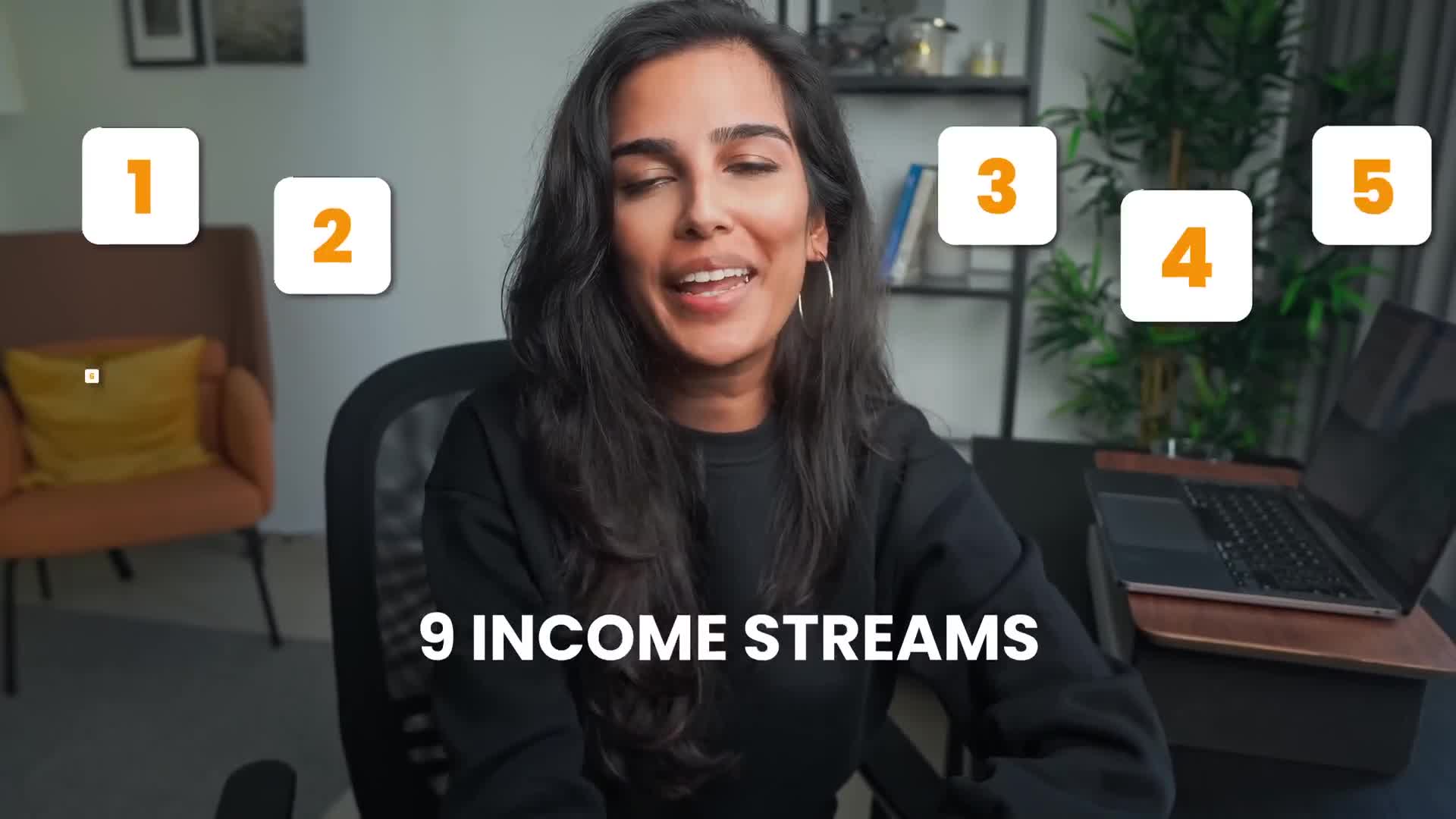
Hi, I'm Nisha, and in this video I'm going to walk you through the nine income streams I have right now.
This time, two years ago, seven of these income streams didn't even exist in my life.
Back then, my entire world revolved around my day job.
I was the person who believed that the recipe for financial success was written in stone.
Work hard at your nine to five, climb the corporate ladder and eventually you'll make it.
That's exactly what I did in banking and I was convinced it was the only way forward.
But here's what I've realized.
Relying solely on active income is risky for two reasons.
First, you're completely tied to trading your time for money.
Which means there's always going to be a ceiling to how much you can make.
And secondly, you're putting all your eggs in one basket, hoping that that single source of income never disappears.
That's why I'm a big believer in building multiple income streams.
And what's interesting is that building most of these income streams that I'm about to tell you didn't require much upfront capital.
I created them whilst working my nine to five using whatever pockets of free time I could find.
There are a few that did need some investment to get going and I'll tell you exactly which ones.
In fact, one of them is actually losing money right now, and I'm going to show you exactly what I'm doing to turn that around too.
Right, so let's break down each of these income streams.
Number one, YouTube AdSense.
Let's start with YouTube AdSense.
This was one of the first additional income streams built whilst I was working my nine to five.
Here's how it works.
Once you hit 4000 watch hours on your long form and 1000 subscribers, YouTube starts showing ads on your videos and you start earning money.
There are two really important elements to understand here.
CPM, which is what advertisers pay per thousand views.
An RPM, which is what we as creators actually receive after YouTube takes their 45 cut.
So let me show you some real numbers from my own channel.
Let's take my how to become unrecognizable video.
Advertisers are paying a CPM of around $13, but my RPM, what I actually get is $6.86 per 1000 views.
So with 86,000 views, that video has made me $594 in total.
On the other hand, my five side hustles that can make you 1000 a week.
That video performs quite differently.
The advertisers are willing to pay a much higher CPM of $33, giving an RPM of $15.61.
So to give you a like for like comparison, with the same 86000 views, this video would generate more than 1300.
That's double the revenue of the become unrecognizable video.
If you want to see exactly how much YouTube paid me in my first month of being monetized, including all the details about RPMs and how different types of content perform.
I've made a really detailed video about that.
You can find it over here and I'll also link it in the description.
Number two, dividends.
The second income stream is dividends.
And this is a really interesting one because it's genuinely passive once you set it up.
What it essentially is is that when you own shares in a company, some companies will distribute a portion of their profits back to their shareholders.
That's what we call dividends.
Think of it as getting a small slice of the company's profits regularly just for being a partial owner.
And then you can use those dividends to reinvest or to spend.
While you can buy individual company shares to get the dividends, I prefer a more strategic approach here.
Instead of putting all your eggs in one basket with individual companies, you can invest in dividend funds like this one that holds multiple dividend paying companies, or this one.
This way, you're automatically diversifying your risk, and if one company cuts their dividends, you're still earning from all of the others.
The third income stream is my community platform.
And, to be completely transparent here, this is my newest venture and it's actually loss-making right now.
I soft-launched it a few weeks ago and it's taught me a lot about building sustainable income streams.
What makes a community different, whether you run it online, like I'm doing, or in person, is that it's all about bringing together like-minded people who share similar goals and challenges.
And the reason why mine is loss making at the moment is because I've invested in a community manager who handles the onboarding and all the day-to-day operations, including the weekly challenges, the monthly updates.
A personal finance expert who answers all the questions that come in within 48 hours.
I pay for the system and the platforms where all of this is hosted.
And I pay for the monthly coaching calls with industry experts.
And the reason why I've got industry experts in is because I recently paid 200 or the equivalent for a one hour call with a tax advisor.
And that one hour call saved me $40,000 in taxes.
I was privileged to be able to spend that much for an hour.
And I know a lot of people wouldn't want to do that.
But it's the kind of value that I want to bring to the community.
But in a group setting, that's more affordable for everyone.
So during the soft launch phase, I'm covering all these costs whilst we test the model out for the first 100 members.
And then now the plan is to open it up to 500 founding members at a really special price point.
And then, once we've covered the operational costs, we'll increase the pricing to make it sustainable long term.
What I like about community income is it's completely dependent on you and not dependent on another platform like YouTube, for instance, where the AdSense can fluctuate massively month to month.
So you feel a lot more in control over this revenue stream.
Number four, sponsors. sponsorships the fourth income stream comes from sponsorships i get a lot of sponsorship requests like nine or ten a week but i'm really really selective about who i work with because it takes years to build a reputation and that reputation can be destroyed in a matter of seconds So I point blank only partner with brands I genuinely trust and believe in.
And speaking of sponsorships and trusted partners, this video is sponsored by Build Your Store AI.
And I'm genuinely excited to tell you about this because it solves one of the biggest problems I hear from you, which is how to start an online business without massive upfront costs or technical knowledge.
Build Your Store AI.
Uses AI to create a complete, ready-to-sell Shopify store in less than two minutes.
But it's not just about speed.
It's about getting it right.
The AI selects winning products, optimizes your store for conversions and then lets you customize everything to match your brand.
What I love about this platform is it's completely free to start.
And then you only need $1 to get your Shopify store running for the first month.
And there are no hidden costs.
The platform integrates with AutoDS, which automates your entire product sourcing and order fulfillment process.
So just to break down how simple it is, you firstly sign up on Build Your Store AI, completely free.
You then choose your niche.
Then you let the AI help you create your optimized store.
And then finally, once you're ready, you set up Shopify.
You start selling with pre-selected proven products.
They're offering my viewers a special deal to get started.
Just go to buildyourstoreai or click the link in the description below, and the AI will help you create a store that's unique to you, without any technical knowledge, so that you can have your business up and running today.
Thank you, Build Your Store for sponsoring this video.
Active income the next income stream comes from my accounting work and, to be completely upfront about this, one is probably the most active income stream on the list.
Since I'm a chartered accountant, I help businesses set up and manage their accounts.
I've kept this going partly because I want to maintain my accountancy membership, but also because it helps me keep sharp in the field.
This income stream is different from the others we've talked about.
It's purely active income, meaning I can only earn when I'm actually doing the work.
I can't scale it unless I hire other accountants and build a firm, which isn't my goal right now.
So, while it might sound a bit weird to keep such an active income stream alongside the other passive ones I'm creating, I think it's important to share this because it shows that not every income stream needs to be scalable or passive.
Sometimes, just maintaining your professional credentials and expertise in a field can open up doors to other opportunities.
Number six, next one is real estate income.
And this is actually one of my longest running income streams.
What's interesting about real estate is that there are so many ways to get started, regardless of your budget.
You could either invest in physical properties or, if you don't have the capital for that yet, you can invest in something called REITs, which is Real Estate Investment Trusts, which let you invest in real estate through the stock market with a much smaller amount of money.
Recently, when it comes to physical properties, I've shifted my strategy from residential to commercial.
Particularly in the UK.
Commercial properties often provide more steady income streams and the way the UK tax and legal system is structured, it actually makes more financial sense to me.
The tenancy agreements tend to be longer and there's typically less hands-on management required compared to residential properties.
Number seven is public speaking, and this is an interesting one because it's one of those income streams that can start small but grow exponentially with your reputation.
It's.
It's essentially organizations, companies or events paying you to share your expertise through keynote speeches workshops, panel discussions.
And the amazing thing about speaking engagements that I found is that you're essentially getting paid for your knowledge and experience packed into an hour or two of your time.
You don't need to be a famous expert to get started.
I actually began doing this at smaller events for free, just through word of mouth, mostly focused on personal finance topics.
And then each event built my credibility and expanded my network, eventually leading now to paid opportunities, for example at Google or at a creator summit.
Number eight, affiliates.
I actually realized I've been doing this one for years and you probably are too without even knowing it.
You know, when you refer a friend to your American Express credit card and you get bonus points, or when you recommend someone to a bank account or a business account and you get a referral award.
That's essentially affiliate marketing.
In the content creator space.
Companies give you a custom link and when someone uses that link to sign up or to make a purchase, you earn commission.
It's the same concept as those credit card referrals, it's just more structured.
So to give you a real example of me doing this, when I promote certain investment platforms like this, you might get a free share for signing up, and I get either a free share or a commission for introducing you.
It's a win-win.
You get value from a product or service I genuinely use and recommend and I get compensated for making that connection.
Number nine, courses.
This is an interesting income stream because it lets you turn your expertise into something that can generate income long after you've done the work.
In my case, it made sense to create courses about money and finance, given my background.
But what's fascinating is you don't need a formal qualification to create one.
You just need to be really good at something and able to teach it effectively.
So, whether that's graphic design, cooking or even organizing your home, if you can help people solve a problem or learn a valuable skill, there's potential to turn it into a course.
There are two main ways. you could do this.
So you can either sell it through third-party platforms like Skillshare, for instance, where they handle all the technical stuff and bring an existing audience for you.
Or you can create your own platform and have complete control over the pricing and the marketing, whether that's through earned audience, building an audience or paid audience.
So putting out ads.
Something to note before you spend months creating a course, try and pre-sell it.
This way, you can validate whether there's actual demand for what you're teaching.
There's nothing worse, in my opinion, than putting so much time and energy into creating something that nobody wants to buy.
The beauty of creating a course while they do require a lot of upfront effort to create is that they can continue generating income for years to come.
Think of it as building a product once and then selling it multiple times.
So those are the nine income streams that I've built.
If you like these kind of videos, let me know.
I can keep creating ones or give you quarterly or six month updates on how they're going and which other ones I'm working on.
Thank you so much for watching.
Don't forget to subscribe if you haven't already.
Otherwise, I'll see you in my next video.