Discussion keeps the world turning.
This is Roundtable. You're listening to Roundtable.
I'm your only enjoying by lime and steve happily.
Coming up on the second half of the show, with summer vacation in full swing, families across China are flocking to museums to take advantage of their rich educational resources.
Displayed in a fun way. Today, we're exploring why museums and places alike are becoming the go-to destinations for summer learning.
And we're discussing the new travel trend that's taking the internet by storm.
Raw doggy travel. What does it entail?
Stay tuned to find out. But now.
It looks like museums are the new hot spots for family outings in China this summer vacation.
What are the benefits of museum visits during the summer break and how does this trend reflect changing attitudes towards cultural education among parents and children?
How are museums adapting to this sudden enthusiasm?
I have so many questions, but can you tell us the museum fever?
Is it real in China now? It's real.
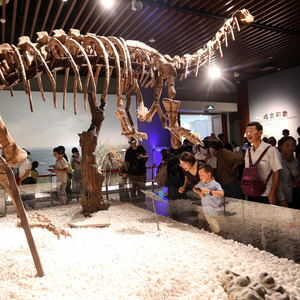
Last Saturday I brought my son to a museum in downtown Beijing.
He's called the Paleozoological Museum.
I was there at 9 a.m. and already there was a line waiting.
And it was a small museum of only three stories.
And each floor is quite small.
But still, every floor was crowded.
And parents and kids. So, so, everywhere.
And they even were considered enough to arrange some interaction events.
There was a guy dressed up like a dinosaur at 9 a.m.
So, everybody will crowd out and try and touch the dinosaur.
Wish my son didn't because he was too scared, but then it was fun.
So I think the first and most immediate benefit of going to a museum during the summer break is that is a place under the roof.
You are not exposed to the elements.
We are talking about temperatures in the higher of well, 30 degrees Celsius.
Plus, plus, plus. I know.
It feels a lot hotter than that.
So, when you have a chance to stay out of the sun, I think that's obviously a good solution.
And then there's growing interest in education, other sources of education.
We talk about summer vacation yesterday as well, and how that is a compliment to the curriculum in school.
By its nature, holidays, summer holidays and winter holidays are considered as a supplement to the curriculum.
Students are expected to try and pursue studies outside of the curriculum.
And so, I think it's a natural for parents to want to bring their kids to a museum where the children can feel and touch and hear and see sometimes with high end technologies like augmented reality.
That's what we had over the past weekend.
I spent almost a hundred yen to get them.
I was waiting for the complete surprise.
Yeah, but I think a lot of parents are agreeing with Lyme in here.
We see that museum ticket bookings have surpassed those for theme parks, ranking as the most popular among all types of attractions, the summer vacation, and according to a platform that is C-Trip, museum bookings in Shanghai during the summer holiday period have surged by 371 percent compared to last year.
And do you guys know how many museums are here in China?
I'm going to guess... About two thousand?
Yeah, maybe more than ten thousand, I would guess.
Well, actually, as of 2023, China has 6,833 museums with any visitors nearly 1.3 billion.
So that's a lot of people visiting museums.
And I think a really important...
Well, Lyme, share of that to visit.
It actually happened during the summer holidays.
Yeah, I mean myself. I don't know if you would call the terracotta experience a museum or not.
But it's definitely cultural and history related and themed.
Qualified, it doesn't.
And that was one of the recent experiences that I had in Xi'an.
And if you're listening and you haven't had that experience yet, I would absolutely encourage you to do so.
Lots of people that day, I think it was 36 or 37 degrees that afternoon in Xi'an.
People learning experience, tons and tons and tons of families there.
And it was just... Everything Lyme just said.
The indoor areas were nicely air-conditioned and really hot outside.
But just a great way to spend an afternoon.
And I think maybe probably during COVID times, museums really suffered, right?
Not only here in China, but everywhere around the world.
Coming out of it now, museums are getting popular again.
The summer vacation. Parents always want to know what can I do with my kids during the summer vacation.
I know. So a museum is a great way to entertain everyone in the family.
Yes. And different museums are actually rolling out different policies, helping parents and kids to better enjoy during the summer vacation period of time.
They have already, I think, coming down from the pedestal in the past few years here in China instead of making all the tour and all the explanation of different artifacts that they display different exhibits.
They have already tried really hard to make the experience much more enjoyable for kids.
They include fun stories of each and every exhibit.
They provide artificial intelligence, assisted information and they provide virtual reality related information and experiences.
And immersive performances and stuff.
But this summer, it seems that they are leveling up the game as well.
Well, many museums have implemented a reservation free policy allowing visitors to enter without prior bookings.
This is different from previous years, especially during COVID when there was a restriction on the number of tourists on a daily basis.
This is obviously giving up, freeing up the spices for tourists to go and swarm the museums.
And then the National Cultural Heritage Administration suggested that key and popular science extend their opening hours or offline online exhibitions to maximize visitor satisfaction.
And so for instance, the museum in Hürnan during the summer holiday decided to extend the office hours by one hour.
So the office hour is now is 9 a.m.
to 6 p.m. and the National Museum, the National Museum now has extended the office hours to 6 p.m.
So that's not bald enough.
We know that China Garden Museum actually can source its Monday closing policy from July the 15th to August 31st and they hold, well, actually 8 a mid-summer night stream event from July to August.
Like a night tour. Like a night tour.
Actually, during the event, children can spend the night at the museum and having this one day time travel in the mid-summer garden with a romantic name and night tour for museums.
It sounds super fun. I should try and book a reservation for that.
I should stay there because I go there very often, the Garden Museum in Western Beijing is quite close to the office here.
It's a different experience at night too, right?
I know. You talk about the movie.
You know. Oh, yeah, exactly.
You know, you talk about lifting of reservation policies and things like that.
I think that really helps out the tourist population here in China.
We know now New Visa policies to help make things easy for tourists coming into the country.
The 144-hour Visa Free Transit Policy.
Now think of that. I'm thinking of that from my point of view, right?
If I'm coming in on that permit and I don't know anything about how reservations work in China, I don't know what to do.
I'm not familiar with WeChat or any other apps where I can make reservations.
Having this no reservation policy is really, really helpful because number one, I wouldn't know how to do it in the first place.
Number two, I might not even realize that I have to make a reservation, right?
You might not even realize that.
That way you're going to get more people coming to the museums and allowing them to have a great time while they're in China with lots of different cultural experiences, then they take those stories back home and they share those stories online or with their friends or family, and that's going to encourage more visitors to come to China in the future.
Not only overseas travelers are enjoying this policy actually for those kids traveling with their parents enjoy a really good quality family time in a different city, I don't know if those who are listening are familiar with kids, they don't get tired.
They want to spend a very fun night time as well and planning a night tour is no easy work.
If you can actually take them to some night tours in museums, which are usually full of different activities, immersive performances and also the hands on little gadgets kind of handy work that kids can actually occupy with.
All these activities are in mostly I feel like included in these night tours and it takes up a lot of their time and also with fun and educational content.
I love that. The museums really have opted their game in comparison a few many years ago when I was a college student in Shanghai, I went to the museums, I got bored really honestly speaking.
I got bored from reading the lines describing the artifact displayed in front of you and without prior knowledge or some background information in archaeology or in the history in the part of the history being displayed, I don't think an average museum goal would be able to appreciate and understand the significance of the artifact being displayed.
But now I think at least from last weekend's experience I feel like the museums really have done a lot to facilitate the outreach, to help the audience and the tourists understand what's going on, the talk of the augmented reality technology, the goggles.
My son was wearing it the whole time and everywhere he go he looked for the sign that says you can access you augmented reality goggles here and see some computer generated image about some long dead animals.
Because that's what kids want, they don't want to read a little placard on the wall that says.
Well yeah, exactly and even if they could, this came from this year at this time and it's just not fun for kids.
And like you said, you're a college student and you didn't even enjoy that at the time.
Now ancient coins. Or here's a chair from 3000 years ago.
Okay, well make it fun and cool for me.
It seems like that museums have really kind of clued into the fact that they have to make things a little bit more fun for people.
And on top of knowledge, they also design activities that people can pay for to participate.
I mean, I, again, I'm making a complaint about having to spend about a hundred yen so my son could go digging some jewels.
And all he did was within one minute.
So six jewels he managed to got it.
My wife had to say I'm not happy with the, with these jewels, they're all of the same color, they're probably of the same type, go, go back to the sand pit and try and get me other jewels that are different colors and different types.
Yeah, I think online, you know, talking about the experience in house being more fun online too.
I was looking it up and the most visited museum in Canada is called the National Museum of Canada.
It's located in Quebec.
And their website says that they have 218,000 artifacts available online.
So I think things like virtual tours, you know, with the ticket reservation policies being lifted and that there are downsides to that, by the way, you know, you could be looking at very long lines at places when you go.
And if that's the case and you don't, even if you can't make it to the museum, if you can't make it to your favorite Beijing museum, you can still enjoy the experience at home if museums go in that direction as well.
It's just another way for them to bring in more customers.
You're already seeing some commercial products being rolled out, Apple's Vision Pro.
And then I think Google has around been promoting its own artificial, what was the virtual reality goggles?
So I could see perhaps in 10 to 5 years, the museums could join the bandwagon and come up with their own unique experience.
Did you try the VR goggles?
I haven't. And even if you're old school like myself who enjoy bugs, actually there are very playful bugs.
Are there still a thing?
Actually, a lot of museums roll out different types of playful books.
For example, the Forbidden City once collaborated with a bookstore and wrote out this book that you can play, you can basically play the book.
It's a role-playing game and you try to solve different mysteries.
Within the book, it can play a really good game already.
But if you take the book, actually to the Forbidden City, you get to see certain little clues hidden in certain places of the Forbidden City, helping you to basically unlock, unbox the sideline story of the book itself.
And that part of the game is also online.
It can be super fun for kids as well.
Learning a little bit of part of history and also enjoying the experience.
Maybe in a two-hot summer day, but still, you can have the night tour in the Forbidden City.
And on top of that, we see museums are trying, again, really, really hard to provide different services to different people.
I know this is kind of an extreme example, but I really want to mention it.
That is actually in Shanghai Museum.
We see that they are having an ancient Egyptian civilization exhibition.
And they're allowing visitors to bring their Pat Katz to visit the exhibition.
You know, Katz? What's special with Katz?
So Egyptian civilization, Katz, and Mattias.
And with each event, accommodating 2,000 visitors, they include 200 Pat Tickets, each allowing one Kat per ticket.
And Pat Tickets for the first exhibition on July 27th were sold out in just one second.
Yeah, exactly. It sounds a little bit silly on the surface, doesn't it?
Bring your Kat to the museum.
But look how quickly it sold out.
Exactly. And again, it's another example of museums trying to be creative and trying to offer services to their customers that they hope and they know perhaps that they will enjoy.
Yes. And previously, Steve mentioned the 144-hour visa-free transit policy.
And we see that actually according to survey done by China Tourism Research Institute on satisfaction of import tourists, over 60% of respondents cited experiencing Chinese culture as their main reason for traveling to China.
And the number of foreigners visiting China in the first half of this year has increased by 150% here on year.
So we see more and more people, not only those who have kids, bringing their kids, taking advantage of summer vacation, but also people living outside of China to enjoy and taking advantage of this really fun and nice cultural destinations.
And we see that there are more people who are in the country.
Just get there early if you're going to go to a place that doesn't require the resumption.
I know. Some people might have to concern that with the museums opening a store still very late at night, sometimes in the middle of the night, and then removing the restrictions on the number of tourists who get allowed there, maybe there is an over-crowded situation in museums and I personally felt that when I brought my son to various museums across Beijing and across the country.
I personally felt the anxiety and also the pressure from when you see so many people around and pushing you around the amount of opportunity you get to really feel and touch the exhibits simply reduces.
Yeah, I think I read, don't quote me on this, but I was looking up the information in Xi'an about the terracotta warriors.
And I think they said they limit the number of tickets sold to 13,000 a day.
Again, don't quote me on that.
But even them, it was really crowded.
It did take, if I'm being honest, it did take a little bit away from the experience because it made picture taking more difficult.
You're right, a little pushing and shoving from the customer side.
That's a little frustrating.
I get it though, from the museum side, they're trying to accommodate safely, of course, as many people as they possibly can and they just, they have to draw that line somewhere.
Yes. And even without reservation, actually many museums, many destinations are providing this real-time number of people in our site, kind of service, making sure that they still kind of control the number of people in the area so that a certain level of comfortness can be assured.
And also, they're kindly sent the message to those who want to get into the museum, saying that, you know, already many people in may be unifying another time.
Take a tour and come back.
Maybe your luck would be better next time.
So these can be some other measures taken by museums and we do hope the museums can be smarter in managing the number of people and providing up to standard services.
In the meantime, here in China, we'll also see some other fun cultural-related activities.
We see movie nights or movie festivals for entire week, rolling out different types of movies, including those classic ones, provided in Guangzhou and in Luoyang, there are role-playing games.
And the games are based on Chinese classics, modern classics, ancient classics, allowing you to play the role of your favorite character and with your friends.
And there are some other activities, for example, in Millennium City Park.
They create the market life and architecture style of the Song Dynasty.
And you can wear traditional Chinese custom, get in there and enjoy the immersive experience, immersive being the key word here.
And that actually is the kind of picture we want to paint for the summer vacation, if you're interested and if you're making a plan.
Maybe this is your window.
This is your inspiration to make a plan for a cultural and history-packed kind of trip for your family.
The growing trend of visiting museums during summer vacation underscores their role in enriching our lives beyond the classrooms.
And it's not just for the kids, it's for us too.
You're listening to Roundtable coming up, have you heard about the latest travel, virtual travel, actually viral travel trend?
It's called Ro-dogging Trouble.
And it's all about doing nothing but looking at the window while you're on a flight.
It's kind of Zen, right?
Let's chat about why people...
I guess the humming of the engines.
We are going to chat about why people are loving this and how it's changing the way we think about travel and mindfulness.
Stay tuned. Looking for passion?
How about fiery debate?
Want to hear about current events in China from different perspectives?
Then tune in to Roundtable, where East meets West and understand it is the gold.
It's the hour of Roundtable with myself, Neil Honglin, Limeing and Steve Heatherley.
So Steve, Ro-dogging, what is it?
Well, yeah, let's not focus on the term.
Let's just focus on exactly what it is.
This is kind of stupid in my opinion, but it's a trend nonetheless.
So here's what you do. When you get on an airplane, you typically do what?
Limeing, what's your airplane routine?
Don't ask him. Very quick.
No? It's not fun. I bring up my laptop and start working.
Okay. And I come playing about getting interrupted by the food and coffee and then food and then food and then.
And kind reminder from the air assistant, because they say, oh, you've got to have to take away your computer.
It's not safe for this period of time.
They have play mode. What about you, Honglin?
Don't ask me, I'm the same.
All right. Well, typically a person gets on a plane.
They'll sit down, maybe check out which movies they want to watch.
Should I order perhaps something to drink to wait for their food?
I wish to be so typical. And then sit back and relax and enjoy a film.
Listen to some music. Read a book.
Do some work, even, right?
But that's not what this is about.
This trend, which emerged on TikTok, is all about doing nothing.
Absolutely nothing. Nothing on a plane.
No movies. No music. So no food.
No water. No sleep. In other words, you spend hours up in the air staring blankly into space.
Hopefully you have the window seat.
At least you have something to look at.
But that's the challenge.
Do nothing on a flight. So what they're trying to do is see how long they can go, meaning how far the flights are, where they can literally do absolutely nothing.
There was a DJ from England.
And he got a 1.3 million likes on his video.
What? He was bragging about traveling on a seven hour flight without headphones or sleep or or anything else.
He called it quote, an incredible dopamine detox.
And the people who support this say it's a digital detox.
It's mindfulness. It's connecting with nature on a level because you're up in the clouds looking out the window.
And you're completely just with yourself and nothing else.
What the people who support it.
All of this, well, oversized passengers sitting right by you.
Well, how about you go for a hike in the forest and do not bring your film where you take it to fly mode?
I think that is a better way to connect with the nature and you're not exactly doing nothing.
But you're hiking, which is also beneficial to your physical health.
Also, it's a very low-carbon way to detox.
Yes, it's also 34,000 feet lower.
And cheaper too. Yeah. Listen, I'm not here to promote this thing.
Like I said, I think it's a bit dumb, but people are doing it.
Experts though, they have responded and they said that this can potentially be dangerous because foregoing liquids on a flight, for example, can lead to headaches and dizziness and fatigue, low oxygen pressure on flights changes in humidity levels and increase, increase amount of water evaporates from our skin and lungs when we're flying.
That's a fun little fact to know.
Anyway, stay hydrated if you're on a plane.
That's what experts are saying.
They're not recommending that you do this at all.
But the internet, they do what they want to do sometimes.
If we have to find an excuse for people who are pretty much into this, I can assume that maybe they're like little babies.
Babies, when they don't want to go to sleep, when they refuse to be quiet, you put them in the car and you start the engine and they start going and then they quiet down.
Some people say this reminds them of the time when they are in their mother's womb, when the rumbling of the bowels sounds just like the rumbling of the engines when they are in the car.
So I wonder whether these runups who couldn't find any other way to relax, they're looking for the same kind of experience that they have long forgotten.
I mean, I kind of get it, right?
You're not staring at your phone, you're not entertaining yourself with a move, you're just with your own thoughts, right?
And experts again, they say being with your own thoughts for too long can be a dangerous thing.
You can start overthinking and blah, blah, blah, blah.
Plank of lacrosse. Yeah, but sitting, I mean, that's really down a dark path if you go there.
But just sitting with your own thoughts, I mean, I get where people are coming from.
But just drink some water and have a snack or a meal.
There's nothing wrong with that.
You can still accomplish your number one goal, but while doing that too.
Yes. And in the meantime, once you take the allure of internet connection out of the equation, maybe doing nothing can be a little easier for those who do all want to disconnect with this really fast space of living style and living and working constantly talking to people.
They do not want that, but they cannot really say no in real life where when your feet are close to earth and without that excuse, you cannot simply do that.
But with the desire, maybe on the plane doing a little bit of nothing is helpful.
But I do think doing nothing is the second best way to disconnect with the world and enjoying being yourself because the best way to spend some time on the plane in my opinion is listen to roundtable because you do find roundtable on many of the ways.
Bro, a little shameless self promotion before we wrap up today.
I think that is a really good option if you're on, I think, airline China or some other planes.
Southern the alliance too.
Yeah, you get to listen to roundtable span, a very relaxing one hour, eat a little bit something, drink some water, be dehydrated and get nurtured both mentally and physically.
Why don't we just make roundtable airlines?
We can do that too. And that brings us to the end of today's roundtable, which I'd love to hear your thoughts on today's topics.
Leave us a comment wherever you listen to your podcast.
Until next time, keep the conversations going and the ideas flowing.
I'm your homely and with Steve and Limeing.
Thanks for listening. Bye for now.