Hey, grownups, Mindy here from Wow in the World.
And over the years, you've listened to all of the bonker balls things that we have said and shared.
And guess what?
Now it's our turn to listen to you.
What do you like about Tinkercast shows?
What do you not like?
What's your favorite type of pasta?
Mine's elbow macaroni, but I also like meat. macaroni.
You're right, Reg.
We probably won't ask you about pasta, but the questions we do have will really help us to understand who our Wowzer fans are and how we can keep making the bonker balls content that you love.
Grown-ups, visit Tinkercast.com slash survey to find out more.
It won't take much of your time and you'll automatically be entered for a chance to win a prize pack of Wow in the World toys and books.
That's Tinkercast.com slash survey.
We can't wait to hear from you.
That's it, and now let's get back to the show.
Three two, one.
So many discoveries that are jumping off.
One buzzing bee in the hive, one buzzing bee
He buzzes around, goes out on the town.
No more buzzing bees in the hive.
Yay!
OK, let's start over.
99 buzzing bees in the hive, 99 buzzing bees.
How about we give it a break for a little, Dennis?
We're almost at the museum.
Oh, good.
I need to use the washroom.
The what?
The water closet.
I don't know what that is.
I gotta poop.
Gross, Thomas Fingerling.
That's disgusting.
No, it ain't.
What's disgusting is waking everyone up at 7 am, forcing them into your little ice cream truck here and then taking them on a surprise field trip before they've had their morning constitutional.
Oh!
It's going to be so much fun.
The Bee Museum, everyone.
Don't you all want to see the hive?
The hive?
Oh, that's what they're calling the museum building, because it's shaped like a giant hive.
Oh, I want to see it.
See, everyone?
Dennis is excited.
Don't you all want to be like Dennis?
No.
What?
Well, it doesn't matter, because look, we're here.
Wow, it really does look like a giant beehive, Mindy.
Told ya.
Is that a giant mote of honey running around the outside of the building?
Yep.
Now, everyone, out of the truck.
I want to make sure that we're the first ones in.
Locking up the ice cream truck.
Okay, now, which way to the poo-poo potty?
Firstly, please don't call it that.
And number two.
Oh, yeah, number two.
That's what I'm saying.
Number two, the toilets are right there next to the entrance.
Okay, good.
You all have fun.
I got some business to attend to.
I told him he shouldn't have drunk that gallon of banana milk for breakfast.
So Mindy, why was it so important for us to get here so early anyway?
Well, Guy Ross, they have this brand new exhibition that I've been jonesing to see every time I heard about it on the Buzzing Bee.
The Buzzing Bee podcast?
Yeah, it's a daily podcast I listen to that keeps me up to date with all the hips and happenings of the bee community.
Buzzing Bee.
Huh.
So what's this exhibition all about, Mindy?
It's all about mummies.
You mean like the queen bee?
Like she's the mom to the whole hive?
No, no, no.
Not mommies, Guy Raz.
Mummies.
Oh, like moms, but from England.
No, Dennis.
I think Mindy's talking about, you know, the wrapped up stored in a sarcophagus Egyptian royalty, those kinds of mummies.
Ah.
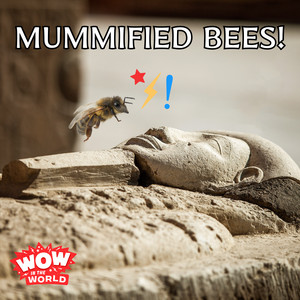
Yeah, only I'm talking about mummified bees.
Wow, what does that even mean?
Okay.
So this group of scientists recently found a whole colony of 3000-year-old mummified bees off the coast of Portugal.
And they're on display right in there.
In the museum?
Now, come on.
The entrance is just over this moat bridge.
All right.
Huzzah!
Ooh, look at all that honey.
It's all gooey and shiny.
I can see my face in it.
Hi, honey Dennis.
Hi.
Dennis, don't get too close to the edge.
You might... fall in.
Help me.
I can't swim in honey.
Dennis, that honey is only two feet deep.
Just stand up.
Oh.
Let me just, uh, crawl out of here.
Dennis, you're all stinky now.
Don't worry, Guy Raz.
I'll lick it off as we go.
Oh, hey.
Wow.
Didn't expect to see anyone out here this early.
Ah!
Is he all right?
Who, Dennis?
Yeah, he'll be fine.
Okay.
We're here to see the mummified bee exhibit.
Oh, yeah.
That one's been super popular.
Come on in.
All right.
Okay, so four people and one pigeon for the mummified bee exhibit.
Is that correct?
Yep, that's it.
I ain't going to no exhibition.
What?
I'm just here to go tubing in the honey molt.
Now, where'd you keep your inflatable tubes, young lady?
Uh.
What?
Oh, I think she wants to go out to that honey river.
You've got outside and ride down it in a rafting tube.
Oh.
Well, we don't have those.
Well, no bother.
I brought my own.
Ta-da!
Cool!
But, Grandma G-Force, you're not even wearing your bathing unitard.
Wrong again, Garage.
Hey!
What in the You've been wearing that swimming unitard underneath your wrestling unitard this whole time?
Now if you'll excuse me.
Oh, what do... So, three people and one pigeon.
Yes, please.
Yay, museums!
All right.
The exhibition starts in that room just down the hall.
Thanks, Miss Ticket, ma'am.
All right, so where does this exhibition start?
Oh, down there, Mindy.
I see it.
Mom Bees.
3,000 years of bee history preserved in time.
Ooh, an exhibition introduction.
I love these things.
But they're so boring.
Don't worry, Dennis.
I have a plan to un-boring it.
Hold on.
I've got it right in my adventure toolkit here.
Oh, here it is.
A boombox?
Uh-huh.
Now, Guy Raz, put on your best reading voice.
Huh?
Let me just push a button here.
And go.
Me?
Yeah, read it.
Oh, okay.
In 2019, a team of researchers from the Naturejo UNESCO Global Geopark were searching along the Portuguese coastline for signs of how the ecosystem in that area had changed over time.
What they found was astonishing.
Oh!
OMG!
What was it?
What was it?
Tennis!
Shh!
What the researchers had found was a subterranean sarcophagi of mummified bees, some of them over 3000 years old.
What?
Their story is on display for you today in the Mum Bees Exhibition.
3,000 years of bee history preserved in time.
Great job, Guy Raz.
Dolphinately not boring.
Now, let's find out more about these mumbees.
After you, Mindy.
Thank you.
So, Mindy, these bees were found in Portugal?
Uh-huh.
Does that make them Portubese?
Uh, huh.
I guess it would.
Hey, Mindy, come here and check this out.
What is it, Guy Raz?
Look.
It's the material that the bees were covered in that allowed them to be preserved in this mummified state for so long.
Ah, bonker balls.
And look, it says here that these bees only came out about once a year for a few weeks when their favorite plant was blooming.
Ah, sort of like how Grandma G-Force only comes out to eat if there's chili on the menu.
Uh, yeah.
Brr.
So for the rest of the year, these bees basically hide inside of these cocoons that the queen bee makes for them.
That's adorable.
It's like she's knitting each bee a little blanket or sleeping bag to sleep in.
Yeah, except this blanket is waterproof and really well stitched together.
And so it was able to preserve the bee inside of the colony around the time it came to its untimely end around 3000 years ago.
Huh.
And this is the actual material here?
Well, it's actually a replica of that material.
The museum made it so we can see what it feels like.
Here, check it out.
Let me see that.
Ooh, feels kind of smooth, like silk.
And a little light, like linen, right?
Oh, let me see.
How... Ugh.
Yeah!
Ugh!
Tastes horrible!
Dennis!
What?
I'm not supposed to eat the material.
Well, nobody told me that.
I just thought it was a very soggy looking potato chip.
You know that's my favorite kind.
Dennis, just spit it out and put it back.
Don't put it back.
Okay, then just stick it behind your ear until we can find a trash can.
Oh, good idea.
Okay, let's move on to the next room.
A movie theater?
Are we going to watch a movie?
Looks like it, Mindy.
How do we get it to start?
Oh, maybe it's this big red button that says play movie.
That might be it.
Yay!
I found it, so I get to press it.
Go for it, Dennis.
Reggie!
Dennis, shh.
The movie's starting.
An innocent colony of bees, the Portuguese coastline, and one of the coldest cases of all time.
This is How Did the Bees Die?
Ooh, so dramatic.
In 2019, a group of researchers on the Portuguese coastline discovered one of the greatest mummified insect remains of all time.
They found hundreds of bees.
Wow.
Look at them, Mindy.
They're perfectly preserved.
Perfectly preserved.
Yeah, it's like they're frozen in time.
Practically frozen in time.
Hey, quit copying us, narrator.
Shh, Dennis.
Oh, sorry, sorry, sorry.
But the researchers wondered, what happened to these unfortunate insects?
How did they meet their untimely demise?
I wonder if they developed any theories.
The researchers developed several theories.
Hooray!
Theories!
For instance, there was evidence of a flood or a drought.
Because of this, perhaps the bees' food supply got cut off, causing them to die of hunger.
But that theory was proven false.
What?
Upon further inspection of the cave where the bees were found, researchers discovered vast deposits of pollen.
Meaning that they had plenty of food to survive.
So with starvation ruled out, they turned to a second theory.
A sudden weather shift.
A sudden weather shift?
What happened?
The researchers now believe that a sudden drop in temperature was responsible for the death of the colony.
But there is hope.
Oh, I'm so relieved.
Despite this weather event, there are still more than 25 species of bees living in Portugal today.
Overall, bees and their ancestors have been around for more than 120 million years and they're not going anywhere anytime soon.
And that's something to buzz about.
Okay, everyone, are you all ready for the main event?
What's that?
The actual remains of the mummified bees themselves.
I think they're in the next room.
I'm ready, Mindy.
Well, then, come on.
Let's go.
All right, let's see.
Wow.
Look, there it is, Guy Raz, behind that glass case.
A 3,000-year-old bee.
One old bee.
What?
That's it?
It just looks like a giant cocoa puff.
That's the cocoon, Dennis.
The bee is inside.
But it's boring.
I thought we were going to see a real life mum bee, with little wrappings and maybe even a curse or two.
Not just the cocoon.
I'm going to go wait outside.
I mean, he kinda has a point.
I suppose it is a little underwhelming.
If only we could find a way to look inside this cocoon without breaking it open.
Yeah, that would be pretty amazing.
Whoa!
In this room, they found a way to look inside the cocoon without breaking it open.
What?
Come on, Guy Raz.
Let's go see what he found.
All right.
Whoa.
Look at all these photos, Mindy.
Yeah.
Looks like this museum just turned into an art gallery.
What are these images?
It's the...
The bees?
Yeah, look!
Read the description!
Let me see here.
Okay, um.
By using a machine called an X-ray microcomputed tomography, scientists were able to make three-dimensional scans of the mumbees without destroying their protective cocoons.
What?
Wow.
X-ray microcomputed technologies.
Wow.
These images are kind of incredible, Mindy.
Yeah.
I'll say.
Attention.
Could the owner of the angry old lady in the bathing suit please come and collect her from security?
Oh, yeah.
Keep your hands to yourself, please, ma'am.
Well, that seems like our cue to leave.
Sorry that took so long.
What did I miss?
The whole thing.
Rats.
But don't worry, Thomas Fingerling.
We were about to leave anyway.
Grandma G-Force just got caught by security again.
Yeah, leaving might be a good idea.
None of you are going to want to use the restrooms.
What?
Mr. Fingerling, what did you do?
Oh, nothing that a plunger and a pipe dredger and maybe some industrial-grade odor eliminator can't fix.
Oh.
Oh, boy.
Clean up crew to the men's toilet block.
Clean up crew to the men's toilet block, please.
Uh-oh.
Busted.
Wow in the World will be right back.
Grown-ups, this message is for you.
Whoa-ho-ho-ho!
You're listening to Bongo and the Big Two in the morning on KWOW.
Hey, Bongo, guess what time it is.
It looks to be about 7.40 AM.
Now it's time for Big Toot's Big Favorite.
Oh yeah, the part of the show when you, Big Toot, hit us with your favorite new song.
What you got for us today?
Alright, today's big favorite is a song from a new artist called Wow in the World.
Well, what's the song?
It's called...
The Scientifically Most Danceable Song in the Whole Wide World.
Wow, that's a big title.
Yeah, let me spin you up a clip.
Oh, oh, the scientifically most danceable song in the world.
A wide world.
The scientifically most danceable, danceable song.
Oh.
That was totally rocking!
Where can we listen to the rest of the song?
Anywhere you get your tunes, Bongo.
They're out on Spotify, Apple Music, or wherever you like to spin your tracks.
Well, thanks for tuning in to Big 2's Big Favorite here on Fongo and the Big 2.
In the morning on K-W-O-W.
Bye-bye now.
Later.
That's it.
Back to the show.
Hi, thanks for calling Wow in the World.
After the beep, get ready to record.
Hi, I'm Ann from Andover, Ohio.
My Wow in the World is that seals can close their noses to go underwater and not get water in their noses.
Isn't that bonker balls?
Say hi to Grandma Dee for us and Dennis for me.
Oh, snap.
Huzzah!
And give Reggie a pigeon treat, too.
Thanks.
Love your show.
Woo!
Hi, Mindy and Guy Raz.
I'm Ellis.
I'm eight years old, and I live in Shawnee, Kansas.
My wow in the world is that Arctic fox change colors due to the weather.
Say hi to Reggie for me.
And Grandma G-Force.
Bye.
Hi, Mindy and Guy Raz.
My name is Owen.
I'm 11 years old, and I live in South Virginia.
My wow in the world. is that Venus is actually the hottest planet, not Mercury.
This is because there are carbon dioxide clouds that are outside of the Venus surface and they're so thick that once he comes in, it isn't going to come out.
I'm Indian Guy Raz.
I love your show.
I'm Indian Guy Raz.
My name is Aubrey.
I'm 11 years old, and I live in California.
And my wow in the world is that your brain is actually gray.
Isn't that bonker balls?
Bye.
Love your show.
Say hi to Reggie, Grandma G-Force, Thomas Fingerling, and of course, the one and only Dennis.
Bye.
Hi, Mindy and Guy Ross.
My name is Lucia, and I live in Nashville, Tennessee.
My wow in the world? is that the letter Q doesn't appear anywhere in any state name.
Bye.
Say hi to Dennis for me.
Hi.
Hi, I'm Zachary.
I live in Rockville, Maryland.
My wow is that frogs can breathe and drink through their skin.
Isn't that fun?
Say hi to Grandma G for Reggie and Thomas Fingerling.
Hi, Guy, Roz, and Mindy.
I'm Lucian, and I'm from Cary, North Carolina.
My wow in the world is there are sea caves, ice caves, and land caves where bats may live.
Some bats sleep in cracks, and others sleep upside down.
Say hi to Reggie.
And Grandma G-Force for me.
Bye.
End of messages.
You can also hear Jed Anderson in the voices of Dennis Thomas Fingerling, Reggie and many of the other silly characters that you hear on our show.
And Lizzie Freilich can also be heard as some of the silly characters on our show.
Jessica Bode keeps our facts straight as our fact checker.
And Meredith Halpern-Ranzer powers the wow at Tinkercast.
Our theme song was composed and performed by three-time Grammy nominees, The Pop-Ups.
Find them at thepopups.com.
Special thanks to Kit Ballinger, Rebecca Caban, Dr Natasha Crandall, Kenny Curtis, Kristen Yang, Thuy Mac, Erica Medina, Henry Moskal, Jody Nussbaum, Ali Paksima, Linda Rothenberg, Steph Sosa, Joanna Weber, Anna Zagorski and all of the other tinkerers at Tinkercast HQ.
And to keep the wow rolling after you finish this episode, visit us at Tinkercast.com.
There you can become a member of the World Organization of Wowzers to get year-round mailings and weekly activities.
Shop our wow shop.
Get tickets for upcoming events, find our best-selling books and learn about some of the other amazing podcasts from Tinkercast.
Grownups, you can follow Wow in the World on Facebook, Instagram, and Twitter at Wow in the World.
And our email address is hello at Tinkercast.com.
And if you're a kid with a big wow to share with us, call us at 1-888-7WOW-WOW for a chance to be featured at the end of our show or an upcoming episode of Two.
What's in a Wow?
Thanks again for listening.
We're here every Monday or you can check out Two What's in a Wow every Friday right here in the Wow in the World podcast feed.
And don't forget, we wow on the weekend with Dennis, Saturday and Sunday.
Keep on wowing!
Wow in the World was made by Tinkercast and sent to you by Wondery.