If you'd like to listen ad-free and access weekly bonus episodes, extra long stories and our entire back catalogue, you can try out premium free for seven days by following the link in the episode notes.
Now a quick word from our sponsors.
This is an ad by BetterHelp, one of our sponsors.
These days, it feels like there's advice for everything.
Cold plunges, gratitude journals. screen detoxes.
But how do you know what actually works for you?
With the internet and information overload about mental health and wellness, it can be a struggle to know what actions to take these days.
That's where BetterHelp comes in.
Talking to a professional therapist can help you break through the noise and work out the best approach to move forward in your life.
From my experience I know a good therapist takes the time to tailor sessions to get the most out of them with you.
And with an App Store rating of 49 out of 5, based on over 15 million client reviews, BetterHelp will match you with the right therapist to get you where you want to be.
Talk it out with BetterHelp.
Our listeners get 10% off their first month at betterhelp.com slash get sleepy.
That's betterhelp.com slash getsleepy for 10% off your first month.
But many other places also have it, and they might not be as careful.
That's why LifeLock monitors hundreds of millions of data points a second for threats.
If your identity is stolen, they'll fix it, guaranteed, or your money back.
Save up to 40% your first year.
Visit LifeLock.com slash podcast for 40% off.
Terms apply.
Welcome to Get Sleepy, where we listen, we relax, and we get sleepy.
I'm your host Thomas, thank you so much for being here.
This week, all three of our new stories were written by the brilliant Joe Steer.
It's a bit of a funny world we're living in nowadays, particularly in terms of the sort of content that's being put out and consumed across a number of mediums and platforms.
But it just makes us all the prouder to celebrate our amazing team of writers, narrators and wonderful people behind the scenes that make this show and all of our podcasts so unique authentic, thoughtful and special.
I know all of you, our beautiful community of listeners, really appreciate it too, and we appreciate every single one of you.
So in the first of our episodes this week, Nadim will be reading Jo's story all about the life of the 19th century writer Isabella Beaton.
Today, Beaton is best known for her influential guide, Mrs. Beaton's book of household management.
In Victorian Britain, it was a go-to guide for running the household, offering countless recipes.
Soon we'll meet the woman behind the book and see her at work in her own kitchen.
But first, let's take some time to unwind and relax.
Whenever you come here to listen, I hope you feel a sense of community and shared understanding.
When I say understanding, I guess I'm referring to the fact that we're all here for the same purpose.
No matter how we feel about anything and everything else that goes on in life, we need our sleep to enjoy life to the fullest.
And I'm fairly sure you're here to make good rest come that bit easier or to feel comforted with a gentle bit of background noise as you drift off.
And that's the same for everyone else listening, too.
That sense of community and shared experience means such a lot to me.
So thank you for being a precious part of that positive purpose that brings us all together here.
And, with that in mind, let's enjoy a few deep breaths together, sensing the collective peace and relaxation that we're creating.
Breathe in, allowing the chest and stomach to fill with air.
And with the release of the breath, let everything relax.
Breathing in again, Draw in that shared sense of care and connection.
And as you exhale, release anything that doesn't serve your purpose at this time.
We are all here to relax, unwind, and rest.
So embrace the opportunity, knowing that you're one of many, many people around the world doing the same thing.
Thank you for being a part of that.
Now, I'll make way for Nadine so we can begin our story.
It's time to meet the famous Mrs. Beaton.
Isabella was born in London on the 14th of March 1836.
Her father, Benjamin Mason, was a linen merchant trading from cheapside in London, where the family then lived.
Benjamin passed away when Isabella was just four, leaving her mother Elizabeth, with four children to raise.
Elizabeth remarried three years later to a widower named named Henry Dorling, who had four children of his own.
The family then moved to the county of Surrey, where Henry was the clerk of Epsom Racecourse.
Together, Henry and Elizabeth would have another 13 children, amassing a brood of 21.
Isabella and many of her siblings were sent to live in the grandstand of Epsom Racecourse.
By all accounts, it was a somewhat chaotic home.
Bella, as her family called her, was the eldest of the children and as such, she took on the most responsibility.
She was as much a mother as an older sister when it came to the care of her younger siblings.
During this time, she developed her skills as family manager.
She learned the importance of planning and organization, bringing order to the household.
It was a skill set she would bring to her own marriage.
The publisher and magazine editor Samuel Beaton.
The pair married in 1856, when Bella was 20 and Samuel was 25.
They moved to the village of Pinna, northwest of London, to a lovely large house named Shandos Villas.
We'll join Bella in 1861 at this very home in the English countryside.
The couple have lived here for five happy years and have the home just as they'd like it.
Shandos Villas is a beautiful building of substantial size, surrounded by a lush green lawn.
And Villas is an appropriate name, considering the house's Italian design.
It echoes the fashions of 16th century Italy.
This kind of architecture has become very popular in Victorian Britain.
At Chandos Villas, the hallmarks of this style are visible everywhere in the gentle slope of the roof, the decorative molding, the arches above the doorways and the tall Venetian windows.
Right now, Bella is walking on the lawn, enjoying a little air on this bright, sunny day.
She wears a cream-colored dress with matching bonnet and gloves.
The dress is full length and buttoned to the neck, with long sleeves decorated in lace.
The lower half is bell-shaped, with material stretched around a hidden frame.
It has rows of frilly lace, which dances and sways with Bella's movements.
She looks every bit the Victorian lady, though in fact, Bella is anything but ordinary.
Her short life will be filled with achievements.
In her work as a writer, she'll become an authority on the household and a guiding light to housewives everywhere.
Now in her mid-twenties, her youthful appearance would likely come as a surprise.
Most readers who know her only as Mrs. Beaton would assume her to be a much older woman.
She writes in a tone that is stern and matronly, sharing wisdom and guidance that seems far beyond her years.
It's style of writing that inspires respect. and undoubtedly reassures many of its readers.
For Victorian housewives, life can feel daunting at times.
The voice of Mrs. Beaton offers comfort and support.
Bella began writing less than a year into her marriage, contributing to a magazine published by her husband, the Englishwoman's Domestic Magazine.
With more and more women able to read, Samuel Beaton had recognized a gap in the market.
He sought to fill it with an affordable magazine aimed at an audience of middle-class women.
The magazine had practical tips on everything from gardening to cake making.
Bella wrote on a number of subjects.
She translated French fiction, described fashions in Paris, and produced the monthly cookery column.
Thanks in part to her input, the magazine was a success, with a readership of 50,000 by 1856.
From 1859, Bella authored a monthly supplement.
Each one offered 48 pages of advice on cooking and household matters.
These pull-outs would eventually be compiled and published as a book.
Which brings us to the present.
A Sunny Afternoon in 1861 Mrs. Beaton's book of household management...
Bella doesn't know it yet, but the book will sell 60,000 copies in its very first year.
Already the sales are extremely promising, as are the reviews from various critics.
The house has been abuzz with excitement, and evening dinners have felt more special.
Tonight's meal will be no exception when Samuel returns home from the city.
Often, Bella will work alongside him at the publishing office in London.
She doesn't care that it might ruffle feathers in an age where women are generally restricted to their homes.
And Samuel is her greatest supporter.
He's a firm believer in equality in marriage.
Fate and circumstance brought them together.
They first met years ago as young children.
The families were neighbors on Milk Street in Cheapside, where Samuel's father ran the local tavern.
The pair would lose touch until years later when Bella was 18.
She had returned home from Heidelberg, Germany, where she was educated.
By chance, she'd gone to the same school as Samuel's sisters.
So, a reunion with their brother seemed somewhat inevitable.
When the pair met, they quickly fell in love and began a correspondence that would lead to a marriage.
As Bella enters the house, she pauses by a portrait of her husband.
He looks young and handsome in his suit and bow tie, his hair styled neatly in a wavy side parting.
Bella smiles at the portrait as she unties her bonnet and places it on a high up peg.
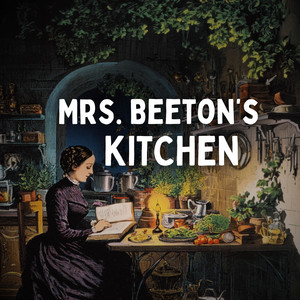
Now she heads towards the kitchen, the great laboratory of the household, as she once described it.
It's a large room, with magnolia walls and a stone floor.
Daylight pours in through the windows, brightening the cabinet on the opposite wall.
The surface is lined with a hodgepodge of items a pestle and mortar, jugs and containers and iron weighing scales with heavy brass weights.
The shelves above are also charmingly cluttered.
One shelf displays a row of copper pans.
Ascending in size, each one sparkles in the sunlight.
Another is home to decorative plates, blue and white porcelain with intricate designs.
On the other side of the room, there is a cast iron oven.
It sits beneath a mantle, which is covered with candlesticks and ornaments.
Firelight glows from the oven, emanating warmth that radiates through the room.
It's one of the reasons that Bella loves the kitchen.
It's the warmest and coziest room in the house.
At the center of the kitchen is a long oak table with various items left there by the maid.
There are bowls, pans, and kitchen utensils, along with a selection of food from the pantry.
And in the middle of the table is a copy of Bella's own work, Mrs Beaton's book of household management.
The novelty of seeing it has yet to wear off.
Her very own book, in a ruby red jacket.
She traces her finger around the title on its spine, noting the imprint of the golden letters.
It's a heavy hardback, more than a thousand pages thick.
To Bella, each page smells like hope and possibility.
Only she knew that it would still be in print over 150 years later.
How proud she would be.
Today, the book has solved in the millions.
Some historians credit Mrs. Beaton with shaping the identity of the British middle class.
Her writing offers insight into Victorian perspectives and focus on the home as the heart of the family.
Bella opens the cover, tingling with pride as she flicks through the pages.
Her fingers pause on a page of contents where a wealth of topics is neatly listed.
It begins with chapters for the mistress, housekeeper, and cook, with instructions for each role.
The mistress, for example, is given general advice on rising early and wearing comfortable clothes.
She's also taught the importance of being good-tempered and cheerful with servants as well as family.
To read such things, one might assume that the author's life has been relatively easy.
But sadly, this isn't the case.
Although she's young, Bella has already experienced hardship and loss.
This only makes it more remarkable that she found the strength of mind to write as she did.
She has never given up on the idea of family and is full of gratitude for all that she has.
And by sharing her guidance, she has helped many other women build happy, loving homes.
Her book is filled with practical information.
It's a how-to guide on running a household.
On one page, the reader can learn how to clean the oven.
Another page lists the wages for every type of servant.
One chapter covers legal matters such as tax and disputes, while another contains medical advice.
Some of the content might seem overblown or irrelevant today, but 19th century society was bound in rules and social etiquette.
One can only imagine how daunting it might have been to run a household without guidance.
Queen Victoria's Britain was much changed by the Industrial Revolution.
More families were socially mobile, resulting in the emergence of the middle class.
It became common for newlyweds to move to the suburbs, often away from their friends and families.
Women were expected to run the household without the support that they'd previously relied on.
With this in mind, it isn't surprising that Mrs. Beaton's input was so well received.
What a relief it must have been to have a book that seemed to answer every question.
How to set the table at each meal.
How to work the new fangled kitchen accessories. or the correct etiquette for calling cards.
And then there are the recipes, Bella's reason for consulting the book today.
Tonight's dinner will be a four-course affair, and every dish is taken from the book.
Now, Bella plans to prepare the starter and dessert, so they're ready for this evening.
She turns to the chapter on soups and stews, flicking through the pages until she finds the recipe she's looking for.
Soup is the starter for tonight's evening meal, as it commonly is in Victorian households.
Today, Bella will prepare the Mulligatawny.
It's a soup that originates from South Indian cuisine and was adopted by the British during the occupation of India.
The name Mulligatawny derives from words that might be translated as pepper water.
However, no pepper is included in Bella's recipe.
Her soup is made using meat stock from the previous day, as well as onions, apple and the whites and shells of eggs.
The soup is seasoned with lemon juice and a sprinkling of salt and that all-important curry powder that gives its flavor.
Bella enjoys cooking and baking.
It's her contribution to the family she loves.
And it's even more satisfying when she's following her own clear instructions.
Over 900 recipes are included in her book.
There are frugal soups and seasonal preserves, as well as vegetarian meals and dishes inspired by international cuisine.
There's a recipe for every occasion.
Most aren't authored by Bellah.
They've been sent to her by readers of the magazine or adapted from other books.
Ella has tried and tested the recipes over the years, sharing the best on the pages of this book.
Her real skill is less in the recipes and more in the way she's chosen to display them.
Bella perfected the kind of format that is now commonplace.
She lists ingredients first so that everything might be gathered before cooking.
Next, there are step-by-step instructions.
Everything is clear and easy to follow.
To us, it might seem strange that a recipe would be organized in any other way.
But before Mrs. Beaton, that was just the case.
Many cookbooks seemed nonsensical and disorganized.
A cook might find themselves halfway through a recipe before suddenly realizing that they're missing an ingredient.
Bella's recipes cover every detail.
She gives the length of time required for cooking, and the time needed to reheat later.
An average cost is provided for each meal, as well as the number of servings it's expected to yield.
She even mentions when the dish is seasonable.
Again, we can imagine what a relief it would be to a young housewife.
The information on these pages would support her immensely, not just in cooking, but also shopping and budgeting.
It's a matter of pride to the middle class wife.
Preparing meals that are both seasonal and and economical and equally the food must delight the taste buds so it's something the whole family can look forward to Bella rests the book open on the table and removes an apron from the back of the door.
It's a white pinafore with frills around the edge, hung around her neck and tied at the waist.
Over her hair she pulls a matching cap.
This completes the transition from Bella to Mrs Beaton.
She's ready to begin her work in the kitchen.
First, she turns her attention to the ingredients on the table and carefully slices the onion and apple.
These are placed into a deep pan with meat stock poured on top.
After that, She tips in the curry powder, mixed with some cold water.
She'll heat the soup for an hour and a half, then strain the ingredients through a sieve.
Once it's cooled, she'll add a sprinkling of eggshell and fold in a mixture of stiffly whipped egg whites.
Then, the soup will again be brought to a simmer, then cooled, strained, and reheated.
Lemon juice and salt are the final ingredients, though sometimes she adds rice or pieces of cooked chicken.
Victorian soups are generally very light.
They whet the appetite before heavier courses.
Now that the starter is prepared, Bella can move on to making her dessert.
It's her favorite course, both to make and eat.
She's not alone in Victorian Britain, where having a sweet tooth is increasingly common.
As sugar has become more affordable to many, supply and demand have skyrocketed.
During Queen Victoria's reign, sugar consumption will rise from about 15 pounds per person to 90 pounds each year.
Bella is more of a baker than a cook.
At school in Heidelberg.
As well as learning to play piano and becoming fluent in French and German, she gained skills in the art of pastry making.
She found it so enjoyable that she continued once she was back home.
She sought out lessons with a local confectioner, a man by the name of William Barnard.
He described himself as a fancy bread and biscuit maker and he helped the young Bella to develop her skills.
Dessert today is a frangipane tart with a beautiful base of shortcrust pastry.
Ella flicks through the book to the recipes for pastry, leaving it open on the relevant page.
Step one is to make the pastry.
This will form the base of the tart.
It's a recipe that Bella knows from memory, something she's made many times before.
She takes the weighing scales from the shelves behind her and sets them down onto the table.
As with the soup, the ingredients are already laid out.
There are just a few items to weigh and measure.
The heavy iron scales have a plate at one end and a brass bowl at the other.
Bella selects weights of three and five ounces and sets them down on the plate.
This side of the scale sinks down, while the bowl opposite rises upwards.
Bella scoops flour from a container and places it gradually into the bowl.
With each scoop, little white clouds rise up.
Eventually, the scales begin to rebalance.
Eight ounces of flour are ready to use.
This is poured slowly into a sieve and sifted gently above a large ceramic bowl.
Two ounces of butter and the same of lard are next to be added to the bowl.
Bella rubs them gently into the flour until the ingredients combine and thicken, forming golden clumps.
She washes her hands in the sink before cracking an egg on the side of a bowl.
She allows the egg white to fall in, holding the yolk in its shell.
Then she drops it into the pastry, the yolk bursting as it hits the bottom.
The orange oozes outwards, blending into the dough.
A sprinkling of salt is added next, followed by a teaspoon of baking powder.
Then, a little water is stirred in gradually with a wooden spoon.
Finally she's left with a stiff, golden pastry, and all that's left is to roll it into shape.
The table is wiped clean and coated with flour, and the dough set down.
It's then rolled out with a wooden rolling pin, forwards, backwards and side to side.
When it's the right thickness for the base of a tart, the pastry is lifted and laid across the tin.
Then, ever so carefully, Bella pats it down so that it fits the mold of the circular tin.
Once she's trimmed off the edges, the base is set aside and she turns her attention to the lovely sweet fillings.
Frangipane is a favorite of the Beatons, a sweet, luxurious custard filled with almonds.
Bella checks the ingredients and measures the flour, placing a quarter ounce into a bowl.
A quarter pint of milk is stirred with the flour, then the same measurement is poured into a saucepan.
The milk in the saucepan is mixed with lemon rind, a bay leaf and a pinch of fragrant nutmeg, then heated on the hob.
The scents rise as Bella stirs the pan.
They're the smells of home, of family and comfort.
Bella relishes this part of the process, when she can soak up the smells and the warmth of the oven.
She continues like this for around 15 minutes, occasionally humming as she stirs the liquid.
She shifts her weight from one foot to the other and sways to the rhythm of the tune that she hums.
When it's slightly cooled, Bella strains the liquid, collecting ingredients in the mesh of a sieve.
The milk is then poured into the bowl and blended lightly with the flour and milk mixture.
An ounce and a half of butter is melted in the pan, with an equal amount of sugar mixed in on the heat.
Four whisked eggs are poured in next and mixed continuously.
When it starts to resemble a thick, golden custard, Bella takes the pan back to the table.
A little almond essence is poured into the custard and blended with a splash of rum.
And that completes the frangipane filling, which is poured over the pastry.
Bella glows with pride and joy as she carries the tart to the oven.
It is placed inside, behind the cast iron door, where it will bake for half an hour.
Now, Bella fills the kettle with water and places it on the hob to be gently heated.
She clears surfaces and washes and tidies until steam rises from the spout of the kettle.
Then she places a sprinkling of tea leaves into a teapot of blue and white china and pours boiling water on top.
Bella takes the teapot and sets it down on a silver tray, along with a cup and saucer.
The smell of baking pastry has made her hungry, so she heads to the pantry for a plate of biscuits.
They're macaroons, made just yesterday and beautifully flavoured with almond and orange.
Bella carries the tray into the drawing room, an elegant space with large, bright windows.
She places it down on a stylish little table, taking a seat beside the roaring fireplace.
Bella pours the tea through the strainer and stirs it with milk and a spoonful of sugar.
Then she drinks, soothed and strengthened by the warm, sweet tea.
She nibbles on the biscuits, taking delicate little mouthfuls.
Always elegant, even when alone.
All the while, she gazes into the flames, watching them dance and listening to the crackle.
She looks forward to dinner in the company of her family and imagines their delight at the frangipane tart.
It's a thought that warms her, just like the flames.
Her heart is full of love and gratitude.
Soon the tart will be taken from the oven.
And Bella will resume her household duties.
But for now, she'll pour another cup of tea.
She can enjoy the comfort of this moment by the fire. knowing there's nowhere else she needs to be.
Her thoughts settle as her breathing begins to deepen and she sinks happily into the cushioning of her chair.
Thanks for watching!
Thanks for watching!
Thanks for watching!
Thank you.