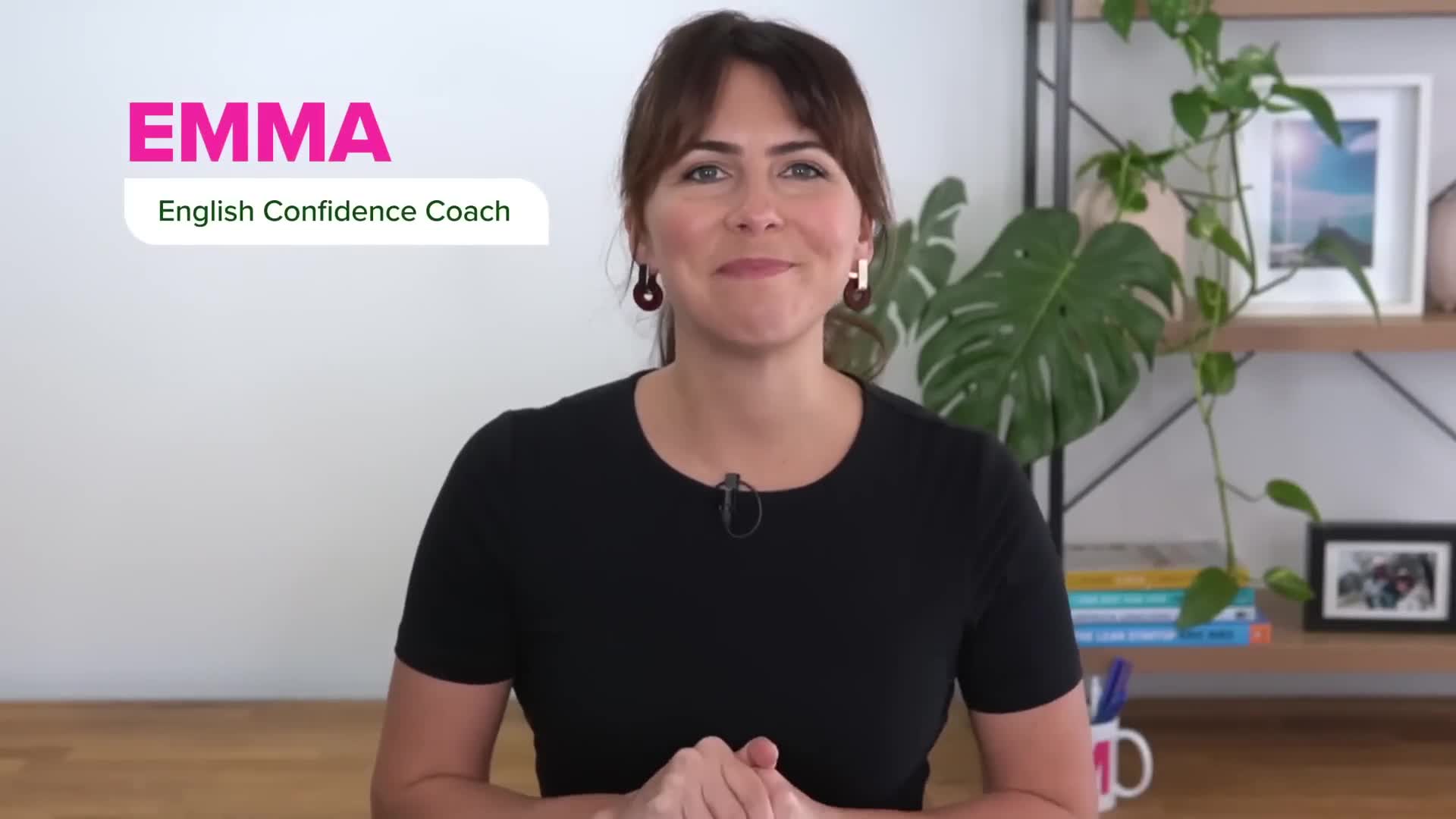
Well hey there I'm Emma from mmmEnglish!
These are some of the most common English words.
You see them in almost every English sentence, and today we're going to practise their natural pronunciation.
The way that they really sound when you hear them spoken out loud by native English speakers.
And, that and were are often not so clearly pronounced.
They usually sound like .
So getting familiar with these more natural pronunciations will help you to understand fast-talking native English speakers.
Plus, it's going to help you to sound more natural and relaxed as you speak in English too.
Let's dive into the lesson!
These words are all function words or grammatical words, so when they're spoken in English sentences, they are usually unstressed.
They don't carry a lot of meaning in our sentences and they are less important than other words.
Nouns, verbs, adjectives, these are important words.
These are the stressed words in our sentences, but these ones, these ones often get murmured or mumbled, or pushed together with other words.
Let's take a closer look at that one.
Actually, that can be stressed or unstressed in English sentences depending on how it's used.
So when that is a determiner, we use it to explain which specific thing we're talking about.
So then we usually stress the word so that it's really clear which one.
Oh no, not this one, that one.
It's really clear.
As an adverb, it will probably also be stressed.
I'm not that hungry.
But when that is used as a conjunction to connect two clauses in a sentence together, then it's unstressed.
So instead of that it becomes that.
So that vowel sound softens and it reduces to the schwa sound.
I told her that I'd be there.
It wasn't the answer that I wanted to hear.
That I wanted.
It wasn't the answer that I wanted to hear.
Be is definitely the most commonly used English word but it has several different forms, doesn't it?
Depending on the subject and the tense, it could be am is are, was or were and, just like the verbs do and have, The be verb can be used as a main verb as well as as an auxiliary verb.
I'll be home soon.
Be home.
Here, be is our main verb, isn't it?
Be home.
I'll be home soon.
In the present tenses be becomes, I am, we are, it is right, but they are usually pushed together to create contractions when spoken so we can say them more quickly.
I'm where it's in the past tense be becomes, i was and they were.
But when spoken quickly, those vowel sounds reduce, right down, was becomes, was.
I was upstairs earlier.
But compare that pronunciation to I was upstairs earlier where we're really trying to emphasise that that's the truth.
I was upstairs earlier.
No, you weren't.
You were in the yard.
I was upstairs.
I was putting the washing away.
And were becomes They were waiting for the train.
They were waiting for the train.
Let's take a closer look at this fabulous preposition, on.
Now if you watched my lesson last week, It's up there if you missed it.
If you watched it, you may remember me talking about an important pronunciation rule when you're listening to fast English.
That words starting with a vowel sound are often connected to the end of the word before it.
So on doesn't sound too different in its unstressed form, but it does often get pulled towards the word before it when spoken quickly.
Like in this sentence.
It's on my computer.
We'll take on a new mechanic in May.
Take on.
Take on.
We'll take on a new mechanic in May.
The same pronunciation rules apply for in.
To use this word and to sound natural.
While you do it, you need to focus on linking that vowel sound to the sound that comes before it.
Can you bring in the washing?
Bring in.
Can you bring in the washing?
I'll meet you in there.
You win.
There's an extra w linking sound between those two vowel sounds and it's a little bit of a trick.
This lesson up here will explain how it works but one last time.
I'll meet you in there.
Let's talk about these brilliant little words, our articles, a and an.
Most of the time when you hear them in English, they are unstressed.
Usually, if we want to stress that there is just one of something, we would say one instead of really emphasising a or an.
More often than not, you're going to hear a and an, a an.
The schwa sound is really important here.
Can we take a break?
Take a break.
It was an excellent day.
It was an excellent day.
Of course we need to include, and on our list of common English words it's used all the time, isn't it?
And becomes, and when it's unstressed and often the d at the end the d sound, we also drop that, so it sounds a lot like an.
I want you to listen to the stressed and unstressed forms in this sentence.
You and me.
You and me.
You and me.
Come and visit me.
Come and visit me.
It happens every now and again.
Now and again.
It happens every now and again.
Now to spelt like this is not usually stressed.
If you do hear to it's probably referring to this word or this word, both pronounced to.
So when to is unstressed what do you think it sounds like?
You're right, we need that schwa sound.
Very relaxed, very easygoing sound.
I want to go to the beach.
I want to go to the beach.
I want to go to the beach too.
It's quarter to two.
To two.
It's quarter to two.
Can is another extremely common English word that is often reduced when spoken quickly, so can becomes can.
I can do it.
I can do it. but compare the pronunciation to I can do it.
This is when we really want to emphasise that it's true.
I can do it.
I can compared to I can do it.
I can do it.
Not.
No, definitely not.
Not is an unusual one to include in this list because, as a general rule, we usually stress negative forms in English.
I am not hungry.
We really want to stress the meaning there, we want to emphasise it, but the word not is actually more often than not.
It's used and it's linked to a verb in an English sentence and it becomes a contracted form.
So I do not like it becomes.
I don't like it.
So not disappears in our sentence, it connects to another word.
Do not becomes don't.
Don't.
I don't like it.
I don't like it.
You can't believe it.
Cannot.
Can't.
Can't.
Now these contracted forms are extremely common in spoken English.
If you're not already using contractions in your spoken English, I suggest you start introducing them now.
You're going to sound so much more natural when you're speaking in English.
Let's practise a few common contractions together right now.
Can't isn't isn't wasn't wasn't don't don't won't won't weren't weren't Shouldn't Couldn't, Wouldn't.
Last, but definitely not least, is the
Now you won't really hear it pronounced like that very often, maybe only from your English teacher.
You will hear a shorter version and you'll also hear our favourite schwa, the.
So there are two unstressed forms of the pronunciation of the, and that change happens depending on the word that follows it.
So if the is followed by a word that starts with a consonant sound, then it's pronounced as the with the lazy schwa sound.
You left it in the car.
The car.
You left it in the car.
If the word the is followed by a vowel sound then it's pronounced slightly shorter as the.
How do we get to the airport?
The airport.
How do we get to the airport?
Yay!
You made it all the way through!
I'm super proud of you for sticking around.
If you want to keep studying how these reductions and natural English pronunciation works, then I really recommend you take a look at one of my imitation lessons.
You'll be able to see all of these words at work in my naturally spoken English.
And if you want to learn a little bit more about linking and how words sound when they're spoken together, naturally in English, definitely check out this playlist right here.
I know you'll love it and I'll see you in there!