This episode is brought to you by Rumchata, a delicious, creamy blend of horchata with rum.
It's best enjoyed over ice or in your coffee.
Rumchata, delivering vacation vibes anyway or anywhere you drink it.
Find out more at Rumchata.com.
Drink responsibly.
Caribbean rum with real dairy cream, natural and artificial flavors.
Alcohol 13.75% by volume.
27.5 proof.
Copyright 2025.
Agave Loco Brands.
Milwaukee, Wisconsin.
All rights reserved.
Happy monday listeners for scientific american science.
Quickly, i'm rachel feltman.
You're listening to our weekly science news roundup.
Let's kick things off with some climate news.
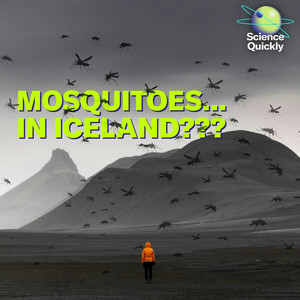
Back in 2016, an article in the New York Times referred to Iceland as a mosquito-free island paradise.
While nearby countries host mosquito populations during warmer times of the year, one of the going theories was that Iceland's propensity for harsh swings between thawing and freezing helped keep the bloodsuckers from getting a foothold.
But that same Times piece warned that this skeeter-free status could be in peril.
Temperatures were increasing in the land of fire and ice, and a local biologist told the news outlet that mosquitoes could get cozy there if the country kept heating up.
Now it seems like mosquitoes have made themselves at home in Iceland for the first time.
According to local news sources, an insect enthusiast got in touch with the Natural Science Institute of Iceland after finding three suspected mozzies out in the wild.
An expert confirmed that the bugs were indeed mosquitoes, marking the first time these insects have been found taking up residency on the island.
This development is a troubling reminder of rapid global warming's potential impacts on our planet, especially up in the Arctic.
One 2022 study in Nature reported that this region had warmed almost four times faster than the rest of the planet between 1979 and 2021.
Speaking of climate change, a study published late last month in Proceedings of the National Academy of Sciences USA suggests that Earth is getting darker and that this shift could speed up global warming.
The measure of how much sunlight our planet reflects back into space is called albedo, and this reflectivity has been decreasing for decades.
But according to the new study, the northern hemisphere is getting noticeably darker than its southern counterpart.
This could be creating something of a climate change feedback loop.
The northern hemisphere is experiencing more warming, and warmer air holds more water vapor, which tends to absorb solar radiation.
Meanwhile, melting ice and snow in the north means less white surfaces available to reflect sunlight back into space.
As the northern hemisphere gradually reflects less sunlight, it's expected to absorb more heat, which scientists think could then decrease its albedo even more.
You can read more about the potential implications of the darkening north on Scientific American's website.
Now let's move into some health stories.
After a summer lull, bird flu is back on the rise.
The surge aligns with the annual southern migration of wild birds, which creates opportunities for domestic flocks to mingle with infected outsiders and their droppings.
Since the beginning of September 2025, outbreaks have resulted in the deaths of nearly 7 million farmed birds across the country, according to data from the US Department of Agriculture.
That includes more than a million turkeys, The New York Times reported.
And according to Axios, wholesale turkey prices are roughly 40 percent above last year's rates.
At the same time, the Associated Press said last week that the ongoing government shutdown would force Centers for Disease Control and Prevention researchers to skip ID Week, a quote pivotal conference on infectious disease in Atlanta Georgia, where experts were expected to share findings on diseases like bird flu, HIV and more.
The shutdown is also impacting communication between state health agencies and federal entities such as the CDC and USDA, making it more difficult to track and respond to bird flu cases.
If you haven't already given it a listen, check out our recent miniseries on the history and future of bird flu.
The first episode aired on June 23rd.
Meanwhile, also at the intersection of agriculture and health, a study published last Thursday in the journal mBio suggests that our conversations about food safety might need to include urinary tract infections.
The researchers screened isolates of E coli, which is often the cause of UTIs.
For more than 5700 California patients with the infection.
The team then screened meat samples from retail sources located in the patients' neighborhoods in an attempt to determine which infections came from non-human animal sources.
Ultimately, the researchers linked 18 of the UTI cases they examined to E coli strains from animals, with chicken and turkey samples most likely to contain infection-causing bacteria.
People in low-income communities were also 60 more likely to contract a foodborne UTI than people in wealthier neighborhoods.
While the new study is localized and doesn't prove a causal link between contaminated meat and human infections, it's never a bad idea to up your food safety game.
Remember to thoroughly cook all of your meat and poultry, wash your hands and kitchen surfaces during and after food prep and avoid cross-contamination by keeping your raw animal proteins from dripping juices onto other food items.
Those precautions can help protect you from zoonotic viruses like bird flu too, in addition to, of course, lowering your risk of common foodborne illness symptoms like vomiting.
In other California health news earlier this month, the state's Department of Public Health announced three unrelated cases of Clade 1 mpox in residents who had not recently traveled abroad.
That suggests that Clade 1 is spreading locally, which is a first for the U.S.
The mpox virus has two distinct genetic lineages, clade 1 and clade 2.
Clade 2 has been circulating in the US at low levels in recent years, but cases of clade 1 have always been tied to international travel.
The news of suspected transmission in California is somewhat concerning because Clade 1 has historically had a higher mortality rate than Clade 2.
But some of the more recent data on this is mixed and it's not clear whether the potential circulation of Clade 1 in the US would result in more severe cases.
Mpux is mostly spread through close contact, including sex, and these new cases align with past Clade 2 surges that primarily hit communities of men who have sex with men, as well as transgender and non-binary individuals and people with HIV.
If you or any of your sexual partners fall into one of those categories and you're not vaccinated for MPOX yet, now is a great time to go get your first shot.
In some more positive health news.
A study published last week in Pediatrics found that peanuts lost their spot as the top allergen for kids under three in the US following a shift in parental guidance around the legume.
You can learn more about the changing science of peanut allergies and other food intolerances by listening to our August 22nd episode or by reading SIAM's recent feature article on the subject.
We'll wrap things up on a high note with some cautiously optimistic news about the North Atlantic right whale.
According to a report from the North Atlantic Right Well Consortium published last Tuesday, these critically endangered behemoths continued to show slow but steady population growth.
Scientists estimate that the whales' population now totals 384, which is eight higher than last year.
The number of North Atlantic right whales plummeted by roughly 25 between 2010 and 2020, according to the Associated Press.
The population decline is reportedly thanks to threats like boat collisions, fishing nets and decreased food on their migration path as a result of global warming.
While the whales still definitely need our protection, experts are pleased to see them moving in the right direction.
That's all for this week's Science News Roundup.
Tune in on Wednesday for a conversation about how the highly anticipated sale of TikTok's US operations could impact its infamously powerful algorithm and what a skew in 4U page content could mean for the country.
Science Quickly is produced by me, Rachel Feltman, along with Fonda Mwangi and Jeff DelVecchio.
This episode was edited by Alex Seguiera.
Shayna Posis and Aaron Shattuck fact-check our show.
Our theme music was composed by Dominic Smith.
Subscribe to Scientific American for more up to date and in-depth science news.
For Scientific American, this is Rachel Feltman.
Have a great week.
Thank you.