NPR.
This is The Indicator from Planet Money.
I'm Darian Woods.
I'm Waylon Wong.
And I'm Adrian Ma.
We take a little pride in having our econ nerd credentials.
And every once in a while we think, why not put these credentials to the test by having...
A little competition, a little friendly competition we like to call the Indicator Quiz Bowl.
Today on the show, it's a trivia matchup between our own Darian Woods.
Hello.
And Waylon Wong.
I'm shadowboxing.
You can't tell.
So the way this will work is I'll ask five questions.
Whoever gets the right answer will get a point for that.
And the winner will be the person with the most points at the end of the show.
Simple enough.
Today's Indicator Quiz Bowl topic will be the economics of the public sector, aka government economics.
Ooh, does Darian have an unfair advantage because he's worked in the public sector pre-NPR?
But in New Zealand, so does that transfer?
We'll find out.
Don't you also have a degree in public policy from an American university?
Nobody at the Olympics complains that the other person's been training too much.
All right.
Let's find out after the break.
This message comes from AT&T.
America's first network is also its fastest and most reliable.
Based on RootMetrics, United States Root Score Report 1H2025, tested with best commercially available smartphones on three national mobile networks across all available network types.
Your experiences may vary.
RootMetrics rankings are not an endorsement of AT&T.
When you compare, there's no comparison.
AT&T.
Support for NPR and the following message come from Edward Jones.
A rich life isn't always a straight line. unexpected turns can bring new possibilities.
With a hundred years of experience navigating ups and downs, Edward Jones can help guide you.
Let's find your rich together.
Edward Jones, member SIPC.
This message comes from Capital One with the VentureX card.
Earn unlimited double miles, a $300 annual Capital One travel credit, and access to airport lounges.
Capital One.
What's in your wallet?
Terms apply.
Details at CapitalOne.com.
Okay, Darian and Waylon, here is your first question.
Which economic concept describes the situation where individuals benefit from a public good without contributing to its costs, thus undermining incentives to pay for that good?
Freeride.
Oh, my gosh.
That is the correct answer.
Oh, man.
I'm relieved.
You were so fast, Darian.
My brain was like buffering, buffering, buffering.
You've got to talk to your internet service provider for that.
No, I have to talk to my brain because I'm going fast enough.
Freerider is the correct answer.
And you know, in a free market system you wouldn't necessarily expect private companies to take up certain services or goods because they could be susceptible to this free rider problem.
And that's why, for example, you have government stepping in and doing things like providing for the national defense.
Yeah, I mean it would be hard for I don't know a private military to go around every household asking for contributions.
Goodness.
I never answer my doorbell ever.
Okay, one point for Darian.
Next question.
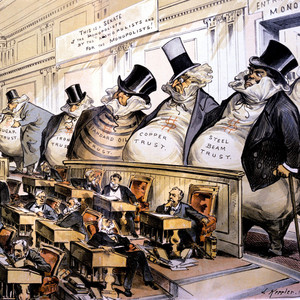
The Sherman Antitrust Act of 1890 is the foundation of antitrust policy in the United States.
What was the name of the company that was part of a landmark anti-monopoly case in the early 1900s?
Standard Oil.
Standard Oil.
Oh, gosh.
Got to give that to Darian again.
The answer was Standard Oil.
What if it was just the lag?
Maybe it was the lag.
Oh, my gosh.
Here's some trivia about Standard Oil.
It was officially declared an illegal monopoly in a landmark 1911 Supreme Court case called Standard Oil Company of New Jersey versus the US.
In that case, the court ruled that Standard Oil violated the Sherman Act by restraining trade and commerce in petroleum.
And it also established the, quote, rule of reason antitrust precedent, which still lives on today.
Is this covered on The Gilded Age?
I haven't watched that show.
That is going to be its own episode, I'm sure.
Oh, okay.
Spin-off.
Yeah.
Question number three.
What do you call a market intervention that levies a tax on a market transaction that creates a negative externality borne by individuals not directly involved in the transaction?
The Gilded Tax.
That is the correct answer.
Oh, my gosh.
You said it so fast I didn't even hear the answer.
Pigouvian tax.
Pigouvian tax.
Okay, I think that I would not have been able to come up with even with more time.
Then Dr. Arthur Cecil Pigou.
Cambridge Economist.
Okay, stop showing off.
I'm sorry.
I'm the most hated quiz contestant.
No, I love it, actually.
I love it.
That is three for three for Darian.
This is my revenge for the movie trivia episode where Waylander swept the floor.
So that is the correct answer.
Some examples of Pigouvian taxes include things like carbon taxes, taxes on tobacco—
Or the plastic bag tax at your local grocery store.
Send your complaints to Arthur Cecil Pigou in Cambridge about 100 years ago.
Yeah, I was going to say via psychic medium.
So does that mean I've won the majority of the five questions?
Well, Darian, I'm just here for the learning.
So if you just want to make it about points, I guess we can do that.
But I'd like to keep going.
All right.
Let's go for more education.
Yes, I think that sounds good.
Fair.
Darien is technically won a majority of the points, but there are other reasons to play trivia and not all of them are about points.
Some of them are trivia.
Some of it is about salvaging my dignity, if I can get one of these next two questions right.
Question number four.
What's the term for the built-in budget mechanism that can adjust federal spending and taxation during an economic downturn to keep the economy afloat without the need for additional legislation?
Automatic stabilizers.
That's correct.
Oh my gosh, and I did a whole episode on automatic stabilizers.
And I listened to that in my preparation.
Oh my gosh, Jerry.
I've been training for this my whole life.
Clearly.
Some government programs with automatic stabilizers include unemployment insurance, the Supplemental Nutrition Assistance Program, also known as SNAP, and also Medicaid.
So these benefits are boosted during times of recession where incomes fall, and the opposite happens when the economy is experiencing a boom.
Right.
Less people are on SNAP because more people are employed and there's less need.
And I had done this episode about how some economists want to have like national or statewide baby bonds programs that would also potentially kick in in, you know, fallower economic times.
Well, clearly on that reporting, didn't we have a lot of good here in this show?
If we just pretend the quiz starts now, anything could still happen.
Match point. for that one point.
All right.
I'm ready.
I'm ready.
Okay.
Final question.
Universal basic income is a policy often associated with the political left.
But free market economist Milton Friedman in the 1960s advocated for a more free market version of this.
That became influential among some, on both the left and the right.
So what was that alternative?
Negative income tax.
That is correct.
Oh, my goodness gracious.
I like this game.
So a negative income tax, as Milton Friedman envisioned it, would essentially have the government provide individuals below a certain income with money.
The structure he had in mind made it so people who work made more money than people who received just the negative income tax benefit.
And he also believed that this system would essentially replace all welfare programs in the US someday.
Oh, and actually the earned income tax credit is not too dissimilar.
It's different, but it's the same idea that when you earn below a certain amount of money, you will get some money from the government.
Okay.
Well, Darren gets a bonus point for extra learning.
Now the score is six to zero.
Wait, did you know the answer?
No, I don't.
I don't.
I think I would have needed like a little bit more time to think.
Darien has all these facts at his fingertips and I need to sit here and let the organ grinder monkey in my head fool around a little bit more.
I did know the standard oil one right away, but Darien was faster.
In any case, let's not take away Darien's well-earned win here.
Yes, yes, and let's not dwell on the past, shall we?
Darien Woods...
Five out of five on this Indicator Quiz Bowl.
That makes you the reigning champ for today.
Yeah, I want to thank all my economics and public policy tutors and my wonderful colleagues who've taught me a lot of what I know today.
I need to go back and listen to our back catalog more.
Listeners, I hope you enjoyed playing along.
Tell us how you did and what you think about the Indicator Quiz Bowl by sending us an email at Indicator at NPRorg.
Or if you're listening on Spotify, leave us a comment.
From the Indicator team, happy Thanksgiving.
We'll see you on Monday.
This episode was produced by Corey Bridges with engineering by Kweisi Lee.
It was fact-checked by Sierra Juarez.
Cake and Cannon edits the show and The Indicator is a production of NPR.
Message comes from Capital One.
Banking with Capital One helps you keep more money in your wallet with no fees or minimums on checking accounts.
What's in your wallet?
Terms apply.
See CapitalOne.com slash bank for details.
Capital One N.A., member FDIC.
Brian Reed here host of Question Everything from KCRW working on a bunch of new episodes coming out in September.
But if you, like me, are feeling perplexed by how journalism and truth are faring in this moment, please go catch up with the stories we've done.
This message comes from Capital One.
Banking with Capital One helps you keep more money in your wallet with no fees or minimums on checking accounts.
What's in your wallet?
Terms apply.
See CapitalOne.com slash bank for details.
Capital One N.A., member FDIC.