Welcome to English Listening Channel.
Hello everyone.
Today we're going to learn useful money vocabulary through a slow and easy English conversation.
In this video, you will follow a simple story between two co-workers, David and Aaron.
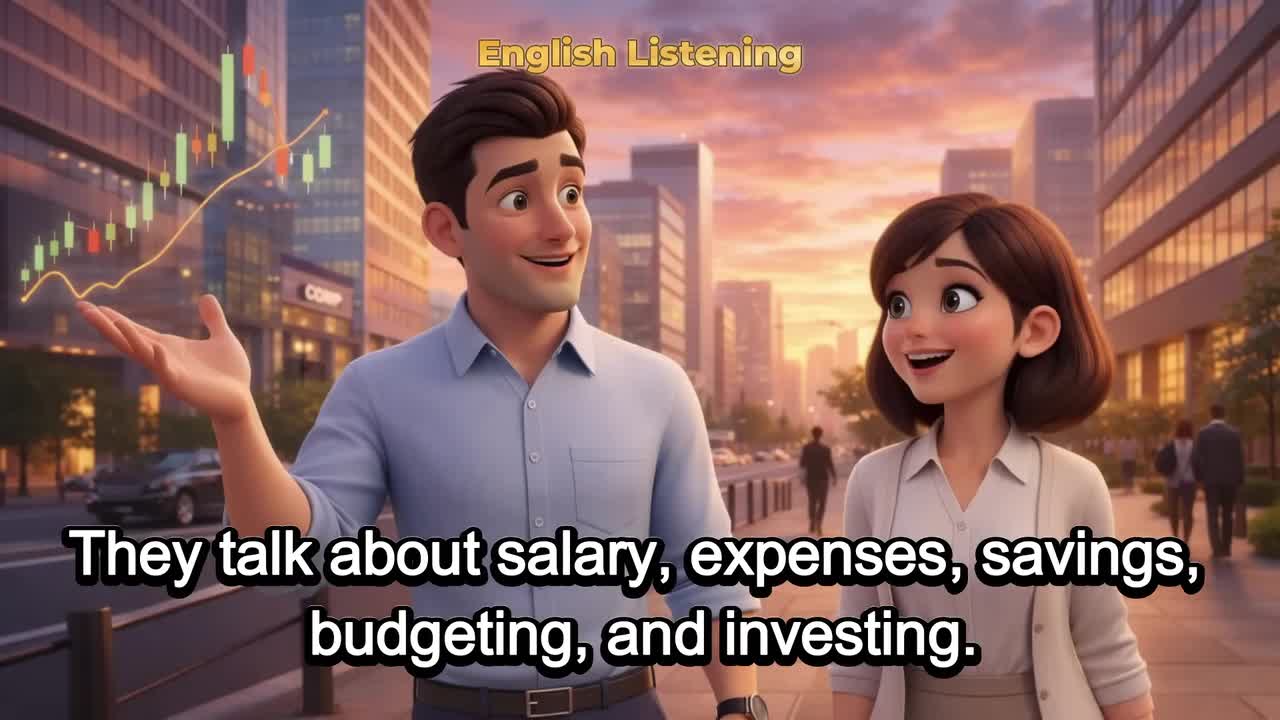
They talk about salary, expenses, savings, budgeting, and investing.
Don't worry, I will speak slowly and clearly, so please relax and enjoy the story.
Before we start, I have a small question for you.
Please listen carefully to find the answer.
So here is today's question.
What are Aaron's daily expenses?
The answer is in today's story, so please listen carefully until the end.
And when you find the answer, please write it in the comments in English.
Alright, are you ready?
Let's get started.
David, today is a great day.
Oh, really?
Why are you so happy today?
I got my paycheck today.
I finally have money.
Ah, payday.
Everyone loves payday.
I know how you feel.
Yes, I work hard every day, and now I have my money.
It feels so good.
That is right.
You earn money when you work.
Do you know the word earn?
Earn means I get money for my work, right?
Exactly.
Your company pays you a salary every month.
That is the money you earn from your job.
I love my salary.
Now I want to spend it right away.
What do you want to spend your money on?
I want to buy new clothes, and I want to go to a really nice cafe this weekend.
Maybe I will buy a new bag, too.
A new bag, too?
You really want to spend a lot.
Of course.
I worked hard for this money.
I know that feeling.
But Erin, be careful.
You should not spend all of your paycheck.
Why not?
I earned it.
It is my money.
I know, I know.
But there are many things you need to pay for every month.
Trust me.
Really?
Like what?
Let me explain.
How about we go to the cafe near the office?
I will tell you everything.
Okay, but you are paying for my coffee, right?
Fine, fine.
Let us go.
So, David, here is the thing.
Every month I get my salary, but the money goes away so fast.
I do not understand why.
I understand.
That happens to many people.
Do you know why your money goes away?
Not really.
I do not think I buy anything expensive.
Well, it is because of your expenses.
Expenses are things you need to pay for every month.
They are necessary.
Expenses?
Like what?
Can you give me some examples?
Sure.
The biggest one is usually rent.
Rent is the money you pay every month for your apartment.
Oh, yes.
My rent is so high.
A lot of my salary goes to rent.
And then there is food.
You eat breakfast, lunch and dinner every day.
That costs money.
That is true.
I eat out a lot, so I spend a lot on food.
Then there are bills.
You have a phone bill every month, right?
And an electricity bill.
Oh, yes.
I almost forgot about my bills.
I pay them, but I never really think about them.
And don't forget about transportation.
You take the train to work every day.
That's another expense you have every month.
Wow.
Rent, food, bills, and transportation.
There are so many things to pay for every month.
Yes.
So you see, first you get your salary, then you spend a lot of it on these necessary expenses.
That's normal.
So my money is not really disappearing.
It's going to rent, food, bills, and transportation.
Exactly.
Those are your daily expenses.
Now, the important question is this.
What do you do with the money you have left after paying your expenses?
Hmm.
Honestly, I usually spend it all on shopping and eating out.
I see.
Well, that's something we should change.
Why?
What should I do with it?
You should save some of that money.
Save you mean keep the money and not spend it.
Yes, exactly every month i save a little bit of money.
I put it in my bank account and i do not touch it.
But why do you do that?
Why not just enjoy your money now, Because the future is not always easy.
Sometimes bad things happen and you need money.
Bad things?
Like what?
Like an emergency.
What if you get sick?
You might need a lot of money for the hospital.
That is an emergency.
Oh, I did not think about that.
That could really happen.
And hospitals are not cheap.
Exactly.
Or what if something breaks in your apartment, like your washing machine or your air conditioner?
You need money to fix it.
That has happened to me before.
It was expensive.
Yes.
And what if you lose your job suddenly?
You will need money to pay your rent and buy food while you look for a new job.
That is really scary to think about.
It does not have to be scary, not if you have savings.
Savings is money you have saved over time.
It can help protect you savings.
So if i save a little money every month, that money becomes my savings.
Yes, that is right, and you keep your savings in the bank.
It is safe there, I see.
I want to start saving.
I want to have savings for my future and for emergencies.
That is a wonderful idea, Erin.
But to save well, you need a plan.
A plan?
What kind of plan?
A plan for your money.
We call it a budget.
A budget?
That sounds really difficult and complicated.
No, it is not.
It is actually very simple.
A budget is just a plan for how you use your money each month.
Okay, tell me more.
How do I make a budget?
First, you look at your income.
Income is the total money you receive.
For us, our salary is our main income.
Okay, so I start with my income.
I know how much my salary is.
Good.
Then you think about what you need to spend.
Rent, food, bills, transportation.
These are your necessary expenses.
You cannot avoid them.
Right.
Income first, then my necessary expenses.
And then the most important part of a budget.
After you pay your expenses, you save some of the money you have left.
Even a small amount is okay.
So let me understand.
I get my income, I pay my expenses, and then I save some of what is left.
Yes, that is your budget.
Income, then spend on what you need, then save.
If you follow this simple plan every month, you will be in a much better place.
That does not sound so hard.
I think I can really do this.
You can definitely do it.
Just start small.
Even saving a little bit every month is much better than saving nothing.
Okay.
I will make my budget tonight after work.
Good for you.
Now, there is one more thing I want to tell you about money.
Really?
What is it?
Let's walk back to the office.
I'll tell you on the way.
So, David, you said there is something else about money.
Is saving enough?
Is that all I need to do?
Saving is very important.
You should always save, but some people also invest their money.
Invest?
I have heard that word before, but I do not really know what it means.
When you invest, you use your money to try to make more money.
You try to grow your money over time.
Grow my money.
That sounds really amazing.
How does that work?
Well, one common way is the stock market.
In the stock market, you can buy a small piece of a company.
Wait, i can buy a piece of a company like a real company.
Yes, a real company.
For example, you can buy a small piece of a big company.
If that company does well and makes more money, your piece becomes more valuable.
Your money grows.
So, if the company makes money, my money grows too?
Yes, sometimes.
That is called an investment.
The money you put in is your investment.
So people invest their money in the stock market and then they wait for it to grow.
That is one way.
Yes, many people around the world invest in the stock market investment.
That is so exciting.
I want to invest all my money right now.
Wait wait wait, not so fast.
There is something very important you need to understand first.
Oh, what is it?
Come, let us go inside.
I will explain at the office.
Okay, so here is the important thing.
Investing has risk.
Risk?
What do you mean by risk?
Risk means you can lose money.
When you invest, your money can grow, but it can also go down.
You might get less money back than you put in.
Lose money?
That is scary.
So my money is not safe when I invest?
Not always.
Sometimes a company does badly and the value goes down.
Then you lose some of your money.
So what should I do then?
Maybe I should not invest at all?
No, I am not saying that.
Investing can be very good for your future, but you need to be smart about it.
Okay, so how can I be smart about investing?
There's a few simple rules.
First, never invest all of your money.
That is very dangerous.
Always keep your emergency savings safe in the bank.
Okay, so I save my emergency money first.
That money stays in the bank.
Exactly.
That is the most important rule.
And second, you should think about the long term.
The long term means many years in the future, not just a few weeks or months.
I see.
So I should think about the long term and not expect to become rich quickly.
Right.
People who invest for the long term and are patient usually do much better than people who try to make quick money.
I understand.
So the steps are clear.
First, I save my emergency money and keep it safe.
Then I can invest a little bit, and I always think about the long term.
You understand perfectly.
And always remember this one thing.
Never invest money that you cannot afford to lose.
Never invest money I cannot afford to lose.
That is a really important lesson.
Thank you, David.
Thank you so much for everything today.
I feel like I learned so many important things about money.
You are welcome, Aaron.
I am happy to help.
So tell me, what did you learn today?
Okay, let me think.
First, our company pays us a salary.
That is how we earn money from our job.
That is right.
Good.
And then what happens?
Then we spend money on things we need every day, like rent, food, bills, and transportation.
Those are our expenses.
Very good.
And what is the next important step after expenses?
We save money.
We should save some of our money every month and keep it in the bank.
That gives us savings for the future.
Excellent.
And why do we save money?
For the future and for emergencies, like getting sick or losing our job.
If we have savings, we do not need to worry so much.
Perfect.
And what about investing?
What did you learn about that?
We can invest money to try to grow it, like in the stock market.
But here's the important part.
Investing has risk.
We can lose money.
And what should you do before you start investing?
First, I save my emergency money and keep it safe in the bank.
Then, I invest only a little bit, and I always think about the long term.
I should never invest money I cannot afford to lose.
You remembered everything.
I am impressed.
Well, you are a very good teacher, David.
That is perfect, Aaron.
You really learned everything today.
Earn, spend wisely, save, and invest carefully.
Those are the basics of money.
I feel so much better about money now.
I'm going to start saving from this month.
No more spending everything.
That is wonderful.
I'm proud of you.
Good luck, Aaron.
Thank you so much, David.
See you tomorrow at work.
You tomorrow.
Oh and aaron, remember to not spend your whole paycheck on that new bag tonight.
I will not.
I promise i'm going to save.
How was it?
I hope you enjoyed today's video and learned some useful english money vocabulary.
Today We heard words like salary expenses savings budget, investment and risk.
These are all important words to know in daily life.
And now, here is today's question again.
What are Aaron's daily expenses?
If you know the answer, please write it in the comments in English.
Also, if you enjoy our videos and would like to support this channel, please check out our membership.
Thank you so much for watching.
See you in the next video.
Bye you