We often think that to reach financial freedom, you need to earn more.
Earning money doesn't actually make you better with money.
It's about how you manage what you make.
What does the top 1% understand about money that most of us don't?
The single easiest way to get rich long-term is by Hey everyone, welcome back to On Purpose.
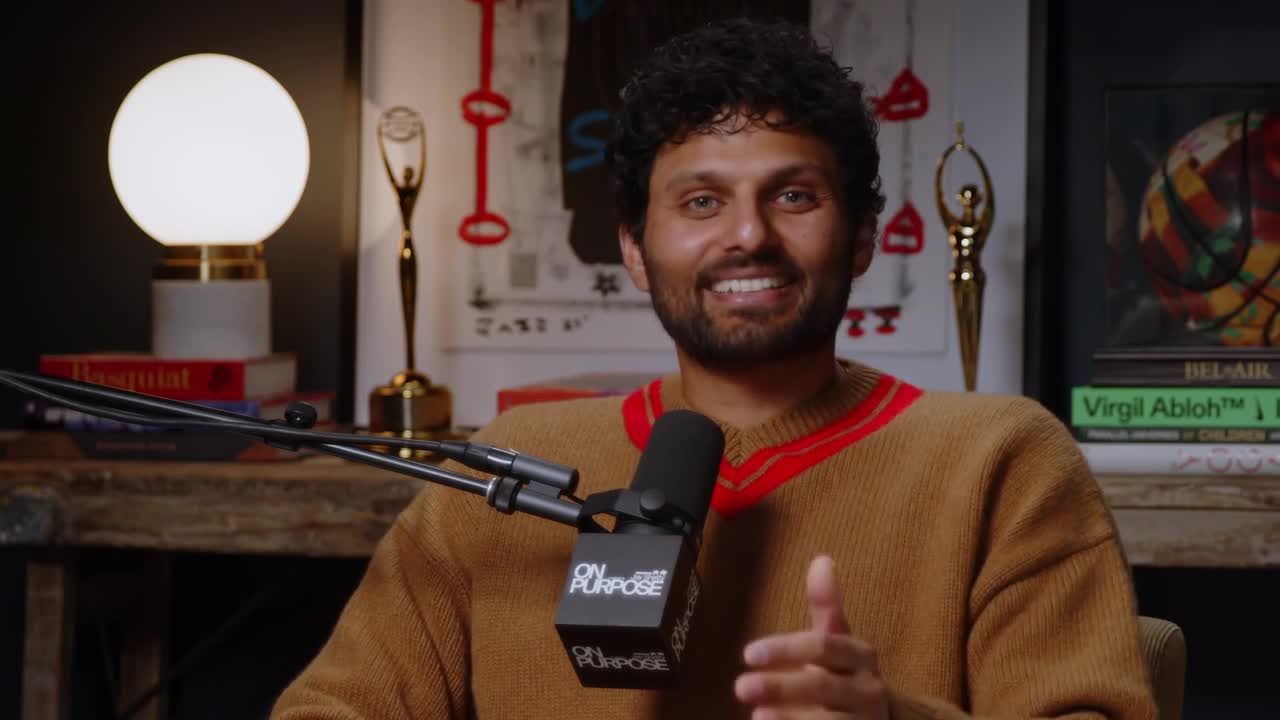
Today I'm sitting down with Nisha Shah, former investment banker and accountant, who left the traditional path to help millions rethink money, success and freedom.
Nisha breaks down how to stop letting money anxiety run your life.
Nisha is a dear friend and I love welcoming friends to On Purpose.
Please welcome Nisha Shah.
Nisha, it's great to have you here.
Thank you so much for having me.
I was so excited.
I wanna talk to you about this transition you went through.
We know a lot of the same people.
For me, going to a good university, getting a good job was like the pinnacle.
You did that.
Yeah.
You achieved that.
Why would you leave behind a great job with a great salary?
There's so much more to life than following the traditional path where you get a job qualify, keep going, climbing up the corporate ladder.
And there was a point in my life where I felt like I had to really look inwards and ask myself what am I actually doing?
For a good part of it, I was really enjoying the banking lifestyle.
There was glitz and glam to it.
There was business trips.
There was a status.
And for a while, I convinced myself that this is what I want.
This is the life I want to live.
And then, as I went on, I felt like there was a massive disconnect between what I wanted to do and what I was doing.
And I felt as I kept going, that misalignment kept getting louder and louder and louder.
I had to go through quite a dark phase to understand that this isn't what I wanted.
And it was at that point where I had to look inwards and ask myself the difficult questions like am I living a life that I actually want or one that everyone else expects me to live?
Yeah, am i buying things that i want to buy for myself or what i want to show other people that i have?
The question that really, really changed everything for me was would i still be happy if i was living the same life in five years or ten years time as i am today?
The fear of that was so much greater than the fear of anything that i had to do, and it gave me the confidence to say no, i'm walking away.
I'm walking away from this job, i'm walking away from this lifestyle, i'm walking from this identity because there's so much more out there for me and i had a bigger why that overtook anything that that moment had in store for me.
I feel like there's probably a lot of people listening right now who are thinking the exact same thing.
They've got the traditional degree that they were expected to do, they've got the job.
Maybe they're five years in, ten years in, and they're thinking i'm not in the right place, but you've got all this sunk cost bias, this idea that I spent all those years studying for that.
All my friends thought this is what I was going to do.
Maybe I've even got a partner.
Maybe I've got children.
This isn't the right time to rock the boat.
Talk to me about the bias that we have of, I've invested so much time and money into this.
Everyone in my life understands this.
How could I possibly dream about doing anything different?
I mean, it's the hardest thing to do, living life because of what everyone else has told you to do.
But if you don't have the courage to write your own story, someone else will always write it for you.
And I think what most people think of as bravery or courage or doing something new and leaving behind what you've created is actually just having a financial cushion in place and having the safety to be able to walk away from situations you might not like or environments that you might not enjoy.
But we put a lot of pressure on ourselves today that we have to do all or nothing.
We've got to quit our job and follow our passion.
So for someone in that situation or that position, i would say a get your financial cushion in place, because that gives you more peace of mind and sanity than anything else that you could possibly think of.
The second thing i'd say is that when i was in banking, there was a lot of comfort that came from having a salary which let me have a lot of tiny experiments on the side.
So it was my evenings, my weekends, i just spent trialing and testing and doing loads and loads of different things, and when you do it that way, you actually look at your job and think oh, i'm so grateful that i've got this salary coming in that lets me do all these things on the side without thinking i've just got to somehow figure out a way to pay my bills, and it makes everything just a lot less enjoyable.
I fully agree with you.
I that was the same path for me.
I was working my day job and then doing this on the evenings and weekends.
I at the time making videos, and i don't think i would have been as creative if i had been financially crippled now.
I wasn't making that much money, but i was making enough to pay my bills and take care of things, and I was having to edit my videos because I couldn't afford to outsource it to someone.
I was having a friend do me a favor by shooting my videos because I couldn't afford one.
But the idea was I wasn't creatively starved because I wasn't scared that every video had to make money.
And I think people put themselves into these positions where you take this big leap and now the dream has to pay the bills.
And now the dream doesn't feel like a dream anymore.
It feels like pressure, absolutely.
It turns into a chore when you don't have that money coming in, and so i always like to think of different things that you're doing that serve different purposes, and sometimes your job just serves the purpose of paying your financial life, and then a passion project can be the purpose of your creativity or whatever without, like you said, feeling like oh, how am i gonna?
Or going into survival mode.
Is there a good way to calculate what a financial cushion should be for someone?
Typically, you'd recommend three to six months of your living expenses.
So you calculate what it costs for your basic living expenses in a month and you times it by three if you're feeling a bit comfortable with a lower cushion, or six if you want to be a bit more safe.
I went all the way for the nine months because I'm super, super calculative.
But it really comes down to what makes you feel comfortable, what makes you feel like you can walk away from this and be like I've got a good financial runway ahead of me.
Yeah.
Yeah.
That's smart.
That makes a lot of sense.
What was the cost?
What were the things that were sacrificed in switching away from the life you thought you'd lead?
I'd say the biggest thing that I sacrificed at that moment in time was this identity that I'd built around myself.
And when you don't spend time to look inwards, you find a way to have external noises define who you are and what you do.
And without knowing, for the good part of nine years, which is how long my banking career was My identity was around what I did for a living, knowing that when I walk into this other path, all of that is going to be stripped away from me.
All of what I thought defined my worth had to vanish.
So you find a way to get that fulfillment and that validation from within you, or you find something that is so much bigger than what has defined you up until that moment in time.
That's such a great point, because that is the biggest thing you're giving up is what you've defined your identity to be.
I didn't get to the point where it was complete like breaking point, but I did see that the ladder that I was climbing was leaning up against the wrong wall.
And that's when I thought okay, I could either keep walking, but it's just not a situation I want to be.
So in that sense it was yeah, it was great that it wasn't complete breaking point, but it was very near.
I really wanted to understand that.
I wanted our audience to really understand, because I do think that the majority of people are in that position.
And I love this few takeaways that we've already had, which is you don't have to quit your job.
You can build something on the side.
You don't have to go all or nothing.
And it is okay.
You do deserve to ask the question, do I want more?
Do I want to be more aligned?
Do I deserve a better life?
Can I leave this behind?
I think sometimes people don't feel worthy to ask that question.
They feel like they don't deserve it.
Talk to me about the biggest money mistakes people make in their 20s avoiding looking at their finances.
That is the number one thing that sets people back.
It's very easy to do, to just ignore it.
And because it makes you feel a bit uncomfortable sometimes looking at your finances.
I mean there's a psychological bias called the ostrich effect, where we actively avoid information that makes us feel uncomfortable, in the hope that if you ignore it, it sometimes disappears.
And it's the reason why you don't check your bank account after a weekend of spending, don't check your credit card statement because you're scared of the damage and what it will do.
But in your 20s you are creating the habits that will either, over time, compound for you or compound against you.
The stakes aren't that high.
So you want to be able to learn and learn the small habits early.
Look at your finances, all the small gaps that are happening, and solve them or improve them, before it compounds against you.
Why do people avoid looking at their bank account?
Because it almost shows them sometimes what their priorities are and what their focus is.
And that might be completely out of alignment of what their core values actually are.
And they might impulse purchase, or they might buy things that they didn't actually think of at the time.
And then looking at it and seeing actually, these are all the things that I've bought, but all of the things I wanted to do for myself, for my future self, have taken the back seat.
So I think that's a big part of it.
Yeah, i even i saw this study years ago which talked about how money has changed.
So, for example before, when you paid for something, you took cash out of your personal wallet and gave it to someone, so you actually had to count how many dollars, how many cents, how many pounds, wherever you live, right and you had to count and you'd be like, oh my gosh, this is a lot of money.
It's a hundred dollars, it's fifty dollars, whatever it is.
Then we had cards, and so now you can't see money anymore, And so it's so much easier to tap your card and put your card into a machine than it is to actually count the dollars.
And now you just do an online transaction.
So you don't have to give anything.
You literally just type in a code or press buy and you click or whatever it may be.
And the next thing you know, it's already there.
And so spending money has become so much more easier.
And so I get why people are scared, because it's like you've gone from having to count to having to give, to having to click.
Absolutely.
And now you don't even have to think about it.
Yeah, you can literally buy a car from your phone at 2am in the morning and not speak to anyone in the process.
And so it requires effort.
It's friction.
And so the uncomfortable thing to do is create friction between you and a purchase.
But that's the hard thing.
It's hard to wait 48 hours before you make an impulse purchase and then decide if you actually want that thing or not.
Yeah, it's hard to say no to an instagram ad that pops up multiple times and decide you don't want to buy that thing.
This is the hard, hard things.
To do that more more.
It's more important now than ever, like you said, because everything is so frictionless, and would you argue that is it a willpower issue or do you believe if we looked at our finances, we'd make better decisions automatically?
Definitely think it's an accommodation, but one of it comes down to willpower and being able to say no to things at the time.
The world at the moment it's built in a way to take your money for you to spend.
That's how the economy runs, so a lot of it is requires you to have the willpower, but a good way to stop that is actually looking at your finances, spending 20 minutes at the end of the month, looking through what you spent and saying okay, do these purchases line up with what i wanted?
Did they bring me happiness?
Did they actually improve my life in any way, shape or form, and then deciding do you want to continue that habit in the next month, in the next month, or are you going to start making some changes?
If someone listens to this podcast and they go okay nisha, i'm going to start looking at my finances for 20 minutes at the end of the month.
Is that the right time to do it?
Yeah, what is the plan?
Talk to me through a really simple 20 minute plan yeah, of what someone should look at when they're checking their finances.
I would say there's probably two types of people.
And one type is they absolutely do not want to look at their finances.
The idea of budgeting or looking at the numbers just makes their skin crawl.
They've tried to romanticize it.
They've tried to do it with a glass of wine.
They tried to do it with a girlfriend and it just hasn't worked.
For them.
I would actually recommend taking a step back, zooming out and thinking about what's the objective of looking at your finances.
Why do you wanna budget or look at your finances?
And the main objective is so that you save a portion every single month.
I would recommend, if you fall into this back of a napkin approach, take your take-home pay, minus an amount that you wanna save every single month.
Start with whatever you feel comfortable with, whether it's 50, we're in the States 50 100, whatever it is.
That's your saving.
Put that away, don't touch that.
The rest you could spend.
Important thing to do here is, with that amount, as soon as your money comes in on payday, set up an automatic transfer so it's out of your bank account into a separate bank account that you cannot even touch.
If you hate numbers, if you hate looking at your finances, if you don't want to look at your bank statement, do that.
And then as the months go on, you could try and tweak that saving amount.
If you are someone who's like you know what.
I want to look at my bank statements.
I want to look at my numbers.
I want to understand this a bit better then I would recommend a less restrictive way of looking at your finances that makes you feel like taking control is a way to say yes rather than saying no to buying stuff.
And so I recommend if you fall into the bucket where you're like okay, I want to optimize my finances looking at your take-home pay once again this is a number on your payslip, not on your job description and splitting that take-home pay into three buckets.
These are three numbers that everyone should know.
The first would be your fundamentals.
These are your must-haves in life.
The things that you need for day-to-day living, mortgage or rent, groceries, car payments.
That's your first bucket.
The second bucket is your fun bucket.
So these are leisure, travel, manicure, pedicure, spa, massages, all of that.
That falls into the fun bucket.
And then the final bucket is the future you bucket.
So this is anything for you tomorrow.
Savings, investments, even extra debt payments.
When it comes to your spending.
Allocate a percentage of your spending to each of those three buckets.
One that I recommend is around 65 for your fundamentals, 25 for your fun, and then 10 for your future you.
So that's what you want to look at when you look at your bank statements.
The first thing is, are you saving enough?
That's the first category.
And then you want to look for patterns in your other spending.
What am I consistently spending on?
What can I cut out?
And if you're looking at your items line item by line item, ask yourself three questions.
Do I need it?
If I do need it, can I live with less of it?
Or can I get the same thing for cheaper?
Say those three again.
Do I need it?
Can I live with less of it?
Or can I get the same thing for cheaper?
Those are great questions.
That's that perfect break between about to click and buy and actually create some space in your mind.
Yeah, because as soon as you say those three, I'm like yeah, it makes you question whether you want to buy that thing or not.
Yeah absolutely, absolutely.
And I love your breakdown because one of my favorite quotes is from Warren Buffett, where he said don't save what is left after spending.
Spend what is left after saving.
Yeah, And that's exactly what you've just shared with us, which is, you have to put aside your saving first.
And I think most of us just spend and then see what we have left at the end of the month and then put it away.
And of course, that never grows up.
I think one of the biggest things Nisha is when it comes to finances, And I know I was like this.
Honestly, I used to feel like you had to wait for a big payday to make money and save money and invest money.
And until you got that, it didn't really matter.
Like you're not really gonna do, you're not really gonna save that much and little amounts.
What are they gonna do anyway?
What are the micro habits that actually make us rich?
Because i think we think it's these big things that happen, like getting a promotion, somehow selling an amazing company or like you know, all these things that you see online that you think are going to make you rich but what are actually the micro habits that make people rich?
A couple of weeks ago, I was in a hotel lobby and this lady came up to me.
She was super sweet.
She said, I watch your videos and I've been wanting to invest, but I need to know a little bit more.
I just need to learn more about it.
And as we got speaking, I realized that she knew what she wanted to invest in.
She was following the recommendations that everyone says online, the S&P 500.
She knew how much she wanted to invest.
She even had an investment app downloaded on her phone.
And she hadn't turned that knowledge into action yet, for whatever reason.
And we were standing there.
We were both waiting for our taxis.
And so I just said, OK, why don't you just do it right now?
Why don't you just invest right now?
You know what you want.
You know what you want to do.
We could do it together.
So she did it.
She got her phone out.
She bought what she wanted to buy.
And within three minutes, she had invested.
And it was like this thing that she built up in her head for so long this analysis paralysis, this fear.
It just collapsed the moment she actually took action.
And that is one of the micro habits that actually put people so far ahead taking what you've learned and turning it into action.
Because so often we just learn for the sake of learning and we don't actually do anything with it.
So that is one of the main things.
Every time you learn something new about personal finance, action it that day and then refine it as you're going.
It might not be the thing that works for you, but it might.
But as long as you keep moving and keep implementing your own life.
That's what makes someone who's sitting in the backseat and doing nothing from someone who's actually taking the driver's seat and carving the way for their life.
And another habit I would say is they create goals but have concrete plans to follow up with those goals.
So how often do we say, I want to save more or I want to invest more?
All the time. or I want to reach financial freedom, right?
We say it all the time, but one of the habits that people could get into the mindset of is following that up with the really, really concrete steps.
So instead of saying, I want to save more, it'll be, I want to save 5,000 over the next 12 months.
That's just over 400 a month.
And to do that, I'm going to do X, Y, Z. I'm going to cut my subscription stack.
I'm going to negotiate this bill and I'm going to automate my savings.
That's a completely different situation now.
Absolutely.
Yeah, that's huge.
Huge.
You've now got a clear goal and a path to get there.
The people who are good with money and not good with money or bad with money.
It's not about different goals.
It's just the follow through plan of those goals.
Celebrate your unique story with Pandora Jewelry, crafted with meaning and exquisite artistry.
I've learned that the most meaningful gifts aren't just beautiful, they carry a memory.
When I think about gifting jewelry, I think about the women who've shaped my life.
For Radhi, it might be a simple engraving that reminds her of who she is, even on the days she forgets.
For my mom, it could be a charm that honors everything she's given without ever asking for anything back.
From sparkling lab-grown diamonds to personalized engravings and heartfelt charms, Pandora offers endless ways to express what's in your heart.
Each piece feels intentional.
Rings, bracelets and necklaces.
You can mix match, stack and style, not just for how they look, but for what they represent.
I love that Pandora lets you tell a story through the details.
A word, a date, a symbol that means everything to you and nothing to anyone else.
Think about who you'd gift Pandora to and what you'd want them to feel every time they wear it.
Every day is a chance to be love.
Let Pandora Jewelry remind you that love starts with you.
Shop in-store or online at pandora.net.
You're right.
We do throw out these goals all the time.
Like, I wish I had more money.
I want to save up for this.
But you haven't really broken down what it looks like.
And like you said, it could be as simple as the automatic savings, cutting your subscriptions.
Talk to me about how much does having a coffee every day actually negatively impact your bank account.
If you're really, really really feeling like you're living paycheck to paycheck and you actually have cut everything out except for coffee, then maybe you wanna look at the coffee bill.
But actually, it's a lot more about alignment when it comes to spending and intentional spending.
Because what you want to do is you want to look at the things that bring you joy or bring you happiness, and then deciding for yourself whether that's worth keeping or worth cutting out on.
So I wouldn't say, oh, take out those coffees and instead invest that money.
It's just looking at every single decision or every single pound or dollar that comes into your life and asking yourself what do I want the purpose of this pound or dollar to be?
Because if you don't define its purpose, it will end up defining yours.
So just be more conscious and more intentional with how you're spending rather than cutting things, because that's what everyone else online is telling you to do.
What happens to someone who says i'm going to save up one month, three months, for a bag?
How do we improve our willpower towards the expensive things that make us happy?
Yeah, so for someone who's like, i do want that pair of shoes, i do want that bag, i do whatever it may be for anyone you can afford it, but can you really like?
Is it really creating a better life for you?
Are you more financially safe?
How do you control your willpower when it feels so addictive?
It's a lot easier to spend on things when you know that the future you is being taken care of.
And when you know that okay, the first thing I'm doing is saving a portion and that money is compounding for the future me, you feel a lot more happier to spend on whatever it is in that moment in time that will make you happy.
And I do encourage everyone to have a look at their life, their goals, and decide is this bringing me closer towards my life goals or taking me further away from them?
Do you need a six-figure salary to achieve financial freedom?
This is such a common misconception.
We often think that to be better with money, to reach financial freedom, you need to earn more.
Whilst that is great, earning money doesn't actually make you better with money.
And it's not actually about how much you make, it's about how you manage what you make.
So someone on 100000 who is spending 100000 is actually worse off than someone who's on 50000 and saving 10 of it.
So if you want to reach financial freedom, you got to be saving and investing a portion every single month.
And then really what the market rewards is time and consistency.
So even small contributions today, leaving it for the future, leaving it for 10, 20 years, can massively compound over time.
And it's such an unfair advantage that people don't make the most of using the money that you have right now and using leverage to let it multiply in a way that doesn't require you to keep working and trading your time for money.
Yeah, I love what you said about the habits, because it feels like that's what it really comes down to, where just because you earn more money doesn't mean you're better with money.
And I think that's what happens is that you can go from making 50k and even if you went to make 250k, if you are used to spending everything you had at 50, you do the same.
And that's so fascinating that we ultimately just have more to do the same thing with.
And so we've got to sort these habits out early.
It feels like yeah, and and it's hard right, because i feel like money mindset's built from families, it's built through trauma, it's built through our relationship with money over the years.
Like it's not easy, like i grew up in a house where we always had just enough, And so I grew up with zero in my bank balance, often growing up.
And I started working when I was 14.
I delivered newspapers.
I then worked at Morrison's, which is a grocery store in the area.
I then worked in retail.
Like I basically worked every year since I was 14 years old.
But even when I was working, I was paying for my phone bill and I remember paying for my car insurance and all the rest of it.
I would end up with zero in my bank balance a lot because that's what I was always trained to have.
Yeah.
And so it took me years of like changing my relationship with money, to actually understand what to do with it.
And it was almost like an emotional relationship, more than even a.
It was definitely a tactical, practical relationship, but there was also an emotional relationship I needed to work on.
Do you touch on that in your work at the moment?
Yeah, I do.
And you know what?
It's so much easier, no matter where you are in your financial journey.
It is actually so much easier to feel behind financially than it is to feel ahead financially.
And a big part of that is because we compare how we're doing not based on how much we have, but how much we have compared to those around us.
There's research on this.
There's research that shows that two people could earn the exact same income and report different levels of satisfaction purely based on whether the people around them are earning more than them or less than them.
So you could be on 50 000 and you would feel and could feel happy about your finances if everyone around you is earning 45 000, or feel less happy about it if everyone around you is only 55 000.
That's wild.
Yeah, we measure our success based on We're humans, we're social creatures.
We measure our success based on what's happening around us.
And previously this wasn't such a bad thing when our social circle didn't extend beyond our local town or our local neighborhood.
You could be a baller, blissfully unaware of the bigger fish down the road, right?
But now, with the internet, it exposes us to everyone, and the most successful outliers, the most successful anomalies, are there for everyone to see.
So yeah, it's really it's.
The emotions are a big part of my work, but i want people to understand that there are things that drive their emotions, that are outside of their control, and to always remember, like the checkpoints that matter, and come back to the finance part of it, to understand if you're doing better or um, you're doing okay financially.
Yeah, I'm really glad you raised that too, because I also think that it shows a kind of flaw in human training in that you'd hope that if everyone around you is making more than you, you could study them and learn from them and also grow.
But we just end up envying them or being jealous or being upset at ourselves.
Even if we're not jealous or envious of others, we kind of become harsh on ourselves.
Oh, you should be doing better and you're behind and everyone's ahead of you.
It's almost like if we could learn to study people instead of envy them, criticize them or be upset at ourselves.
Then it would be healthy to be around people who are doing better than us.
Because we also always hear the famous quote of you're the average of the five people you spend the most time with.
If you're trying to grow your finances and i'm not telling people to change their friends, but if you're trying to grow a certain area of your life, you will have to be around people who are excelling in that area absolutely and it just knowing, or people excelling in that area.
Sometimes you are at a certain level of your finances and you don't realize what's possible, because everyone around you is also at that same area or same stage.
And i remember the moment when i heard uh, someone earning x amount per month.
That's when it clicked for me that I thought oh, that's actually possible.
And then when you get there, then you hear someone else say, oh, this is how much I earn per month.
And it just changes your view on what normality is.
And yeah, like it's not about, like you said, it's not about changing your circle to try and find brands that make more money, but just understanding that this is the things that are possible.
And none of that is out of your reach.
None of it is like you could do whatever you set your mind to surround yourself with.
What does the top 1% understand about money that most of us don't?
There's the 1% of financial success, and then there's the 1% of financial happiness.
And they're two different things.
Financial success is society's definition of happiness.
Financial happiness is your intrinsic definition of happiness.
And the people who are in the 1 of financial happiness.
They get A really, really clear on what they want out of life, what a good life means for them.
And going back to my banking experience, this is a lot easier said than done.
Because if you don't take your time to look inwards, then you're just going to follow what is outlined for you and the path ahead of you.
So that's the first thing that people do who are in the 1% financial happiness.
And the second thing is they understand that every money decision they make, every pound or dollar that they spend, is either working for them to get closer towards that level of happiness or further away from that.
And that's the thing.
If you don't know what you're doing or why you're doing it, you're going to be spending money carelessly, not realizing if it's bringing you closer to your life goals.
But you can't have number two without having number one.
You've got to get clear on your why first and then spend in alignment with that.
Why love that redefinition?
I think that's so important because i think social media has also made us more focused on the top one percent and here's the billionaire list, and here's the millionaire list.
And and the reality is that living an aligned life and living a life based on your values and what you care about is far more within your reach and grasp and is going to make you happier.
And i love that reframe from financial success to financial happiness, because i think that's what we're all actually looking for.
And it comes back to your same point of just it's not just about making more, it's about knowing what you're doing with what you have and then allowing that to expand.
And i'm so glad that you're kind of pushing that conversation out there as as a money expert, because i think it's easy to get excitable and just talk about, like how to make like a hundred million dollars or a million dollars or 10 and whatever, and it's like well, a there may, that may be a long road, and you know this comes back to all the get rich quick schemes.
It comes back to like people promising you you can make a million dollars in a week, like all that.
What's your take on passive income?
Is it even possible?
There is no such thing as pass completely passive income.
There are different forms of income, but none of them are completely 100 passive without requiring a lot of upfront work.
So so glad you said it, it's just not.
And the most passive way of actually making money with the least amount of work is investing.
It is the easiest to get into, the easiest to understand and you can make extraordinary amount of wealth through small amounts of income.
So passive income, in the way that is marketed online or through what we see on the internet, it's take it with a pinch of salt and understand who's saying it, why they're saying it, and nothing is passive without a lot of work.
The easiest way, and the single easiest way, to get rich long term is by investing in the stock market.
Yeah,
And that's, and I feel like that's again.
If you were exposed to that as a kid and you knew about it, then you know.
Otherwise it feels like this wild, wild west.
Like it feels so scary.
And you're like, well, how do I know what that means?
Like where, where do people start to give them a 60 second masterclass on investing?
Where do people start?
So we believe that to start investing, we need to pick individual stocks.
We need to find the next Tesla, the next Nvidia, the next Amazon.
But the truth is that could work, but it's very, very hard to do.
And it requires a lot of time and a lot of energy to do it, even semi-safely, and you could still get it wrong.
Even experts get it wrong.
Actually, an example of this, a great example of this is in the 2008 Lehman Brothers, just before the financial crisis, just before they collapsed, which triggered the entire financial global crisis, analysts at one of the largest investment banks in the world gave Lehman a buy rating. a buy a couple of months later it collapsed these are some of the smartest people in finance and they have access to information to data they have experience that most of us don't have and they still got it catastrophically wrong That's to say it is very, very hard to do.
It's almost impossible to consistently get it right.
If they can't get it right.
It's very hard for normal people with less information, less time, to be able to do it consistently and reliably.
So the way that I recommend for people to start when it comes to investing is through index funds.
Index funds is just instead of buying individual companies, you're buying tens, if not thousands, of companies all at once.
So for instance, an S&P 500, it's 500 of the largest companies, you're buying a small slice of 500 of the largest companies, Coca-Cola, Amazon, Tesla, Johnson & Johnson, all in one go.
And it's the safest and most reliable way to build long-term wealth.
Even Warren Buffett.
He's instructed for 90 of his wife's inheritance to go towards low-cost diversified funds.
For the majority of people, that is the way to go once you have that foundation set up.
Once you've got that set up, then sure you can have your fun money and play around with some stocks that you might think are high growth, but you can't do that without having a solid foundation in place.
It's just not worth that level of risk that comes with individual stock picking.
And is that money that you're planning on leaving there for like a decade, two decades like this is money you're not touching.
And how much do you need to get started?
Yeah, so I recommend not investing anything that you're going to need in the next five years because historically the stock market has averaged eight to 10 over the long run.
That's the average annual return of the stock market, but that is over the long run.
If you look at any given year, the stock market could go up 30%, it could be down 40%.
So if you need that money in the next five years say you're saving for a home, you're saving for a car payment, you're saving for your kid's education if you need that in the next five years, you don't wanna put it in the stock market.
Because the last thing you want is to save money and then need it in the next couple of years.
And actually at that time, the stock market is at a dip and you have to pull out at a loss.
You want to avoid that.
So any money that you want to invest, you want to make sure you don't need that money in the next five years.
And you want to keep it there for 10 years, 20 years.
The longer you keep it there for, the closer you get to the average stock market returns.
Yeah, great advice.
You can start with a dollar.
You can start with the price of a loaf of bread.
The hurdles that we had to invest back in the day just don't exist anymore.
You could do it within a second on your phone with as little as a dollar.
You just brought this up.
Should people even plan on buying a home?
You do not wanna look at a home as an investment opportunity.
There was a time when I thought buying a home was a really, really good decision.
And when I bought my home, I thought that was a great financial decision and it gave me a lot of comfort and peace of mind knowing that, no matter what happened, I will always have this roof over my head.
That psychological comfort is hard to put a number on.
Now I rent and that gives me a huge amount of psychological comfort, because knowing that I could pick up and leave if an opportunity comes up, that I'm not tied to a certain place, that gives me a lot of freedom.
So there's two ways to look about the buy and rent situation.
First is actually when it comes to your home, it is a psychological part of it.
That plays a big, big role.
And then the second part, then comes the numbers.
You want to figure out, okay?
Does it make sense for me to be putting this money towards buying a home?
Also taking into account the cost that most people forget, which is stamp duty buying, all the furnishing, legal fees, surveyor fees all of that comes into the cost maintenance.
Yeah, or does it make sense for me to rent and invest that difference?
So those are the ways you want to look about the buy and the rent situation.
It's not a what we used to think, which was just buying is the way to go, and if you're paying someone, if you're paying rent, you're just paying someone else's mortgage.
There's so much more that comes into the emotions and the psychology of making something like a house purchase, which is one of the biggest purchases you're going to make in your entire life.
A few decades ago, it felt like that's what you had to do.
Why has it suddenly become a debate over the last five to 10 years, maybe?
A decade ago, even for our parents' generation, it was a lot easier to get onto the property ladder.
And if you compare the way house prices have gone up since then, the way everything has gone up since then, and compare that to wages, it's not the same anymore and for the majority of people it's not as easy to do as it was for previous generations.
And actually, with the way the stock market is going, it might make a lot more sense saving that money, but you have to be disciplined enough to save the money that you would have otherwise put in towards a mortgage or the difference between a rent and a mortgage, and saving that money and then putting towards the stock market.
So it's a very, very different economy that we're in.
And whilst having or buying a home, if that's your goal, that's a great goal to have.
But I don't think it's the be all and end all if you don't get onto the property ladder.
There's other ways to make a lot of wealth that doesn't require you to buy a home.
I think you've acknowledged something really important there.
Like the reality is it feels like the cost of everything is going up.
Like the cost of fuel, the cost of rent, the cost of a mortgage, the cost of living, like everything's on the rise.
No wonder everyone's stressed, like everyone is so stressed, and so no wonder we're getting more scared or insecure about our finances and we don't want to look at them because everything's just fear-based right.
So it's like the cost of living is going up, the cost of raising kids is going up.
Uh, you're not getting paid more necessarily to catch up with that rate, exactly.
So then of course we're like what do i do?
And i can empathize and i understand that it just leads to this like uh freeze right, it's like that fight or flight, and we're just like we're kind of stuck in freeze because we're like well, nothing i do makes a difference.
If someone wants to completely transform their finances in the next six months, what's the plan?
There's a specific order of steps that I'd recommend people take.
And especially the first bit.
I think a lot of that fear comes from the first thing, which is not having an emergency cushion in place.
So saving your expenses.
The first one that I recommend or the first step that I recommend anyone saving is $2,000.
And Vanguard Research shows that just by saving that 2000, that increases your financial well-being by up to 21.
Wow.
From saving $2,000.
And then if you up that amount to three to six months, that's a further 13% on financial wellbeing.
We don't realize the extent of having that cushion has to not operate from a place of scarcity.
Just $2,000 to start.
Just $2,000 to start.
Yeah.
After that, you want to make sure that your high interest debt has been paid off.
And by high interest, I mean anything above 8%.
This is credit card debt.
This is consumer debt.
And I say 8% because historically, the average stock market return has been 8% to 10%.
So if you have debt that is more than 8, you're actually worse off financially by keeping that debt than by paying it off.
So that's the first thing that you want to do.
And then for interest or for debt that is less than 8.
Again, this is where the mathematically smart choice is to invest instead of paying off the debt below 8.
But again, we're not robots, we're not ai.
We're humans with emotions, and one of my.
We have a a whatsapp chat with some of the girls i've known for like 13 years and in that, in that whatsapp chat, we talk about our investments and what we've been investing, give each other ideas and one of the girls she has invested far, a far little amount.
She's just dipped her toes into it, but she spent her whole time paying off her student loan and has nearly paid off her mortgage For her.
Sure, the mathematically right choice would have been to invest her money.
And we look at finances in terms of optimizing revenue, expected value, expected rate of return.
But peace of mind has value too.
And if you've got debt that keeps you up at night and that stresses you out and that adds to the way you're feeling, then who's to say that you should be investing first?
Absolutely, yeah.
You want to be doing the things and making sure that your finances are set up in a way that helps you sleep at night.
And then, once you're comfortable on that debt position, then you want to start investing and going on towards your long-term wealth journey.
But that's what I recommend.
I love that plan.
That's such a great plan.
It feels so achievable in the beginning.
It gives you a step-by-step process, because I think sometimes people are debating do I save money first or do I pay off my debt first?
And you're like, well, actually you'll feel much better if you just have that cushion.
Yeah.
That's important, you need that.
Next thing, start paying off that debt.
And now, once you've done that now, further down the line, we can start thinking about investing in everything else.
And I think you're so right that often we do it the opposite way.
We think, oh, if I invest first, then hopefully one of these things will make me a bit of money.
Obviously it doesn't, or it takes five to 10 years or even longer.
Yeah, and so the fear doesn't go away, the insecurity doesn't go away, and now you're not saving right either.
So exactly, i really like that reframe because i'm really hoping everyone who's listening and watching right now, like nisha's, just laid out an absolute master class of what to do with your money right now.
If you're in that tight position and i couldn't agree with you more sorting out your financial well-being and your peace first is a much stronger foundation to build from.
Sure, people need to get better with their finances, but I want them to use their finances to build a life that's more aligned for them, more bigger, more bolder.
And that comes with deciding what peace of mind means for you and then doing what works for that.
Yeah.
What are the three things we should stop wasting money on that most of us don't even realize?
The first thing people need to stop wasting money on is anything that they think increases their value by showcasing to others what they have.
Oh, good answer.
I mean, it's one of the quickest ways to save money by saying I'm not gonna buy this thing to show other people that I've got it.
And actually with every purchase that you buy, ask yourself am I buying this for me or am I buying it because I want other people to know that I have it?
So that's the first overall thing that I'd say for people to do.
I'm remembering a purchase I made early days.
Like it was just like... this early days um watch that i bought that i thought everyone would notice and everyone hated it like people first of all no one noticed it yeah and so then i'd i'd try and like be like you know like just trying to like just hope that yeah exactly yeah and and then when people saw it they just they weren't impressed by it whatsoever and i was like wow like and that was like it wasn't even that expensive um you know even at the time it wasn't and i was just like oh wow like that did nothing for me yeah because i didn't even like it myself i bought it because everyone thought it would be cool and now it's you know i don't even know where it is anymore and it's like no like let me buy things that i think are cool and i know the value of and yeah i think that's the difference you do it if you buy it for yourself and it makes you feel good or makes you enjoy it yeah then go for it if you're purely doing it thinking it's going to bring you happiness based on other people's expectations or opinions don't bother it's not and i've made a similar mistake my first three months of my paycheck when i started at the first investment bank that i worked out went straight on a new car and it was the most ridiculous purchase i could make but i didn't have that introspection at the time to know whether this is what i wanted or if it was in line with my goals or not yeah the second thing that people shouldn't waste their money on is upgrades I actually believe that when you buy something for the first time, your level of happiness increases massively.
But then for every marginal upgrade that you have after that, there's this diminishing law of return, where the amount that you spend in proportion just doesn't match up to the extra happiness that you get.
So actually, rather than spending that money on a new thing every single time, spending it on experiences or memories has a way bigger impact on your happiness and overall life satisfaction than buying spending it on the next big thing.
Yeah yeah, absolutely.
The new iphone, for example, like it's going to be the same for the next four years anyway.
Yeah, and every time you've bought the upgrade, you really can barely tell the difference between the first one totally.
I really appreciate that you're thinking about this advice, because the quality of insight you're giving is allowing us all to reflect.
It would be so easy for you to just say, cancel your subscriptions, cut out the coffee.
Like, and those are basic things that sure people can look at.
But the questions you're making us ask are actually the drivers of how and why we spend money.
And I feel like that's so much more at the root of it.
The third thing i would say is actually, when you're buying something understand, are you buying it for the name or are you buying it for the purpose that it holds the utility of it?
So are you buying a designer purse because of the designer of it or is it because you like the person it can actually help you carry your money around?
Yeah, having that way of thinking actually can shave off a lot of the spending that you're unnecessarily doing in your day-to-day.
Yeah, absolutely.
I've had so many friends I remember who've bought sunglasses or wallets that they thought looked cool, but then they never wear them or use them because they don't actually like it the way it looks on their face.
But you made the purchase that day, you exchanged and now you can't give it back and all the rest of it.
You're stuck with it.
No, those are absolutely great.
And I feel like it's so true that so much of the money we spend is either things that we're unaware of or because we're doing it based on some subconscious need that we're trying to figure out.
And even if you do that, it's good to just know.
So, even if you're spending based on some subconscious need, it's good to just be aware of it and accept that that's what it is.
What I want to do with you, Nisha, is I want to talk about saving that actually works.
And so this is a little bit of a quickfire session on saving, specifically because I feel like so much of your work is based on helping us save better.
Okay.
What habit do successful savers do?
Hold on, hold on.
But I also want to say that you only save so much.
Okay, go on, go on.
You're flipping the script.
Yeah, you say that, you and i i.
One thing i want people to understand and to know is that saving is only going to get you so far.
You could only cut so many coupon codes, you could only find so many offers.
After a while, you realize that you cannot cut your costs beyond a certain level, whereas the other side, the earning income side, that side is infinite and there is unlimited potential, and i actually feel like a lot of people miss the earning income side, and that has far more scope to change your finances than saving money.
Does we just think about when you're saving?
If you think about saving literally, what?
What is it?
If you think about it more broadly, is the difference between your income and your spending, and one way to increase your saving is sure by cutting your spending.
The other way is by increasing the amount you're making.
The easiest way to increase your income is by creating more value.
Money is just an exchange of value.
And the amount of value you could create as a byproduct, money will come from that.
So with that in mind, how can you increase your income firstly?
How can you think about increasing your value?
If you work in a day job, what can you do to make you more indispensable to your corporation?
If you work for a company,
Can you take on projects that no one else wants to take on?
Can you increase the revenue for your team?
Can you cut the stress for your boss?
What are these things that can warrant a pay rise or a promotion?
And if you're working in a place or a situation or an organization where you're almost capped with your increases in your income and you can't get pay rises or promotions as you can in other industries, then the same still applies.
It's how can you increase your value?
But you want to look for ways to do this outside of your day job.
Look at your friends, your families, your colleagues and ask yourself what do they need?
And what do I have that can solve what they need?
What skills can I charge for?
If you think of your saving as the difference between your earning and your spending If, over time, you keep earning more, you get those pay rises, you get those promotions and your earnings increasing and you keep your spending somewhat the same sure, enjoy upgrades.
If you get a small bonus, spend a little bit to make yourself happy.
I don't believe in the notion of just completely cutting out and just making your life consistent.
But if the gap and the difference between your earning and your spending keeps increasing and getting wider and you keep banking at that difference and saving away, that is rocket fuel for your finances.
That is going to make a way bigger difference than just focusing on cutting back and finding ways to save, because you could only save as much as you earn, but you could always earn more.
Yeah, i'm glad you did that reframe and i'm glad you went there after talking about the habits for saving because, like you said, the habits will expand into wherever we are.
But i couldn't agree with you more.
I remember in my family it was always about like making sure we saved every penny that we could and that was really important to us.
But what i found was that the amount of time dedicated to savings so, for example, if if you'd bought something from the supermarket whatever, and it you had to return it, or it wasn't perfect or there was some, it was past its sell by day or whatever and i remember like sometimes my family would like sit on the phone for like an hour or two hours trying to save like 30 pence a pound, whatever it was.
Yeah, And as I grow older, I start to realize well, if you put that two hours towards making money, it would just and I'm not saying this is easy
I'm not saying that you're stupid if you're doing the opposite.
That's not the point.
The point is, time is money.
We've heard that for years.
And you can either put two out.
Once you've done everything Nisha said, you're either spending two hours trying to save an extra X amount which, like you said, is limited.
Or you have the ability to use that two hours to use your creativity, to use your passion, to use your energy, to use your skills, to use your, whatever it may be, to actually create value in the world, which has no limit.
And I love the way you put that, that saving has a limit, earning has no limit.
But I think that's where it comes back to what we talked about earlier, where it's like, if you don't believe that you can make more, you hit, you listen to this conversation right now and you go yeah, easy for you to say, you know.
And it's like, and and i remember being that person and that's why i'm raising it in a vulnerable way is i grew up in a town where the most the wealthiest person i knew made a hundred thousand a year and i believe that if you were anywhere close to that, then you had made it in life and that was the pinnacle.
And i know that that's for some places that's a high amount, for some places that's a very low amount, but that was the amount where i grew up.
Yeah, and i knew one person that made that everyone else was making 50k or thereabouts.
I knew one person who made 100k and and everyone just thought he'd made it.
And then, as time went on, i met people who made 100k not in a year but in a month, And I was like what?
Like, I never knew someone could do that.
I didn't even know an entrepreneur growing up.
Like everyone I knew pretty much worked at companies.
So I was like, oh, you can be an entrepreneur.
Oh, you can run your own business.
Like fascinating.
Then I met someone who can make a hundred K in a week.
Yeah.
And then I met someone who made 100K in a day and then an hour and whatever else it was.
And I was like, oh my gosh, I have been living on this tiny little island, even though it wasn't not knowing what was possible.
And I say that with empathy and love and compassion.
Yeah, to tell you that no one who's making that much money is that much smarter than you, or better than you, or knows more than you.
They have just found a skill and figured out a way to use that skill to add value to other people.
And school didn't teach us that.
Chances are.
Our parents didn't teach us that, not as a dig, just as they didn't have the skills either and they weren't given that training.
And so don't limit yourself by that voice in your head.
That just goes.
You can't do that, you don't deserve it, right.
Yeah, and sometimes you have this voice that's telling you if you want more money, you're a bad person.
Or that you're looking forward to earn more, there's something about you that's not right.
That is also completely wrong.
That quote that is money is the root of all evil, which is not money is the root of all evil.
It's the love for money is the root of all evil.
But trying to earn more isn't actually about the money necessarily.
It's just about even it, just for a lot of people.
Having more money just exasperates who you are at your core.
And if you could do more with the money that you have, then actually there's no harm in also wanting more for yourself.
And a lot of people say oh, i don't know if i can earn more, i don't know if this is for me.
I would recommend even setting yourself an hourly rate in your head, putting an hourly rate for yourself, and anything that you can outsource for less than that hourly rate, outsource it.
So even, for instance, if you're spending three hours trying to save ten dollars, What is your hourly rate?
Because you just spent three hours trying to save $10.
Whereas if you spent that three hours trying to earn more, that would change your finances.
That would have a way bigger impact.
That's a great way of thinking about it.
I like the hourly rate breakdown because you basically just said your hours are worth $3 each.
Yeah, and you know that you could go out there and add more value and and make a lot more.
I feel like there's a lot of talk about in our generation right now and and the generation that's growing up around the value of money, and that's why i love your reframe of financial happiness.
I think you're spot on uh to talk about financial happiness over financial success.
What are the keys to people who are financially happy, not just financially successful?
I'm just going to be talking from my experience here, where I've almost felt like I've lived two lives in a way, where I worked for a corporation for nine years of it.
And part of that, I loved what I did.
I found it really intellectually stimulating.
I enjoyed the work.
I enjoyed the environment.
And this is not to say that working in a corporation is not the thing to do at all.
If you're an employee, own that and you enjoy it, that is totally for you.
If you're an entrepreneur and you enjoy that, totally that's for you.
But for me, I found that my version of financial happiness was to be able to work on things that genuinely made me happy, to be able to take on projects that I wanted to take on and that I knew I can do really well at.
And also just being able to have more control, freedom, options, independence with my life.
And whilst I don't necessarily think you have to get that from outside of as an entrepreneur or doing your own thing, I do think that a lot of people do look for the same things.
And that comes from getting your finances in check and setting up in a way where, like we said before, you can carve a life that's more aligned to what you want.
I also think there's so much of an idealization around being an entrepreneur today.
Like we're living in that era where it's like quit your job, do what you love and whatever else it is.
And I think about this two ways.
One is I worked inside organizations with people who are really smart and sharp and are still at those organizations doing really well for themselves, and i have an amazing team that i couldn't do what i do without and they're incredible and i'm very lucky to work with them every day.
And i look at that and i go this pressure that's on people today for everyone to figure out what their own path looks like.
I'm like I don't think it's fair to put that on everyone.
I don't think everyone's meant for it.
And I don't think it's better than someone who succeeds inside an organization.
Like, you know, Steve Ballmer was inside Microsoft.
He didn't invent Microsoft.
It's one of the wealthiest people on the planet.
And Bill Gates invented Microsoft and he's one of the wealthiest people on the planet.
And I'm like, who's done it better?
Who's done it worse?
It's like well no, maybe they were just playing to their strengths.
Yeah exactly, and survivorship bias is real.
We always see the wins and the people who have made it online and the people who have made entrepreneurship a thing, but you don't hear about all the losses and the failures that happened.
And even if you look at content creation, like the amount of people that actually make money through creating content, which is what we usually see on social media, is such a small, small percent, and even that most of them don't earn more than paycheck to paycheck.
So I think that there's a lot to say by having that regular paycheck coming in, that security coming in, that knowing that you don't have to put a huge amount of capital at risk and that there is very little downside, at least in the short term.
So yeah, I don't think that this whole message about doing your own thing and being an entrepreneur is a way to go at all at all.
What's the best investment you ever made?
Best investment i've ever made is in myself and when i had to change what i do what i did from banking to what i do now.
I mean i spent my days on spreadsheets and doing presentations and speaking to clients.
I didn't know how to use the camera.
I didn't know how to edit.
I didn't know how to do any of the things that comes with content creation.
And I spent a lot of money behind it.
I spent a lot of money learning it.
I spent money on how to edit because the first five months I was editing myself.
I spent money on like everything you could think of a new camera, a new mic, that's and that was all to fulfill this creativity for me.
And so it was, even though i didn't know if i was going to make money from it.
I it took me 11 months for me to actually start making money through social media.
I didn't care, because for me it was such an escape from my day-to-day job.
I'll go to work and i'll be doing my job and i'll be crushing it there.
But i know deep inside that part of me wanted more and for me, going home in the evening and spending my weekends working on this creative passion project just gave me life.
It was kind of like this escape from my day-to-day and actually i spent money on this project not knowing if it was going to bring me anything in return, but it increased my happiness massively and then over time, i've it's yeah, it's completely changed my life, But that investment was in myself and just to keep improving in my skills and knowledge.
And we really are so afraid to spend on our skills and knowledge.
And we really sometimes we we look at courses and online programs as like the scam, but really someone's condensing so much of the information into a short space and i bought so many and if i didn't, my trajectory and where i would have got to would have been a lot slower.
Yeah, i'm just learning other people's knowledge, and so that's one thing.
Investing in your skills and your knowledge that's one thing that no one can take away from you.
You could go bankrupt, you can lose everything, but as long as you have those two, you can start and build yourself up.
Yeah, with everything else, it can be taken away, it could be stolen, it could be robbed, but you own those things for life and i think that is, hands down, the best investment i've made.
Yeah, great answer.
I feel like it's that's like a critical pattern in all high performers is that they'd all say the best investment they made is investing in themselves, like it's not a tech investment or something that made them a billion dollars or a million dollars, whatever.
It's always this investment they made in themselves, because they know that that's all they have.
Yeah, and everything came from that, and i think we're so quick to.
Again, this isn't a criticism, it's it's a reflection point of it's really easy to spend a lot of money on a vacation.
Vacations are important.
Rest is important.
Yeah, i'm a i am completely a proponent of avoiding burnout, but at the same time, there may be a period of your life where that investment in yourself may pay off for better future vacations, And I think there's this challenge we have today of this short-term, long-term thinking.
I think maybe for our parents and those generations they thought too long-term and they didn't have any fun in the short term and they didn't really create those memories.
And then for our generation, I think the pressure is the opposite.
It's like, have fun now, do everything now because you're not going to be around forever.
And the reality is, chances are you probably have a few more decades left.
Yeah.
And that's going to be really stressful.
So I feel like we've got to find this middle ground as always is the balance.
And I don't mean work-life balance, but I mean the balance of like, short-term and long-term thinking.
Like I know I want to be happy today, but I want to be happy tomorrow and in 10 years time.
Yeah, and you can't take your money to the grave with you.
Like, you've got to be spending it in your lifetime at some point.
And there's that Bronnie Ware who's written that book, The Top Five Regrets of the Dying.
And for those of you, anyone listening that doesn't know, she wrote this book, Top Five Regrets of the Dying, where she based on her experience, where she was a nurse and spent time with people who were in the last weeks of their life.
And what she found was that the main regret for people was that they didn't have the courage to live a life true to them.
No one spoke about earning more or making more money or wishing they beat the SP 500 or any of that.
It was just living a life true to them.
And so always using money in a way to live a life that's true to you.
Yeah.
What's the worst thing you've ever spent money on or the worst money you've ever spent?
The worst money I've ever spent was on my first couple of months of paycheck going towards a new car.
Okay.
I mean, at the time it was the best thing ever.
I mean, and I think there is a time and a place when you can do that.
But at that point in my life, it wasn't necessary.
And I could have spent in so many other ways, where sometimes I look back and I say to myself oh, I wish I took some risks earlier on in my life, but I wasn't able to because I didn't have my finances set up in a way that enabled me to do it.
And if I was a bit more conscious earlier on, I might have been able to play a little bit less safe earlier on.
Think there is a feeling of being behind.
Yeah, and you've raised this earlier.
But like just going back to it, like there's this feeling of like i wish i started saving when i was 25.
Yeah, i wish i started saving when i was 35.
What would you say to that person who's saying i'm listening to nisha, i wish, i wish you were in my life 20 years ago.
The best time to plant a tree was 10 years ago.
The second best time is today.
You can't turn back time, but if you're sitting there watching this in your 30s and 40s, you have so many other things that are going for you.
You probably have a higher income than when you did when you were in your 20s or 30s, so you might be able to afford a bigger portion of your paycheck.
And secondly, you have likely a more clearer definition of what you're aiming for and what you're aiming towards.
And that can be very, very powerful in the long run, because a lot of saving comes down to having something that you're saving towards and knowing why you're doing it.
And when you have a very strong reason why you're doing it, you're a lot more likely to keep it up or keep with it.
So for anyone listening listening, who says i wish i'd started this 20 years ago, you're in a, in a place where you can.
You have a lot of unfair advantages with the place of the life you're in at the moment and use that to help yourself with where you are Right.
All right.
We're going to play a game that me and the team came up with called This or That Money Edition.
So we're going to give you a choice and you have to decide.
So Nisha, This or That Money Edition, financial discipline or financial flexibility?
Financial flexibility.
Explain.
You've got to live life in seasons.
There are different parts of your life where spending on different things will have outsized benefits than spending on it later on in your life.
And when you're so stuck in discipline and structure you forget the whole serendipity of life.
You sometimes aren't so spontaneous.
You miss things, you don't take on opportunities.
When you're flexible with your spending, you're flexible financially.
You want to take a broader view on life.
You want to zoom out.
And at times in your life when it's times to save, you save.
On times in life when it's times to spend and make the most of life, you make the most of it.
Well said.
You get a 500 bonus, invest it or use it to pay off debt.
Me personally uh no, anyone depends.
I mean, this is the boring answer, but it depends what debt you have.
If you have debt over eight percent, pay that debt off.
If it's less than eight percent i mean, i'm a mathematical person i always go for the financially optimal decision when it comes to debt and invest investing.
So invest it expensive wedding or save for the future.
Save for the future.
Talk to us about that.
I do love the idea.
I do.
I'm not against weddings at all.
I love the idea of having everyone in your life on both sides together in one room.
And it's probably the only time where both of your partners will have you and your partner will have all your friends and family in one room.
That doesn't come around again, but I don't think you need to spend a lot of money to be able to do that.
And there is a lot more that comes from a return on a relationship, when you spend towards the life that you're trying to create with someone than just hosting a big wedding.
Think about all the time like just how much is spent on weddings and even compared to how much we had the time we, me and radhi, had at the time when we got married, and how much we spent on our wedding.
I'm like i look back and i go that was so irresponsible, yeah.
And i look back and i think, oh my gosh, like i can't believe no one just talked some sense into that.
And we didn't even spend that much, but we spent a lot for what we had is what I'm saying.
Yeah, no, and same here.
And it's because that's what everyone around you is doing.
And so when you're not doing it, you feel like you're behind or something's not going right.
But yeah, it's something that you always reflect on looking back.
Yeah.
Credit cards only or debit only?
If you know how to use credit cards in a way that can stack up for you credit cards only if you are paying them off in time.
Because if you use credit cards correctly, the bonuses, the advantages that you get from it is way bigger than what you'd get from debit card.
Not to mention also the insurance and the protection you get from credit card spending as well.
But if you are someone who thinks that with a credit card you're just going to spend unnecessarily with money that you don't actually have, then debit card.
Yeah.
Seeing a high balance in your bank account or knowing your money is working by investing it.
I mean, it's so rewarding looking at your bank account and seeing that go up in value.
But it's a very almost irresponsible way to look at your finances.
And when you invest your money, you can still think of that money as yours.
It's just in different forms.
Rather than in cash, it's growing for you in assets.
So 100 anything over your emergency fund and money that you don't need in the next five years invest it.
Let that money be working for you.
Thousand dollars online shopping for a dress, or a thousand dollars investing.
Thousand dollars invested, hands down, unless you're going to a place where the way you look might generate more than a thousand dollars for you.
Good answer, good answer, i love it.
Uh, well done, nisha.
I think you did great on this, or that?
You're fantastic.
Uh, we end every episode of on purpose with a final five.
These questions have to be answered in one word to one sentence maximum.
All right, these are your final five.
Uh, question number one what is the best financial advice you've ever heard or received?
Best financial advice i've ever heard or received is you can't take money to the grave with you.
You got to spend it in your lifetime.
Second question what is the worst financial advice you've ever heard or received?
The worst financial advice i've ever received is save your way for retirement.
You cannot save your way to retirement in this day and age.
It is just not possible with the way things are going, with the way cost of living is going.
You have to be investing your money.
Uh, question number three what would you do differently now, looking back on your financial journey?
I mean, there was a period of my life where I spent a lot of money on material items and design items and looking the part.
Since then, I've made quite a lot of good money decisions.
I'd like to say and I use it in a way that really, really does bring me happiness today
But if I could go back in time, I would have spent more money on things that drive me intrinsic happiness, which I didn't at the time.
And it would have changed those years for me.
Question number four, if you could give your younger self a piece of advice, what would you say?
Lil Nisha.
Lil Nisha, if I could give you a piece of advice, I would say and it's that quote which is leap, and the net will appear.
There've been so many times um where I've feel like I'm standing at the edge of a cliff and I don't know if I can take the leap and have it in me to do whatever the thing is.
And as I've got older, I've just found that as long as you're in motion, you will find a way to make it work.
You will find a way in motion to make that net for yourself.
And fifth and final question, we ask this to every guest who's ever been on the show.
If you could create one law that everyone in the world had to follow, what would it be going to make this a financial one?
Yeah, please and i'm going to say, not to treat other people with the amount of money that you, they show that they have or that you think that they have.
I think so often we assign a value to someone based on the dollar number in front of them, but actually there's so much more that comes with a person, so much more characteristics that define a person, And I also think it will solve so many issues about not having to spend money for external validation.
That would probably be a law that I would love to create.
Well said.
Nisha Shah, thank you so much.
Thank you so much.
For being on On Purpose.
Everyone who's listening and watching, make sure you subscribe to Nisha's YouTube channel.
You can follow her across social media.
And, of course, check out her programs.
All about financial training, financial savviness and creating a better future for yourself.
Nisha, thank you so much for being so open, thoughtful, insightful.
I felt like I learned so much uh, and i'm so grateful we got to spend this time together.
Thank you so much, and even for you, jay you're exactly the same person as you are online and offline, like you could tell that your whole why online is trying to serve as many people as possible and to give back as much as you can, and even offline you do that in your day-to-day and everything you do is about helping other people, and i'm so grateful to be to see both sides of you, so Thank you.
Well, I appreciate that.
And congratulations to you.
I can't wait for so much more to come.
Thank you.
So excited for you, Nisha.
Amazing.
If you're ready to take control of your finances, create freedom on your own terms.
You'll want to hear my conversation with Cody Sanchez.
If you want to be successful today is that there's really, there's two type of people.
One type of person will be really successful and one type of person will never be successful until they change their mentality.
And we call these fixers versus freeloaders.