Hey, I'm Robert Vinlow.
And I'm from New York Times Games.
And I'm here talking to people about Wordle and the Wordle Archive.
Do you all play Wordle?
I play it every day.
All right, I have something exciting to show you.
It's the Wordle Archive.
What? OK, that's awesome.
So now you can play every Wordle that has ever existed.
There's like 1 ,000 puzzles.
What? Wordle Archive.
Oh, cool. Now you can do yesterday's Wordle if you missed it.
Yeah. New York Times Game subscribers can now access the entire Wordle Archive.
Find out more at nytimes .com slash games.
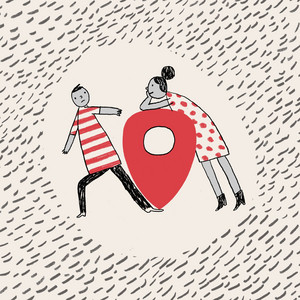
from the new york times i'm anna martin this is modern love our show is inspired by the modern And by all the messiness of trying to love, trust, and stay connected to other people.
One way my dad likes to stay connected is with a ritual he does basically every night.
Before bed, he pulls out his phone, fires up the Find My Friends app, and sees that me and my two sisters are at home in our apartments.
And when he sees that, he sends a text to the family group chat that says something like, Like, ah, my three little chickadees at home in their nests.
It's simple, it's sweet, it's a way he expresses his love, and it's made possible by location sharing.
We recently asked you to tell us how location sharing affects your relationships, and you filled our inbox with stories about the people you're sharing your location with, and the people you're not.
I share my location with a bunch of my friends and my parents and my brother.
We've been together for about three years.
We've shared locations since the start.
My ex -husband and I are still sharing a location.
My children are out and about at night and we're trying to see where they are late.
If they're past curfew, for example.
At first I didn't even want to do it because I just kind of felt icky about it.
Right now I don't need to know where my girlfriend is 24 -7.
I'm happy that we were sharing location services because I got to find out very early that he was cheating on me.
He is getting married in two days and still shares his location with his ex -girlfriend.
Because why not? What is there to hide?
Your experiences with location sharing were, there's kind of no other way to put this, all over the map.
A handful of you absolutely, unequivocally refused to share your location with anyone, anywhere, ever.
But a lot of you said it adds something really valuable to your lives.
On multiple occasions, my mother has called me to say, I'm lost, how do I get to wherever it is she was going?
And I could look at her location and tell her how to get there.
She loves the feeling of being taken care of that she gets from having me watch her.
which is the exact opposite of how my adult children feel about sharing their location with me.
My brother David has Down syndrome.
And when I see him, every once in a while, he'll just like open up his phone and he'll show that both of us are in the same place.
And he'll just burst out in happiness.
Probably about 45 minutes or so into the hike, I realized I was pretty lost. I couldn't make heads or tails of the map that I had.
So I ended up calling my partner.
He was actually able to locate me on the map.
I was so, so grateful that we had the tracking device available to us because I don't think I would have found my way back.
So I would recommend it for couples who may be directionally challenged like myself.
On the flip side of that, there were stories like this next one where location sharing started off okay but took a bad turn I moved to a new much larger city so I was a little nervous about being away from my hometown for really the first time away from all the people who would typically know where I should be and if something terrible happened to me so it was a relief to make two really good girlfriends and all agree to just share locations with one another but it definitely ended up feeding into one of the friends just insecurity jealousy the fact that she could always check our locations she
started just obsessively checking our locations and we'd get a text hey didn't realize y 'all were hanging out tonight why didn't you invite me or hey i see you're at my favorite coffee shop would have loved an invite.
So I had to end the friendship basically over that.
Being able to see someone's location is almost like having a superpower.
But like any superpower, it must be used responsibly.
And sometimes that means just turning it off.
The relationship kind of ended on uncertain terms. And in this uncertain period of kind of breakup, kind of not, I started very obsessively checking her location at all hours.
We're on a college campus in a very kind of contained radius.
And it started turning into not just psychological anxiety, but a physical manifestation.
I just would not feel comfortable around her, or even anywhere, because I knew exactly where she was.
And one night, I was walking alone on the street, and it was dusk, and I had my headphones in, and was listening to some sort of melodramatic music, and opened my phone and looked at her location.
And all of a sudden, there was just kind of a snap of like, I need to stop.
I want to feel feel free.
It's clear that location sharing has changed something fundamental about our relationships.
Whether you opt in, whether you opt out, someone in your life is probably going to feel some type of way about it.
And everyone seems to need their own roadmap for where to draw the line.
Today on the show, I talked to a Modern Love essayist who has wrestled deeply with drawing his personal line around location sharing.
And he tells me how a family tragedy made the stakes of that decision feel exceptionally high.
Stay with us. Hi, I'm Megan Loram, the director of photography at The New York Times.
A photograph can do a lot of different things.
It can connect us. It can bring us to places we've never been before.
It can capture a story in a universal visual language.
But one thing that all these photographs have in common is that, you know, they don't just come out of the ether.
We spend a lot of time anticipating news stories, working with the best photographers across the globe.
These are photographers who have spent years mastering their technical craft, developing their skills as visual chroniclers of our world.
You know, getting certified as a scuba diver and learning how to shoot underwater to document climate change or tremendous cardiovascular training in order to ski on the slopes next to Olympic athletes.
This is an effort that takes tons of time and consideration and resources.
All of this is possible only because of New York Times subscribers.
If you're not a subscriber yet, you can become one at nytimes .com slash subscribe.
When Arlen J. Staggs was a little kid, he had a lot of room to wander.
Whatever you picture of a boy growing up in rural Alabama, that's exactly what it looked like in the 80s.
There were all of these trails through the woods and creeks, and our parents never knew where we were.
were. Arlen was the youngest of three boys.
But his older brothers, Paul and Hank, they still let him in on a lot of the action.
We had a great childhood, especially for boys, because we were throwing rocks at each other, shooting bottle rockets at one another.
I mean, it was dangerous.
You know, boy stuff, throwing rocks at each other.
And just like that 80s movie that's probably playing in your head right now, Arlen could always hear his mom's voice in the distance when it was time to come running home I could be half a mile away in the woods and I could hear my mother's voice calling me.
She would go out on the back deck and just yell.
It was like a wild, animalistic mother calling her, trying to find her young out in the woods.
As Arlen got older, he started to feel a need for a different kind of freedom.
His parents were religious and conservative, and he felt like he didn't quite belong in their world, especially as he realized he was gay.
So he decided to put some distance between himself and his hometown.
I remember driving to college and playing my U2 cassette.
I remember singing at the top of my lungs.
I remember the roads were windy and taking those sharp curves just, like, you know, with abandon.
And I think that was kind of the first moment I felt free.
Eventually, Arlen landed in California.
He came out to his family, which in time they accepted.
Then he got married and built a life on his own terms. But even many years later, he still had lingering feelings about what it meant to be the son who left. And he told me that when his mom started tracking his location, things got more complicated.
Arlen J. Staggs, welcome to Modern Love.
It is my pleasure to be here.
Thank you. So Arlen, after growing up in this tight -knit family in Alabama, you decide to leave the South and go live in California.
How did your mother feel about that?
Yeah. She was devastated.
You know, my parents ended up teaching at the high school that they graduated from.
They lived in the same hometown their whole lives, which there's something very sweet about that.
And I love that for them.
But I think just California was so, I mean, in distance, yes, it's far, but just in mindset and culture, it's so far away for them.
Did you feel guilty for moving so far away?
Yeah. In some ways, I still do.
It's almost like there's an agreement we all had, and I broke that agreement.
Even though we never stated that agreement, nobody never said, you know, we never sat down and said, okay, in this family, you're not allowed to move to California.
Does everybody agree?
But I knew I wasn't supposed to do that.
Can you tell me about how you first started sharing your location with your mom?
Whose idea was it? I remember it being her idea, but I was not resistant to it at all.
So Drew is my husband.
He and I had a vacation rental in Florida.
We lived in San Diego, but we would drive back and forth.
And the first time that we did it, my mom was like, you know, can you turn on your location on your phone so that we can see you?
So I thought this is a great idea because if something did happen, somebody would know where we were.
And I think she found a lot of peace in kind of following our daily progress.
It was kind of fun for her to, you know, see how far we got each day.
And it took about four days to drive across the country.
She would be like, well, I see you're in Arkansas, or it looks like you're getting close, or you made really good time today or whatever.
But then at some point, location sharing with your mom started to become kind of a problem.
Can you tell me what happened with that?
I think when I started to notice that she would see me in a location and then make up a concern about it, then it became an issue.
you so one time i took chip my dog to the vet and my mom called later that day and she was like is everything okay with chip and i was like yes he's fine why like why and why are you asking do you know something i don't know yeah yeah she said well i just noticed that you were at the vet's office today and i worried that something bad happened and by the way nothing was wrong with them it was literally just like an annual checkup that was the first time I was like okay that's a little bit too invasive stop watching me like you know like it's none of your business that I'm at the vet and so I waited
probably a few days and then just kind of once I knew she was had gone to bed and it was late in Alabama and maybe still early in California, I just, you know, discreetly unshared my location.
Did she notice? Yes.
Yeah. But, but it took her a while.
I turned it off and maybe two or three weeks later, she was like, hey, I can't see your location anymore.
You know, what happened?
So after that, I turned location sharing back on.
and then one day i'm running errands my phone was in my pocket and i was unknowingly butt dialing her and i did this probably seven or eight times which by the way i'm very familiar with because since my name starts with a this happens to me a lot so because you're talking my friend that's right no do you get butt dialed a lot too yeah so but for me i don't ever assume the worst i just turn my phone off or whatever But when I got back in the car and I realized that she had, I think she had even maybe called back each time and she had texted me like, what's going on?
And why do you keep calling me?
And so I called her and she had made up this whole story about how she was afraid that I had been kidnapped and locked in a trunk.
And, or maybe I was in a ditch somewhere and the only way I could communicate with her was like butt dialing for help.
But she could see your location.
Couldn't she see that you were in like a...
Yeah, well, she saw me, she saw me in the Sam's Club.
So I think she thought I was in the parking lot tied up in the trunk of a car.
I mean, you're laughing now, but it sounds like she was really scared.
Yeah. I mean, I don't know how committed she was to that interpretation, but that was the interpretation she had.
And it was clear to me at that point that she's really going to a dark place about it.
And I don't know how much it serves her to know where I am.
And after that, I turned location sharing back off.
Were you just turning on and off and on and off and on and off your location sharing for like years?
Maybe for a year. Okay.
Okay. I usually blamed it on technology.
That was my go -to scapegoat.
What do you mean? Is I would say, well, I would say, oh my gosh, my phone must have updated again or, you know, and it must have turned my location off.
Let me turn that back on for you.
Like I would blame the iPhone.
I would never say, yeah, well, I turned it off.
Because why? Why? This is one of those questions I have to think about because I don't know really.
I guess it felt easier to just keep going through the process of turning it off than having a conversation about it.
it felt more efficient to press a button than to sit down and say mom let's talk about boundaries let's talk about what's okay and what's not okay and there's this history of i left where i'm from i left i left home so i don't know if i just took on that like i was the bad son that didn't stay or it was never about her seeing me at the vet and getting upset about what might or might not have happened to Chip.
It was always about this unresolved kind of broken agreement.
That does not seem like something your mom was saying to you, right?
Like this was something you were saying to yourself.
Absolutely. So, in addition to location sharing maybe not being so helpful for her anymore, it strikes me that it also was not so helpful for you, right?
Like, it's making you talk quite unkindly to yourself.
Yeah, for sure. But part of you, I really want to understand this, like, part of you felt like you owed her this information about where you were?
Yeah, 100%. I felt like I owed it to her, I think.
Especially after my brother Paul went missing.
We'll be right back.
Arlen, Colin, can you tell me what happened with your brother Paul?
I guess the catalytic moment or the catalyst for all of it was when my mom got a phone call from the Alabaster, Alabama Police Department.
And they had picked my brother up on Interstate 65.
um he had pretty extreme paranoia um he was hearing voices in his head and he was running from people he claimed were trying to kill him and you know this was this was a very shocking phone call to get because paul had always been a little troubled and as a kid i just remember him being grounded a lot and you know lots of teenage door slamming and loud 80s metal music playing from his room and and that just kind of continued through his life you know like he was just Just constantly unsettled.
But he was never at that level of, you know, a mental illness.
And so that was kind of the first moment that kind of, in a sense, woke us all up to like something deeply troubling is going on with Paul.
Did you eventually find out what was happening with Paul?
at the time he was diagnosed with cannabis induced psychosis okay um and what doesn't make sense about that to me is from what i've read about that is most cases they can be that severe but then it kind of goes away it tapers off and his did not his continued and even got worse when you say things got worse can you share a little bit about what that means yeah he well they got a little better in the beginning because he they gave him some medication which helped and he lived with my parents for a while and the deal with my parents was you know they said you can live in our home as long as you
need to but you have to take your medication and one day he just said you know I don't want to take it anymore.
I'm going to leave. And he did.
And then what? Did you know where he was?
No. I mean, we would get these calls.
The first call that mom got was from Tallahassee and the authorities in Tallahassee had essentially rescued him from some kind of pond or swamp.
I remember they mentioned that there were alligators in the body of water that he was in.
And he always called the people that were trying to kill him the goons.
And he was claiming that the goons had put poison on his skin.
So he was in that water trying to wash the poison off of his skin.
Oh my gosh. And then they got a call from Tyler, Texas, and it was a psychiatric hospital.
And the nurse had a conversation with my mom.
And I remember mom said that her brother, the nurse's brother, also had a similar condition.
And she was like, unless they take their meds, there's really nothing you can do.
And that was the last call that mom got, I think.
what was it like not knowing where paul was what was that like for you emotionally i'd like to say that i had this deep concern for paul and i really wanted to go out and help paul but i think hank and i both became very protective of mom Because she was worried about Paul enough for everybody that I was starting to see her lose herself in that loss.
And she would get lost in telling us all the specific details over and over and over again.
And we would go all the way back to Alabaster, Alabama, and exactly what the police officer said on the phone, exactly what the receptionist at the hospital was wearing, exactly what the muffin tasted like in the cafe where she bought a muffin.
I think it was her way of saying, this is how we got here, and I need to make sense of how I lost my son.
Arlen not too long after that your family experiences a really sudden loss can you tell me what happened yeah yeah um my dad went in for a heart procedure in 2022 and he was just going to have like a stent stent replaced it's supposed to be a very easy procedure you know they don't even use anesthesia uh but when they were done with the procedure they fixed the stent um and he coded and he didn't make it oh my gosh i'm so sorry thanks that is so much for your family to go through yeah well i remember at dad's funeral My brother Hank and I both gave a eulogy.
I just remember stopping in the middle and I asked the congregation if we could pray for Paul.
And I prayed that God would show us where he is.
and four months later he was found dead in las vegas how did you find out about paul's passing mm -hmm i got a call from the coroner's office in las vegas like on tuesday i get the call my mom's birthday is wednesday um and then thanksgiving is on thursday my gosh so i called hank and i said we need to go and tell mom i was in florida at the time he was in nashville so i get in the car we meet at my mom's house in alabama and yeah I remember turning on my location oh you were doing the drive while I was doing the drive and we were going to have dinner with her celebrate her birthday and then tell
her and yeah when you did tell her what was that like i don't have the word for it but when dad passed away it was what i would call a very a pure grief like a uh like when we say grief what we're talking about when paul passed there was definitely grief but it was mixed with relief and closure and um you knew where he was we knew where he was And I remember both of us just holding her.
She just cried and cried and cried for what felt like a really long time.
And I remember the position of my body was so uncomfortable.
My leg was falling asleep and my back was starting to hurt, but I could not break that blob that we made by hugging her.
What a word. I mean, it's just, yeah, in a blob.
Well, you said when you were driving back home to tell your mother about Paul's passing, you turned your location back on.
Yeah. Did you ever turn it off again?
Yeah, I mean, maybe I had gone on one of my trips to reflect and grieve and pray.
And I don't know what prompted me to turn it off, but at some point I did turn it off again.
and then a few months later mom comes to visit me in florida and i was taking her back after her visit to the airport and then i come in and i kind of walk her to the tsa line and i remember i hugged her said goodbye i love you i'm just kind of standing there watching her and she hands her ID to the officer.
She starts to put her bag up on the machine and the sadness overwhelmed me.
That scene of her doing all those things all by herself I just felt like Somebody should be getting on that plane with her Somebody should be putting her Carry on in the overhead bin for her Somebody should be there with her She's just kind of always been surrounded by these strong men And now she's doing all this by herself And by the way, not to She's an incredibly strong woman Of course, of course Not to invalidate her at all and she wasn't falling apart I was yeah yeah and then you know what's what's there underneath it all is just all the years that I had run away to California and all the years
that I wasn't there and the birthdays where I just called and sent flowers and I wasn't there for for the party, I went back to my car and just sort of allowed myself to cry, to cry about Dad, to cry about Paul, to cry about her.
And that was the moment when I'm sitting there in my car in the airport parking lot where I needed to share my location with her, like I needed it.
and i almost felt like it's almost like being a little boy again like there i was lost in the woods and i'm gonna say here i am and you don't ever have to wonder where i am and and that's when it started to give me peace to know that she could get peace by by looking at that.
You know, Arlan, it's interesting you say that because we've been talking all this time about location sharing, but it strikes me that, you know, really what we're talking about is your family relationships, right?
Your complicated, joyful, devastating, beautiful family relationships.
I mean, it's... Yeah.
And we're also talking about this dance between boundaries and grief and how the two interact, you know, because it was the grief that had the boundary fall away.
And I think it's almost like I think the simplest example of that is it would be really weird for me to pass you on the street, Anna, and then just grab you and hug you.
But if I were to pass you on the street and I know you just lost your dog, it would not be weird for me to grab you and hug you because you're because the grief changes that boundary.
And I think maybe that's what we're having a conversation about.
Yeah, it's just so much more than toggling a little switch. It is.
It definitely feels like an act of love.
Arlen J. Staggs, thank you so much for this conversation today.
It's been my pleasure.
I've loved it. Thank you.
If you'd like to read the essay that inspired this episode, you can find the link in our show notes.
The Modern Love team is Amy Pearl, Christina Josa, Davis Land, Emily Lang, Jen Poyant, Lynn Levy, Reva Goldberg, and Sarah Curtis.
This episode was produced by Reva Goldberg.
It was edited by Lynn Levy and Jen Poyant.
This episode was mixed by Afim Shapiro with studio support from Maddie Macielo and Nick Pittman.
Fact -checking by Will Peischel.
The Modern Love theme music is by Dan Powell Original music in this episode by Alyssa Moxley, Dan Powell Marion Lozano, and Pat McCusker Special thanks to Mahima Chablani and Jeffrey Miranda The Modern Love column is edited by Daniel Jones Mia Lee is the editor of Modern Love Projects If you'd like to submit an essay or a tiny love story to the New York Times we have the instructions in our show notes I'm Anna Martin Thanks for listening This podcast is supported by BetterHelp.
Workplace stress is now a leading cause of declining mental health, with 61 % of the global workforce feeling it more than ever.
You can't escape work, but you can take small steps to care for yourself.
A walk, some sun, a favorite song.
Therapy is one of those steps.
Ongoing support to build resilience for whatever your day throws at you.
Balance is tough. Getting help shouldn't be.
Visit BetterHelp .com slash The Daily for 10 % off your first month.