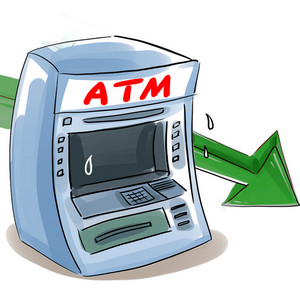
If you're looking for an ATM around China, it may be getting more difficult and difficult as the years pass.
Why do I say that? Because China's ATM count has plummeted to 800 ,000 as digital payments surged, shrinking the cash reliant infrastructure by a quarter in just 5 years.
While this cashless revolution brings seamless transactions for tech -savvy urbanites, it risks marginalizing those still dependent on physical currency.
Could this rapid shift ultimately leave some segments of society financially excluded?
We are live from Beijing, this is Roundtable, I'm Steve, and for today's show I'm joined by Niu Honglen and Lai Ming.
First, on the program.
A report by The People's Bank of China revealed that the number of ATMs in the country has fallen to just about $800 ,000, that is significant because it's a 25 % drop since 2019, as mobile payment platforms like Alipay and WeChat and more dominate everyday transactions.
This decline, it signals a broader societal shift towards a cashless economy, I can't remember the last time I used cash living here in Beijing, and it brings unmatched convenience for most. while it does though pose challenges for older generations and rural communities still dependent on physical cash as digital payments become the default.
The way people shop and travel, and even split bills, is transforming, marking a fundamental change in China's financial landscape.
Good afternoon, Lai Ming and Niu Honglin.
When was the last time you actually used an ATM?
Was it recent or not?
Maybe in your recent memory, thank you for giving that question to me earlier before the show because I really have no idea, but I do I do have a better have a habit of keeping every spending in my you know in my account.
Literally every. So I did some research and found out that last time that I went to an ATM machine was July 2023.
Wow. That was after a trip back to my hometown and many of my AL senior members of the family they I gave gift money to my son which who was young.
So we got a lot of cash, and when we came back to Beijing, we went to the ATM machine to have them deposited.
So that was the last time I used ATM.
And then the last time I used cash was 2024, November.
I tipped a plumber.
Like I said, every.
You tipped a plumber?
Yeah. Okay, when was the last time you went to an ATM, Yonglin?
Earlier this year. Okay.
For the exact reason Laiming has just said, you tipped a plumber, I got money from senior family member and the money was given to my kid.
So that was the only reason I can think of when it comes to using an ATM or actually going into a bank and to make a deposit.
And there you have it.
There's two examples of why we're seeing this trend in the large reduction of ATMs around the country.
So let's get into the details.
Laiming, where do we begin?
Well, you also somehow introduced some of the information earlier on.
The number of ATM machines in China dropped by more than a quarter in the past five years according to a report by China's Central Bank.
The total number of ATMs was 1 .1 million in 2019, but has come down to around 800 ,000 as of the end of 2024.
And according to a recent report by Red Star News, the number of ATM machines peaked at around 1 .1 million in the year 2018 to 2019.
There are different claims according to different media organizations, but we surmise that is around the year 2018 to 2019 when the number of ATM machines peaked at around 1 .1 million.
And this is not surprising at all, because now I see a QR code that can be scanned for people to pay everywhere.
When I say everywhere I'm not exaggerating.
My hometown is the provincial capital of Shanxi province and very occasionally I would see one or two beggars sitting alongside a very small alley or street, and they have a QR code right in front of them if you want to give them some money.
Meaning they would have a smartphone and they would have WeChat or Alipay applications installed on their phones.
And the thing is the passersby do not think it's a strange thing because they're begging for money and they have cell phones and they have a digital wallet.
It's not a strange thing.
It's kind of like the default setting for everyone's, which is everyone's way of dealing with their financial no matter how much money is in the bank or in the wallet.
So it's not It's something, well, I mean, cash or ATM is no longer as a necessity in people's life.
And recently I've made a trip, a business trip to Malaysia.
And while in the airport I was thinking I didn't, I was too busy, didn't have time, took God's Malaysian money.
And at the airport I was thinking I need to have a safety money, safety net money with me.
So usually that's cash for travelers, right?
So I got the cash. I got only 500, 1000 Yuan, I changed the 1000 Yuan I had, and I brought the money to Malaysia.
I didn't spend a penny.
I used surprisingly Alipay for all of my purchase.
So it's not even only in China, it's like in many Asian countries as well.
Yeah, in Thailand too, they have a lot of signs around that says Union pay, that's another option, right?
Ali pay, WeChat pay.
Although I think that's restricted to Chinese mainland citizens.
I'm not sure if other people who live in China can make use of that or not, but it's to your point, right?
It's just ultra convenient now, and here in China, it feels like everything's done digitally.
If you get some cash in an envelope during a big holiday, sure, you have to go deposit that, but daily life, it seems like that's the way it is.
Everything's done digitally and that's why we're seeing the number of ATMs reduce around the country.
There was a story a university student who was born in the 2000s told Time Finance.
This is cute. She had never used an ATM in her life, not one time.
She doesn't even know whether there is such a machine on the university campus or not.
That's one cute story.
Another cute story, a housewife said that she had not used cash for a really long time.
She even pays for the vegetables in the market by scanning the QR code.
And that's another example, you go to the supermarket here or the convenience store or any shop of any kind, and you can simply scan to pay.
That's just the way it is.
Yes, and according to an article, by 2024, non -cash payments have accounted for over 90 % of total retail sales in the society, and in first -tier cities, the mega cities here in China, the average annual cash usage among young people is less than 500 yuan.
The story about the university students not knowing whether there is an ATM machine on campus really brings back very fond memories of my university days when my parents still wired money to my debit card account, so and they would do it on a monthly basis.
You know college kids, they run out of funds very easily so I had a habit of going to the ATM machine to check whether the money has arrived and they're also the joy of getting oh, this interest rate accruing.
But it's really eye opening to see that a lot of young people these days they they don't even know such a thing might exist and they certainly don't have use for that because they have mobile applications where they can go and check the interest rate and whether the funds have arrived.
Everything can be done online.
So what are experts saying about this decrease in the number of ATMs?
Is this kind of in line with what they expected?
An insight in the banking area is that some people have not used cash for several years, and the convenience of ATM machines has been replaced by mobile payment, like we agreed earlier.
And if you want to deposit or withdraw a large amount of money, you can only go to the bank counter.
And this coincides with some policy changes within the country.
There or efforts aimed at fighting money laundering and also bank fraud, and as such, any transactions exceeding a certain amount will have to go through the counter.
The banks will have to see into it, and you might have to go there in person.
So an ATM machine wouldn't work, so that really further reduces the need to have ATM machines around everywhere.
And from the bank's point of view, you mentioned the banks, it's not really cost effective as well, there was a banking industry insider that was talking about when ATM machines are not used frequently banks still need to pay the maintenance costs right so he thought that banks originally chose to expand ATM service functions because they failed to foresee the rise of a cashless society but the larger number of ATMs held by banks has essentially become like an asset with a low return for the bank but a high cost and then ongoing operational expenses too.
There was a report from Tech Media 36K -R that mentioned it's quite normal to costs over 10 ,000 yuan.
That's almost fourteen hundred dollars as an annual rent fee for an ATM machine if the location happens to be a prime location.
So, you know, you might think, oh, that's not really a huge amount of money for a bank.
But if you multiply that by a ton of bank machines, that number can add up very quickly.
And it's not the only rent.
is not the only money you have to think about, the only cost. There's also electricity, maintenance and cash transportation.
While there have been reports saying that the daily operating cost of a single ATM machine exceeds 300 yuan, while the revenue per transaction is only 3 .5 yuan.
Thinking about how many people still now use ATM, it definitely is not cost Some reports said that some ATM machines, less than 10 people use it and less than 10 transactions are made on these machines.
Oh, really? That does not make it worth it at all.
Alright, so this is what I want to know.
So the decrease in the number of ATNs is linked to the fact that most everyone makes their purchases through their phone apps.
The big ones that we talked about, WeChat, Alipay, Union Pay, there are others as well.
When did this shift occur?
You mentioned earlier, Lai Ming, that the peak of ATMs was about 2018, 2019.
But the shift goes back before that time, does it not, when in China the direction towards a cashless society really started to grow.
Yeah, it started, if you ask me, and who is relatively older in the room and who's been paying attention to the changes.
and I might say that the whole thing started as early as Taobao when the online shopping platform appeared, and there was the issue of trust between small vendors on the platform and consumers on the platform.
And who's to say that if the consumer pays the vendor, but the vendor will refuse to mail the product, and who's to say when the vendor mails the product, but the consumer refuses to So Alipay came up, Alipay was a solution and Taobao really came up with the platform as a third party guarantee or guarantor kind of thing.
So a consumer would pay into Alipay, and then the money will be kept at Alipay until the consumer can confirm that they receive the commodity, and then the vendor will be able to receive the money via Alipay.
So that worked before the age of mobile internet we I I think I registered my account when I was in postgraduate years around the year 2008 2009...
in fact really yeah very early Wow 2008 yeah I remember correctly 2008 because back then instead of the really convenient way of linking your card bank account or any kind of debit card, or now credit card with your WeChat wallet or Alipay wallet, what you had to do in 2008 is you go to the post office, you get the cash, you give the cash to the cashier and you fill out this sheet and you're mailing your money to the Alipay and then you physically mailed it like a package.
I don't know how it goes, but I would bring the cash, and I would fill in the sheet, and it's not to my account, it's to Alipay, and my account is just a affiliated message I fill in, in one blank.
And that's how I got the money into my Alipay wallet.
You're guarding the business the hard way.
But I think I, when I started, I already connected my debit card to Alipay.
So I could do it online without going to the post office.
But then that was the age of 2G mobile internet I believe.
But that was also the age of smartphones correct?
Not quite there yet.
Yeah, we were still using older generation phones that where you can send short messages, but not really smartphones like iPhone or Android phones that had to take a few more years around the year 2010, 2011.
So would it be fair to say then that even though these online digital payment platforms did exist and they were available before smartphones boomed here in China, it was with the boom of smartphones that coincided with the boom of society using digital payments?
A little further down the road because the years of the smartphone explosion was around the year 2010, 2011.
But then we were working on 3G mobile internet.
It was not fast enough to support consistent and large -scale communication of transactions being taking place around the country, in fact.
So it'll have to wait until somewhere around 2014, 2015, when we had a 4G network, That's LTE or TD LTE, so that's when we had faster internet connection, mobile internet connection, and that's when things become much easier.
I apologize for getting off topic a little bit, but I find that to be an interesting one.
Let's get back to the ATMs then.
So how are people feeling about the reduced number of bank machines?
For some, for Gen Z perhaps no big deal, never used an ATM, don't know if there's one on campus.
but for others who might live in rural communities, who might depend a little bit more on cash in their daily lives, that might have some sort of adverse effects.
So good or bad, how are people feeling?
Well, we already talked about not many people use ATM machines that often in their lives.
So technically speaking, if, well, for me, personally, I didn't even notice the huge reduce of the number of ATM machines, But when we talk about it, most people would worry that many outer people cannot use their mobile phone to pay that easily, and without ATM machines, it may be difficult to withdraw cash for them.
And now China has nearly 300 million people aged 60 and over at the end of 2023.
There are many of them who cannot pay by their mobile phone alone.
By saying alone, I mean without the help of their child or people in the community helping them linking everything up.
Yet still, ATM machines, it's not because of the lack of trying because Steve, you earlier mentioned that the ATM machines or banks did not anticipate the fast development or developing into the digital or cashless society.
To be fair, we are defacto a cashless society because you can go get around without cash, but it does not mean you cannot use cash if you want to.
When I and my wife were first moving to China and we arrived, as we were arriving, before I got on the plane in Korea, I texted Lai Ming and said, I only have cash and we have to take a taxi from the airport.
Can I give cash to the taxi driver?
And Li Ming's response was, well, he can't refuse it or she can't refuse it, but you also made the point, but they may not have change.
They may not have the right change.
And just before the show, I thought about that story and then I looked it up online, was curious to know whether travelers coming into China, whether they want to use cash or online through platforms and it's both, a lot online, but that was one of the paragraphs I read in a blog post. Yep, you can use cache with places like taxi drivers, but just give them the exact amount because you're probably otherwise going to be potentially giving quite a large tip.
Yes, and the banks have seen this coming, that is why they have been upgrading their ATM machines.
They have added a lot of different functions on the ATM machines.
I noticed in recent years in...
well, a couple of years ago.
Before ATM machines were quite straightforward, you get your card, you get your money in or out and that is it.
But later I realized that many things that you want to do about your account can be carried on by these ATM machines and previously people can even get their money out from their card or from their account by scanning a QR code that appeared on the screen of an ATM machine.
It's the cardless transaction functionality.
They have been trying, but apparently the society has been moving even faster than they anticipated.
It's like the mini disc player of the early 2000s.
It seemed like a great idea, but it never really caught on.
If you're curious to know about other countries, you're going to find similar trends between In 2015 and 2019, ATMs kept popping up all over the United States, it went from 8%, about 434 ,000 machines to 470 ,000 during that period, an 8 % increase.
But now the trend is the same, right?
Around the year 2019.
Yeah, exactly. It started to decrease, and it's been a pretty consistent fall -off since then.
for example, $462 ,000 in 2020, and then about $456 ,000 in 2021, and they predicted a 6 % drop through the year 2025.
So, and it's the same reasons as well, right?
Gen Z is perhaps more comfortable using digital transactions than they are, or then they have a need for going to the bank machine.
So, will we see ATMs disappear in the end?
that what we're looking at here?
I don't know. I think the banks need to think twice and really think carefully about what they plan to do to satisfy the needs of the customers, because there are clients who are complaining that they have to wait in the line for more than one hour to get service at the counter.
And every now and then some VIP will come in, some public account business, people might come in and jump the queue.
There are situations where people are really complaining and shouting, in fact, at the lobby for not getting service in time.
So, the banks really have to think about how to deploy the resources, both human resources and their hardware resources, to make sure that people with varied needs can get their service they deserve.
I go to the bank once a month here in China and the bank opens at 9 a .m. and I know I know I better be there by 854 a .m. because if I show up at 859 I'm in a line of grandmas and grandpas who are there to do their do their transactions.
And I think Leimeng is right when he says that the banks and the ATM machines need to think about what to do next and some of them already doing this.
ATMs have begun supporting facial recognition, foreign card withdrawals and 10 yuan small value withdrawals, just in case you need some change.
And they're even being integrated with services like government fee payments, financial consolations.
And also development is shifting towards senior communities, remote towns and international airports to meet the needs of non -digital users such as the elderly and foreign nationals.
That being said, I don't think ATM machines will disappear, I think they'll just shrink to a really, really small number.
And I have some examples supporting my opinion.
I took a look at the public phone booths here in China.
I think it's really similar, right?
And I found that around 70 years ago, the starting age of People's Republic of China, So public phones began to appear in urban areas, and by 1995, the number of public phone users in Zhejiang province reached 45 ,000, rising to 145 ,000 in 1998, and in Beijing, for instance, in 2003, it exceeded 330 ,000 with an average of 146 phones per square kilometer, and over 30 phones per 1000 residents.
That's a lot of numbers.
That is. A lot of phone booths.
What year was that?
2003. Okay. Yet now in 2023 public phone booths in China, or in Beijing recorded 17 ,000 emergency hotline calls.
So that's the cost, it's not just the phone booth, it's how many calls are made by these public phone calls.
with a total call time of only 32 ,000 minutes and these calls are generally to the one, two, three, four, five citizen service hotline.
Like something is happening that shouldn't be happening and someone's reporting it maybe.
So if you see the decline of public booth, public phone booth, you see definitely it will decline to a small number.
Yet, there is due the need, and they are going to stay there.
Yeah, and you know, there are scenarios, and like you said, you know, cashless society doesn't mean you can't use cash.
And that's what a senior analyst at a market consultancy firm called Botung analysis said, is that, you know, there is the decline and that decline may continue as the number of users decrease, but there will always be special scenarios where demand does exist and regulators have consistently emphasized that cash must not be refused and that diverse payment methods should be supported." So that makes sense.
So then, what are some good ideas, some suggestions, Lai Ming?
If you're on the board of trustees for all the banks or all the ATM groups in China, what are your recommendations?
I'm not sure the banks, individually or independently, can come up with a solution of diminishing ATMs and its impact on its clients.
I think But what we are facing is slicing time.
Just like the case which Nihongling mentioned earlier about the phone booths.
Just because people are still using them to make some calls doesn't prove that they are not still on the decline.
So I think the number of ATM machines that are still likely to continue to diminish to a point where some other technology can completely replace it.
The digital gap that we were talking about, especially facing the elder members of the population, I believe it is still a problem of a lack of development.
If we somehow were able to develop technologies like mobile payments or maybe a ring or a bracelet that elderly folks can carry around, and maybe someone can have it fully configured, so elderly folks don't need to worry about them.
They only have to use them.
Then we would need a society where we have to make sure their ATMs around and their ATMs with large fonts around.
So, I see this as a as a lack of development, as a lack of advancement, and I see it being solved later on in the future by some, you know, by some disruptive technology.
I guess with the challenge, as is the case with every challenge, there's an opportunity to improve that exists as well.
Fewer ATMs around the country, some people don't care.
Inconvenient for others, but a trend that we are seeing here in China.
And in fact, we are seeing it in many, many countries around the world.
And I think this really comes to no one's surprise.