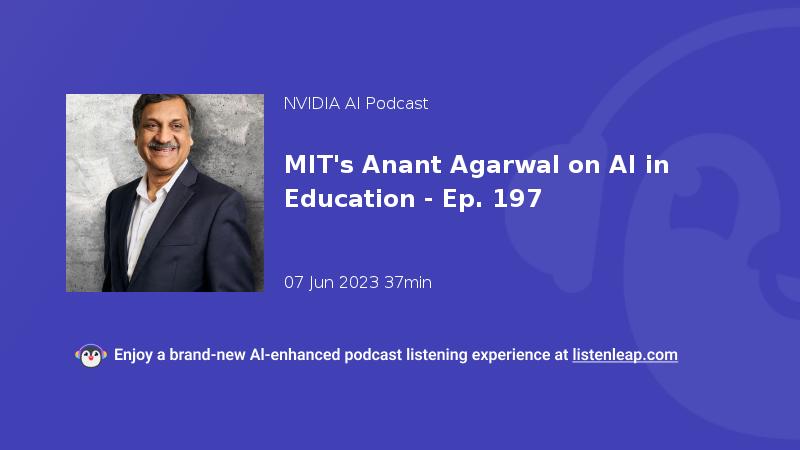
Hello, and welcome to the NVIDIA AI Podcast.
I'm your host, Noah Kravitz. Our guest today is Anant Agarwal.
Anant is the founder of edX, a massive open online course provider that has been working at the forefront of digital education for more than a decade. now.
Anant is not only an education visionary, but he is also an MIT professor and former director of MIT's Computer Science and Artificial Intelligence Laboratory.
He now serves as Chief Platform Officer at 2U, who acquired edX in 2021.
Anant is here to talk about edX's new ChatGPT plugins, which are designed to enhance the learning experience, making it more interactive, personalized, and engaging than ever before.
More broadly, we'll also be exploring the role of Gen-AI in education and what education can and should look like. as everything from the job market to the purpose of colleges and universities changes in the years to come.
I'm really excited about this one, so let's get right into it.
Anant, welcome, and thank you so much for joining the NVIDIA AI Podcast.
Thank you so much for having me, Noah. Really excited about this conversation.
It's near and dear to my heart. As we were talking about before and the intro alluded to, I can only imagine, given your background, So hopefully we'll have time to dig in a little bit to the things you were doing before edX and to you later in the episode.
But I have a little bit of a background in education myself earlier in my career, so I want to dig in.
Let's get right into it. Maybe we can start by you telling the audience a little bit about edX. and to you now as well.
And then we can get into the new AI products that were announced recently.
Fantastic. edX is an online learning platform.
The organization was founded by Harvard and MIT in 2012.
And as a platform company, edX brought together learners from all over the world who came to edX to learn from some of the top institutions in the world, like MIT and Harvard, of course, Berkeley, Stanford, and companies as well like IBM, Google, Linux Foundation, and others.
Right. It's a platform company in that we don't have any professors or such at edX.
I'm probably one of the few professors here But really, we connect learners to great content.
We have over 4,000 courses and programs from some of the top institutions.
And, you know, we have... about 70 million learner prospects who come to our platform looking to learn and uh you know And the learning experiences can range from individual courses that might be free, to professional certificate programs, to executive education, boot camps, or degrees.
I was familiar with edX before, but in leading up to this, I logged in and was checking out a data science course actually.
And so there are free options. There are paid options, some of which lead to certifications and other accreditations that you can use. in your career in in job hunting uh what will you one of the things that struck me in in researching for the conversation is how many adults, I think it was in the US, but I'm sure it's globally, have skills, even have some college credits that are applicable in today's job market, certainly, but haven't necessarily finished a degree.
And so I'm wondering kind of without getting out over our skis a little bit, I'm wondering how you've seen in the time that edX has been out the role of kind of developing skills versus getting a degree, how employers and the job market kind of more broadly are looking at these things. and what that says to you about the changing face of post-high school education in particular.
There are over 40 million people in the United States that have some college, but no degree.
For them, going back to school or college and getting a full degree in the usual way is near unthinkable.
Many of them have are doing gig jobs, driving Lyft or Uber.
And so no way can they go and get a full degree on campus.
And so these may be the people we call non-traditional learners. that need to upskill.
And there's a huge demand for upskilling as well.
The OECD, for example, has projected that over a billion jobs will be completely transformed within the next decade.
And frankly, I think that it's an underestimate.
I think it's even bigger. And so we have an entire planet that needs to be upskilled.
Tens of millions of people in the United States and elsewhere don't have a degree.
And so what edX brings to the table here are a variety of courses and options. where people can upskill.
Let's say you mentioned data science. We have professional certificates in data science from IBM and Harvard.
We have MicroMasters in data science from MIT, and we have complete degrees in data science from Berkeley, for example, and UT Austin.
And we have bootcamps in data science as well from places like Southern Methodist University and others.
So we provide a range of options all the way from courses and programs like boot camps and professional certificates, which are credentials that you can upskill, but not get a degree, and we have degrees as well.
But I think an important point that people often miss is, that is the power of and i call it and thinking where it's not an either or It's not about just getting a micro-credential or a degree, it's and.
With the data science example you mentioned, sticking on that topic for a second, Learners can complete a boot camp in data science from SMU.
And after they complete that boot camp, they can actually to start a degree and apply for and start a degree in data science from Southern Methodist University, also fully online in partnership with edX and 2U. and the credits that they earn in the bootcamp can be applied towards a degree.
So it's not an either or, I see many of these credentials as pathways to complete degrees, Should people want complete degrees?
In AI, the topic of this podcast, we have a large number of micro-credentials in ai we have a professional certificate in ai from google we have uh you know into the chat gpt courses And then we have degrees in AI.
We just launched a very disruptively priced degree in artificial intelligence and machine learning from UT Austin for $10,000.
And when we announced the degree three months ago, we had 2,000 expressions of interest from learners within 24 hours of launch.
And today... We have over 10,000 learners who have expressed interest in that degree.
And this is just a few months. So there's a huge demand for popular learning.
Yeah. So as you said, we're talking about AI on this show.
So let's dig in a little bit to or a lot, I should say, to the role of AI in teaching and learning.
And specifically, I mentioned at the top, there are two new plugins, OpenAI and rolled out plugins to a wider audience, ChatGPT plugins in the recent weeks, and there are two edX plugins, I believe, and there's also the edX Expert product on the platform.
So maybe you can talk a little bit about those.
Sure. So, you know, edX had a history of innovating when we launched edX out of Harvard and MIT 12 years ago.
There we brought in digital technology applied to learning and helped to revolutionize learning both on campus and beyond with these micro-credentials, upskilling. and also creating much more engaging learning experience that enabled flexibility for the learners.
So today, no matter where you are, We can give you upskilling free of a very low cost and on your own pace and your own time and completely enabled by digital learning.
And so digital technology completely transformed education.
AI is another really, really big thing. I think of the AI revolution as big or if not bigger than the steam engine revolution. or the entire wireless telecommunications and so on and this is the internet this is big if not bigger and has it's going to have widespread impact on everything that we do at work or at home And certainly learning is no exception.
I strongly believe that Education can benefit incredibly from artificial intelligence, much as anything else.
When I was at MIT in 2007 and 2008, My group at MIT was experimenting with using AI and machine learning to make computer architectures more energy efficient.
By using AI to analyze how codes were running, and use machine learning to change how resources were acquired in order to make computation more energy efficient.
Today we are applying AI at edX to learning.
And we've released two products. One is we've released a ChatGPT plugin.
The ChatGPT plugin is available in the ChatGPT plugin store.
At this point, it has been rolled out to ChatGPT plus users.
So you can go to ChatGPT, become a plus user, and then go to the plugin store and you can install the edX plugin.
That will enable you to have a great experience with discovering new learning experiences, and it can also help you with learning in a way that goes beyond what ChatGPT can do in a generic manner.
So that plugin takes content from within edX courses.
For example, from my circuits course, out of MIT and learners can ask it.
If they have the plugin installed, they can ask it circuits questions and the circuits course will answer those questions through the ChatGPD interface.
Right. So that is one product. The second product is called Expert.
Expert XPERT is the set of technologies that we have released on the edX platform that we will continue evolving over time. the expert technologies will enable learners to learn better.
So just as one example, we've released expert summaries.
So when a learner is within an edX course and people can go try it out in my circuits course on edX, if you watch a video or any other piece of content, uh we have the expert summary button you click on the button and you see a brief summary and this has been powered by chat gpt so we have an enterprise integration into ChatGPT and we provide a summary.
And so just summary as an example can help learners quickly refresh on materials.
But that's just one example. We are working on Expert Tutor, which will be an online learning tutor for people.
We are working on an expert health center and learning assistant that will help learners learn better as well as get doubts cleared. adaptive learning.
We're also working on things like better authoring for faculty to enable You know, imagine, so there's many, many roles that AI can play and we're just scratching the surface in terms of what we can do.
When I think about AI and digital and education, digital learning, I always go back to the Neil Stevenson book, Diamond Age, and there's something called The Primer, which is essentially a... hyper-personalized, very active learning from everything sort of tutor that it goes beyond what we think of as, education and school and in all facets of life, but kind of this hyper-personalized tutor that stays with you, has a memory, learns from you, knows about your learning style, all that kind of stuff.
Is that the path you see things headed on when it comes to AI enhancing the learning experience?
Are there sort of paradigms in your head that you and your team, I should say, are kind of moving towards?
Or is it very much right now a matter of we're just scratching the surface, like you said, and it kind of remains to be seen how this evolves?
And we're certainly scratching the surface.
And no matter what I say, I will be woefully off.
But that shouldn't prevent us from dreaming a little bit here.
So one can imagine three approaches. One approach is, and these are incrementally more, what shall I say, more heavily dependent on AI.
The first one is, fairly straightforward tools like a summarizer or a video translator, or things like a discussion forum moderator, a very specific essay grader.
These are examples of things that are specific tools.
So that's one. The second one is where AI augments the human teacher.
And think of this as co-pilot. There are, when you program in Python or whatever, you can access a co-pilot in many of these programming environments that help you write better code. to go faster.
Similarly, one could imagine kind of every student potentially having an avatar kind of being a co-pilot helping them learn or a professor having an avatar or a co-pilot helping them teach better So those are examples where these avatars are augmenting the existing learning experience.
So for instance, if I'm learning and I have trouble with something, I can say, hey, I didn't understand that.
Can you explain that to me better? Or uh can you help me understand that or give me a hint for instance or with our edx chat gpt plugin for example one of the questions you can ask our plugin is uh hey quiz me on this topic.
And our chat GPT plugin will quiz you on that topic.
And so that's one example where it becomes more like a It augments your own experience or augments the instruction as a co-pilot.
That's two. And the third one is where the whole teaching experience is uh you know whether it's adaptive learning or a tutor where you You know, literally give yourself up to AI and say, hey, you know, I want to learn this topic.
You know, hey, help me. And so it will just take you through the whole learning flow.
And if you learn adaptively, it might first ask you, what do you know?
And it might ask you, where do you want to go?
One of the tools we are building is an AI-based carrier navigator and carrier helping tool, learners can navigate and explore careers and find learning paths.
So in that third model, It is where AI is providing the entire teaching experience, whether by tutoring the learner.
It's almost like... In India, you know, when you read some of the major master, you know, the old masterpieces like the Mahabharata and Ramayana, You see all the kings and princes and princesses had amazing tutors like Drona who are personalized tutors.
And if you were really rich or if you were a king's offspring, you would learn from a great tutor.
But imagine now that... Everybody in the world can have a personalized tutor.
And so AI in that third category can completely democratize education where everybody can have a great tutor.
So I see these kind of three approaches.
So one of the things that strikes me, and you say that, and the word democratize, that, and correct me if I'm wrong, but edX seems like one of the, perhaps the founding principle, one of the things that strikes me about it is how it offers kind of democratizes access to these very high quality big name learning experiences, MIT and Stanford and courses at IBM, whoever it is.
And so somebody can get access to these courses and these materials created by professors, employees at these big name companies without necessarily having to be admitted to Stanford and pay full tuition, that kind of thing.
What happens to the role of the professor in an age where, if we extrapolate out a little bit, where somebody can go on to edX or use the edX Chat GPT plugin and get access to these materials and then perhaps have an AI-powered personalized tutor. then the professor themselves is kind of further removed from the act of teaching, if that makes sense.
Where do you see the role of the professor, the teacher themselves going as we move forward into this age where maybe the professor has an agent who's helping to create the materials and to teach them.
And I as a learner have an agent, an AI agent, who's kind of helping navigate me.
And you know where I'm headed with this.
What happens to the role of the expert educator?
It's a great question, Noah, and it's a very personal question.
I've been a professor at MIT for- Of course. for 35 years.
So it's very personal as well. But first, let me address your first point, which is about democratization.
Through the history of mankind, great technologies have really democratized access in various ways.
It's always the case that initially these technologies have been accessed by the people who already have it all, the rich and educated.
But over time, the technology gets available to everybody.
It's like cell phones. Initially, the big bulky cell phones were expensive and they were bolted to your car and so right in your limousine yeah But now, as I travel all over the world, in India, for example, I've seen young kids driving a bullock cart with their cell phone glued to their ear.
And so everybody has it. And so technology, great technologies of democratized access, certainly with education, Digital technologies like with edX and so on are democratizing education where no matter where you are in the world,
We have 48 million people learning and taking free courses on the edX platform.
And so, you know, no matter where you are, you might be a kid in, you know, a kid in uh you know like kigali or or or in bangalore or whatever and you can be learning from the top professors and engineers, whether it's at Google or IBM or MIT or IIT Bombay.
So I completely agree with the democratization point.
So to your question about what will this do to professors, as the famed Yogi Berra said, this is like deja vu all over again.
When we started edX in late 2011, 2012, I was asked the same question almost every day, saying, hey, Anand, what will this do to your job when We have all this content and courses online with digital technology.
What will this do to the teacher when people can It acts as great recorded videos and computation can create essays in the cloud and all of that stuff.
What is it going to do to the teacher? And so in some sense, AI is just more of the same here.
To me, I see AI as making learning possible. better for the learners in terms of access and outcomes.
At the same time, I also see AI making authoring and creating courses and teaching better for professors and course authors.
So I see AI as a rising tide. that will up the game of learners as well as professors, certainly in the short to medium term, where For learners, much like when calculators came out, it really helped everybody do computations faster.
And similarly when AI came out, as AI comes out now, as AI is coming out, I can see it help learners learn better and faster.
Adaptive learning where We can create learning sequences that are not one size fits all, where learners can learn much more efficiently.
If I'm faster, I can be shown more advanced concepts and if not, I can be given more background materials.
We are developing that technology with something called Blockstore within the Open edX platform.
I think adaptive learning is one big example of what AI can do.
Similarly for authoring courses, frankly, as an author and as a professor, One of the most time consuming things is creating a great problem set.
And so I can imagine looking at a piece of content or, you know, pointing AI to my book chapter in my circuits and electronics textbook and say, hey, you know, cons me or create for me a problem with those features, and it can create 10 different problem types for me.
We've begun to do that with ChatGPT with our plugin already.
And so with structures like that, we'll be able to help professors create problems very quickly.
And we also have to create mechanisms where instructors can edit the problems to make sure that it is correct and properly provides what we want to do.
So I see AI as a rising tide that will up the game of learners in learning and professors in teaching.
In the very long term, it's hard to say where the world is going to go.
I can see all kinds of scenarios. Some scenarios are exhilarating and some scenarios are petrifying and I expect the answer to be somewhere in the middle.
To that end, not to the not to the petrifying extreme, but are there what are some of the the potential pitfalls or warning signs that you're aware of and EdX is working to avoid as you roll out the plugins and roll out expert and think about all the things you were just talking about, about AI helping both create the materials and enhance learning experience?
No, the timing for this question is perfect.
I do what I can. Just yesterday, uh we rolled out our plugin the plugin got rolled out to the chat gpt plugin store in the inaugural launch of the plugin applications on ChatGPT about a week or so ago.
Right. And so as part of that, it was very clear that as I've talked to professors and talked to students and technologists all over the world, There's always concerns about, hey, what happens to data privacy?
What happens to learner data? What happens to our content?
This content is IP that may belong to a professor in a university.
What happens to this content as we train a generative AI model?
Does the data go out into the wild? What's going to happen to all of this stuff?
And so we thought through all of that pretty hard.
And we came up with an initial set of what we call core principles for responsible use of AI.
So it is a core principle for responsible use of AI.
And we shared that with the partners to show them that, look, this is a great experimental age. we want us to to experiment together but we can put guardrails in place so for example one of the core principles is that look whatever we do must benefit uh learners and or faculty and institutions that is one right second example and very critical is is guard rails where as we work with the chat gpt plugin or as we work with our with the enterprise apis for our content the guardrails should ensure that content partner content partner ip which is in the courses and so on uh does not get incorporated into public AI training sets.
That IP should stay where it is and should not get released into the wild.
Another example of one of these core principles is that we need to be careful about accuracy and bias.
We need to take steps to ensure that we provide clean data inputs to avoid bias.
And similarly, in all of the work that we do, we are including user mechanisms for user feedback. when the user interacts with AI, with expert, in each of these interactions, we provide them a mechanism for feedback where they can tell us how it's working,
Another one is innovation and transparency, where we want to be uh continuing to innovate but also provide transparency to the learners that says look this is being answered by ai so uh you know their expectations can be set And then finally, you know, as with all that we do, we are open sourcing our learning and teaching technologies as open source to help the world.
Right. And so these are just some examples of core principles that we've come up with for responsible use of AI.
And are the faculty, the institutions who you've talked to, are they receptive?
They're extremely receptive. very appreciative that although we may not have the perfect answers, that we've been thoughtful about it, we've been responsible about it, and thinking about it in a way that balances innovation and speed with responsible use.
Many technologists have said, let's move fast and there'll be breakage.
I think what we are saying is that let's move fast but let's create guardrails so that we can be very thoughtful about how we use these technologies.
I'm speaking with Anant Agrawal. Anant is the founder of edX, an open online course provider that's been at the forefront, really, of the digital learning revolution for more than a decade now. edX is now part of 2U, and we've been talking about their work broadly, but specifically about the role of gen AI in teaching and learning and the products we were just talking about, the ChatGPT plugin that rolled out recently, as well as the Expert feature on edX's platform.
Anat, I want to briefly, and this is a whole separate podcast that maybe we can have in the future.
I asked you about your time prior to edX when you were the director of the MIT Computer Science and AI Lab.
And I don't know the best way to ask you to tell the audience about your experiences there in five minutes or less.
You referenced the Yogi Berra quote, excuse me, about deja vu all over again.
And as you were talking about the IP considerations, it reminded me of years ago, I was working at a small college in Brooklyn, New York, helping them design a distance learning program.
And the professors had the exact same questions about the IP, the time they'd put into the course materials, where does that all go, who owns it, all these kinds of things.
So I'm wondering, maybe a good question to ask you is, as we sit here talking about gen AI and the future of how this is going to impact everything, education, jobs, all of this.
Do you have feelings of deja vu all over again from your time running the lab at MIT?
And if so, are there particular things you think about as you're working on the future of education?
I think the thing that comes most closely to mind, having been a professor and researcher at MIT for 30, 35 years, And certainly as the director of the lab in 2011, that as educators and researchers, it is incumbent upon us to experiment and create the latest technologies to advance humankind.
And at the same time, for us to do it in a way that balances the ethics and other considerations to make sure that these technologies are used thoughtfully and carefully.
So we need to experiment hard on the one hand, And these technologies need to benefit humankind.
MIT's mission statement talks about how we need to impact the world and students all over the world and create new knowledge and so on.
And similarly, our research and teaching should create new knowledge, should help the world.
So benefiting the world is really important.
And at the same time, We need to do it in a way that is very thoughtful.
And we also need to be thinking about the ethics of it.
So for instance, the AI... master's degree that you launched in partnership with the UT Austin, that is going to have a significant artificial intelligence of course technology and machine learning and so on, but also a significant ethics component.
And so I think the ethics is one big part of it.
I think the second thing is, The second thing that I found that is very interesting is that as I've been talking to many of these companies, whether it's OpenAI or Google with their BARD work, What has been amazing is that ultimately our students are our ambassadors.
And as I was talking to a key technologist at Google, He told me that he got his degree at MIT in computer science and these technologies while he was at MIT in the late 80s.
Many of the folks working in the area, similar to OpenAI, one of the leaders we talked to has taught courses on edX before.
So at the end of the day, what I've learned over the years is that one of our biggest products, if you will, is the students we educate, and that's how we transmit technology and knowledge around the world.
And I think that may well be our single most valuable resource.
Some of the best AI was being done at MIT Computer Science and AI and many universities and research labs around the world. my colleagues working on NLP and speech processing and a lot of the principles of vector computing and so on. that formed the foundations of a lot of the chips today, that Power AI came out of the work that was done at MIT, Stanford, and Berkeley.
And similarly, a lot of the work in machine learning and so on came out of these labs.
None of this happens in a vacuum. There's one thing I've learned from my experience as a lab director, or as a professor is that education and teaching may well be our single biggest contribution.
For somebody listening to the podcast who maybe was drawn to it because they're thinking about upskilling, maybe they're who knows the situation they're they're young and they're learning they're like you described a non-traditional learner who's working jobs and you know, trying to advance their education, their career prospects on the side.
Are there particular areas that I know it's different for each learner, but broadly speaking, Are there particular areas you would recommend that people study, particular skills to pick up, trends you see in you know, where the world is headed, particularly where the job market is headed that relate back to the kinds of educational opportunities people can take advantage of. absolutely noah with the digital transformation whether it's through automation whether it's through ai whether it's through digitalization, whether it's through data,
The future of work is completely being transformed and none of the jobs that we know are going to be what they are.
And really, everybody has to become upskill and become lifelong learners.
Some of the key areas that we're seeing where the jobs abound, where people are upskilling in a big way.
And we can see that because we just see what people are searching for on edX and other places. some of the hardest areas of upskilling Certainly today, it's things like data science, machine learning, AI, coding, particularly Python.
Python has become kind of an R. R was the programming language for data science for healthcare. but Python is kind of the language of AI and machine learning.
And so Python is very popular. A lot of the libraries like PyTorch and TensorFlow and so on.
So these are all areas where jobs abound. whether it's data science or marketing analytics.
Many of these fields that combine data in other fields are becoming very, very popular for companies upskilling and so one of the things we did was uh we have a number of boot camps that we offer that enable people to go from what we say from zero to hero, where even if you don't have a background in that, you can do that. whether it's coding whether it's data science whether it's project management or cyber security These are all very hot areas for upskilling.
And we just recently announced micro bootcamps and topics like coding and machine learning and so on, where we believe that people will take advantage of this to upskill very quickly. in order to get a pay raise or a promotion or a new job.
As we wrap up, a final thought, final word of advice.
I don't want to put you on the spot with a prediction.
We've already talked about how it's... near impossible to imagine how this will all unfold long term.
But for somebody who is interested, again, from the learner side, from the teacher side, whatever it may be, in the future of digital education, how AI is impacting anything.
Final thought you might want to leave them with?
Absolutely. I think the future is going to belong to those that are continuously learning.
And the world is changing so rapidly that you just have to be pedaling hard just to stay still.
I think gone are the days when we could go get a degree and then coast for the rest of our life.
We have to become continuous learners and continuously upskill and reskill.
And so my advice to everybody would be, become a learner. uh learn continuously and now with digital learning available like with edx and other places you can be learning very inexpensively and flexibly While you're waiting for your train.
While you're waiting, it's on mobile, they're on mobile.
So there's really no excuse. And then you can learn from the best.
And there's a wide range of course available.
And while you're doing that, I have one last thought for everybody, which is that in all of this as you know, The COVID and the pandemic hit, and now we're getting the AI revolution really, really gearing up and kicking off.
We need to remember our humanity. And we are seeing that, you know, we have an enterprise offering edX for business where companies sign up for our subscription packages to upskill their employee bases.
We're seeing that post-pandemic, We saw a big uptick in employers signing up for our soft skills course catalogs, soft skills courses.
Even when you're working, people are valuing human skills more and more like communication, empathy, storytelling.
Can you inspire other people? How do you work remotely and connect with people?
So we have courses on all of that. We're seeing the popularity of these Soft skills courses, we should call them power skills, really, really take off, whether it's in the enterprise space and the B2B offerings, or for the consumer offerings.
And so I think that's the other thing I would remember.
Be a continuous learner lifelong. But at the same time, you know, think really deeply about your humanity.
And frankly, that is what is going to separate us from artificial intelligence.
And that is... Real intelligence. Yeah, yeah.
No, that's great. I love ending the episodes on a note of humanity.
Always a good thing. For listeners who want to learn more, obviously edx.org, edx.org. is the website are there specific places you might direct folks if they want to learn more about the ai initiatives in particular i don't know if you have a research part of the website, anything like that where people can go.
If you're working at a company and you'd like to take advantage of edX for business, for your employees or colleagues come to edX and you can click on the edX for enterprise edX for business page.
Or it's simple enough, you know, just come to edX.org and search for If you want AI degrees, search for AI degrees.
You want AI courses, search for AI courses.
Simply search for AI and you'll see the range of offerings that we have across a wide range of subjects from courses to professional certificates, to boot camps, to exec ed, to degrees.
Perfect. Well, Anant, thank you so much for taking the time.
I feel like this is, as you said at the beginning, we're just scratching the surface here.
I'll be keeping an eye on edX and the plugins and everything else in the months and years to come.
It's going to be interesting times. Thanks for coming on the show. sharing a little bit with the audience about your outlook.
Oh, thank you, Noah. Thanks for having me and such a delight to chat with you.
The future is never going to be the same again.
And the faster we can get abreast of AI, using it in our lives and using it in our work, the better off we will be.
Because frankly, a lot of people have expressed concern that AI is going to come and take away their job.
While that may happen in the future, What is certainly going to happen now is that someone who can use AI much better than you can is more likely to take away a job in the short term.
So a really good piece of advice would be to learn about AI.
If you're a programmer, learn about how you can apply AI while you're programming, or if you're doing data science, learn how to use AI. you know, get abreast of AI as quickly as you can.
Sage advice.