It's the Book Club for Kids.
It's the Book Club for Kids.
It's the Book Club for Kids.
It's the Book Club for Kids podcast.
Hi, I'm Kitty Felde.
Can a book be funny and deal with one of the toughest topics around?
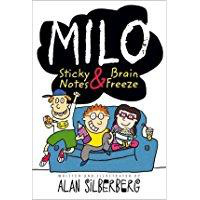
Well, it can if it's Milo, Sticky Notes, and Brain Freeze by Alan Silberberg.
The book is full of, well, not particularly helpful advice.
Dabney St.
Clair says that timing is everything, which is why I make sure to wear a watch every day, so I'm always ready, just in case.
That's our celebrity reader, actor Joshua Molina.
Our readers from Elliott Hine Middle School on Capitol Hill say the author used illustrations to help tell us more about Milo.
I feel like the cartoons in the book let it show how weird he was.
He's normal, but he's not trying to be like everybody else.
He wants to be his own person.
He does his own thing.
Writer Alan Silberberg says Milo's name appeared out of the blue one day as he was doodling in his sketchbook.
And I drew the name Milo and saw that the L-O of Milo's name was the beginning of the word loser.
This is the Book Club for Kids, the show where kids talk about books.
We'll tell you how you can be on the show a little later on, but first, let's hear from our readers.
Hello, my name is Elizabeth.
Hello, my name is Hazel.
Hello, my name is Sierra.
We are a 7th grader at Eliahan Middle School in D.C.
So the book is Milo's Sticky Notes and Brain Freeze by Alan Silverberg.
What's it about?
The book is about this boy named Milo, who is constantly moving, and recently his mother has died, and so he is going to school and trying to become this cool kid and trying to date this girl that he likes.
And he's new to seventh grade and like he keeps moving like this is his fifth house.
His mom died when he was in fifth grade and he forgot about her a little bit and like because his dad doesn't have pictures of her in the house.
It's sort of like Milo's journey to acceptance, because at first he's sad and then he gets mad, and then finally, at the very end, he accepts it and can move on and make new friends.
When I first picked up the book it didn't.
I thought it was just gonna be a goofy funny book, but it kind of changed.
The comics in it, or little cartoons, make it seem very light-hearted, but then you start to notice small details that are peculiar, and then, when it finally reveals that his mom died, it all makes sense.
I kind of underestimated the book because at first I thought it was going to be a kind of childish kind of book that really I kind of find boring.
But I kind of found it a little more interesting than I thought.
I thought it was going to be cliche because I
It's talking about how he's a normal 7th grader with a little bit of problems.
But then when it said his mom died, he tried to cover it up.
Like, oh, my mom died.
It's okay.
I was young and I really didn't understand.
But then when it got more farther in the book, he started understanding how much he missed his mom.
And he got mad at her at some points for not being there to help him through 7th grade.
Let's do talk about the cartoons in this book.
I feel like the cartoons in the book let it show how weird he was.
He's normal, but he's not trying to be like everybody else.
He wants to be his own person.
He does his own thing.
Like giving a test to his friends to see if they passed it and are able to be his friend.
They kind of showed who Milo was in a way, because he was also sort of silly, but he had Sort of like lots of hopes, and those are expressed through the cartoons.
Like he hopes to get a new friend and then they show the friend test.
Or like he hopes that he can go to the Halloween party and it shows you his types of costumes that he was thinking of.
Well, here's a scene from the book where Milo is trying to make a good impression on the most popular girl in school.
Our celebrity reader is actor Joshua Molina, who you might know from The West Wing or from the podcast he co-hosts, The West Wing Weekly, or perhaps from the TV show Scandal.
Here he is reading from Milo's sticky notes and brain freeze.
I've memorized Summer Goodman's school schedule and do my best to casually linger near the places she might happen to be.
Through careful planning.
My goal is to be in the vicinity of Summer, but not next to her or even within direct eyeshot.
I also ride my bike past her house as often as possible.
Even though we've been in school only a few weeks, I've mapped our whole relationship out and see exactly how Summer and I are going to celebrate our monthly anniversaries.
Of course, all this depends on my talking to her, which I have faith will definitely happen sooner than later, because I'm practicing every night in the mirror.
Dabney St.
Clair says that timing is everything, which is why I make sure to wear a watch every day, so I'm always ready, just in case.
I figure it's like when you go to a baseball game and bring your glove because it's possible a foul ball will come right at you.
And even though you're sitting under the grandstand roof, where no balls ever go, you wear that baseball glove through the whole game, which makes the popcorn you buy taste like dirt and oil and other stuff you can't even put a finger on, but probably already did.
And all that matters is you feel ready for the slimmest ever chance that the first stray ball in the history of baseball is going to be hit right at your impossible seats.
Marshall tells me I'm dreaming, but what does he know?
He's never been in love with anyone but his dog, and dogs don't know any better than to love you back.
So where's the effort there?
So until my perfect plan gets the chance to be executed and by executed I mean activated, not killed off.
Though when you think about it, maybe that would be a better use of the word.
Anyway, until that moment arrives when Summer Goodman and I hold actual hands and not ones that I draw on an empty page in my notebook.
Until then,
I keep busy and do what I always do, stuff.
You mentioned something, Sarah, about this wasn't how authors usually portray seventh graders.
What do writers get wrong when they're writing about seventh graders?
They don't get that.
Seventh grade is.
It's hard, but it's like I'm going to have someone to sit at lunch and all that type of stuff.
My experience in seventh grade is different, because our bodies are going through changes and we're going through different stuff that we don't know how to handle.
What else do writers get wrong about middle school?
Writers.
Usually they kind of write middle school as a place that's really tough and where there are lots of fights and there's just a lot of drama.
But at some middle schools, it's actually kind of the opposite.
Like there is drama, but not as much drama as the writers kind of explain.
And it's actually sometimes simple and not all as hard and disgusting as they make it.
For example, the cafeteria lunches.
Authors are always kind of writing how it's disgusting and all that.
And nobody eats it and kind of exaggerating.
But our middle school lunch is actually pretty good.
It's not that gross at all.
So, besides the cafeteria, what else do middle grade novelists who write about middle grade, what do they get wrong?
The fights.
They don't really talk about fights in books because they think it's bad.
In school, we do have fights every month.
What do you mean when you have fights?
People fight.
After school, in school, and every time it happens, people talk about it and like it's the top of the conversation.
To be honest,
And the bullying in certain books.
They show that people bully a lot, but that's not how real life is.
You get bullied maybe once like or twice in your life, but in books it like shows like oh, he gets bullied every day.
Nobody's ever going to like him and stuff, but there's usually one person that's gonna be there for them.
Did you like the book?
If I were at the library, I probably wouldn't pick up this book, just because it's not one of the types of books I like to read, because I'm already going through seventh grade, so I know what it's like.
I don't have to read about it.
What kinds of books do you like to read?
I like to read out-of-this-world stuff like out-of-this-world technology or magic, because that's more interesting, because the author has creative liberty.
Good book, bad book, what do you think?
I'd say it was a good book, even though it doesn't really fit the types of books I like to read.
Did you guys think that it would have been a more interesting book if he had chosen a different protagonist?
I'm not sure, because probably not if it was Marshall, because he's quirky.
But Milo is the one who's going through a lot and Hillary is trying to be a good friend.
I may have enjoyed Hillary's kind of side of the story better or her life story kind of better.
Hillary has a pretty difficult life with her parents being strict on what she can and cannot do.
And so I also feel like that kind of is as, I guess, dramatic as Milo's life is.
What else about this book that we haven't talked about?
Milo's dad made me mad at some points.
It's like he didn't care at some points.
He was a father, and he knew his responsibilities and cared about Milo.
But at the same time, he shielded his wife like, oh, she can be put away and replaced and stuff.
I disagree with Sierra that his dad was trying to hide away his mom.
I think that what was happening was he was trying to hide away all the bad memories and move on, but he wasn't doing it in the right way.
It was sort of like he was sweeping glass under a carpet where...
You're never going to forget and by trying to move on in that way, by just leaving the past behind and not treasuring it.
That was his main problem.
He wanted to forget the bad memories more than he wanted to remember the good ones, because every good memory it came with a price, because it came with a sadness.
You guys got some questions for our writer, Alan Silberberg?
My question is did you base the book kind of on your life growing up for your seventh grade year, or did you twist it up a little bit, or is it something that you just felt had to be made up?
It really is a story I didn't know I was going to write.
When I started writing the book, I just wanted to make up a funny story about a kid in seventh grade and I started the first chapter, actually not knowing who the character was, and the more I thought about it and the more I started thinking about what I was like in seventh grade.
All these memories from my past came up.
And because my mom had died around that time, when I was actually nine, the character of Milo and most of the story of Milo started flowing from a place of memory for me and remembering what I went through after my mom died.
So there's a lot in the book that's based on my life growing up and there's a lot in the book that's made up.
But together, they form this whole book that is called Milo.
My question is, why Milo?
Why the name Milo?
Where did you find that name?
Because I like the name.
It's just, it's not very common.
Well, that's a really great question.
And the answer is kind of silly.
When I was trying to come up with different names for the character I was doodling, which is how, I think, usually.
I'm in my sketchbook and I'm drawing pictures.
And I drew the name Milo and saw that the L-O of Milo's name was the beginning of the word loser.
And it's actually a cartoon that's on page nine of the paperback.
My loser.
Just it made me really identify with that's how he would feel about himself.
So I loved the name and I loved that it was different.
Who was the inspiration for Marshall?
Because he is Milo's friend, but he's also sort of weird and quirky.
A lot of people have some quirks, but not that many.
So I'm wondering if the author met somebody like that.
When I was growing up and after my mom died, a new kid moved onto the street and his name was Aaron and he became my best friend and he He was silly, he was smart, but he was a really good friend and he didn't have to say anything to know how I was feeling.
He was just somebody who, I guess, got me understood what I was going through and always knew how to make me laugh.
And then, because I needed him to be a little sillier, I drew from a bunch of my other friends and added different quirks, especially the quirk of um loving the freezies together.
That was from a bunch of my friends when we would go to the store down the street and get Slurpees and freeze them up and get brain freeze.
Aaron has read the book.
He recognizes himself.
And in fact, there's a character in the book called Sylvia.
And Milo at first just thinks that she's this old lady down the street.
But soon he learns to confide in her and they share stories together about loss.
And Sylvia is Aaron's mother, and they became a second home for me.
I grew up on a dead-end street and especially after my mom died, it was like I had lost a mother.
But I suddenly had eight other mothers all over the street who would take me in, and Sylvia was a very special person to me.
Why like Hillary?
I like her character.
She's a cool person.
She has a weird side, and then she has that friendly, soft side of her.
And I feel like her parents are like pushing away the bad things and showing her all the good things.
I felt like she had to be perfect.
I knew that Milo needed to have not just the best friend who was silly like Marshall, but somebody who got Milo on a different level.
She came into my mind as somebody who would understand more of his emotional side.
And I think the fact that Milo is coming from a broken home, I wanted her to have two good parents.
I don't consider them pushy.
I consider them just caring.
But I did base her on an old friend of mine who actually confided in me once that she collected all the broken doll pieces she could find because no one else would want them.
And I felt that that was just such a perfect way to describe a girl who sees Milo as the broken boy that he was.
All right, we're back to the ultimate question, which is what is your favorite book and why?
My favorite book is Holes.
I've read it a lot of times, and I really like it because the main character really develops.
But it also has a journey into the past, explaining the sort of bad fortune that has befallen the old town.
And it brings together mystery and also reality.
My favorite book is The Girl Who Fell.
It was good because at the end it showed how to get out of abusive relationships.
My favorite book is Out of My Mind because it shows you how you shouldn't judge a book by its cover, because the girl Melody has a bunch of disabilities but then people think she isn't capable of all the things that they are like talking, and they think she doesn't have any kind of thoughts of her own.
But really she does and she's really smart.
I like it because it just shows you don't judge a book by its cover.
It shows me that I may have made some wrong opinions on how people are and what they think because of how they look.
The people with disabilities, I guess, are trying to always prove everybody wrong and show them that they are more than what's on the outside.
And we should mention that Out of My Mind is one of our favorite Book Club for Kids podcast episodes and we'll have a link to that episode at our website, bookclubforkidsorg.
What about you, Alan Silberberg?
What is your favorite book?
When I was in second grade, I read a book called Half Magic by Edward Eager.
And it was a magical story about a family of kids who find a magical coin, but it's only half of the coin.
So all their wishes only come out half.
And it was just a story that has stayed with me all these years.
And I read it to my kids.
It sort of helped me become a writer.
That is my favorite book of all times because it really turned me on to reading as a young kid.
Your turn, Josh Molina.
One of my favorite books as a kid was Richard Scarry's Busy, Busy World.
It was published way back in 1965, a year before my birth.
And I'm happy to say that, having read it just a couple days ago to a three-year-old, the book holds up.
It's still very funny and very entertaining and a lot of fun to look through.
It's a big, bold book with lots of colorful, funny pictures.
Richard Scarry tells stories about different animals from all around the world.
And one particular story that I remember loving as a kid is that of Stumpa, the tuba-playing bear from Austria.
Stumpa.
Always loved it as a kid.
My family still will occasionally say, apropos of nothing, Stumpa, what a funny fellow.
Thanks, Stumpa, or Josh.
So what is your favorite book?
Want to be on the Book Club for Kids podcast?
Well, just give us a phone call and leave us a voicemail.
Our number is 323-639-3560.
That's 323-639-3560.
And if you are looking for a good book, we have lots and lots of suggestions at our website, bookclubforkidsorg.
This episode is funded in part by the Capitol Hill Community Foundation and the D.C.
Commission on the Arts and Humanities, an agency supported in part by the National Endowment for the Arts and by a grant from the Nora Roberts Foundation.
Thanks to our producer, Ilse Setziel.
Jonathan Jensen created our music with additional themes from Charles Nilman.
Emma Steinkeller created our logo.
And thanks to our readers.
This week, Sierra Hazel and Elizabeth at Elliott High Middle School in Washington DC.
And thanks to Suzanne Wells for arranging our visit.
We have a free newsletter for teachers, parents and librarians full of free tips about how to turn kids into lifelong readers.
Sign up at our website, bookclubforkidsorg.
I'm Kitty Felde.
Thanks again for listening.