From The New York Times, I'm Rachel Abrams, and this is The Daily.
You get benefits on the first, yeah?
Yeah.
And what happened today?
They just didn't load.
Says that they will arrive, but they will be late.
The Trump administration has agreed to restore some of the funding for the food program known as SNAP.
But there's still uncertainty about how much money will come through and when.
What would that normally look like today?
It would be like $7.80.
Is there an account balance?
I have 12 cents.
Tens of millions of Americans, one in eight, rely on SNAP.
Without federal assistance, many people do not know how they will provide for themselves or their families.
I adopted my grandson.
He's two.
And it's terrifying thinking I can't feed him.
Now that that's been frozen, I literally have nothing in the house.
It's not everybody's fault that Congress can't make a decision on a bill.
So they shouldn't punish the low-income family, the needy people, because that's what we rely on.
Today we hear from people in one of the communities most reliant on food aid and from my colleague, Tony Rahm, about the ongoing fight over SNAP, as the government enters its second month of a shutdown.
It's Tuesday, November 4th.
Are we getting going?
Looks like we're going to start rolling now.
Last Friday, Daily producers Olivia Nat and Anna Foley went to Kermit, West Virginia, a rural town of about 300 people.
How about candy?
Apples and meat, same thing.
One per family, up to two families per cart.
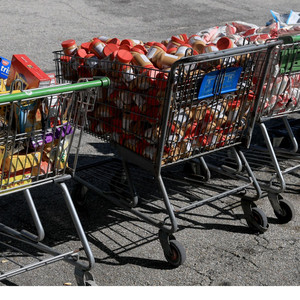
There was a mobile food pantry set up outside a Baptist church.
Volunteers loaded items including eggs, potatoes, plums, and cucumbers into people's cars.
Honey, that's good.
Thank you.
West Virginia is one of the top recipients of SNAP benefits in the country.
About 16% of West Virginians get food assistance through SNAP.
And even with the extra help, a lot of people rely on food pantries, especially at the end of the month and especially this month, when there hasn't been much clarity about whether benefits were coming or not.
Hi there.
My name's Olivia.
I'm with The New York Times.
Walking down the line of cars, Olivia and Anna spoke to people about what they were planning to do next.
I am.
You all want to talk?
My name's Anna.
So could you start by telling me your name and where you're from, how long you've lived here?
A little bit about yourself.
My name is Roy Messer, and I'm from Kermit, West Virginia.
My name is Teresa Hodge.
I live here on Stone Co., right down the hall.
My name is Brianna Lockhart.
I was a stay-at-home mama for a while but just recently went back to work because of the shutdown that's going on.
And what brings you guys out here today?
Well, right now, times are rough.
I mean, they took the food stamps, so you got to do what you got to do.
Feed your family.
I'm picking up for me, and I brought my cousin with me so she can... Get me.
Get some meat.
Yeah, that's what they said.
It was supposed to be meat and some food.
I've seen the list, and they have turkey and eggs.
If that'll work, at least I'll be able to have something for Thanksgiving.
What can a box of food do?
Like, what is the impact for your family?
Well, that's going to be able to effectively feed my family for an extra week.
You know we're going to be in a struggle to make sure that it's either going to be food or bills, because even though my wife works full time, we still depend on SNAP benefits to help get us through buying the extra meat and stuff like that.
Since there'll be no stamps, this food bank will be the only food I have to go in my house.
How much money do you receive, if you don't mind me asking?
Snap, $136.
I think it's like $292.
I get a whole $63.
How far does $63 go for you?
Two bags.
And you might get a box of crackers, maybe.
You know, even with your food stamps, usually about two weeks before the month comes back up, you're skimming tight.
You're running to food banks trying to get help, you know?
It's just plain and simple.
Can you describe what a dinner would look like with your SNAP benefits?
And then, if you can imagine, you know if you don't have the SNAP benefits what a dinner looks like in that situation too.
With the SNAP benefits we don't have a good southern meal like fried chicken and green beans, mashed potatoes all the good stuff rolls, all that.
But without, it's more like hot dogs and ramen noodles and stuff like that.
And that's just not healthy.
It's really not.
When did you find out that you probably weren't going to be receiving benefits for November?
About two weeks ago.
When the government got shut down, we kind of had an idea that you know like, if people aren't going to get paid their salaries, then government assistance is going to be the last thing they're worried about.
And you know, when that realization kind of struck you, how did that make you feel?
It made me feel less important to my lawmakers than what I used to feel.
I served our country in the Navy and it's like I feel like my family, as veterans, doubly gets looked down upon because we just get cast aside.
We're angry.
We're angry.
Because, you know, we do count.
To be honest, I have a lot of hatred.
Like, and Trump was one of those that I was all for.
But now I feel like he's more about the money and helping the rich and like not caring about the people that really do need help.
The Democrats down there, they don't need to be getting their payday, but they're all rich people.
So, you know, it don't hurt.
Their kids and grandkids ain't going to go hungry.
You know what I mean?
What are your plans for making ends meet this month?
Hunting season's coming in, so that helps out a lot.
You can't really depend on the government really for nothing, so you got to... Eat more squirrel.
And deer.
If I had children, I'm going to tell you something, I'm going to feed them babies.
Whatever it takes to do it, I'm going to feed them.
You think people might get really desperate?
They are now.
We're going to be against each other over something as simple as a loaf of bread before it's over.
There's already people that have to decide between food and their medicine.
Have you ever had to make a choice like that?
A couple of times.
A couple of times.
And if it wasn't for this food bank about two months ago, if it wasn't for this food bank, me and my little grandson would have starved for about 10 days.
We eat mashed potatoes and macaroni for four days out of this food bank.
And I wouldn't have had nothing to eat with that little boy if I hadn't of.
And most of the time I didn't need it all because I'd make sure he had something.
I'm so sorry.
And yes, it's very upsetting.
You can understand that, right?
And I think it's a sad state of affairs when poor people that are not able to work anymore and I've worked, believe me, my whole life can't even get away to eat.
Coming up, my colleague Tony Rom explains the standoff in Washington that's delayed SNAP funding.
We'll be right back.
So Tony, we just heard from people that our producers interviewed at a food pantry in West Virginia and we heard a lot of confusion and a lot of worry.
Could you explain what is going on with SNAP funding right now?
SNAP is in a very difficult place.
And the concerns that you're hearing out of West Virginia are concerns that we're hearing nationally, as this shutdown now lapses almost into its sixth week.
SNAP is a program that serves about 42 million people across the country.
And even though it's a permanent fixture in law, lawmakers have to put money into that program every year.
But because the shutdown has gone on so long, SNAP has exhausted its normal budget.
And so that's left this program at a bit of a crossroads.
You've been following some legal challenges to the administration's position that it wouldn't or couldn't release any SNAP funding.
What is the status of those challenges?
We've seen a number of cities and states and nonprofits file lawsuits against the Trump administration over the way that it has handled SNAP during the government shutdown.
And this all stemmed from a decision that the administration made just a few weeks ago.
Initially, USDA said it was going to tap a special set of emergency funds to pay SNAP benefits if the shutdown dragged into November.
This is a pot of money that was roughly about 5 billion or so as of late October.
That's supposed to be used in instances where SNAP doesn't have enough to cover benefits for everybody.
And that's a lot, but still not enough to hit the roughly 8 billion or so that it needs every month to keep those benefits flowing.
But sort of abruptly, the administration said it wasn't going to use this money after all.
And that created this huge fiscal financial cliff that we were seeing for the program as we entered November.
And so cities and states and religious groups and others filed lawsuits against the administration, essentially to force the release of funds.
In both cases, federal judges have found serious issues with the way that the Trump administration has handled the SNAP program.
But only one of those courts, at least so far, has ordered the administration to spend that money and told the administration that it had until Monday to essentially say how it was going to do so.
We finally got that information from the administration.
And the short of it is that the Trump administration is just going to tap only the small set of emergency funds that it has for SNAP and not some of the other money it has laying around across government.
And as a result of that, it's going to make partial payments to people, but those partial payments may be perhaps half of what families are expecting to see in the month of November.
And it's not even clear when that money might reach the millions of people who depend on SNAP.
So while in some ways it was a bit of a victory, for people who subscribe to this program, it's a little unclear if it's actually going to provide the kind of relief that these families truly need.
Is there any precedent for any of this?
Has anything like this happened before?
No, no, we haven't seen anything like this with the SNAP program.
I mean, there are fights around federal safety net programs all the time.
But you know, both sides admitted while they were in court that there had never really been anything like this.
So I can imagine that this is really confusing to the 40 million people that rely on this funding to feed themselves or their families.
Can you remind us who are these folks?
What does the money get used for and how exactly does the program work?
So SNAP is the Supplemental Nutrition Assistance Program and it's the largest anti-hunger program that the federal government offers.
There are about 42 million or so people who receive benefits under SNAP every single month, which amounts to about one in eight Americans.
And these are people located all over the country.
They live in rural and urban areas.
They live in Democratic and Republican-leaning communities.
Many of them are children.
Some of them are veterans.
They're seniors.
It's a pretty wide swath of the population that relies on this critical federal safety net program.
But there are some restrictions to it.
Generally speaking, to get on SNAP you have to make or earn an amount of money near the poverty line.
For people who qualify.
The average benefit per person is about 187 a month, which is critical to helping these people buy groceries but doesn't go all the way in meeting all of their nutrition needs.
And so that's why SNAP is part of this bigger picture of food pantries and other services that help address the issue of hunger here in the United States.
And, in short, the way it works is that the federal government approves money for SNAP and eventually that money makes its way to states and onto benefit cards that millions of Americans use.
How did SNAP end up in the crosshairs of the administration to begin with?
SNAP has been in the crosshairs of Republicans for some time now.
It even predates this administration, because there's a belief among Republicans that many of the people who receive those benefits don't actually need them or don't deserve them.
And so we've seen a number of instances in which Republicans have led efforts to restrict who can be part of SNAP and the kinds of benefits that people can receive.
And we saw this most recently in the context of the debate around the president's tax package, where one of the ways Republicans offset the massive cost of that bill was to cut SNAP, to impose new work requirements on recipients, which helped save Washington some money, but also created a situation in which millions of people may lose access to benefits as a result.
And so in many ways, what we're seeing right now is that play out on a much larger scale.
Because, while President Trump has been willing to move around various pots of money within the budget during the shutdown to ease some of its impacts, he's largely done that for programs that he personally cares about or those that may be essential to his political agenda.
But in others, like SNAP, where Republicans have long sought to cut, this administration has not been as generous and hasn't been as willing to move money around.
And indeed, that's why this administration is only providing partial payments.
It's because a court has told them to.
Basically, what you're saying is that during the shutdown, the administration has found ways, sometimes questionable, sometimes temporary, but nevertheless has found ways to pay for other things it needs to fund, like the military, for example, other federal employees.
So this feels a little bit more deliberate.
And I just sort of wonder what purpose withholding SNAP serves politically.
In some ways, this is about political retribution.
If you rewind the clock back a few weeks, when President Trump was asked about the shutdown and how he was going to handle it, he said that he was going to go after.
Quote Democrat programs.
And President Trump at the time didn't really explain what he meant.
He didn't identify anything specific.
But what we have seen since the president made that threat is a very deliberate effort across the administration to cut funding streams that they associate with members of the political opposition.
And even President Trump sort of acknowledged this just a few days ago when he said that the SNAP program was one that largely benefited Democrats, that most of the people on the program were Democratic voters.
We know that that is not indeed the case.
But throughout all of this has just been this very clear effort to go after areas that Democrats like in a bid to pressure them into coming to the negotiating table.
How does this fit into sort of the larger agenda of the Trump administration vis-a-vis cutting the government, shrinking the government, cutting programs?
Yeah, in many ways, this fight, this crisis around SNAP is just a microcosm of everything that President Trump has been trying to do with federal spending since he returned to office.
You know, on one hand, this is about rethinking the size and the reach and the role of government in Americans' lives.
And you can see that in the programs that the president has looked to cut internationally.
That's cuts to federal health and education and science and research and other programs.
And the reality that his budget for the 2026 fiscal year, if Congress were to adopt it, would set domestic spending at its lowest level in modern history.
But beyond that, the other really dynamic facet of all of this is that President Trump and his top budget advisor, Russell Vogt, have gone to great lengths to recalibrate the budget without the approval of Congress, which has that power of the purse under the Constitution.
They have closed entire agencies and laid off droves of workers and halted billions of dollars in federal spending enacted by Congress without getting lawmakers' support.
And so the SNAP program just really sits in the middle of all that, because it shows the ways in which the president wants to rethink those federal safety net programs and the cuts that he aspires to make, but also the ways he's willing to use presidential power to achieve them.
So now that the administration has said that it will comply with the court order and find a way to fund the SNAP program at least partially, how quickly does that mean that people who receive SNAP benefits will actually see that money in their accounts?
Yeah, that's the big question.
And in short, we just don't know yet.
Because the Trump administration previously told the court that, by providing partial payments, it could take potentially weeks or maybe, in some cases months, before the federal government and the states could get these benefits out to the millions of people who depend on them.
This could have been avoided potentially, if the government had chosen to provide full payments and had tapped other sources of money to backfill that shortfall.
But the Trump administration opted not to do that.
And, as a result, millions of people still find themselves facing the same uncertainty today that they did a few days ago about when that next snap payment is going to arrive.
Which makes me wonder.
Just to go back to West Virginia for a minute, a state that Trump won handily in the last election.
People are angry and people are confused.
They don't understand why they're losing their benefits.
And so it sounds like the political calculation is that this will ultimately benefit Republicans more especially in the shutdown negotiations.
But do you think that that is correct?
What is your assessment of the political calculation that's been done?
Yeah, I think they bet that A it will be the kind of thing that pressures Democrats into negotiating and, B that, absent that, the president can accomplish what he proposed to do as part of his 2026 budget even without having Congress vote on it.
Whether that translates into a victory in the eyes of the American people remains to be seen.
I think there have been times where people have blamed the administration for the cuts across government and the ways that that's affected their daily lives.
But there's also been times where I think people just blame what's happening on just the general mess of Washington.
And the result isn't that they see it as the work of one party or another, but just another chip away at their confidence in the work of government.
And so I think that's in many ways one of the lasting repercussions here.
It's just another instance where people look at Washington and think this place isn't doing anything for me and I can't count on it for help when I'm in my greatest need.
And so in many ways it really just distills how bad things have gotten here in the nation's capital and the real people who might be hurt in the process when the two parties can't talk to each other.
Tony, thank you so much.
Thanks for having me.
We'll be right back.
Here's what else you need to know today.
Kimberly Clark will buy Kenview, the maker of Tylenol, for 40 billion, a signal that the consumer products giant is betting that the painkiller can weather a barrage of attacks from President Trump and his administration.
The president and others have made unproven claims that the use of Tylenol and other acetaminophen products during pregnancy can lead to autism.
And President Trump weighed in on the race for New York City mayor on the eve of Election Day.
In a social media post, he endorsed former Governor Andrew Cuomo in his uphill battle to defeat Assemblyman Zoran Mandani, the Democratic nominee.
And he vowed to limit federal funds going to New York City if Mandani wins.
Today's episode was reported and produced by Olivia Nat and Anna Foley, with help from Muj Zaydi.
It was edited by Patricia Willans, with help from Paige Cowett, and fact-checked by Susan Lee.
It contains music by Marian Lozano and Dan Powell, and was engineered by Chris Wood.
Special thanks to David Fahrenthold, Rachel Culbertson, and the Facing Hunger Food Bank.
That's it for The Daily.
I'm Rachel Abrams.
See you tomorrow.