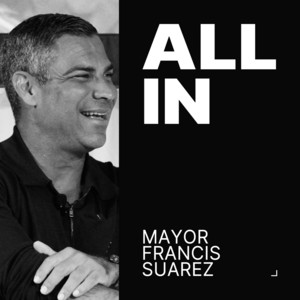
43rd mayor of Miami has served two terms since 2017, and his tenure is going to end in September because he's term -limited.
Although I hear these days that's flexible.
Please welcome Francis Suarez.
We were ranked the happiest city in America, the healthiest city in America.
The formula for success is simple.
Keep taxes low, keep people safe, lean into innovation.
How are things going in Miami?
Obviously, you know, we talked to you a couple of years ago We had our first all -in summit here.
And you had a no -nonsense approach that you thought was gonna work with the homeless challenges that we're seeing.
I think, candidly, we discussed a large portion of the homeless problem in these major cities is an addiction problem.
And, you know, giving a junkie a home doesn't exactly get them off the street.
It just does this work.
And you were one of the first people to say that plainly.
How are you dealing with it?
Has it gotten worse, is it an intractable problem?
Yeah, take us through it.
So in homeless specifically, we are at an 11 -year low.
We did our census, we do two census a year.
We do one in January, one in the summer.
And our January census had us at an 11 -year low at 546 homeless, unsheltered homeless in the entire city of Miami.
We have a couple thousand sheltered.
And I actually raised money on an annual basis as a mayor's ball.
I did my mayor's ball last year and this year.
I'll be doing it in May 31st to end homeless We want to be the first major American city to have zero homeless and we think we can get there we call it functional zero And and and frankly the the strategy is not that complicated, you know, obviously there's a macroeconomic strategy We have a lowest unemployment in America.
We have the highest median wage growth in America We I lower taxes to the lowest level in history and we've seen a hundred and forty percent growth in nine years So, the economy is robust. We were ranked the happiest city in America, the healthiest city in America.
Frankly, if you're happy, you're healthy, and you're working, you're probably not homeless.
And then, of course, we've done innovative things in the homeless space.
We've worked with charitable organizations that help people reunify families if they live in other parts of the country.
And also, we rent homes so that we can get around the building process and give all the same wraparound services, but we sort of hack through that process.
Those 500 individuals who are categorized as homeless, Yeah.
How many of them are suffering from mental illness and or self -medicating slash addicted to drugs?
A very high percentage.
I would say 80 percent -plus.
Right. And that's sort of anecdotal.
And I've been out there to the streets, I'll be out there before my homeless ball now on May 31st. I'm actually going to spend a night out on the street.
And when you talk to them, when you engage in them, a vast majority of them are unfortunately.
Okay. So, let me double click on that.
this problem wasn't as acute before the super drugs meth, like the serious...
Well, the really serious ones they're making out of fentanyl...
And fentanyl, right?
This combination seems to be, you know, we had people addicted to heroin, like Miles Davis and like Philip Seymour Hoffman, who produced incredible art and were addicts for 30 years, and they went in and out of it.
But this drug is pernicious, different, deadly, super addicting.
how much of the problem are those two drugs specifically, if you double clicked on it?
A big part of the problem - heroin or opioids.
He's asking for a friend, by the way.
Yeah. I'm asking you.
You have a hookup. No, but I'm being deadly serious because we had these homeless individuals in New York, you know, back in the day in the 70s, 80s.
They were kind of like hobos and vagavonds, not seriously addicted, you know, suffering where they're folding over and curled up in a ball from fentanyl.
Well to your point, I mean meth and and the opioids are incredibly addictive and they're very hard to beat, right.
I mean even people who are wealthy and get addicted to these drugs have a very hard time.
The recidivism rate is very high.
And so you know you just had Antonio on here a minute ago and he was talking about you know immigration and the border and one of the big problems with the border is that tens of thousands of people that die annually because of fentanyl that gets imported through China and through our border and so there's a tie -in right between federal policy and and local policy but for us again in 1980 during the cocaine era different drug we had 220 homicides so you had drugs hurting people but you had the business of drugs very much hurting people right yeah last so we started recording homicides in 1946
in Miami 1946 we had 32 homicides from 1946 to today, the lowest number we ever had was 24.
Last year we had 27.
Wow. Okay we had 220 in 1980.
This year we're trending below the 24, so we may, this may be the safest year in the history, recorded history of Miami.
Can you connect those thoughts.
Like I think when people think about social policy, everybody confuses the correlation and causation.
But you've been in the seat now for a time.
So you've seen what hasn't worked, what has worked, what maybe has been correlated, but if you had to sort of like lay out the roadmap for other cities but frankly for other states, the rest of the country, what's the roadmap, the Frances Suarez roadmap?
The formula for success is simple.
Keep taxes low, keep people safe, lean into innovation, right?
Can we just double click into those?
Yeah, of course. Let's take the other side of these things just to help the conversation, because I believe in them but let's try to steelman the other side.
Keep taxes low. What people say, if you look at California and if you look at New York, what they would say is we have a duty to invest in the social services and the infrastructure to support everybody that isn't necessarily as well off or didn't get the right side of luck and we need to raise taxes in order to generate the revenues to fund that.
My counter -argument would be government is not a good purveyor of those services.
It's not an efficient purveyor of those services.
So just to double click, right.
I lowered taxes to the lowest level in history.
And I took the city in 2009 as a councilman out of bankruptcy.
So I got it in bankruptcy.
We decided, this is sort of the doge before doge.
We decided not to raise taxes.
We cut costs. We cut, you know, we didn't let anyone go.
But we had tiered salary cuts, pension reform, and we balanced our budget.
And we had 10 years of prosperity.
And that prosperity led to a tripling the size of our government.
So we went from a $500 million government to a billion and a half to our government while lowering taxes.
So we grew 200%, right?
So the resources that we had to dedicate to these actually went up, even though taxes went down.
And then, you know, when you have a place where there's prosperity and where people are investing and where people are employed, there's not as many social problems. So they're not out there killing people, They're not out there hurting people.
So the 1980s, we were one of the murder capitals of America and we're now one of the safest big cities in America.
And then I think, you know, the, how can I help moment that you guys are all familiar with, was this juxtaposition with what American cities were doing, right.
Famously, New York competes for and wins the Amazon HQ2 prize.
Right. And then rejects it.
Rejects it, yeah. And also famously in California, you had a, I guess there was a legislator that said F Elon Musk.
Yeah, Elana Gonzales.
Exactly. And he replied, message received, and he left. And then, she went to run a union, right?
That's where she ended up?
Yeah, I think she went to work for a union.
She's the CEO of one of the big unions now.
But the issue is what I tell people is, look, it's bad enough to kick out a trillion dollar company from your city, or the richest person, arguably, in the world from your city.
But think about the signal.
The signal, to me, is much, much greater.
The signal is, if you want to bring another headquarters, or if you want to be another company, we just got FC Barcelona.
Two days ago, we announced that F .C.
Barcelona moved their headquarters from New York to Miami.
Every single day, we announced $900 million of loans in two projects in the last two days in two buildings, our stadium, our Inter -Miami stadium.
We have the FIFA World Cup headquarters for 2026 in the world, right?
So, I mean, this formula for success would seem simple.
Other cities are getting it wrong completely backwards.
Their taxes are high, it's not safe, and they're not leaning, they're rejecting innovation.
Are there downsides to growing this fast?
Are there things that have to keep up that are harder to change, like building code, housing density, those sort of cost of living things.
Have those, have you guys been able to drive reform there, or is that not where you want it to be?
Ken Griffin recently was interviewed in a fireside chat like this and said, I'd rather have the problems of success than the problems of failure.
And so there's no doubt that there are problems that stem from success, right?
housing prices, we had a tremendous amount of inflation in the last administration and you sort of couple that with hyper demand here in Miami and you get hyper inflation right.
So housing costs have certainly gone up significantly and we do everything we can to leverage public dollars and public assets like land to try to build projects at up fifteen to one or twenty to one leverage rate so for a hundred million dollars invested we'll get two billion dollars worth of products.
There's a five million housing housing shortage across the country, and Miami has its fair share just like any other major city.
Traffic, I know none of you guys have experienced any bad traffic these last few days.
I was in the car two hours and forty minutes going over to that.
I'm not going to tell you how far along we are with a boring company on trying to find underground boring systems, or with some of the eVTOL companies that we're working with.
But I do think that transportation generally has to sort of turn the page from last generation's archaic solutions to the next generation.
How did you get that train?
And what do you call it?
The Sunshine Line or something?
Bright Line. The Bright Line, yeah.
How did you get that done so quick?
And everybody says it's the greatest thing ever.
That's a private sector project that was done by a company.
We had a piece of it.
Which was we did a piece with Tri -Rail to bring it into the station.
And when we did that piece we made it free for inner city residents to be able to use.
So it was something that I was very proud of, was part of my legacy.
So a private company built it.
You gave them the right of way.
No, they had the right of way.
So it was totally private.
So, look, we have micro -mobility options that are private like scooters.
All you did was just not get in the way.
Exactly. Shocking, by the way.
Shocking. Wow, what an idea.
Well, what an idea.
Let me ask you, how can...
It's like the Hippocratic oath, do no harm.
Do no harm. How can mayors address...
They come into office with a reform motivation, and they're elected on, hey, we don't have what Miami has.
We gotta fix this. We gotta get the city working again.
and we got to attract business, we got to attract growth.
And they inherit this regulatory morass, this massive infrastructure.
Like San Francisco recently, I got all caught up in the fact that you can't put these phone booths in your office, in a lot of startups, I don't know if any of you guys have these, these phone booths, you got to have someone go in and make a call, you put the phone booth in.
And all my startups, all the companies that were involved in.
Wait, you can't put one in San Francisco?
So you put these phone booths in and then you can go in and make calls.
So when everyone's in an open desk configuration but you gotta do a private call.
You hop in, everyone loads up their offices with these phone booths.
In San Francisco, they're illegal.
Turns out that you need to run, and there's a piece of paper which I was actually gonna tweet because it's insane, it's like three pages long.
All the things you need to know about the phone booths that you wanna put in your office.
You gotta get an architect review, an engineering review, a design review.
You gotta get sign off from the engineer.
You gotta submit the permitting fees.
It gets reviewed by the City Inspector's office.
You gotta design fire sprinklers that have to go into the phone booth.
In case there's a fire in the phone booth someone needs to put out the fire.
That's hilarious. So I was talking to some folks about like what are you going to do about this?
But the mayor's kind of like I don't know if there's enough action that I can take because it's in law that there's all this kind of regulatory stuff.
How do you advise mayors that are stuck with this sort of an environment?
And this is not just San Francisco.
There's a lot of big cities in this country that have books and books of this stuff and We can talk about, philosophically, why this has happened.
Sociologically, why this has happened.
Books and books of this stuff where the city can't get out of the way.
What do the mayors do?
And when you guys get together, is there any advice or are we stuck?
What's the solution?
We're not stuck. I think it's cultural, right?
At some level. You have to inculcate a culture where you empower your employees to innovate and to de -conflict.
I think when people come to me with a problem, I say look, first issue is, if there's something that's blocking it that doesn't make any sense, why don't we just change it?
We're legislators. That's what we do.
We legislate, so we can fix it.
Maybe it happened, maybe it made sense 20 years ago, maybe it made sense 50 years ago.
It doesn't make sense today.
Let's just change it.
I think regulation is the other side of the coin from innovation, right?
So regulation is telling you times what you can't do, or how to do something.
Innovation is to protect loss.
It's sort of a first principles thinking, we want to do this, right?
we want to make this work.
And I think I always, not always, but I regularly fall on the side of innovation.
And I think you as an a public official, frankly who's elected by the people, really are the one that has to push the bureaucrats, the bureaucrat class, right.
The bureaucrat class, they get very accustomed to saying no, they're risk adverse, you know, they're not incentivized oftentimes, there's no incentive structure that says hey if you innovate, you're gonna get X or Y or Z.
And then I think the third piece of it is artificial intelligence.
I really feel that there's a breakthrough that's going to come.
It's not just in transportation.
We're talking about EV tolls and underground boring and all that.
But I think in zoning codes and and all that, it's going to be computer to computer.
The codes are all straightforward. We have the same code for 15 years.
Probably 97 or 8 % of all known decisions have already been made under this code.
All you have to do is be replicated going forward. That's the code changes and then you just change the coding and you make the decisions all over again.
So it's not that complicated.
You should be able to submit something.
The computer should be able to spit it out immediately.
If it needs changes, it should tell you what the changes are.
A computer can look at that, make the changes and spit it back in.
And if you were to do that, it takes to get a permit on a home in most places in America or on a building in most places in America, six months, nine months, a year, a year and a half.
I mean, it's insane.
It should be done instantly.
And it could literally be done instantly with the technology that we already have available to us today.
Hundred billion dollar business, by the way, in case anyone's...
It's a great idea. It's a killer idea.
I think some startups have worked on it, too.
I know multiple that are working on it.
Yeah, they're working on the other side of it.
Building on Friedrich's point, the two best proposals I heard about regulations, and I'm curious if you could steel mill them, or just how practical you think they are, putting a time limit on regulation.
So if you fought for some regulations around these phone boots, back when phone boots, you know superman changed his costume in them from the 60s and 70s like back from that era maybe it lasts for 20 years and then it expires or you want to add two regulations to office space regulations you got to take one off the books you know and those were the two proposals I've heard some way of timing these out or if you want to add you got to you got to find something to take off or either those practical I couldn't like the first one better than the second one okay the second one I mean this sort of one
-for -one I mean there's gotta be a to do one or the other, right?
I like the first one better.
Actually what we normally do in government is the opposite.
What we do is we do what we call pilots, right, so you'll do something that goes away very quickly, right.
In other words, you implement a piece of legislation say, we're gonna do it for a year.
Let's test it out, right.
And it's a pilot and then it goes away.
I like what you're saying in terms of, you know, a big part of regulatory culture can probably be phased out over a 15 -20 year period as being anachronistic, right?
it just doesn't work anymore.
5 % a year get reviewed and the government's responsible for reviewing 5 % a year for 20 years, and they re -certify it or let it come?
100%, right. And then you have the ability to re -implement it if you think it makes sense, but I think what happens is you go back down to zero.
You were asking and Tony, and I was listening to the conversation, because we did it like I said, we have to cut our budget by 20 % in one year.
And part of the problem is budgeting is like layering, right?
It all layers on top of each other, same as regulation, it layers on top of each other.
So, if you were to be able to strip it down in a mechanical way, right, and in an instantaneous way, as opposed to having to fight the structures.
In our case, we're very lucky, there was a state statutory vehicle that allowed us to implement the cuts.
Otherwise, we'd have to bargain for them in a union process.
And obviously, no one would ever bargain to cut their salaries or never bargain to cut their...
Nothing would have happened.
Nothing would have happened.
We would have been bankrupt.
And then a court would have taken us over.
We would have looked like a joke.
And instead, we cut costs, and we survive, and we thrive, right, going forward. And by the way, my employees now love me.
They were not happy the first couple of years when we did it.
But now they... I don't even have to go to a union interview when I run for office.
They just support me right away.
Do you want to be governor?
I don't think it's quite that simple.
I want to dunk. I want to dunk.
Yeah, I want to be able to dunk, too.
Look, I think that I'm a Republican, for those of you who don't know, and the president's already weighed in on the Republican primary.
I respect the president's perspective.
I have a good relationship with Congressman Donald.
So, I think politics is very circumstantial.
We've talked about that a lot in the past. So, you know, things sometimes conspire in your favor, things sometimes don't, right?
And I do think it is circumstantial.
So, I think you have to weigh the circumstances.
You know, I ran for president because I had a thesis.
The thesis was urban voters, Hispanics and young voters, if they went Republican would favor the Republican candidate or Republican candidate win.
And they did it just wasn't me.
Right. It was a different candidate.
But, you know, the president did a great job on podcasts, right, going on all these podcasts that, you know, the vice president didn't do.
And he got young voters and he got urban voters.
Republicans never gonna win Philadelphia.
Right. Trump lost Philadelphia to Biden by 85 percent, but he lost Philadelphia to Kamala by 75 And that delta, the 75 -85, that 10 percent delta gave him Pennsylvania.
Yeah, that's the election.
Which was such a crucial state, right?
Like arguably the winning state.
So you know Republicans are never going to necessarily win urban votes or the urban population centers throughout America.
But you're also seeing, and I think it's important to note, you're seeing Democratic mayors lose across America.
London breed lost in San Francisco.
Yeah. Tashara Jones lost in St. Louis.
The mayor of Chicago, Lori Lightfoot lost. On that point, you were the, or still are the, I was.
I was a President of a U .S. Conference of Mayors for a year and a half.
We had to ask you. You can't live in Miami.
Yeah. You met all those mayors who, where are two places that you think are actually well run that aspire to do something great and have their shit together?
Cities? Take your time.
Don't jump to an answer.
I'll tell you a mayor that I like, how about that?
Justin Bibb. Justin Bibb is mayor of Cleveland.
We got a couple of Cleveland people here?
Apparently. There we go.
Justin is a good friend.
I have a lot of friends that are mayors.
I'm a mayor, you know, I love all my mayors because I was president of that institution.
But I think Justin is a young, dynamic guy who's smart, not super partisan, cares tremendously about his city and we talk a lot about it because obviously, Miami and Cleveland are little different, right?
That's fair. And we joke about it.
He says, I wish I had the kind of problems you have. To go back to sort of the Ken Griffin quote.
They don't struggle with affordable housing.
They got plenty of affordable housing because people don't necessarily want to live there.
Sorry, I love you bro, but it's true, right?
It's kind of true. So, he's dealing with economic development.
He's dealing of getting investment getting the tech community there, getting people special people to move into his community and believe in his vision.
And I think the company building is hard as you guys know you guys have built some incredible companies.
Ecosystem building is even harder.
It's 1000x harder than building a big company.
I mean companies take years into decades and ecosystems take decades into centuries.
It's too different.
Is there something that inside of the next gubernatorial campaign let's say you don't run for governor that's a high impact job at the state level.
Not really. I get to practice and I have a private sector life.
I have an 11 year old and a 7 year old.
So I mean if the president called me and said you know I want you to be the U .S. ambassador to you know a country that I have a passion to help you know in terms of the United States in terms of their relationship and world peace and things of that nature which I think are high ROIs for for the time investment and this financial sacrifice that you have to make.
I would strongly consider it.
But other than that, I mean, I'm, I live a very blessed life.
You know, I am the mayor of the best city on the planet, you know?
And I have incredible, incredible, incredible bosses.
These are my bosses.
I have the best bosses in the world.
Yeah. And they're constantly encouraging me.
They're constantly cheering me on and and I live and breathe for them.
I wake up early in the morning.
I go to bed late and I carry their problems, their hopes and their dreams of my soul.
All right. Give it up for Francis Suarez, your mayor.
Thank you to our friend Francis Suarez, the mayor of Miami, for joining us on stage at our F1 event.
And thanks to you, the audience, for tuning in.
Give us a like, a thumbs up, a subscribe, write a review, whatever you're into.
Maybe send it to a friend.
If you want to come to our next event, it's the All In summit in Los Angeles.
Fourth year for All In Summit.
Go to all in dot com slash events.
apply. A very special thanks to our new partner.
Okay, X, New Money app.
Okay, X was the sponsor of the McLaren F1 team which won the race in Miami.
Thanks to hider and his team an amazing partner and an amazing team.
We really enjoyed spending time with you and okay x launch their new crypto exchange here in the US if you love all in go check them out and a special thanks to our friends at circle.
They're the team behind us DC Yes, your favorite stablecoin in the world The USDC is a fully backed digital dollar, redeemable 1 for 1 for USD.
It's built for speed, safety, and scale.
They just announced the Circle Payments Network.
This is enterprise -grade infrastructure that bridges the gap between the digital economy and outdated financial rails.
Go check out USDC for all your stablecoin needs.
And special thanks to my friends including Shane over at Polymarket, Google Cloud, Solana, BBNK, we couldn't have done it without you all.
Thank you so much. And a dog taking a whiff of your driveway.
Thanks. Oh, man. Oh, man.
My appetizer will meet me and put him down.
We should all just get a room and just have one big huge orgy, because they're all just useless.
It's like this sexual tension, but they just need to release them out.
What?! You're the B.
What! You're the B.
You're the B. We need to get merch. I'm going all in.
I'm going all in