The round was 100 million.
And the price was?
It was at 2 billion.
I think we'll live in a world with many, many models with different use cases.
We're already seeing this with a lot of application layer companies, where they all have these specialized use cases for how they want to leverage the models.
I think being a recruiter is the highest prestige position in any company.
The recruiter is the one who controls the talent inflows and outflows of every company.
And pretty much you can gather all you need to know about a company from seeing the talent inflows and outflows.
The businesses that succeed in a world where software costs approach zero will be built on network effects.
This is 20VC with me, Harry Stebbings, and today we have an exclusive.
One of the fastest growing companies in Silicon Valley right now.
McCore has closed a 100 million round at a 2 billion valuation, led by Felicis.
They are exceptional for many reasons.
They scaled to $70 million in ARR in just 24 months.
They are famed for working six days per week, 9 a.m. to 9 p.m.
All of their founders are teal fellows.
And with this latest round, they are also the youngest unicorn founders ever.
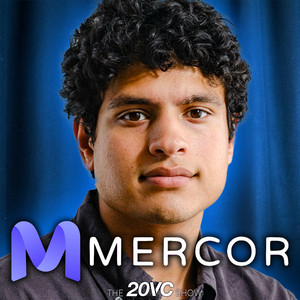
Today I sit down with McCaw's co-founder, Adarsh Hayamath.
But before we dive in today, here are two fun facts about our newest brand sponsor, kajabi.
First, their customers just crossed a collective eight billion dollars in total revenue wow.
Second, kajabi's users keep a hundred percent of their earnings, with the average kajabi creator bringing in over thirty thousand dollars per year.
In case you didn't know, kajabi is the leading creator commerce platform, with an all-in-one suite of tools, including websites, email marketing, digital products, payment processing and analytics, for as low as 69 per month.
Whether you are looking to build a private community, write a paid newsletter or launch a course, Kajabi is the only platform that will enable you to build and grow your online business without taking a cut of your revenue.
20 VC listeners can try Kajabi for free for 30 days by going to kajabi.com forward slash 20VC.
That's kajabi.com, K-A-J-A-B-I.com forward slash 20VC.
And after building your online empire with Kajabi, it's time to scale your global team with remote, seamless hiring solutions.
So every business is a global business in 2025.
But how do you do payroll for your global business and team and comply with international labor laws?
Well remote handles payroll benefits taxes, stock options and compliance.
To help companies of all sizes pay and manage full-time and contract workers all over the world.
No matter where your team lives or works Remote's global employment solutions.
Keep your team, your finances and your intellectual property secure.
Remote never charges hidden fees, just best-in-class global employment solutions for a low flat rate.
The world's top remote companies love Remote.
GitLab, the world's largest all remote organization, trusts Remote to run their global team.
Remote is funded by Index Ventures, Sequoia Capital and the host of the greatest podcast ever, Harry Stebbings, and 20VC.
Ready to learn more?
Head over to remote.com forward slash 20VC, that's 20VC, and begin hiring within minutes.
Enjoy 10% off your first three months by using the promo code 20VC at checkout.
Now that your team is up and running worldwide, make sure your finances work just as hard.
With Brex, the ultimate financial stack for startups.
So when Brex was founded, it wasn't just about creating another financial product.
It was about solving the really gritty challenges that founders face daily.
Let's be honest building something from the ground up is hard enough without dealing with clunky, outdated banks that pile on fees and leave your cash idle.
Brex is different.
It's the financial stack that scales with you, no matter where you are in your journey, from corporate cards to maximizing your runway, to earning yield on your cash.
Brex was designed with founders in mind to make every dollar go further, so you can focus on building.
And here's what really stands out to me.
Brex combines the best of checking, treasury, and FDIC insurance in one powerhouse account.
You can send and receive money globally at lightning speed, earn yield from day one and still access your funds whenever you need.
Plus, with 20x the standard protection through program banks.
Your cash is not just working harder, it's working safer too.
It's no surprise that one in three venture-backed startups in the US, with companies like Anthropic, Coinbase and Robinhood I mean my God, these companies are incredible.
Trust Brex to help them grow.
If you want to join the smartest startups on the planet, head over to brexcom.
Forward slash startups and see what they can do for you.
You have now arrived at your destination.
Adarsh, I am so excited for this, dude.
Listen.
I've heard so many good things from Pat Grady, from Nico, from Anil, from Scott Sandell, even.
So thank you so much for joining me.
Thank you for having me.
Really, really a big fan of the pod.
That is very, very kind of you, dude.
But I did my stalking beforehand and everyone told me about your mastery of debating.
You and your co-founder, Saria.
So you were debate champions.
How did debate prepare you for founding a company?
Let's start there.
One thing about Brendan, Surya and I is that we actually go quite a ways back.
So I actually first met Surya when I was 10 years old.
And the reason we got along so well is because we were pretty much the only elementary schoolers who wanted to compete in a high school debate.
And then we ended up at the same high school, which is also where I met Brendan.
All three of us were on the debate team together.
Surya and I decided to do policy.
So we ended up being debate partners together and then going on and competing in all of these national tournaments.
But debate is a lot like founding in a lot of ways, right?
Like I like to think of my debate partnership with Surya as sort of my first startup, just because we had 50-50 equity in each other's success.
If one of us were to mess up, it would tank the odds for both of us.
There's like this constant feedback loop after every debate round about whether you won or lost.
Picking the right debate partner is like the most important decision you can make in policy debate.
And similarly, picking the right founding team is the most important decision you can make while starting a company.
So there's that parallel.
And then there's just the immense amount of ownership, right?
You know, we both have a stake in each other's success.
At the time, you're like 18, 19.
And you can correct me if I'm wrong there.
But you, Brandon Surya, get interested in labor markets.
How does that happen?
Actually, so Brendan Suri and I started working together without any business ambition.
We just started a dev shop together.
So we were like, cool, let's learn how to build software really, really quickly.
Let's go to these startups.
Let's figure out things they want built.
Let's build it together.
And what we ended up doing is recruiting these really, really exceptional folks from India to help us out with our dev shop.
And then very, very quickly, we realized the software was one thing.
But we had found some really, really exceptional people.
And it was more about the people than the software.
So then we were like, OK, we found these people in a completely manual way.
Can we automate this?
And that's how the automated candidate side of the platform was born.
Very quickly, we realized brendan sir, and i couldn't scale well by doing sales manually, so then we had to automate the other side of the platform too, the the company-facing platform, and that's how the marketplace was born.
Okay, so the marketplace is born.
We've automated both sides of the platform.
How exciting.
Except you're at harvard at the time, i think, and now you have this very vibrant and working platform.
Take me to that moment and the decision between whether you drop out or whether you stick to the traditional course.
Well, it's funny that you say I was at Harvard.
I was definitely there physically, not sure about mentally.
I was pretty much doing everything I could to avoid going to classes.
And I actually have a pretty funny story about this.
So Brendan would visit me pretty frequently at Harvard.
And my roommate at the time, Artemis, had this really, really weird sleep schedule.
He would just go to the engineering building and pretty much be nocturnal.
So the routine that we would typically follow is Brendan would visit me.
He would just crash in Artemis's bed because he'd be in the engineering building just working on problem sets.
And then he'd come back, wake Brendan up, and then we'd get to work together.
And then he would go to sleep during the day.
And then, you know, fast forward today, Artemis has joined the Mercora team.
So it really was the typical dorm room story.
When you're then deciding, shit, am I actually going to leave Harvard?
It's one thing to say, it's another thing to do.
Can you just take me to that moment?
At the time, it wasn't obvious at all that we should drop out.
And I really, really sympathize with my parents at the time for not approving because here I was.
We hadn't raised our seed round.
We hadn't raised the Series A. There was no Teal Fellowship.
There was one side of the marketplace that had a little bit of revenue.
And I was telling them that I wanted to abandon my degree program.
So it wasn't an obvious decision at all.
But I think, you know, like most of these decisions, you just make them completely emotionally.
And I just knew I wanted to work with my best friends.
Can I ask for a lot of students who are wanting to start a business, who have a business already?
How do you advise them on whether to drop out or whether to stick to the traditional path?
It's an emotional decision.
You can try to rationalize dropping out or starting a company or try to figure out the exact set of prerequisites that you have to do.
But for me, for example...
The moment I knew that I wanted to drop out was actually back when we had an office in Palo Alto.
And the office had exactly three desks, one for Brendan, one for Surya, one for me.
I was like, Surya, man, should we drop out?
And then he just looked at me and he was just like, dude, how hard could this be?
Wasn't a logical argument at all.
But in that moment, I was just like, let's do this.
Let's drop out of school.
Where was the business at at this point, just to frame it?
No seed round, a little bit of revenue, no Teal Fellowship, nothing.
We were just three friends working in a small office in Palo Alto with our amazing team in India.
Take me to the seed round, dude.
How did it go?
Do you remember getting the term sheet?
Just take me to that because you were 18, 19 at the time.
We were 19 at the time.
So that was just surreal.
So what ended up happening is initially we thought we wanted to base the company in New York.
So I'll take credit for making the wrong call there.
I very, very quickly realized that it was the wrong decision.
But what ended up happening is we had moved to New York before.
Before raising the seed round.
For me actually, the more surreal moment wasn't actually when the money hit for the seed round.
It was actually when we changed our salaries in Gusto to $500 a month.
I felt like we made it at that time.
I was like, amazing.
We just moved to New York.
We changed our salaries to $500 a month.
And then afterwards, we closed our seed round.
And then when the money was wired, we were just looking at the account in awe.
How was that process?
Like, did you pitch many venture investors?
Did the round come quickly?
How much did you raise?
Just take me to it.
It's a special moment.
So we raised over $3 million and it came very, very quickly.
So General Catalyst led the round and really, really enjoy working with Max and Nico.
You are one of the fastest-scaling companies in Silicon Valley, in the U.S., in startups in general.
It was 50 million, I think, of ARR in November.
I quoted it wrongly.
You may be able to correct me, but it's much more now, with 30 people at the time of the 50 million.
And I've heard a little rumor on The Grapevine that you do 9-9-6, so 9 am to 9 pm, six days a week.
Can you unpack, if that's true, why you do it and how that works in reality?
It's really funny.
A lot of people ask me this question about the 996 thing.
The only reason we actually just floated those numbers out is because we didn't want our team working on Sundays.
So I like to think of the 996 stuff as more of like a side effect than an objective.
We've just really, really carefully selected for working with people who care deeply about the mission.
The side effect about that is they don't want to wait until Monday to move the company forward.
So people really do it just because they enjoy being in each other's presence.
They enjoy what they're working on.
Do you worry about creating a hustle culture with 996?
This is not something unique to Mercor.
It's like all the successful companies have had pretty intense cultures historically.
And it's just a function of a startup, right?
You got to work harder than everyone else.
The one thing I will say about that is that momentum is very, very energizing.
I think, when we select for people to work at Mercor, one realization that we've come to is that you can teach people a lot of things, whether it be you know technically, or going to market or whatever.
But the one thing that you can't quite teach people is to care.
And that's one thing that we index on pretty heavily in our hiring process and something that we really look for.
I heard that you've been growing 50% month on month continuously for quite a while now.
That growth to keep up is insane.
How does that feel internally?
And what's the first thing or two to break?
The way I like to think about that level of growth is it's basically a perpetual stress test on the business.
Things are constantly breaking, whether it be process or you know.
You might need to hire people to fill in gaps quicker than you might ordinarily need to do, or whatever.
But I think the main thing is everyone in the company needs to keep outgrowing themselves, right?
Redefining what's possible for them, taking on new roles.
What does no one tell you about scaling that you wish they had told you?
Scaling culture is harder than scaling software.
When you're adding people to the team very, very quickly.
There's this dynamic that the culture that you create with the first 20 people is, in some ways, the strongest the culture is ever going to be.
Ensuring that that culture stays strong as the company grows, does new things and new people enter the company is really, really challenging, but in some ways the most important part of building a legendary company.
We mentioned scale earlier.
One of your investors said to me that you are mostly doing data labeling for foundation models.
Do you think that's fair?
And is that a niche market or a wedge into a much larger market in your mind?
Actually, our insight about the market is that human data and talent assessment have actually become the same thing.
I can take you back five years where, when we think of this data labeling or human data stuff, it's essentially a crowdsourcing problem.
Let's say Waymo wants a bunch of their images labeled.
You get a bunch of people across the world to draw boxes around stop signs to make the model better at classifying stop signs.
Fast forward to today, and the nature of human data work has changed a lot.
Now it's GPT-4.0 or whatever model is not good in a particular domain.
So we actually need an expert to make the model better in that domain.
And figuring out who that expert should be is 100 a talent assessment problem and is a perfect application of the platform.
With a lot of the labs that we work with, we're able to figure out who are the exceptional people in very, very specific domains and have those people work with the labs.
And the interesting thing about this is that it's essentially a forcing function on our long-term objectives, right?
When you think about Mercor, building this global unified labor market.
What do we need to make this happen?
We need tons of smart people on the platform.
And we need the ability to predict job performance and figure out what those people should be doing, which happens to be the exact set of problems that a lot of AI labs are having.
Can I ask you then, when we think about the AI labs today, I heard through the grapevine that, as you mentioned, that you work with some of the top AI labs, Merkle experts how does that fit into these labs?
What does that partnership look like?
Just help me understand this.
It looks exactly the same as placing someone to work at any company.
So, just like Mercor might work with startups making their first hires or companies hiring in a more traditional full-time capacity, it's the exact same thing for a lot of the large AI labs.
They'll hire people through the Mercor platform to essentially help with post-training models.
When you look at today, what is the satisfaction on a hire basis?
Is 90% of hires successful?
At 60%, what are the metrics that you place?
And what is the one core metric that you use for the success of the business?
Customers keep growing their relationships with us.
Net retention is over 100% by a large margin.
As long as they keep expanding, it means that we're doing a good job at finding the right people.
In terms of an infrastructure basis, what models are we sitting on top of today?
It's interesting because the model landscape is just changing so quickly.
But we leverage a variety of models and have been particularly thrilled with the OpenAI models.
Have we always been on OpenAI predominantly?
We've always used OpenAI in some capacity.
If improved in terms of any aspect of modelware, what would make the biggest improvement on the business and the product today for you with McCore?
I think a concrete example would be the AI interviewer.
We've built the product in such a way that, whenever the models improve, the experience for applicants on our platform also improves pretty significantly.
In general, this is something that's been on our mind, right?
There's like this huge wave of models getting better and better and better.
And can we ride that wave to make our product better and better and better?
So to summarize, well, we leverage LLMs and all these models throughout our product.
The whole product gets better as the models get better.
What do you think will be the next generation of models, in terms of what they look like?
First, before we get to training data.
The whole market is shifting to reinforcement learning.
You're already seeing this with 01, 03, the deep seek models.
As a result, I think we're going to see really, really powerful models that in specific domains that can reason extremely well.
And I think that'll be really, really exciting and unlock just a huge number of use cases across a variety of different industries and domains.
Do we live in a world of many, many specialized models, but very fragmented?
Or do we live in a world of monoliths with one or two very horizontal platforms?
I think we'll live in a world with many, many models with different use cases.
We're already seeing this with a lot of application layer companies, where they all have these specialized use cases for how they want to leverage the models.
For us, it's hiring and beating the expert hiring manager.
For another company, it might be financial analysis in a specific domain.
Across each of these use cases, I think these companies will need to make their models better for their own purposes.
How fair do you think the analogy is that the model landscape will be very much like the cloud landscape in terms of three or four juggernauts and it being very hard to switch out of?
Do you agree that it's hard to switch out of them?
Or do you think, given the model transience, it's actually much easier and much less defensible in that respect?
There will only be a couple of companies that are able to build these foundation models that everyone builds off of.
That analogy roughly holds.
I don't anticipate there being 20 companies trading foundation models that can all be leveraged in the same way.
Someone might leverage OpenAI, for example.
In terms of the post-training data side, how much will be human data versus how much will be synthetic data moving forward?
I think a lot of it will be human data going forward.
I think a great example of this is evals.
Evals for models definitionally have to be outside of model capability.
In order to see whether a model is doing well at a particular task, you need to have an eval set, created by humans, that is better than the model at that particular task.
And humans are going to play a huge role in that, for example.
And I think there are a whole set of other use cases, whether it be SFT RLHF RL, environments like how the models of tomorrow are being trained that all require these expert humans to essentially teach the model how to get better.
To what extent would you say that data is the bottleneck that prevents model improvement, more than compute or algorithms?
Data is the bottleneck.
I think that would be an accurate statement.
Why then does so many people tell me, including Jonathan at Grok, that actually synthetic data is often more high quality?
It doesn't involve the dregs of the internet like Reddit, in a lot of cases being included.
And actually you'll see this exponential increase in model performance due to actually mostly using high quality synthetic data, not low quality human data.
Why is that wrong?
So the first thing is that it's not zero-sum.
Even in a world where human data is super important for the next generation of models, it doesn't mean that synthetic data won't also be important.
So synthetic data will certainly be a part of the equation, but in a lot of ways, the bottleneck to unlocking and unleashing the next level of intelligence will be expert humans, which brings me back to the question and phrase that you used low-quality human data.
Low-quality human data certainly won't push the models to be better at anything.
High-quality human data will.
Again, that's a talent assessment problem.
The biggest lever on data quality for creating these post-training sets, for example, is finding the right people which again, is really, really hard to do.
In terms of computing algorithms, how do you think about where we're at today in terms of them being a bottleneck?
We mentioned data is a bottleneck.
Are computing algorithms too?
How do you think about that?
All of them are pieces of the same puzzle, but the era that we're entering requires really really expert humans to make models better at very, very specific use cases.
How long will that be the case for?
For a very, very long time.
There's this huge long tail of tasks that models can't do.
Like what?
Just help me understand.
You're teaching me.
Well, maybe we could take a step back.
If we reach the point, a couple of hundred years from now, where the models are able to do every single job and humans no longer have any work to do, society is going to look really, really different.
We're all going to be living on a UBI.
We're all going to be playing video games all day, whatever it may be.
But until that point comes, there's going to be a whole set of tasks that the models cannot do, whether they be specific economically valuable tasks, like maybe the job that a consultant could do, or maybe a specific category of engineering, or even like more niche things, right.
Maybe it's making the model better at like some specific hobby.
And we're always going to need to fill in the gaps, particularly in that long tail.
And Harry.
Where I can't do something, I give it to the AI, the AI takes it to completion.
But I think the more realistic breakdown is the AI for a specific use case might be able to get us 60 70, 80 of the way there.
But for that remaining 40 30 20, you're going to need a human to be able to take you all the way there.
And the reality of the situation is finding that human will become harder and more valuable to do.
If you get further and further up the spectrum of, we're able to 70 75 80 85, 90.
Do you not need fewer and fewer humans?
Because the frequency is much less as you move closer and closer to perfection.
That's a great question.
And I think that begs the question of what do labor markets look like later on?
I think the key thing is that the market will move towards specialty and sophistication, meaning the types of work that we see 50 years from now will be more specialized and oftentimes will require people with kind of like a higher level of sophistication in that specific thing.
Can I ask you, when you sell to clients, what is the moment where they're like wow shit, we've got to use my core?
When we're able to find exceptional people at the cost of software hundreds of times over.
But when you're in that sales cycle with them today, when are they going?
Yeah, we've got to sign up.
Is it when they see the AI interviewer?
Is it when you show them the price?
Is it when they meet a candidate?
When is that wow moment for them?
It's usually when the first couple candidates start working with them.
What is that buying process?
They buy one at a time?
Is it on a per talent basis?
Is it on a timeline basis?
How does a deal with Mercore work?
One interesting thing about Mercore, we don't have a sales team.
There is not a single person who works on sales at Mercore outside of the founders.
These days, what we're seeing is mostly customer inbound.
Folks have heard great things about Mercore recently from other people who have hired through Mercor and then reach out to us.
And then we go from there.
So right now it's more of a bandwidth thing than any like tactical or coordinated sales motion.
I would say.
What percentage of hires is end-to-end done by software versus has human in the loop?
On our end, the entire process is automated.
This is everything from a candidate hearing about Mercore and going onto the Mercore platform via job listing us, pulling in their resume, their salary expectations and whatnot.
Administering a personalized interview based on both their background and the role, allowing them to get paid for their work.
That entire process is automated.
What does a take look like on a per candidate basis?
It all comes back to quality.
You know, I briefly talked about Uber and just going back to that example, right?
When I get into an Uber, there isn't that much of a difference between the 48 star driver and the 49 star driver, because the unit of work is not exponential.
But with something like Mercor there's a huge difference between the top 01 and then the 80th percentile person.
So usually for customers, it's not a question of price.
It's a question of quality.
If we're able to find those 01 people reliably at the cost of software, what we take is often a second thought.
And so I'm sorry, what is that take then?
Is it like a standardized take?
Is it like on a case by case basis?
What does that look like?
It's on a case by case basis.
For some customers, it can be, you know, over 30%.
For some, it can be less.
Over 30%.
That's great.
Amazing.
Well done.
When you look at candidate completion rates, how much of that is India versus rest of world today?
I know you specialize in finding amazing talent in India specifically.
So the reason we started with India is because our parents immigrated from India, Suri and I So they went to these amazing schools.
So we started these recruiting campaigns from those schools specifically.
And actually one of the things that got us really, really excited about labor markets in general and the inefficiencies associated with it was just because one of the best engineers I've ever worked with on our team we found through a Facebook ad and I manually interviewed him.
Actually, he didn't pass the interview.
But the reason that we ended up hiring him is he sent me a really, really long message about what exactly he got wrong in the interview and how to correct it.
And I just felt like we got to work with him.
It was sort of that that prompted us to start in India.
But if you fast forward to today, actually the number one place that workers on the Mercore platform, who have jobs through us, are from is actually the United States.
Percent-wise, is it like 60% US style?
It's high up there, yeah.
And client-wise, all US too?
Mostly US, yeah.
A lot of young, exceptional people are being told today that they shouldn't maybe study CS anymore because actually CS is becoming so automated.
41% of code is now written by AI.
In five years' time, that'll be extortionately higher.
Do you agree with that advice?
And how do you think about whether or not young people should learn programming today?
My take is that programming is actually more important today.
It's just going to happen at a different level of abstraction.
One could argue that the leap from assembly to Python was actually maybe even a bigger leap than the leap from Python to natural language.
My answer there is that the way we define programming will look very, very different.
It may be a person who has like average skills by today's standards in computer science, who's orchestrating thousands of superhuman coding agents to achieve more than we thought was even possible.
But that skill set, which you know we can define as programming at a different level of abstraction, programming in English, is going to be super important.
Can I ask, how has the way that you program changed over the last two years?
I definitely use a lot of the AI tools.
They've gotten really, really good.
A great example is Cursor.
A lot of members of our team use Cursor and love it.
It makes doing things that would take a lot of time just so simple and elegant, right?
A great example is testing.
With a couple of prompts you can just generate a more thorough test suite than anyone could have imagined, for your application, for example.
And that just wasn't possible before.
Maybe it's like bringing the same consistency from one part of the code base and refactoring it for another part of the code base.
You can basically snap your fingers in Cursor and it'll get done.
And I think the implication for software is that software is going to get commoditized very, very quickly as these coding agents get really, really good.
What does the world look like where software is commoditized?
What does that mean?
It means that people will be able to build applications much faster than was historically possible.
It also means that the businesses that succeed in a world where software costs approach zero will be built on network effects.
The companies that could even give away their entire code base and they'd still be alive.
The marketplaces and companies like Meta and Airbnb that have built these really, really strong network effects will be the ones that thrive.
Do you agree with people who say like oh, SaaS is dead because companies will just build their own software?
Or do you think differently?
I think what we consider SaaS will change.
The next era of SaaS will be replacing entire services, whether it's the end-to-end process of a recruiting agency like Mercor or another different service that is incredibly manual and incredibly repeatable.
You said about network effects there.
If I were to push you to the strongest network effect that you have within Mercor today.
What do you think it is?
It's a great question.
And I would break it down in two categories.
So one is the network effect of a marketplace that you might see in a labor marketplace like Uber, where every additional company that hire through Mercore strengthens the marketplace and every additional candidate on Mercore strengthens the marketplace as well, because there's like a higher pool of really, really exceptional people to choose from.
And the second network effect or like data flywheel is around this job prediction piece.
We're able to see who is performing well on jobs and the specific reasons why they're performing well on jobs, and use that end-to-end data on people's outcomes to make it really really easy to surface the person that might be the best for a given role, even if they themselves don't know it.
How do you think about building stickiness and switching cost and making sure that 50 million is really fucking sustainable?
It all starts with quality.
A lot of the greatest products or companies of our generation have been usage-based.
Stripe is a great example of this.
The reason that that revenue is really, really sticky is because you're able to create these six-star experiences for customers and candidates.
And I think that's one thing that has resulted in our very, very quick revenue ramp, right?
When you think about the product today, what would you most like to change that Brandon and Surya would most not let you change?
Maybe running our entire internal hiring process for Mercor in a completely automated way, meaning Brendan Surya and I don't even talk to someone when they come into the office.
We walk in the conference room to meet them the first time.
And we're just like, wow, this person is awesome.
We couldn't have found this person, even if we spent all day every day trying to find this person.
We're getting there.
And that's just super, super exciting for us.
How do you think about the future of remote and remote versus in-person.
I don't think you can do 996 and do it effectively unless you're in-person.
I think that motivation, that intensity, you feel in the same room.
Yep.
And that's exactly why we do, you know, in person in San Francisco.
Brendan, Surya and I all get super energized by being around people.
A lot of our best ideas for Mercor have come when we weren't even in a meeting, right?
We were just sitting around, chilling, discussing things.
And then you have that aha moment.
And I think there's something really, really special for in person.
What was the worst product decision you made?
At one point, Brendan, Siri, and I all thought that chat was the future of all UI.
So one of the initial iterations of the Mercore product was just built around a chat interface.
Like there was no other way to hire people unless you use the Mercore chatbot because we were so bullish on chat.
I think we've come around to that.
We now mix chat with other things where applicable or leverage LLMs in other ways.
But for a while, we thought the concept of a web app tomorrow would be dead.
And the way you would interface with all web apps would just exclusively be with chat.
So it wouldn't even be you clicking a button to hire someone.
It would be you telling the chatbot to hire the person.
I think it's possible down the line, but we may have mistimed a little bit.
In terms of funding, dude, you've got some of the best on your cap table.
You mentioned GC at the start.
Talk to me, you've raised quite a few rounds in quite quick succession.
How did you think about that?
And do you agree when the money's on the table to take it?
An interesting dynamic about all of our fundraising rounds is just that we didn't intend on doing the fundraising at the time.
And it sort of just came to us.
Going back to the example about Benchmark, someone introduced...
Brendan to Victor.
Brendan said we were heads down.
And then Victor, you know, convinced Brendan to have a conversation with him.
And then the rest was history from there.
How did that process go down?
So Brendan meets Victor, and then you guys meet Victor, and you have a chat.
How does that go down?
The way it went down was Brendan had the initial chat with Victor.
And then afterwards, Brendan was like, OK, going to get back to work.
Afterwards, Victor asked Brendan if he'd ever been on a helicopter.
And Brendan said no.
Before he knew it, Brendan was on a helicopter with Peter Fenton from Benchmark.
And we knew that they were the firm that we wanted to work with very, very quickly.
And so Brandon comes back and goes, hey, guys, they took me on the helicopter.
Let's do it.
Had a couple more conversations with Victor and the benchmark team and it was clear that they were the best.
We wanted to be in business with them and work with them, and they've just been phenomenal.
Then how many months later is the next round?
The next round is about over six months later.
Six months later.
You don't need the money at that point.
Talk to me about that round.
How did you think about taking the money then?
It's interesting because we, again, weren't focused on fundraising, right?
We had built a business that was doing a lot in revenue.
You know, we're paying out tens of millions.
How much is it doing in revenue at this point?
Eight figures in revenue, right?
And we were just like, okay, let's be heads down.
But just like we felt with Benchmark, we wanted to be in business with Sandeep and Felices and the amazing team there, which made it a no-brainer.
Do you enjoy fundraising?
Not really.
Not really.
Yeah.
Do you have a board, Adarsh?
We do.
It's, you know, Brendan, Suri and I and Benchmark on the board.
Is that it?
That's it.
Yeah.
And yeah, we don't enjoy fundraising.
I think the thing that we really, really enjoy is moving the business forward.
That's always the thing that founders enjoy the most.
So we've been laser focused on that.
And sometimes it just makes sense to...
You said about eight figures in revenue there when you raised one of the rounds.
Were you aware of how fast the revenue scaling was?
Were you guys looking at each other going, this is unbelievable?
We definitely had that moment.
At the time we raised that round, we didn't realize how much... the growth was going to accelerate.
We knew of it, we were confident in it, but just the fact that it even exceeded our expectations.
You know, wrapping up Q1 of this year is something that we're, all you know really, really excited by.
And talk to me about this new fundraiser.
Was this new fundraiser the Felicis round?
Yep.
So the new fundraiser was led by Felicis with, you know, other amazing investors, including GC, Benchmark and others, participating as well.
And how much was this round?
The round was 100 million.
And the price was?
It was at 2 billion.
Yeah.
What a phenomenal round, dude.
Like, no, really, it's a brilliant round in terms of dilution.
You dilute 5%, you get $100 million on the balance sheet.
Phenomenal round for a company to do.
Thank you.
Yeah, we're really, really excited to be in partnership with Sandeep and the Felicis team.
They're amazing.
Do you need the money?
Like, what are you going to spend $100 million on?
You guys make a load of money.
You got raised not long ago.
What are you going to do with $100 million?
I think it gets really dangerous when people raise the money and then think that they just have to spend it immediately because they raised the money.
Our goal isn't to deploy $100 million tomorrow.
But Harry, I think the thing about our business is that labor aggregation and building this unified labor market.
It's going to take a long time.
We just want to make sure that we have a balance sheet that is kind of commensurate with that long term.
Listen, I want to do a quick fire round.
So I say a short statement, you give me your immediate thoughts.
Does that sound okay?
Let's do it.
Dude, what do you believe that most around you disbelieve?
I think being a recruiter is the highest prestige position in any company.
The recruiter is the one who controls the talent inflows and outflows of every company.
Pretty much.
You can gather all you need to know about a company from seeing the talent inflows and outflows.
The recruiting function of a company is is the most underrated and undervalued.
Does the whole we should do more with less efficiency on a per human basis not go against McCaw and the importance of recruiters?
Actually, it goes with it, right?
Because efficiency is only possible if you find the right person.
Solving that matching problem and finding the right person is really really hard, especially with manual processes that don't scale.
Who do you think is the best person in the world at what you do?
And what have you learned from them?
It's interesting.
I've had this conversation with some members of the Mercor team before.
I think one thing that we like to joke about is that company execs are a lot like athletes in a lot of ways, where there's, like this, drive and desire to win.
Maybe, you know, I had dreams of being a basketball player a while ago.
Definitely not what I do today.
But, you know, one person who I think really embodies that winning mentality is LeBron.
And I like him a lot.
So...
Exactly like athletes.
How do you treat yourself as an athlete?
I think there's an element of pushing yourself to win and focus on the right things and getting better every day.
And that's just something that I think about, right?
How can I be the best version of myself tomorrow and be an even better version the next day and continue that and have that compound for 10, 20 years?
What have you changed your mind on in the last 12 months?
It's an interesting question.
Part of it is the SaaS answer I gave you a little bit earlier that over time it's become pretty obvious to me that the next generation of SaaS will replace entire services, end-to-end.
And I think that realization has sort of been part of the reason that we've built Mercor in this way.
What's one thing that you're doing today that you should stop?
I have to be honest with you.
I think probably my Lime ride to the office when I'm running late for morning stand-up.
You know we start at 9 am every day and sometimes it's like I'm leaving my apartment at 855 and I'll just take a Lime go straight down the hills of San Francisco in the most unsafe way possible.
So I should probably stop that.
What do you know now that you wish you'd known when you started McCaw?
I would say just how hard it would be to build a business like this.
I told you, you know, back when we decided to start Mercor.
It was like a complete, you know, emotional decision, where Sergey just looked at me and said hey man, how hard could this be?
You know, Brendan came in with his optimism and we just did it.
And I'm thankful for that.
But I didn't really have grasped my mind around how hard building a business like this would be.
You can have anyone on your board.
Who do you have?
I would have to pick Sam Altman.
You can ask Sam Altman any question.
What do you ask Sam?
I would probably ask him more about what AGI looks like.
I know Sam.
Sam would turn it back on you and go, why didn't you tell me first?
What do you think AGI will be?
When we achieve AGI or sort of like.
Think about AGI.
It will certainly involve, you know, doing more economically valuable work, right?
So when more and more and more of economically valuable work has been automated to some extent, you know research has been automated to some extent.
Broadly put that in the bucket of AGI.
It's 2035, okay?
Final one.
Where is McCaw then?
Paint that picture for me of how big you are, how many people you've placed.
Where is McCaw?
Have to work backwards a little bit, right.
So how many job seekers are there?
You know, roughly put it in a couple billions, how many jobs do does each person take on?
Right, people change their roles.
You know, maybe we factor out all the jobs more core creates for ai agents and like roughly focus on just the jobs for people.
Create a couple dozen jobs for each person.
Mercore has created 100 billion jobs and has built the unified labor marketplace, meaning that anytime a company wants to hire a person for a specific job or task, they do it through Mercore.
And anytime a candidate wants to consider a company for a specific job or task, they do it through Mercore.
And Mercore is able to solve the matching problem across every role, across every company, in a seamless way.
Would you love for McCall to be a public company?
One day.
Listen, Adarsh, I've peppered you with questions.
Thank you so much for putting up with my very wayward approach to a schedule, but you've been fantastic.
So thank you, man.
Thank you for having me.
It was really fun.
I have to admit I'm not sure I've seen a company operate with the intensity that McCaw and Adarsh does.
With the 996, I absolutely love the work ethic.
You can find the show on YouTube by searching for 20VC.
That's 20VC on YouTube.
But before we leave you today, here are two fun facts about our newest brand sponsor, Kajabi.
First, their customers just crossed a collective $8 billion. billion in total revenue.
Wow.
Second, Kajabi's users keep 100 of their earnings, with the average Kajabi creator bringing in over 30000 per year.
In case you didn't know, Kajabi is the leading creator commerce platform, with an all-in-one suite of tools, including websites, email marketing, digital products, payment processing and analytics, for as low as 69 per month.
Whether you are looking to build a private community, write a paid newsletter or launch a course, Kajabi is the only platform that will enable you to build and grow your online business without taking a cut of your revenue.
20 VC listeners can try Kajabi for free for 30 days by going to kajabi.com forward slash 20VC.
That's kajabi.com, K-A-J-A-B-I.com forward slash 20VC.
And after building your online empire with Kajabi, it's time to scale your global team with remote, seamless hiring solutions.
So every business is a global business in 2025.
But how do you do payroll for your global business and team and comply with international labor laws?
Well remote handles payroll benefits taxes, stock options and compliance.
To help companies of all sizes pay and manage full-time and contract workers all over the world.
No matter where your team lives or works Remote's global employment solutions.
Keep your team, your finances and your intellectual property secure.
Remote never charges hidden fees, just best-in-class global employment solutions for a low flat rate.
The world's top remote companies love Remote.
GitLab, the world's largest all remote organization, trusts Remote to run their global team.
Remote is funded by Index Ventures, Sequoia Capital and the host of the greatest podcast ever, Harry Stebbings, and 20VC.
Ready to learn more?
Head over to remote.com forward slash 20VC, that's 20VC, and begin hiring within minutes.
Enjoy 10% off your first three months by using the promo code 20VC at checkout.
Now that your team is up and running worldwide, make sure your finances work just as hard.
With Brex, the ultimate financial stack for startups.
So when Brex was founded, it wasn't just about creating another financial product.
It was about solving the really gritty challenges that founders face daily.
Let's be honest building something from the ground up is hard enough without dealing with clunky, outdated banks that pile on fees and leave your cash idle.
Brex is different.
It's the financial stack that scales with you, no matter where you are in your journey, from corporate cards to maximizing your runway, to earning yield on your cash.
Brex was designed with founders in mind to make every dollar go further, so you can focus on building.
And here's what really stands out to me.
Brex combines the best of checking, treasury, and FDIC insurance in one powerhouse account.
You can send and receive money globally at lightning speed, earn yield from day one and still access your funds whenever you need.
Plus, with 20x the standard protection through program banks.
Your cash is not just working harder, it's working safer too.
I mean, my God, these companies are incredible.
Trust Brex to help them grow.
If you want to join the smartest startups on the planet, head over to brexcom.
Forward slash startups and see what they can do for you.
As always, we so appreciate all your support and stay tuned for an incredible episode coming on Monday, on 20VC.