Discussion keeps the world turning.
This is Round Table.
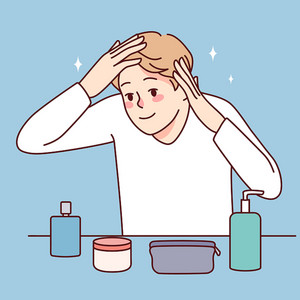
Male beauty is on the rise, and honestly as a woman, I'm here for that.
How is this consumption trend shaking up the industry and changing how we see masculinity?
And from sparkles of joy to unforgettable adventures, we're here to share the happiness that brightened our week.
Join us in Round Table's happy place.
Coming to you live from Beijing, this is Round Table.
I'm He Young. For today's program, I'm joined by Steve Hatherley and Gao Junya.
First on today's show, the world of men's grooming has exploded into a multi -billion dollar industry redefining masculinity in the process.
According to South Reviews, a news magazine, the number of men's hair salons has seen over 100 % growth in the four largest megacities in China from 2020 to 2022.
Additionally, sales revenue for men's cosmetic and skincare products on Douyin, the Chinese version of TikTok, surpassed 100 million yuan, approximately US $14 million last year.
And yes, shopping on short video platforms has become a common practice for Chinese consumers.
So Junya, tell us, how big is the men's beauty market in China these days?
Well, He Young, I don't know if you have heard of this, that there is this online joke that says male consumption power is weaker than that of pets.
And it means that men have lower consumption potential than women, kids and pets.
But now, apparently, the situation has been has changed because we used to say that there are no ugly women, only lazy ones.
But now the case is there are no ugly men, only lazy ones.
And nowadays, men are spending more money to make themselves look attractive.
Yeah. Well, before we get into the figures a bit more, Steve, how do you feel about those powerful statements that this lady just made?
There are no ugly men, just lazy ones.
I guess it implies that men in the past didn't spend a whole lot of time taking care of the outside of themselves.
And I think you could argue of the inside of themselves emotionally as well.
I want to touch on that point a little bit later.
But yeah, maybe, of course, it's tongue in cheek.
It's a joke, but maybe there's a little something to it.
I don't know. Yeah.
And again, as a straight woman, I am clapping my hands when I see guys are more into their looks because I think, you know, if they pay more attention to that, then I think us ladies are there to benefit to some extent.
Before we get to the numbers, I do want to let's get to that question right away because I think in the West and I'm not sure about about China or other parts of Asia or other parts of the world.
There was a connotation in the past where if a man spent too much time on his hair or a man spent too much time taking care of his fingernails or something like that or his fashion, there was kind of a look towards that man that was like, that's a little bit weird.
Now, I'm talking in the past.
These days, that seems to be over.
But from a woman's perspective, do you enjoy this change and you welcome this change?
Well, the thing is, it kind of depends on your history and your past and your observation.
Do you judge today's situation?
And as a Chinese lady who's free to date, actually, from my previous experiences, I think sometimes the lovely Chinese men out there sometimes just don't pay enough attention to their physical appearances.
So we're talking about, you know, building on from just being clean.
So it's not like we're building on from David Beckham.
So therefore, yeah, guys, you know, try a little bit more, explore, make a little bit of effort.
And I think that's totally fine with me.
The proof is in the numbers, I guess.
And one of the proofs may be the rising number of men's hair salons.
A 2022 white paper report on the beauty industry revealed that the number of men's hair salons has maintained a growth rate of above 100 % in four first -tier cities here in China.
Those are Beijing, Shanghai, Guangzhou and Shenzhen from 2020 to 2022.
While the growth rate exceeded 500 % in Guangzhou and 800 % in Beijing in 2022.
800 % growth in hair salons for men in one year.
So the question I have is, I mean, men have always gotten a haircut, right?
So why the increase in the number of places where men can get their haircut?
Because they were always getting their haircut before.
Yes, very good question.
And here lies the mystery of numbers versus percentage.
Because there were such a small number of male salons to start with, because most of these hair salons possibly cater towards maybe mainly the female clientele.
And when guys come in, it's just like, okay, I want something simple, straightforward and cheap.
But for the ladies, this is a little bit of a stereotype.
We tend to spend more and spend the time in the hair salon.
So therefore, with the new male salons opening which specialize in cutting the hair as well as grooming, taking care of the beard or the, what do you call that, mustache?
They're not whiskers, huh?
The mustache comes from whiskers, but we're not cats.
Yeah, men are human beings, not animals.
And therefore, yeah, you see this great rise in the percentage of male salons.
And can I just highlight one fact that when this first became a topic earlier in the year, we covered it on round table.
So yes, that explains why there's this growing, I suppose, demand for these kind of institutions as well as the growing percentage of them opening doors.
But that's just part of the story.
There's also skincare and makeup, and apparently this is a big chunk of the male beauty industry.
Yeah, and I'm not surprised by this.
When I lived in Korea, I saw more and more of these places pop up there as well.
And I think it's quite well known in different places around the world that South Korea is a place where it's known where men take care of themselves very, very well.
And I saw it firsthand.
And in the past, I always went to, I wouldn't call it a woman's hair salon because that's kind of sexist.
Yeah, anybody can go to a salon.
They're for everybody, right?
But when the specifically for men one started popping up, I went a few times.
And to be honest, I didn't really notice anything that different.
You go in, you get a haircut.
The interior is designed in a little bit more of a macho way, I suppose, but ultimately they're doing the same thing.
They're giving you a haircut.
It tends to be a lot more expensive, though, those places, because it's kind of a niche, niche market.
Do they take care of your facial hair?
I can't grow a beard.
That doesn't apply to me.
But does that culture influence you at all as a guy?
You know, when you see maybe more dolled up, I don't know if that's the right word for guys in South Korea or at least that's sort of the preconception we have living outside of that country.
Yes, I think back in the middle school days, I think at my age, you know, our population was influenced that much by South Korean culture.
Those pop bands like BTS, Super Junior.
Yes, and those cute guys, because they paid so much attention to their appearances and their dress up, they were just attractive to us at that age.
I mean, at that age.
Now, I've already passed that age, you know, being attracted to that kind of idols.
But they did bring us a lot of influence.
It's not just places to get your haircut.
It's skincare products as well.
The Global Men's skincare products market size is estimated to grow by 6 .39 billion US dollars from 2024 to 2028.
That's only four years.
The market is expected to grow at a rate of about 7 .2 percent just under that during that forecast period.
That's from Tech Navio from this year.
And then by 2033, they're thinking it's going to reach 86 billion dollars.
This is an industry that has started to grow and it will continue and continue and continue if those projections hold true.
That is really interesting.
While men's grooming primarily emphasizes hygiene and maintenance, men's beauty covers a broader spectrum of aesthetic enhancement.
Now, let's expand our perspective a little bit and explore other sub areas of consumption within this male evolving market.
And I'm interested in, well, this I have mixed feelings about.
Apparently medical beauty consumption is on the rise for guys as well.
I mean, a lot of this discussion, on the one hand, I think it's great to see that businesses are seizing the opportunity and they can grow and that's good for GDP growth.
That's good for individual businesses at the same time.
But I sort of at the back of my mind, I wonder if this is just another brazen replica of the male, the patriarchal structure of society.
And as a woman, we felt it for generations.
But it's the same kind of value system has now sort of encroached on a man as well.
But that's just the thought.
I think it's a redefinition of what it means to be a man.
And again, to reference numbers as proof, this is reported by Cosmetics Design via NewBeauty .com.
And even I found this to be a surprising statistic.
72 % of U .S. male consumers aged 18 to 34, they now use makeup as part of their grooming routine.
72%. And I found that to be a surprising statistic.
And the reason I say that I think it's a redefinition of what it means to be a man, and I'm not talking about a man in China or a man in South Korea or a man in Canada or America, I think this is part of a global trend here.
And I think a long time ago, there was this expectation that a man should be rugged and tough and have huge muscles and not care about their skin and not care about taking care of their nails and not express themselves emotionally and never cry.
That was an expectation that was placed on us by ourselves.
I think it was placed on us by women, and I think it was placed on us by society as a whole and the media as a whole.
You saw it in movies, you saw it in television.
I grew up with it at home, as did everyone else.
Not to say my parents were bad parents, not at all.
That's not what I'm talking about.
I'm just talking about what it was feeling like to be a man then and what it feels like to be a man now.
And you can feel the difference, can't you?
I think I can. What Junya mentioned earlier definitely was kind of new for, I suppose, that the millennial generation as teenagers, because prior to those boy bands from South Korea, yeah, I think it was more that the gen...
Oh, yeah, we went through that phase, too.
Oh, I loved... What's his English name, I can't remember, Takushi Tanashiro, or maybe I've got Jin Chong Woo mixed up with...
But anyway, they're just beautiful men.
But yeah, I think it's really interesting how our perceptions change and what's handsome, what's rugged, what's attractive, and what has sex appeal.
That's all changing.
In the West, I think it was maybe people like David Beckham.
You mentioned Tim already, right?
And maybe even Brad Pitt.
Those were kind of the poster boys for the metro -sexual movement.
If you're not familiar with that term, it means men who take care of their fashion, who take care of their hair and their skin and things like this.
They try, there's an effort to look good.
We saw that in the West.
We saw David Beckham doing it.
We saw Brad Pitt doing it.
Tom Cruise would be another example, I think.
And then it kind of kicked off and people thought, oh, well, maybe it's not weird to care about those things.
And actually, maybe it's kind of fun to go for a facial every once in a while and go for a mani -pedi every once in a while.
And I think that's where it started.
Maybe I'm wrong, but I think we can say...
We can point to the early 2000s as the period where this began.
Well, that's when this became sort of a big talking point for people to discuss.
And what you just described there, Steve, it sort of set my memory back even before my time.
I had this chat with my mom the other day since...
Oh, that French megastar who just passed away.
Ah, Lan Dua Long. Yes.
And he was like the really attractive male superstar for the Chinese people in the maybe 1970s and 80s.
And another super attractive male idol of that time was the Japanese superstar, Gao Seong -jian.
And then I think they aligned a little bit more with what Steve mentioned earlier about the more rugged sort of look.
But Ah Lan Dua Long was like handsome.
And he's got a really pretty face at the same time.
Compared with Gao Seong -jian, they're like very different models in a way.
And I chatted with my mom and then she made this observation that today you've got male idols or superstars, these celebrities who are very handsome.
You may even use the word beautiful, but they kind of lack that raw sort of male appeal.
The machismo, that's what you're talking about.
What is machismo? Machismo is what I was talking about before, that rugged, raw, tough, really quote unquote manly look.
And now the looks are just so much more polished.
It's rare to see young idols who are sort of targeting the teenage or pre -25 female age group to even have facial hair in East Asia, I would think.
So I suppose I don't know whether this is sort of calling back to or is this a direct influence of the metrosexual movement or this sort of male beauty, new male beauty standards or whatnot.
What do you think, Junya?
I mean, we've been going back to 1970s, early 2000s a lot.
I think the change actually is around us.
Look around us, He -yang, our male colleagues.
Are you sure you want to narrow it down to that?
Quite a number of them.
Quite a number of them, especially those young guys born in the 1990s or early 2000s, they're quite smart.
They pay a lot of attention to their appearances.
Don't you think so?
I don't know. And, you know, I had this chance to go for a business trip with another male colleague and I just had a chance to, you know, went through his bags.
He has a lot of skincare products, a lot.
And they're very expensive brands, I'm saying that.
What do you mean you had a chance to go through his bags?
I'm never going on a business trip with you.
TikTok is another good example.
Get this. 389 % year on year increase in TikTok video views around the topic of skincare.
Hashtag men's skincare, 462 million views.
Hashtag men's skincare routine, 28 million views.
Hashtag men's grooming, 1 .9 billion views.
On Instagram, the same hashtag that got used 3 .2 million times in different posts.
This is real, and it's here.
And we talk about the early 2000s or the 1970s.
This goes back way, way, way before.
The idea of what it means to be a man is changing.
I've mentioned it a couple of times.
Simon Goldhill, he wrote a book called Love, Sex, and Tragedy, How the Ancient World Shapes Our Lives.
And in it he said this.
It's part of the pervasive imagery of masculinity because there was a huge cultural anxiety about not being a real man.
It's there, all through the Greek comedies and tragedies.
And part of this ancient concept of being a man is to not really care about things like an eight step face care process.
It's going back two times when we were not on this planet.
This idea of what it meant to be a man.
Well, does this have anything to do with maybe what the ladies prefer might influence what a guy might perceive as being handsome or being attractive, that kind of thing?
I think that's probably part of the reason.
Yeah, men like to dress up for dates just as much as women do.
There's a hair salon in Beijing, and the owner, his name is, or the shop name is Mr.
Wayne. And according to Mr.
Wayne, 40 percent of his customers come in during lunchtime on Friday, right around this time, because they have a date on Friday night.
Oh, good for them. I like a guy who's prepared for stuff.
And also there is this disproportion of male and female population here in China.
I think, gentlemen, you have to vie for the hearts of women.
So that's why they've been trying.
Yeah, maybe that has something to do with it.
And also we see that since there's just this pretty explosive growth of skincare, including makeup apparently, of targeting men.
But do men actually need different beauty products?
Aren't we all human beings, and then it's the skin that we're trying to take care of?
Yeah, well, I mean, they say, experts say, dermatologists say that men in general have thicker, oilier skin.
And they do have a stronger resistance to UVA rays than women.
But they also say that there is absolutely no scientific reason for skincare products to be gender specific.
Men and women do have different skin, but that sentence can be a little bit different or a little bit misleading because women to woman to woman, they can have different skin.
And man to man, they can have different skin as well.
My sister used to work for a skincare product company, and she told me, now this is according to her, that the product in the bottle when you see a four men bottle next to a four women bottle, those products are almost the same.
Yeah, so there's not a big difference.
You'll find difference in perfuming, she said, the way that they smell, and maybe some slight differences in moisturizing and things like that.
But essentially, they're very similar products.
So are you saying then he, well, if we're talking about a straight couple, then he could totally steal from her cabinet?
Yes, I do. And here, I haven't done the research yet, but I'm curious about the tag price of both products, you know, whether the four men is cheaper or of a similar amount or more expensive than the male product, but then the female product.
Depends on the product you're looking at, I think.
You could probably find examples of both.
Yeah, and this is the part that I've been fascinated for years.
Now, I think I get a better understanding.
And it's probably that the guy should figure out his skin type before actually shopping for these skin products.
Just like girls, we figure out, do we have the extra oily skin or the mixed type or the dry?
Indeed. So it's just really interesting looking at what's happening here in the male beauty market.
And yes, you guys mentioned that on Chinese social media, male consumers have often been teased for having less purchasing power compared to babies and the ladies in their household.
However, the reality paints a slightly different picture.
And there are a whole bunch of things that apparently men are consuming and it's not the ladies.
And one thing that first comes to mind is the game, the video game, Black Myth.
Oh, yeah, sure. It was a huge success.
Yeah, men are buying a lot of different products now for themselves that perhaps they didn't do before.
But when I was looking up things to discuss on this topic and yeah, we can point to numbers about increased sales and skincare around the world for men.
We can look at the 800 percent increase in male salons in Beijing.
And again, take those numbers with a grain of salt, as you very well explained before.
That was a great point.
But that wasn't satisfactory to me in terms of why this was happening.
So I dug and dug and dug and dug on the Internet.
And I finally found something that I think is really well articulated.
And this is from a blog called TheCadenceCo .com.
And I don't know who wrote this and I don't know which country it's from.
I know that it's from a Western perspective, but I just wanted to share this with you.
In this era, we acknowledge that the monolith of masculinity was an illusion.
Men are not made from a single mold, but are an amalgamation of their experiences, cultures and aspirations.
They are not afraid to redefine their roles, to take on tasks once deemed outside their purview, and to share the stage in a dance of equality.
And what that means to me is that the 2024 modern man in China, in Japan, in France, in Canada, in America, in New Zealand or wherever is redefined.
And what we're seeing now with men is that they're not afraid to express themselves emotionally.
They're learning how to do that.
And with that comes not afraid to do things that were typically not a man thing before.
Taking care of their skin, buying beauty products, having a skincare routine, all of those things.
And I think the passage that I just shared with you is the reason why we are seeing men take care of themselves and buying beauty products these days.
And you mentioned the things that previously maybe wasn't really socially acceptable for guys to do to express their masculinity.
Well, what about taking care of a baby?
What about doing more housework, taking some of the workload off her shoulders?
That's super masculine and attractive to me.
Yep. And the rise of male consumption signifies a broader cultural transformation where men are no longer confined to traditional stereotypes.
And they invest in grooming and beauty products, just like girls will like to take care of ourselves too.