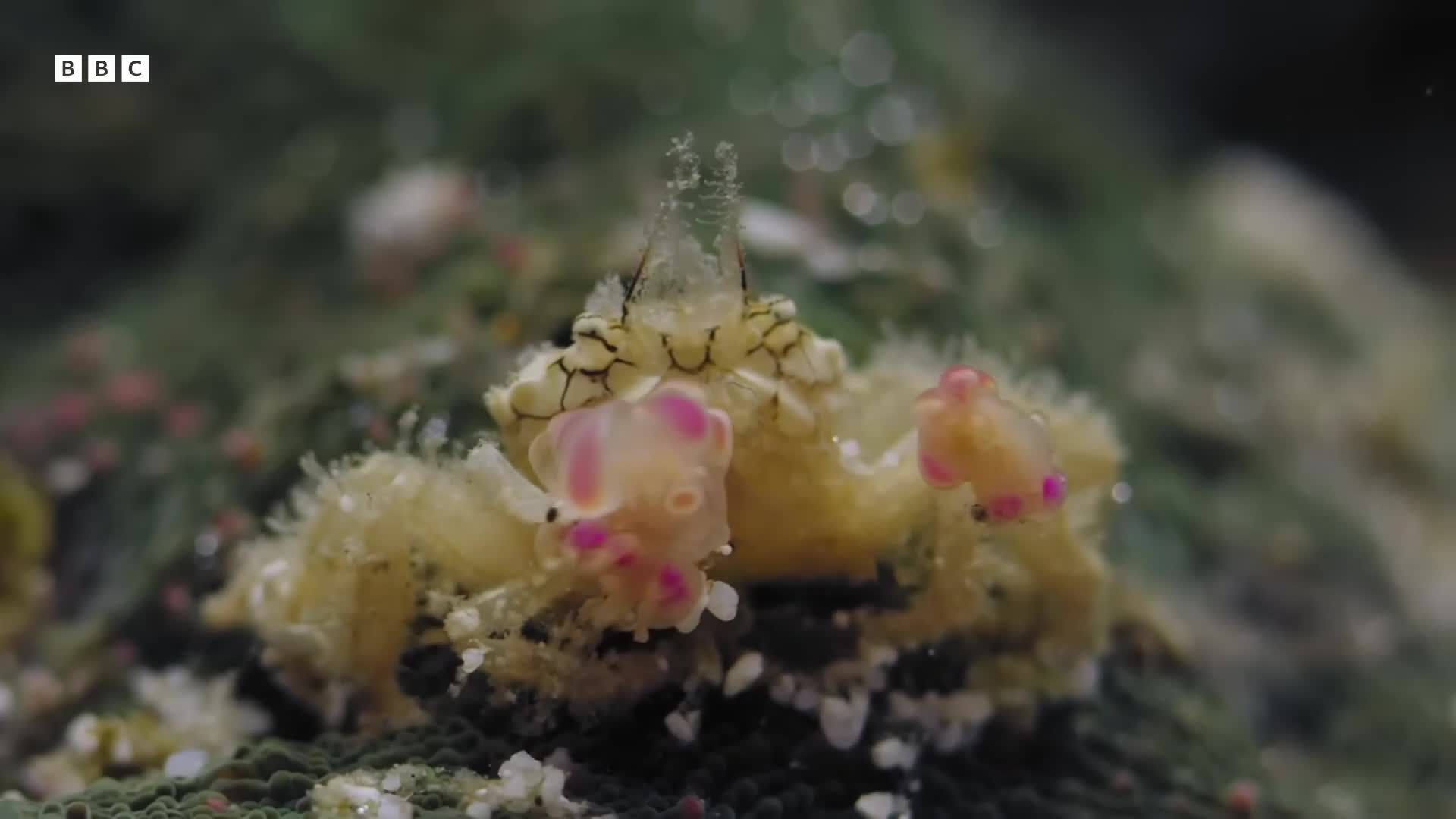
The boxer crab.
In a world where almost everything is bigger than you, you need a foolproof plan to stay alive.
This puffer fish fancies his chances of an easy meal.
But our crab has a secret weapon, the perfect pair of boxing gloves.
A swift left hook is enough to make this fish think twice.
That's because the crab's gloves are in fact sea anemones.
These relatives of jellyfish are just a few millimetres in size, but they contain a powerful cocktail of toxins in their tiny tendrils.
Every time the crab lands a punch, the anemone delivers a painful sting.
It won't try that again in a hurry.
But to protect itself from all threats, this boxer crab needs to keep its gloves in perfect working order, which is where our tale takes a sinister twist.
Scientists have discovered that these anemones could grow up to five times their current size if left to their own devices.
So to keep them small enough to hold, the crab starves them and takes their food for itself.
Gripped tightly in its claws.
The anemones are kept hostage, resulting in a somewhat shocking but cleverly inventive defense mechanism.
But the crab isn't completely out of harm's way.
These anemones have only ever been found living in boxer crab claws, which means that another boxer crab without gloves will inevitably try to steal its precious possessions.
The pika, a rather adorable relative of the rabbit.
It's August and summer is in full bloom.
But the days of plenty won't be here for long.
These slopes are only free from snow for 10 weeks a year.
When winter comes, this pika will be trapped in its burrow.
To survive, it needs to stock up the larder.
But while home is up here, the food is all the way down there.
Every summer, Pajka must collect enough plants to see them through the tough times to come.
Multiple trips are inevitable.
And anyone living high up on the slopes, like this female, has their work cut out for them.
She may make over 10,000 trips in just one season.
And the grand result of this frenetic activity is a haystack.
These stockpiles of food can weigh up to 28 kilograms.
That's more than 180 times a pika's own body weight.
It's exhausting work.
Perhaps there's another way, an easier way.
Just down the slope, another pika is getting started on his haystack.
But he's being watched.
It's daylight robbery.
But this is not just reckless behavior.
By taking food that's so much closer to home, our pika is saving precious time and energy.
It's so tempting, she may well become a repeat offender.
But it's a risky business.
Caught red-handed.
Every bandit needs a good getaway route.
And it's worked.
Vincent has stolen a helpless baby.
Its mother is left empty-handed.
Why has he done this?
Dr. Eric Shaw has been observing these macaques for over 18 years.
He's caught countless males in the act of infant stealing.
To people who are actually watching it for the first time, it looks somewhat aggressive, but it's not as bad as it actually looks.
So it's not an aggressive behavior then?
No, it's not aggressive at all.
It's what transpired beforehand that's brought about what looks aggressive to the human observer.
To understand what's going on, we need to backtrack to before the kidnapping.
Although Barbaries mostly lead a harmonious life, like humans, they sometimes fall out.
Basically, what happens is the males have arguments, a little bit like we have arguments with one another, and what they've got to do is have this conciliation very quickly.
We don't, we just don't speak to one another for months or years.
But because they live in a troop all together, they've got to make friends quickly.
They do that by stealing an infant.
It's the perfect reconciliation gift.
They borrow a baby from one of the females.
And this is the loser who borrows the baby.
In this case, it's Vincent, who's not very high up in the troop pecking order.
And then approaches the one that's just won the argument and presents it to him.
Our winner is Aristotle on the left, the alpha male.
Vincent needs him on side.
Currying favor with the alpha could improve his position in the troop, and a higher rank means better access to food and females.
So they've had an altercation.
One male is more dominant than the other.
The baby is presented, and then what happens?
It looks like they've been very brutal to the babies, a little bit like the camera.
They're turning it up and down, both of them, and they're smelling it and looking at it.
And do you like it?
And you say, yes, I love it.
And you take it off me, and I think, whew, got away with that one.
Right now, I'm showing the meerkat what she's looking for.
In this tube is the scent sample of a brown house snake.
To the meerkat, it will have a very distinctive smell.
Now to find the matching odor in the row of tubes.
There, she's got it.
Brown house snake.
It now needs to find the matching tube for the puff adder scent.
But this time, it doesn't seem so easy.
So now she's indicating the control, which means she can smell the tank.
The empty tank, which essentially smells of nothing.
And she carries on searching.
She can smell something on there.
She's also indicating path out, which means she can't tell them apart.
Since it chooses both scent tubes.
The meerkat simply can't distinguish between the smell of the snake and the empty tank.
It's as if the puff adder has no scent at all.
So this is a form of chemical cryptosis.
They're camouflaging themselves.
This is a fascinating discovery.
The puff adder has evolved a means of masking its own scent, so it can hunt while still evading predators.
It's the first land vertebrate known to use this disguise for its own defense.
But exactly how it does it remains a mystery.
The puff adder has mastered the art of survival.
From fatal venom to ingenious deception, this is a truly remarkable reptile.
This Californian park is bursting with peacocks proudly displaying their 200 tail feathers and vibrating their colorful eye spots to show off their fitness.
But sometimes playing by the rules just isn't enough to get you noticed.
It's a problem that this male, known as Sam, is all too familiar with.
He's having a bad day.
He's been strutting all morning, to anyone who will pay attention.
I think he's getting a bit frisky with me, shaking his tail feathers on me.
Sam's day has been unsuccessful, and it's about to get worse.
One of his rivals is closing in on a peahen.
He proclaims his victory with an earth shattering.
This is the sound a peacock makes when he successfully wooed a female.
Sam, on the other hand, seems rather deflated.
And, worse still, his opponent's trademark mating hoot appears to have drawn in a bevy of other peahens wanting in on the action.
It's time for a new plan.
And it seems that some males are resorting to some interesting cheating behavior.
More victorious mating hoots.
And this time, they come from Sam.
Except he still doesn't have a mate.
He's faking it.
But the lure of his hoot is apparently too much for this female to resist.
She seems to have fallen for his deceitful tactics.
Predators all over the world use the element of disguise to dupe their food.
By pretending to be a harmless branch, this African vine snake tricks its prey into thinking they're safe, when they could be about to get eaten.
In Hawaii, a fly is in for a shock from a carnivorous caterpillar in a leafy costume.
And while it may look just like an alluring flower, this orchid mantis is a stealthy assassin.
But compared to these exceptional masquerades, our spider's disguise is, well, a little rubbish.
Its color is a good match.
It has a decidedly un-spider-like nip at the waist, just like an ant.
But surely no one would mistake one for the other.
Nevertheless, it heads for the nest.
Will it get away with it? right under the ant's radar.
But it wasn't its appearance that did the trick.
It's mastered a far more complex impersonation.
Our spider carries with it the ants' chemical code.
Like all of its kind, it was born in a green ant nest.
Its mother laid her eggs there.
It fed on ant larvae from birth and developed the ability to smell just like them.
Now that it's essentially hacked into their security, it can rob the nest whenever it likes.
Our wedge bill and all other hummingbirds have to eat more than twice their body weight in food each day.
They burn through calories so quickly that if they were the size of an average human, they'd need two cans of fizzy drink every minute to survive.
But over millions of years of evolution they've struck up a bargain with the surrounding plants to get what they need.
The plants produce flowers rich in nectar.
In exchange, the hummingbirds act as pollinators.
Moving pollen between flowers, they enable the plants to reproduce.
But each flower only has a limited supply of nectar each day, which means the hummingbirds must compete for it.
Each species has a unique ploy to get their prize.
The green violet ear is one pugnacious little bird.
Engaging in aerial combat, it prevents all others from getting close to its patch.
The booted racquet tail takes a different approach, using agility and speed to outmaneuver the opposition.
And the tiny purple-throated wood star has a very clever trick.
Most hummingbirds are terrified of bees.
Just one sting could be fatal.
So the wood star mimics the sound of a bee with its wings scaring other hummingbirds off just long enough to get the goods.
Whilst these birds may be somewhat brazen in their approach, they hold up their end of the bargain with the flowers.
Our wedge bill, however, has a far more rebellious plan.
While the other hummingbirds fight it out, it makes its move.
The wedge bill doesn't reach inside the flower.
It goes straight to the base and pierces a hole where the nectar is stored, tapping into the very source.
It gets the food it needs, but it doesn't pollinate the plant.
In the outback, a winged warrior readies himself for the fight of his life.
This male Dawson's burrowing bee is waiting for a mate.
And he's getting impatient.
Beneath this baked earth, thousands of females have been dormant for nearly a year.
But winter has arrived, and now they're stirring.
The male's wait is nearly over. but he's not the only one waiting.
Male burrowing bees feverishly patrol 10,000 entrances to this colony.
Early in the mating season, they outnumber an emerging female hundreds to one.
Each female will mate once, then never again. so the males will have to fight it out.
The white face of an unsuspecting female.
A mating ball forms around her as they grapple for the chance to mate.
Males attack rivals using their powerful jaws and spiny legs.
The colony is left littered with the bodies of battle-scarred bees.
And another casualty is about to join them.
This brawl has got dangerously out of control.
In their frenzy, the males have accidentally killed the object of their affection.
The striated caracara.
It's one of the rarest raptors in the world.
In spring, it feasts on the eggs and chicks of the island's vast seabird colonies.
For Caracaras, these are prime feeding grounds.
Each adult has carved out its own territory in which to hunt.
And there's no space left for anyone else.
This juvenile needs food.
Still too young to have its own territory, there's little access to the hunting grounds.
Another youngster decides to chance its luck.
But the adults are all too willing to take down any trespassers.
The risk of injury in these brutal confrontations is too high.
Getting to the food requires a new plan.
Up on the moorlands, the young caracara isn't the only one in exile.
New research has found that juvenile caracaras use distinctive calls to rally together.
This gang of youngsters are planning a rebellion.
Working together as a group, they invade an adult's feeding territory.
The balance of power shifts.
The adults can't see off the entire flock.
Their mobbing technique has paid off.
Gorged with food, the young birds return to the moorlands.
Being forced to live on the periphery is tough.
And rising up against the adults is the only way to survive.