Ted Audio Collective.
You're listening to Ted Talks Daily, where we bring you new ideas to spark your curiosity every day.
I'm your host, Elise Hugh.
Today's talk is from our brand new batch of 2024 Ted Fellows films adapted for podcasts just for our Ted Talks Daily listeners.
Ted's fellowship supports a network of global innovators, and we're so excited to share their work with you.
Today we'd love for you to meet Ted fellow Joelle Burval.
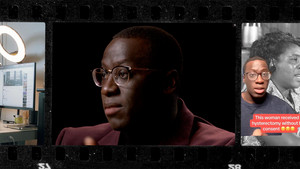
Joelle was one of the only black medical students in his program, and after noticing how misconceptions about race were embedded in healthcare, he turned to social media as a medical myth buster, raising awareness about race -based biases and their harmful impacts.
He unpacks how racism negatively affects our understanding of human health and what the medical field can do to improve the system to better serve patients.
After we hear from Joelle, stick around for his conversation with Ted Fellows program director Lily James Olds, all coming up after the break.
And now our Ted Talk of the Day.
I think in the face of any adversity, communities of color have always found solutions.
I think for me, social media is one of those places in safe havens.
Social media can be a positive change.
It can inform masses about really crucial issues that are often overlooked in the media.
My followers often are commenting on my videos saying, I haven't seen this anywhere else.
I think that social media can save lives when used in the right way.
My name is Joelle Burval.
I'm a fourth year medical student, but I'm better known online as a medical myth buster for creating content about health equity, the hidden history of medicine, and the ways that healthcare needs to change for communities of color.
When I first started medical school, it was a really interesting time.
I was thinking a lot about Ahmed Aubrey and Breonna Taylor and George Floyd.
All these moments were happening at the same time that I entered my first year medical school where myself and one of the medical students were the only two black medical students in our school of 200 students.
It made me think a lot about how we were talking about race in the United States and what race meant in the context of being a medical student.
I kept hearing in my classes that black people were more likely to have asthma.
Black people were more likely to get COVID.
Black people were more likely to have diabetes.
We never dived into the social or other political even ramifications of why that was and the history behind what led to those health disparities to exist.
Seeing the lack of diverse medical education in my curriculum made me want to actually take to TikTok and Instagram to talk about the things that I wasn't seeing in school.
My name is Joelle, the medical myth buster.
And let's talk about racial bias with the alpha -fetal protein test.
And let's talk about racial biases in lung function tests.
Let's talk about the racialization of X -ray radiation.
The misguided racial correction built into this device, this barometer, it assumes that all black and Asian patients have lower lung functioning compared to any other race.
Up to 93 % of cervical cancers are preventable.
Yet in the United States, Latinos are more likely to be diagnosed with it and black women are more likely to die from it.
What looking back at this history teaches us is that racism becomes embedded and unnoticed until we raise the alarm to practices that make no sense.
So many of my videos, a lot of the comments were from healthcare professionals, doctors, nurses, PAs, saying, I've never heard about this.
A study in 2016 was done and actually showed that 50 % of medical students or residents endorsed at least one false biological belief about differences between black and non -black patients.
And so it goes to show how the history of these biases and stereotypes continue till today and can impact the way that patients get care.
Because everyone, especially most black people, have had an experience in the hospital where they felt like they weren't listened to, they were ignored, and they want to understand why.
There's already legacies and histories of why communities of color don't trust the medical system.
You can look at so many things that have been done.
Our job as physicians needs to be to be able to figure out what should and what shouldn't stand from past beliefs to present beliefs.
I think diversity, equity, and inclusion is one way that we're able to critically evaluate the systems around us, especially in medicine.
Diversity, equity, and inclusion, one, is really important because it goes beyond race.
It goes to thinking about all aspects of our social identities and how that interacts with the healthcare field.
And two, it's necessary just because the patient population we serve is diverse in itself.
So often there are places in medicine where it doesn't make sense to use race.
Whether that's through an equation that's about kidney functioning or about lung functioning.
So being able to talk about DEI in that lens allows us to critically evaluate why we use race -specific issues.
If we're not able to accurately critique why race is included in systems, and whether that's harming or helping patients, we're unable to do our job of do no harm.
But there's a concerted effort to try and essentially root diversity, equity, and inclusion out of medicine.
People thinking that's negative in the medical field.
If these anti -DEI bills continue to get passed, I think we're going to see less diversity in medicine across the spectrum.
I think we're going to see less access to research that's really critically thinking about why we're using race and being able to kind of recorrect that.
Which has already been difficult to get people to talk about in the first place.
We're going to see scholarship programs dry up.
We're going to see programs that are investing in the next generation go away.
We're going to see students less interested in going into medicine simply because there's not investments into communities that have been overlooked for so long.
We're going to be set back to a time where we were not moving medicine forward and actually harming patients.
I don't want to scare people away from the health care system, but I want them to know that they have the power and this information they can have when they get to the doctor so that they feel a little bit more confident.
When there's awareness, providers, patients, researchers can actually start tackling a problem.
I think when we don't know it's a problem, we don't do anything about it.
I think there's just so many opportunities to use social media as this kind of ground for community to build and create advocacy and hopefully create change.
I think especially when it comes to anti -DEI bills, I think that's the space we're going into.
It can be a space to continue to learn, educate, and hopefully talk about how we can improve medicine overall.
Joelle, hello, welcome.
So you give us some examples about specific ways racial bias is embedded in medicine.
Can you go a bit deeper and tell us more about one of those examples?
So I talk a lot about how racial biases become embedded in medicine and the ways that we don't even realize it continues to perpetuate and impact the care that patients receive of all races.
There's one I really like to talk about a lot, one example, and it's called the GFR equation.
It stands for glomerular filtration rate.
This is essentially a measure of how well an individual's kidneys are working.
If you have a high GFR number, your kidneys work well.
If you have a low GFR number, your kidneys don't work very well.
But for decades, there's been a racial multiplier that's been added to these GFR tests that basically assume that if you are a black person, you have higher kidney function or better kidney functioning.
And so it artificially increases the GFR number.
What that ends up saying is that all black people, just because they're black, have better kidney functioning.
And this has been in fact for decades.
When you go back to the research, why?
The reason why they even had this multiplier was because they're trying to be equitable.
But what that GFR equation ended up doing because it was overestimated for black Americans was it made it harder for black Americans to be diagnosed with chronic kidney disease, more difficult to be referred to kidney specialists.
And it was harder for black patients to get kidney transplants.
And in 2023, the Oregon Procurement and Transplantation Network essentially said, if you've ever had this equation used that used race, we're going to go back and look at your records and see if we can actually recorrect it and be more accurate for you.
That ended up leading to a lot of black Americans being moved up on the kidney transplant list when otherwise they would not have been.
And I actually had someone who'd been following me for years on social media as I was reporting and talking about kind of the GFR equation.
She let me know that she'd been watching every single video I made about chronic kidney disease because her sister had it.
And when she found out that her sister could potentially be moved up, she sent her sister my video.
Her sister took that video to her doctor.
Her doctor looked into it, found out that her sister was eligible for it, and she actually got moved up five years on the kidney transplant list.
So I like to use that example because I think, one, it shows how biases get embedded from these false beliefs we have about race specifically.
Two, it's one of the first times in medicine that an equation that uses race has been changed.
And then three, where action that's restorative has actually been taken as well to reach restorative justice of reparations of sorts in medicine, which has never happened in the history of the United States.
That's a really amazing example of what you talk so much about.
I mean, you say that 50 % of those in medicine, doctors, nurses, PAs, endorse at least one of these false biological beliefs of these differences between Black and non -Black patients.
And that, you know, these biases are embedded in medicine and clearly really impact how patients get care today.
How do you think we can start to change things in the healthcare industry and medical education since it's such a deep systemic problem?
Absolutely. Well, so that 50 % number you're talking about is from a 2016 study that was done at the University of Virginia.
Basically, what they did was they showed medical residents and medical students, as well as lay people, a list of different false biological beliefs people have about race.
They were asking questions like, are Black people's skin thicker than White people's skin?
And in that study, 50 % of the surveyed medical students and medical residents endorsed at least one false belief.
And those that endorsed at least one false belief were more likely to rate that Black versus White patients' pain was lower so that Black people felt less pain and they made less accurate treatment recommendations.
And so a lot of this comes when it comes to race is about myths, about physical racial differences like differences in skull sizes or varying skin thicknesses that were honestly used a long time ago to justify slavery but have still been passed down in medicine.
And I think how we fix it is the training needs to change.
While so far I've talked about race, there's so many other aspects of this, too, from socioeconomic status to gender, that all impact the care that people receive.
And so personally, I believe we need to be talking more of those, what people, I don't like how they say it, but like softer sides of medicine.
Yes, it's so important to understand these hard sciences, what medications we give.
Obviously, that's important.
But if we don't know how to even recognize it in a patient based on their gender, if we don't know what a heart attack looks like in a woman that can present differently, then we're not able to actually treat people effectively.
And so for me, it really comes from making sure that our medical education that we're receiving is reflecting the diversity that's currently changing inside our world.
And unfortunately, medicines always been slow to adapt.
There's like a saying in medicine where it often takes about eight years for some new research change that gets implemented to actually permeate its way through medicine.
So even though I've just talked about the GFR equation, it's still being permeated into medicine to make sure that this is implemented.
And things are going to be really slow.
And so that's why I think when it comes to medical school and medical education, that's the best way to make change.
Building off that, how do you think that medical professionals can build trust with their patients in that way, gain that trust with all of this in place?
I love that question.
And I always say it starts with understanding why the mistrust exists in the first place.
You can't understand how to build trust if you don't understand where trust was lost.
For a lot of people, trust was lost throughout history from narratives that they've heard from their parents, that they've seen and witnessed from their communities.
In the black community specifically, you'll often hear people talk about the Tuskegee experiments in Native American communities.
You'll often hear people talk about forced sterilizations that occurred in specific communities.
I have an entire series of videos called Hidden Medical History.
And I remember when I started that series, it's all about the things that were done in medicine that were egregious to populations that are vulnerable, but how those actually led to changes to be made in the medical system.
And by talking about it, I often worried that I was going to be scaring people away from medicine.
But what I realized ended up happening was, one, it gave medical professionals an understanding of the egregious things that have happened and why communities of color often don't relate to medicine.
And two, it allowed for people who have felt like they didn't understand the medical system to see how changes have been made based on prior things that have happened.
And so I think really doing a deep dive into the history of understanding how these histories and legacies of mistrust have been built is really important.
One example I like to give is Henrietta Lacks.
For those who don't know, Henrietta Lacks was a woman who went to Johns Hopkins University, unfortunately passed away from cervical cancer.
Her cells, without her knowledge or consent, were taken and were found to replicate in this universal way where they would keep replicating.
And so they've been used in studies for the past 40 years for COVID, for flu vaccines, for syphilis, for name basically any disease.
Her cells have been used.
Yet it wasn't until recently that her family finally got reparations.
I think by actually realizing that our past history isn't as far away as we think it is and still impacts the care that people receive today, that's how we begin making change.
And how do you think patients can identify bias and advocate for themselves more effectively?
Yeah. I give five different pieces of advice, essentially, to people for how they can advocate for themselves when they go to the doctor's office.
So one, I say make a plan.
You make a list of things that you want to discuss with your physician before you go and your goals for your visit, writing down your questions in order of importance.
If you can, bring a symptom diary of things that you're experiencing and having your medical history or any other medical issues with you.
I think immediately when someone gets to their visit, the first thing you're trying to evaluate is how much is this physician listening to me?
And so I say look out for signs like, are they asking you additional questions about things, what you're saying?
Are they making sure they document it?
Do they seem like they're adding value and actually want to get to know you as an individual and your life circumstances?
So once you make that plan, I'll tell people also, bring someone with you if you can.
Whether that's going with a friend or a trusted family member or in some states, you're able to actually record or bring your phone with you so you can have someone on the phone with you.
And just today, I had a patient who said, hey, my husband's on the line, is it okay if he listens in?
I said, of course, I want more people here just in case you forget something, they may remember something that you don't.
And then taking a detailed record of the visit, where that's on your phone in a notebook or asking the provider if you can have some notes afterwards.
I also always say it's a two way street.
In medicine, I think so often we have this imbalance of power where doctors know a lot and patients inherently don't know much about their own diagnosis.
So I always say if you're not feeling hurt, one, ask the doctor to document in the chart your specific concerns and let them know that you're not feeling hurt as well.
And why you feel like you're not being hurt.
And then lastly, I always say ask your doctor what their differential diagnosis is and why.
A differential diagnosis is one of the first things we learned in medical school.
It's a list of conditions that can fit someone's symptoms.
So if someone comes in with shortness of breath, that could be COPD, that could be asthma, that could be cancer.
But we do specific tests to rule out each of these.
And once you go through that with your doctor, I think it makes people feel better because often what's missing is just an explanation for why we're getting specific tests or doing specific things.
Well, we can provide that insight.
It helps people feel a little bit more at ease and helps us to lessen that gap between patients and physicians.
That's such great, incredibly practical advice.
Thank you for that.
I want to talk a little bit about DEI, which you mentioned at the end there.
So, you know, you say that DEI is one way we can critically evaluate why race is included in systems and whether it's helping or harming patients.
And you talk about what you think bills to cut DEI will do to limit research, talent, equitable care and more.
How do you think DEI supports innovation?
I love that question.
I think I should also start by, well, I've talked a lot about race.
DEI is so much more than race, right?
It's, yes, it's race.
It's ethnicity. It's religion.
It's gender. It's your background of where you're coming from, whether you're a first generation student, whether you're a veteran, all these things are part of diversity, equity, inclusion.
And the power in that is you get diverse groups of people who may think differently than yourself and bring additional knowledge into communities that have not often had a seat at the table.
And if we're not reflecting all voices, especially when it comes to medicine, where it doesn't discriminate against who you are, if you're sick, you're sick.
Everyone gets sick at some point.
We need to make sure that our doctors are being trained in a way that understands everyone in the system.
I love that answer.
And I feel like it goes, as we know, so far beyond health care and medicine as well.
And finally, last question, if someone listening is interested in diving deeper into this topic, what resources would you recommend to them in terms of a book, a podcast, something else?
One of the first books I often point people towards is Killing the Black Body by Dorothy E.
Roberts. And in it, she really talks about how race has been used in medicine right now.
It analyzes specifically reproductive rights of black women in the United States.
I think it's a powerful way to look at the disparities in medicine because it's about something we all are related to in some way, which is reproductive rights, whether that's our parents, our sisters, our daughters, whatever it is.
So her book is really powerful.
Dr. Uche Blackstock has a new book out too that came out about a year ago called Legacy.
And it's her walkthrough of being a black physician and seeing kind of how racism once again has been built into the medical field.
And then if people are like podcasts instead, New England Journal of Medicine has a whole series about race and racism in medicine right now.
And they also look at kind of socio -economic status, all these other places.
So I'll just leave it at those three, but I think they're all wonderful.
Joelle, thank you so much.
This has been wonderful.
Thank you for having me on.
To learn more about the Ted Fellows program and watch all of the Ted Fellows films, go to fellows .ted .com.
And that's it for today.
Ted Talks Daily is part of the Ted Audio Collective.
This episode was produced and edited by our team, Martha Estefanos, Oliver Friedman, Brian Green, Autumn Thompson and Alejandra Salazar.
It was mixed by Christopher Faizi Bogan.
Additional support from Emma Toppner and Daniella Valareso.
I'm Elyse Hugh. I'll be back tomorrow with a fresh idea for your feed.
Thanks for listening.