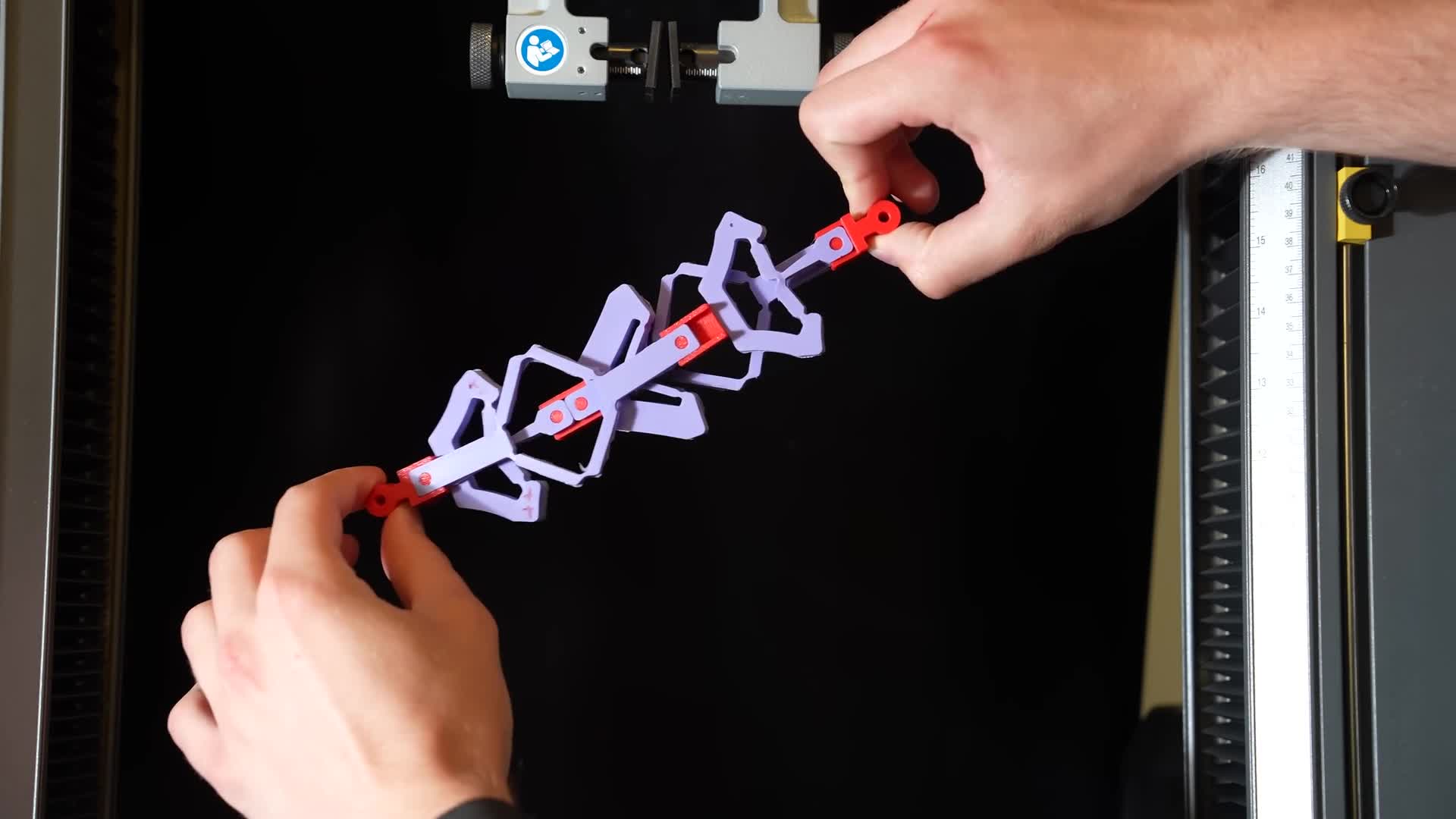
This little mechanism shrinks when you try to stretch it.
You try to pull it apart and all of a sudden it pulls back on you.
That's so weird, right?
Here it is under controlled conditions.
There's a cup hanging from the mechanism, but now look what happens as you add water to it.
All of a sudden, the cup shoots up.
The amount it shoots up is tiny, but the physics behind it is so counterintuitive nobody thought it was possible.
It feels like it violates physics.
That's why it's fun.
The paradox that controls this mechanism governs everything from mechanical systems to food chains, from traffic jams to power grids.
And to understand it, you just need to ask a simple question.
What will happen to this weight if you cut the green rope?
Where is this going to end up?
Is it going to go up?
Is it going to go down?
Or is it going to stay the same?
Can I touch?
Yeah, yeah, you can try it.
Nothing.
You don't think anything's going to happen?
In the same place.
Weight is going to be right over there.
Like it's going to fly off?
No, not too much, but probably it's going to go this way.
If you cut the green rope, this is going to come down.
It will go down.
It will go down.
It drops.
It'll fall down, won't it?
The first thing that occurs to me is as soon as you cut that, the weight is going to drop.
I imagine the weight ends up lower than it started.
Here's a closer look at the setup.
You have a spring hanging from a hook up here and then by this green rope it's connected to another spring that's carrying this weight below them.
There are two extra ropes here as well.
So the red one and the black one are slack.
They're not under any tension whatsoever.
So they're not actually carrying any weight.
What's going to happen if you cut the green rope?
You can pause the video here and try to figure it out for yourself.
Here it is in slow motion.
So, even though the ropes on the side were slack and we cut the only rope in tension, the weight somehow went up.
Okay.
So if you're unconvinced that cutting the green rope actually makes the weight go up, here's a huge version of the experiment.
So the black and red ropes are still very much slack and it's just held together by this tiny piece of green rope here.
So let's see what happens now.
Okay, you ready?
Okay, three, two, one.
That was actually insane.
That was pretty, pretty good, right?
Still don't believe it looking at it.
Okay, so why does this actually happen?
Because the springs are contracting back and just pulling it together.
Maybe the tension in the, you know, this part is changed.
It releases the tension in the springs and only goes to the length of the ropes.
Look at what happens when you remove the slack side ropes from the initial setup.
You're left with this, a mass hanging from a spring hanging from another spring.
So these springs are connected in series.
Obviously, when you hang a weight from one spring, it extends, just like you'd expect.
And the amount it extends by, call it x, is proportional to the force exerted by the weight.
That's Hooke's Law.
But if you add another spring in between in series, now both springs extend roughly the same amount x, because both springs feel the same force of the weight pulling from below.
So in the case of ideal massless springs, you would end up with exactly 2x of displacement.
Now, there's another way to connect these two springs to the weight, and that is in parallel.
This way, both springs are independently connected to the hook above and to the weight.
So each spring is only carrying half the weight of the mass below, which is why both springs extend only half as far, or x over two.
If you look at the setup right after the green rope is cut, you'll notice that this is actually exactly how the springs are laid out.
So the red rope is connecting the bottom spring directly to the hook above and the black rope is connecting the top spring to the weight.
So these springs are in parallel.
So by cutting the green rope, you're actually forcing the springs to go from a series to a parallel, and that change is what causes the contraction to happen.
When you cut the rope, each spring only extends by about half as far as before, which is why you can add so much slack on these black and red ropes to give the impression that the weight is going to fall down.
When you cut the rope, you go from series to parallel, and that pushes you up.
The slack ropes, that's where I get to cheat, and that's the misleading bit, you know?
The key to getting this paradox right comes down to the length of the slack ropes.
Each one has to be longer than the length of one of the springs in series plus the green rope.
That's what adds the slack.
But they also can't be much longer than that because too much slack will nullify the contraction you get between series and parallel and the weight will still fall.
Now you might think that this paradox only really works with the springs in this demo, but the first time it was discovered was actually because of its influence on people.
In April of 1990, New York was getting ready for its 20th annual Earth Day.
It was going to be Manhattan's biggest celebration of environmentalism to date.
On the day, Central Park was turned into a massive festival ground, with almost a million people pouring in to see a stacked lineup of performers, including Hall & Oates and the B-52s.
But the boldest stunt of the day was to ban traffic on some of New York's most important streets, including 42nd Street, one of the busiest streets in Manhattan.
It stretches from river to river, connecting Times Square to Grand Central Station.
And it's almost always jammed with slow moving traffic.
The only thing that's an hour from 42nd Street is 43rd Street.
And maybe not surprisingly, people were really against this idea, insisting that just a six-hour closure of 42nd Street would mean doomsday.
As the commissioner of New York's Department of Transportation put it, you didn't need to be a rocket scientist or have a sophisticated computer queuing model to see that this could have been a major problem.
But the city went ahead with it anyway, and no cars were allowed on 42nd Street for the day.
Now, to everyone's surprise, the traffic in the surrounding area actually got better.
The number of cars was reduced by 20, with bystanders claiming the whole area was a ghost town compared to the way it normally is.
But one man wasn't surprised by this result.
In fact, he predicted it over 20 years earlier.
His name was Dietrich Braze, a German mathematician.
And back in 1968, Braze was studying road networks.
As part of his research, he imagined a scenario where drivers from one side of a fictional town were trying to get to the other, but there were only two possible routes the drivers could take.
Route 1 starts with a wide highway that takes you halfway across town.
The road is so wide that, regardless of how many cars are on it, this part of the trip always takes 25 minutes.
The second half of this route turns into a narrow city street, and the time to drive through this street depends on how many cars are on it.
For every 100 cars on the street, the time to pass through it takes an additional minute.
So 100 cars will take 1 minute, 200 cars will take 2 minutes, and so on.
The second route through town starts with a similar narrow city street.
That depends on the number of cars.
It takes you halfway across and then turns into another 25 minute highway stretch where the transit time doesn't depend on traffic.
So which route would you take to get across town?
Well, you can see that the routes are identical but flipped, so it doesn't really matter.
Since this is just a mathematical model, both will get you there at the same time.
So say there were 2,000 drivers trying to get across the city.
Half of the cars would end up on the first route and half on the second route.
And since there are now a thousand cars going down each narrow city street, the travel time on these segments increases to 10 minutes.
So the total time on both routes is 10 minutes for the narrow street plus 25 minutes for the highway, a total of 35 minutes, regardless of route.
But now say the city decides to connect these two routes at the halfway point with a small piece of highway to give drivers more options.
This piece only takes a minute to travel across.
So which roads would you use now to get across town?
Well, as an individual driver, you should just go straight down.
It will take you 10 minutes to get through the first city street, one minute on the new connecting road and another 10 minutes for the second street.
So your total journey time would now be only 21 minutes, compared to the 35 minutes for everyone else on routes one and two.
Okay, great, so you minimize your own time and that's that, right?
Well, not really.
See, drivers like you are selfish and everyone wants the shortest possible travel time, which means everyone starts flooding the narrow city streets.
As drivers switch to this new shortcut, the narrow streets become more and more congested, making the route slower and slower.
But this makes the original routes worse too, because the time to get through the street segments keeps increasing for every driver.
So everyone decides to switch to the shortcut and now all 2000 cars are driving down the city streets.
Now the time to traverse each city street jumps to 20 minutes.
So the total journey time for everyone increases to a whopping 41 minutes, compared to the 35 minutes we had before the new road was constructed.
So traffic actually got worse for everyone.
To fix it, the drivers could simply go back to their original routes, right?
Well, who's gonna be the first to switch back?
If any one driver goes back to route one or two, their journey time will be the 25 minutes on the highway plus 20 minutes on the now congested city streets, or 45 minutes in total, which is even worse than the now congested streets.
So no single driver would ever want to go back to the original route.
And because humans are humans, it's not like we could all just agree to ignore this new road.
So, even though every driver was making a rational decision to try to minimize their own travel time by just using the city streets collectively, this made the situation worse for everyone.
And there's no way out.
But if the city were to destroy this new connecting road, everyone's journey time would drop from 41 minutes back to the original 35 minutes on Route 1 and 2.
So removing the road would actually make the traffic better.
It's just like cutting the green rope from before.
That's because both of these are examples of the same paradox.
The springs are like the narrow city roads.
The more weight or cars you add, the longer they get.
And the ropes are like the highways.
It doesn't matter how much weight is on them, they don't change.
That is, unless you don't know how to tie them properly.
My God.
This is the paradox Dietrich Braise discovered in 1968.
It's now known as Braise's Paradox, and it is the reason why New York traffic got better after 42nd Street was closed on Earth Day.
Now sure you'd be right to argue that the reason the traffic decreased on Earth Day in New York was simply because people decided to walk or cycle more that day.
But it turns out, mathematicians actually modeled the whole city in 2008 and they found 12 roads that were redundant and could be cut to actually reduce traffic.
And it's not only New York.
The paradox showed up in Boston, London, Seoul.
In fact, if you were to randomly add a new road to just about any city, you'd have an equal chance of making the traffic better as worse.
But there's nothing special about the flow of cars.
Say instead you want to send electricity from one station to another.
Well, now you're looking at the flow of electrons in a power grid.
And, just as before, you could try to improve the grid by increasing the capacity of existing lines or by adding new lines.
But it turns out that this can actually destabilize the grid or even cause a blackout and virtually any other network.
Anytime you're sending things from one place to another, it can fall prey to Braze's paradox.
Be it a food chain, blockchain or even the internet, adding elements to the network can make it worse.
So less can actually be more.
And that kind of got me thinking, it's the same with your data on the internet.
The less of your private info is on the web, the better.
See, I got an email from someone a couple of months ago suggesting that they can create tailored solutions to accelerate growth.
Okay, I thought it was spam, so I didn't reply.
And then I got a couple of emails and I felt bad and I thought okay, I'd be nice and actually respond.
I drafted up a little email, but once I hit send, suddenly my inbox flooded with spam emails.
Grace and Jenny offering price lists for, well, I don't really know what.
Oh, and the best email actually suggested we should turn Veritasium's existing content into high performing YouTube videos to increase our audience and extend the brand's reach.
That's a genius idea.
But unfortunately, most of these emails are spam and I'd very much like them to stop.
And I can with the help of today's sponsor, Incogni.
So I only signed up to Incogni about six days ago.
They already sent out 49 requests to get my data out of Databroker's hands.
And as of today, 33 of those requests have been completed, saving me 24 hours of time.
Precious time I can spend tying springs to strings and asking strangers what happens when you cut the green one.
Incogni tracks down the data brokers holding your information and starts cutting those connections.
With the new unlimited plan, you can use their custom removals feature to target specific people, search sites or sketchy corners of the internet where your info pops up, and incogni's privacy agents will take care of it for you.
And the family plan lets you extend that same protection to others in your life, especially those who might be a little too polite when replying to spam emails.
What was that?
To try Incogni, you can go to incogni.com slash veritasium or also scan this QR code.
And if you use our code veritasium, you get an exclusive 60% off to get your data off the internet.
So that's incogni.com slash veritasium or also there's a link in the description.
Get your data off the internet.
Go.
Go get it off.
What are you doing?
Brace's paradox doesn't occur every time you modify a network.
You need a very specific set of conditions for it to occur.
But if you can make it work consistently, you get this.
So we're here at the Amalf Institute where they actually figured out how to make something shrink when you pull it.
So let's go check it out.
Is it here?
Yeah, I made all the samples.
That's so weird.
What's special about this mechanism is that everything else around us works in the complete opposite way.
Try to press one of your keyboard buttons slowly so that it steadily goes down into place.
You can't do it.
No matter how slowly you go, there is some point at which it just gives way and clicks through.
The same happens if you try to stretch a bendy straw.
You can pull on it as slowly as you like, but at some point the individual straw joints are going to expand suddenly.
Light switches eyeglasses, grasshopper legs these all have a failure point beyond which they give way and quickly snap into a different position.
And this is called, well, snapping.
Here it is mapped to a force displacement graph.
As you'd expect, the more force you apply, the more the material bends or displaces.
But eventually you reach a tipping point and beyond it the force required to bend the material further actually drops.
So if you apply a force higher than that peak, the displacement has to rush to the next corresponding value to match the force which is all the way on the other side of this dip.
And as a result, you get a huge amount of displacement for that tiny increase in force.
That's what creates the sudden snap.
It's very intuitive.
I mean, you've all experienced it, at least if you're in the Netherlands, with your umbrella.
There's a gust of wind underneath your umbrella.
It pops to the other side.
So you sort of go over a peak in energy or in force and it suddenly snaps and typically becomes softer.
And this is the way all things snap.
Everything used to fail in the direction of the applied force until this mechanism came about, doing the exact opposite of snapping.
Call it countersnapping.
Imagine that gust of wind blows under your umbrella but, instead of flipping out, your umbrella suddenly closes in.
Or you try to pull apart a straw and the joints suddenly contract.
The wind is pushing on my umbrella, but instead of it folding out, it would fold.
It would push itself against the wind to close itself.
But it feels like it violates physics.
It's just so counterintuitive that the displacement is in the other direction.
Yeah, that's why it's fun.
So how does this thing work?
Well, the mechanism itself is built out of three different components.
And on their own, they all stretch normally when you try to pull them apart.
Individually, they behave like springs in the sense that they extend when you pull on them.
But then you combine them together and then suddenly they shrink.
Exactly.
If you draw the system as a set of springs, it looks something like this.
The long and lanky components represent the two springs on the sides, but they actually don't feel like springs at all.
You can easily pull them apart until they suddenly get very stiff.
Meanwhile, these pieces represent the top and bottom springs, and they feel a lot more springy.
So the more you pull them, the more they pull back.
And finally, the central piece.
It looks very similar to the previous one, but pulling it apart feels very snappy.
In fact, you can even hear it snap out.
Put them all together, and you get the mechanism.
If you stretch it slowly, you'll see how tension builds up in the three middle pieces, with the sides staying mostly relaxed.
But if you keep stretching, the centerpiece will suddenly snap out and transfer most of its tension to the side springs.
This causes the system to stiffen and shrink.
If you now let go, the system resets.
So the mechanism can flip between a set of springs in series to one in parallel.
It's a reversible case of Brace's paradox.
The force displacement graph you get for the mechanism is one that loops in on itself with two distinct curves, one for the system in series and the other for the system in parallel.
And this leads to some pretty remarkable properties.
If you slowly control the stretching force by adding water to a cup below the mechanism, the mechanism first slightly sags, like you'd expect.
But when you reach the tipping point at the end of this curve, the displacement has to quickly reduce to keep following the force along the graph.
And this jump back is why the mechanism shrinks.
Now you can also control displacement instead of force and measure how much force it takes to stretch the mechanism at any point.
This time, when you reach the tipping point, it's the force that has to follow displacement along the graph.
So you get a sudden jump up in force, showing that the material has stiffened.
Oh.
This little force jump is enough to make it slip out of your hands.
Yeah, yeah.
I mean, even though you said it is a small jump, it's like this is the only thing that does this anywhere probably on Earth.
Yeah, as far as we know, the force jumping like this, it was not reported.
It is pretty insane.
So what is countersnapping actually useful for?
Well notice that there is a force at which the series and parallel curves of the system overlap, which means that at this force the mechanism will actually be the same length in both states.
So if you exert that exact force on the structure by, for example, hanging a weight from it, you can flip between the two states by giving the mechanism a little tug.
And although that will change whether the springs are in series or parallel, it won't change how long the system actually is.
So you can change the stiffness without changing the length.
Now look at what happens if you give the mechanism a nudge in its original series state.
When the mechanism is in series, the natural frequency is 3.7 Hz.
But if you switch to a parallel setup, the natural frequency increases to 6.4 Hz.
What's unique here is that you're able to almost double the natural frequency of the material without changing its length.
I'm going to move the robotic arm very slightly, just up and down.
And I put a frequency of 3.5 Hz.
So it's close to the natural frequency of this system.
This is going to drive the structure into resonance.
But once the vibrations get big enough, the mechanism is actually going to switch states on its own, change its natural frequency and thereby reduce the vibrations.
Like it gets stronger and stronger and then it just locks it out.
Yeah.
Yeah, that's cool.
The same happens in reverse.
If you vibrate the robot hand at 64 hertz, the mechanism is quickly going to switch back to its original state and minimize the vibrations.
It's interesting the way that you say we're moving the point at which resonance happens and that's what stops excessive vibrations.
Other snapping structures could also switch upon resonance, but the problem is that once they switch they're much more elongated, much more contracted, so they wouldn't provide the same function.
You could use this effect to keep structures from vibrating or reaching resonance.
Could it be easier to install a system like this where you're actually moving the resonance, instead of like a whole tuned mass damper or something like that?
Yeah, I think this solution is still very complex.
It's a very complicated design, but I think the principle could be used.
I know it's still super early, but I'm really excited to see it pop up somewhere in a couple of years or decades.
It's more about the concept and showing what it can do.
We're going to try to see if we can maybe make contoursnapping with different types of variables.
It's going to be like a balloon that deflates when you inflate it.
You increase the pressure and the volume will decrease.
Wait, really?
That's crazy.
That would be the equivalent, but it's not there yet.
We'll see if, in principle, it should be possible.