The weather is finally, finally getting warmer, which means it's time to pick up some new outfits for the summer.
I've been wearing the same shorts, the same tees, for a couple of years and it was time to make a move.
So I gave my summer wardrobe an upgrade with Quince.
I picked up a pair of their khaki shorts, which are just the right length.
They're a good cut.
Not baggy or awkward like shorts I've worn in the past. I also got a nice sweater polo from Quince, something that's good for weather that's warmer, but not quite hot.
It's genuinely really substantial quality and did not break the bank at all.
Everything at Quince is priced fifty to eighty percent less than what you'd find at similar brands.
And Quince only works with factories that use safe, ethical, and responsible manufacturing practices and premium fabrics and finishes.
So treat your closet to a little summer glow up with Qwince.
Go to quince .com slash history for free shipping on your order and 365 day returns.
That's q -u -i -n -c -e dot com slash history to get free shipping and 365 day returns.
Qwince .com slash history.
As we go through life we sometimes don't want to think about what happens when the worst happens.
will our loved ones be protected?
Will they be able to afford those big expenses down the line?
Going through even a little health issue recently made me think about this future.
And that's where Life Insurance comes in.
Ethos is an online platform that makes getting life insurance fast and easy to protect your loved ones future in minutes, not months.
It's something you can do today.
There's no complicated process.
It's all online, and you can get a quote for up to $3 million in coverage in just 10 minutes.
Ethos can also customize your rate to fit your budget, as low as $2 a day.
Normally, getting life insurance can get complicated.
Not with Ethos. Protect your family with life insurance from Ethos.
get your free quote at ethos .com slash h t w that's e t h o s dot com slash h t w the History Channel original podcast. History This Week May 15, 1940.
I'm Sally Helm, San Bernardino, a working -class city 60 miles east of Los Angeles.
It's known for its orange groves and as a rest stop for weary drivers making their way across the Mojave Desert on Route 66.
And today, there's a new stop on that route.
A strange -looking octagon -shaped wooden building.
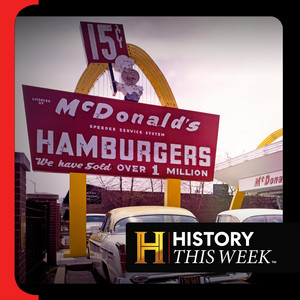
It has a huge overhanging roof trimmed with signs — red -hots, giant malts, hamburgers— and a neon sign announcing the name.
McDonald's Famous Barbecue.
This restaurant is opening today.
And it caters to a new kind of American consumer — drivers.
The owners are two brothers, Dick and Mac McDonald, they want to give people good food and quick service right at their cars.
Those cars pull in head first, fanning out from the octagon like spokes on a wheel.
And the waitresses, or carhops, come right up to your window.
The menu is varied.
You can get the featured items — barbecued beef, ham, or pork.
There's a peanut butter and jelly sandwich, or what's called an aristocratic hamburger — all of it served with a side of fries.
Mac McDonald later says that opening day went relatively smoothly.
There's still a lot to figure out, but he and his brother are off to a good start.
Better than they know.
Because they had no real plans of launching the biggest fast food chain in the world.
But that's exactly what McDonald's famous barbecue would become.
Today, the McDonald Brothers open McDonald's.
How did Dick and Mac engineer a system that would be replicated in thousands of locations across the globe?
And why don't they get the credit they deserve?
The McDonald Brothers aren't the guys you might have picked to revolutionize food in America, making it faster, cheaper, more portable.
the restaurant reflection of the post -war world.
I think a world before McDonald's is increasingly harder to imagine.
Marsha Chatlin, professor at the University of Pennsylvania and author of a book on the history of McDonald's.
She told us the pre -McDonald's world was slower.
Travelers could sit down at a truck stop or a small diner to order some eggs or a sandwich or a hamburger.
Though in the early nineteen hundreds they had a bad rap.
That most Americans thought of hamburger as a low quality kind of cast off kind of food.
Food that was consumed late at night after people maybe enjoyed a night of drinking or consumed by workers who were taking breaks on construction sites.
But that starts to change.
White Castle opens in 1921.
And they actually start to shift Americans towards hamburgers.
But Dick and Mac MacDonald, when they were growing up, they wouldn't have tried White Castle, because there weren't any in their home state of New Hampshire in the 1920s.
In fact, there still aren't any there today.
But there are, at the time of this recording, 62 McDonalds.
The two brothers are seven years apart.
Mac is older, Dick is younger, and the great depression hits their family hard. After the stock market crash in 1929, their dad loses his job at a shoe factory.
He'd been working there for 42 years.
It's brutal. No pension.
No thanks. The brothers vow this will not be their fate.
In fact, they set a goal.
They want to make a million dollars by the time they turn 50.
Job prospects in New Hampshire aren't great.
So? — Like many before them, Dick and Mack McDonald head west with the idea of breaking into Hollywood and having this glamorous American career.
That's Adam Chandler, journalist and author of a book on the history of fast food.
And when the McDonald brothers get to sunny, glitzy California, they do get jobs.
But they don't make it big.
They're basically hired hands on Hollywood back lots.
They'd push around sets and work the lights on silent movies.
Dick later said they were just a couple of flunkies.
But they want to be millionaires.
So they decide to try another time -honored American career, entrepreneurship.
The McDonald brothers take over a movie theater.
But it's still the Depression.
People can't really afford that kind of luxury.
The movie theater is barely scraping by.
Right. So the brothers are like, what else can we do?
And they noticed that one type of business in town seems to be doing all right.
Food. Cheap food. Food that is affordable and not stuffy.
There's a root beer stand that seems to be making a killing.
So Dick and Mac open up a roadside stand next to a nearby airport.
It specializes in the odd combination of hot dogs and orange juice.
This is, after all, orange grove country, and they strike a deal with a supplier to get 20 dozen oranges for a quarter.
Their stand is in a wooden octagonal building.
You step up to the window, order your food, and eat at one of the stools that lines the building's eight sides.
The brothers do great.
They make enough money that they can actually bring their parents from New Hampshire to California.
But they concede that stools are not the future.
The future is cars.
So they set their sights on a new location — San Bernardino. We have Route 66 passing through San Bernardino. It's a place that is being populated by a lot of military personnel because of the growth of military bases in the area.
the brothers are betting that this town will continue to grow they dismantle their original hot dog and juice stand they actually pay a company to slice it in half and reassemble it at their new location on 14th and E Street on May 15th 1940 McDonald's famous barbecue opens its doors they've expanded their menu they're now serving a lot more than hot dogs and orange juice they're doing way too much. There's peanut butter and jelly.
There's barbecue. There's tamales." And, of course, hamburgers, following the trend started by White Castle.
The McDonald brothers are looking to create something informal, approachable, and catered towards drivers.
They hire 20 carhops—waitresses who come out and meet you at your car to take your order.
Carhops were usually women, and they're on roller skates, and it's kind of an experience that you would see in a movie about the 1950s.
The drivers seemed to love it.
Within a few years, McDonald's famous barbecue is hitting a groove.
The parking lot is often full, and it can fit 125 cars at a time.
Revenues at just this one location are topping $200 ,000 a year.
So they're not millionaires yet, but they're on their way.
They're so successful, they're buying a new Cadillac every single year.
The brothers share the profits.
They also share a house, a 25 -room mansion on top of a hill overlooking the restaurant.
They're happy. If they can have the fanciest house in San Bernardino and this business that makes some good returns, like, they're living the American dream.
And yet as businessmen, they're a little bored.
Because, it turns out, the McDonald brothers love running a restaurant.
They love making service quick.
And they want to find ways to make it even quicker.
The McDonald brothers are wizards.
They are obsessed with efficiency.
And they're seeing some obvious inefficiencies.
First, those carhops.
There's concern that the young women are a distraction to the young men who work there and they really just want to focus on getting people in fast. Yeah, there's been some interpersonal drama developing at the restaurant.
Apparently, the fry cooks would ask out the carhops, and when the carhops inevitably said, no thanks, the fry cooks would cook their orders slower.
Plus, McDonald's famous barbecue was really popular with teens, and a lot of the boys wanted to hang out with the carhops too.
The reality that they had these carhops that were attracting younger teens to hang out at the restaurant and perhaps cause mischief and flirt, or hang around too long, made it less efficient than they wanted it to be.
Also, the restaurant is using dishes and silverware, and the brothers are pretty sure that the teens are stealing it.
Plus, they realize that their menu is a little crazy.
Like, why are we selling tamales AND ham AND baked beans?
And so in 1948, Dick and Mac McDonald make a huge decision.
In a wild turn, they decide to shutter their very successful restaurant.
of the world. History This Week is now in its sixth season.
Kind of cray. And we love bringing you these stories.
All of our work is supported by the ads you hear on the show.
But if you don't want to hear those ads, we're now introducing History This Week Plus, available exclusively on Apple Podcasts.
For just 2 .99 per month, you'll get all of our new episodes without any of the ads, and we'll be adding ad -free versions of our older episodes, too.
So subscribe now, and get your first week free!
History This Week +, exclusively on Apple Podcasts.
Exima isn't always obvious, but it's real and so is the relief… from Evglis.
After an initial dosing phase of 16 weeks, about four in ten people taking Evglis achieved itch relief and clear or almost clear skin.
And most of those people maintain skin that's still more clear at one year with monthly dosing.
Ebglis, lebricizumab LBKZ, a 250 milligram per 2 milliliter injection, is a prescription medicine used to treat adults and children 12 years of age and older who weigh at least 88 pounds or 40 kilograms with moderate to severe eczema, also called atopic dermatitis that is not well controlled with prescription therapies used on the skin or topicals, or who cannot use topical therapies.
Ebglis can be used with or without topical corticosteroids.
Don't use if you're allergic to Ebglis.
Allergic reactions can that can be severe, eye problems can occur.
Tell your doctor if you have new or worsening eye problems. You should not receive a live vaccine when treated with EPCLS.
Before starting EPCLS, tell your doctor if you have a parasitic infection.
Searching for real relief?
Ask your doctor about EPCLS and visit EPCLS .Lily .com or call 1 -800 -LILY -RX or 1 -800 -545 -5979.
I'm Emma Greed, and I've spent the last 20 years building, running, and investing in some incredible businesses.
I've co -founded a multi -billion dollar unicorn and had my hand in several other companies that have generated hundreds and hundreds of millions of dollars.
The more success I've had, the more people started coming to me with questions.
How do you start a business?
How do you raise money?
How do I bounce back from failure?
So it got me thinking, why not just ask the people I aspire to the most?
How do they actually do what they do?
I'm so incredibly lucky to know some of the smartest minds out there.
And now I'm bringing their insights along with mine, unfiltered directly to you.
On my new podcast, Aspire With Emma Greed, I'll dive into the big questions everyone wants to know about success in business and in life.
Through weekly conversations, you'll get the tangible tools, the real no BS stories and undeniable little hacks that actually help you level up.
Listen to and follow Aspire With Emma Greed and Audacy podcast available now, wherever you get your podcasts.
The new McCrispy Strip is here!
Div approved by Ketchup, Tangy Barbecue, Honey, Mustard, Honey Mustard, Sprite, McFlurry, Big Mac Sauce, double dipped in Buffalo and ranch, more ranch, and creamy chili McCrispy Strip.
Now at McDonald's. Fall 1948.
Dick and Mac McDonald have decided to close their very successful restaurant and redesign it from the ground up.
Not something everyone would want to do, but the McDonald brothers aren't everyone.
They were logistics guys.
They were fascinated with getting everything they could out of every square inch, every ingredient, every employee.
They hole up in their 25 -room mansion to rethink every aspect of the business, starting with the food.
Which at the time, is largely barbecue.
But barbecue is kind of slow.
They realized that, you know, having to kind of preside over a smoker and have to worry about an open pit wasn't a really viable business move.
Plus when they look at the data, they see something interesting.
80 % of their sales are actually hamburgers.
That's what the people seem to really want.
So their 25 item menu gets cut down to nine.
Starring hamburgers and fries.
There's also potato chips, a slice of pie, milk, coffee, and three different flavors of soda.
This streamlined menu means that they can streamline everything else.
They get rid of plates.
They get rid of knives and forks.
Yeah, no need for silverware, it's getting stolen anyway.
And if you're just serving burgers and fries, they can be wrapped up in paper.
The drinks will come in paper cups with plastic straws.
And you know what, customers?
You can get out of your car and come up to the window and grab the food yourself.
No more carhops. And so, no more leather -jacket -clad teens loitering in the parking lot hoping for a date.
It's gonna be quick, simple, no frills.
You're gonna have hamburgers served to you within a minute or so and you take it with you, either to eat in the parking lot or to hit the road and go.
They're going for cheap food and high volume.
The goal is to make a good, affordable hamburger as efficiently as humanly possible.
And the kind of kitchen you really need to do that, it doesn't exist. So the McDonald brothers built it.
They create the grill that they want, that is bigger than any grill that exists.
They create a lazy susan so you can dress all of the burgers and all of the buns quickly enough without any waste of space or time.
They commission a special french fry chopper machine.
You just do one potato and one crank and then you've got all of these french fries.
To make one of the other machines, Dick McDonald even does a bit of espionage.
He remembered as a kid he'd eaten these peppermint patty candies, and he wanted to know how did they make sure that each peppermint patty had the same exact amount of peppermint filling?
So he contacts a candy company in Los Angeles.
Pretending to be a journalist and goes to a candy factory essentially where they are pumping out peppermint patties out of a dispenser with a with a lever.
It's kind of a cone -shaped dispenser, and each time the button is pressed, the same amount of Peppermint Goo comes out.
Dick McDonald says, thank you very much this will be great for my story.
Then he goes to his designer and says, here's the idea, make something like this for our condiments.
And sure enough they create a dispenser, which is the forerunner of the one that's still in use at McDonald's today.
You press it, and then it presses out like the perfect portion of ketchup and mustard. This is a small item that kind of speaks to the entire ethos of the McDonald's brothers.
Their new kitchen is going to be the site of a complex dance.
They want people grilling patties and serving fries and bringing meals to customers, it's gonna take coordination.
They actually go out to their home tennis court and plot the whole thing out in chalk, imagining all the choreography.
A rainstorm washes it away overnight, so they have to draw it again.
But when all is said and done, they estimate that they'll be able to grill 40 patties every 110 seconds, and serve 900 portions of fries every hour.
They call it the Speedy system.
And they even have a mascot named Speedy.
Speedy has a giant head, made out of a hamburger bun and like a little tiny body.
It's, you know, fast, it's friendly.
And also in creating the character of Speedy, it's appealing to kids.
Yeah. The McDonald brothers are trying to change their clientele.
They don't want to be a teen hangout anymore.
They want to attract a different, very valuable group of customers, families.
And the way to get the families?
Get the kids. The menu itself appeals to kids you know, even today going to a fast food restaurant, and part of the fun is that you're kind of eating kids food.
And they get off to a good start.
The McDonald's reopened their restaurant in December of 1948.
It's now called McDonald's Famous Hamburgers.
Their first customer is a nine year old girl.
She orders a bag of burgers for her family.
The restaurant building itself is also attractive to kids.
For one thing, the brothers let customers look right into the kitchen and watch the food be made.
Kids find that cool.
And it also helps build trust among adults who might think, this food is really fast and really cheap what's going on back there.
So the brothers show them.
You can see them making this food in the kitchen in front of you and see how quickly it all comes together and it's kind of a marvel in and of itself.
It feels futuristic.
Somebody's dressing the hamburger, somebody's grilling the hamburgers, the milkshake machines are churning out all of these different flavors of milkshakes at once.
It was this very intricate dance And it moved so quickly that people would wonder if the food had been pre -prepared, but it really wasn't.
This new McDonald's is the future, and not everyone is ready for it.
Customers will sometimes pull their cars up to the restaurant and flash their headlights, honk their horns, expecting a car hop to come up to their window and take their order.
But those days are gone.
And the first few months after the reopening, it doesn't seem like it's going to work.
York. Customers are annoyed, and revenues are down by 20 percent.
But as word spreads and more and more families start coming to the new McDonald's, things pick back up.
Pretty soon, profits double.
And yet, the brothers aren't satisfied.
They keep refining.
For example, their famous fries.
They leave the potatoes out so they could cure in the desert air so that they will be that much more crispy.
This is some real type A, fastidious kind of restaurant -ing here, and it's something that's hard to replicate.
But people decide to try.
The brothers are getting some attention.
Other restaurant owners want to know how are you getting so many burgers out the door?
And Dick and Mac start sharing what they've learned.
People can come and look at their operations and see how they arrange the fryers and the grills and the milkshake machines and they're being featured in restaurant industry publications for what they've created.
The brothers could be keeping this all secret.
That would have been the better business move.
But they're proud of what they've done and happy to share.
Dick McDonald said they figured everyone can see into the kitchen anyway.
He recalled giving tours to lots of other restaurant tours.
Quote, they would come in with paper and pens and copy the layout, and my brother and I would laugh.
Soon enough copycat stores start popping up, dozens of them in California alone, counter -service burgers at low prices, all done the McDonald's way.
If the if McDonald's brothers had had someone hanging upside down, manning the grill, they would have done the same thing because whatever was happening at McDonald's was working well enough that they would have copied anything ruthlessly.
Keith Kramer and Matthew Burns take the idea to Florida.
They add a flame broiler to the concept.
Their restaurant is called Burger King.
One regular customer, Glenn Bell, opens his own fast food joint years later based on the speedy system, he applies it to Mexican food and names the restaurant after himself, Taco Bell.
As this kind of copycatting first takes off, the brothers belatedly try to take control of the situation.
They license their name and branding to some local franchisees, nine of them in total.
But the quality is really inconsistent, and the royalty system in place, just an upfront fee of about a thousand dollars.
The brothers are clearly good at running the business.
Expanding it, not so much. But they are about to meet someone who will take this local hamburger stand and make it bigger than the McDonald brothers could have dreamed.
Enter... Ray Kroc. Ray Kroc has been in the restaurant business for decades.
He played piano for diners.
He sold paper cups.
By 1954, he's selling milkshake machines, and the McDonald Brothers are some of his best customers.
In fact, he has no idea how they're going through so many machines.
What's going on over there?
They're making an insane number of milkshakes.
He decides to fly to California and see for himself.
He shows up at the Octagonal Building in San Bernardino. He sees so many people coming in and out.
He doesn't just see long lines, he sees people moving through the lines quickly.
He gets in line with the other customers and decides to do a little test. He blurts out, I've never waited in line for a hamburger my whole life.
The regulars tell him, Don't worry, It moves fast, then it's worth it.
Crock later says he doesn't remember what he ordered — probably a burger — there aren't many options.
And he is stunned by how fast his food is ready.
He's blown away by it, because it's so counterintuitive that your food would be ready that quickly, that they would hand it to you in a paper bag, everything wrapped up, ready to go, there's no place to sit, and it happened so quickly that you turn around and you're done.
The brothers are both working that day, like they do every day.
Kroc waits for the lunch rush to die down before approaching them.
He invites them to dinner that night.
They accept. Over that meal, he learns about their entire operation.
And he knows, I've got to get in on this.
He immediately has a vision for it.
Every place that has a school and a church should also have a McDonald's.
And he makes that pitch over and over again until the McDonald's brothers let him take a shot at it.
Ray Kroc becomes McDonald's exclusive franchising agent.
He'll be in charge of expanding the operation.
And he sees — it could be huge.
He's done everything in restaurants his entire life.
And all of a sudden he sees this model that makes him realize this is the future.
And he's absolutely right.
But the McDonald brothers don't exactly share his big vision for their business.
They just see the world differently.
Like, Ray Kroc is this jet -setting salesman.
The brothers, they never take airplanes.
They like their local life in San Bernardino. They were probably thinking, we could probably do business with this guy, make a little extra money.
Maybe he'll take us, you know, as far as Los Angeles, maybe down to San Diego.
No, but Ray Kroc — he's going way beyond San Diego, no matter what it takes.
The McDonald's brothers are keen on making sure that the quality and the standards hold up.
And Ray Kroc is a little bit more open to finding compromises to make sure that it scales more easily.
And that's part of — one part of the conflict that sort of erodes their relationship.
They argue about a lot.
About, for one thing, the famous French fries.
You can't keep this San Bernardino French fry model in a place like Chicago, where you can't leave the potatoes out to cure in the desert air.
It's Chicago. And about bigger things like money.
There's a lot of frustration on both ends.
Ray Kroc himself is not doing financially very well in this situation and he's letting him know that he's unhappy even though they're seeing profits.
Crock does expand the business, there are more and more McDonald's.
They open a lot of stores, but it's not exactly the McDonald's that we know it to be today where it's on every corner, and it's in every community, it's still trying to find its footing.
And behind the scenes, the tension continues to grow.
What happens next depends on who you ask.
The brothers say they wanted to sell the business to Crock.
The headaches aren't necessarily worth it to them, and they've already amassed a fortune that leads them to be rich for the rest of their lives, many times over without any question about it.
Crock later tells a slightly different story, that he's the one who asked them to sell, to name the price that would get them out.
That price was 2 .7 million dollars.
Which, after taxes, would net out to a million per brother.
No royalties. No continued payments.
But they'll get the cool million they set out for back in New Hampshire all those years ago.
And at this point, they barely even need it.
Kroc gripes about the price tag.
But he agrees. He buys the brothers out and takes full control of the McDonald's corporation in 1961.
There is one other condition.
The McDonald's brothers keep the original McDonald's open and Ray Kroc being Ray Kroc opens one across the street in San Bernardino and puts the original out of business, which is exactly the kind of move that Ray Kroc would do.
McDonald's goes on to be McDonalds.
As of 2025, it's the most valuable restaurant brand in the world, with some 40 ,000 locations and $25 billion in annual revenue.
And yet, the namesake founders live out their lives, seemingly content with their decision.
They were happy with a new Cadillac once a year.
Marsha Tatlin says, there's basically no way the brothers could have predicted what their burger stand would become.
I think the scale of it would be so confusing and confounding to them, and I think the idea of like touching a screen and getting your food without talking to someone would probably be bewildering because they lived before the internet, but they would probably wonder if they could still deliver what they wanted to with these mechanisms. Ray Kroc, at many points in his life, refers to himself as the founder of McDonald's.
Which is true, in a way.
What he did and what the brothers did, they're almost two different businesses.
They're both founders.
What Ray Kroc does with the financing, the building of the franchise model and not just him, but his lieutenants in the creation of the operations machine that allows fast food to grow does warrant some kind of founder status in its own way.
So I punt, I split the difference.
I think they all deserve credit.
Crock does grant the brothers something important when it comes to the history books — their name.
You know, if it had been called Crock's hamburgers, nobody would really be as interested in it.
When you hear the name McDonald's, you just have this association with it.
So I do think the McDonald's brothers in a lot of ways win out because that name echoes through the generations now.
Thanks for listening to History This Week, a Back Pocket Studios production in partnership with The History Channel.
To stay updated on all things History This Week, sign up at historythisweekpodcast .com.
And if you have any thoughts or questions, send us an email at History This Week at History .com.
Special thanks to our guests, Adam Chandler, journalist and author of Drive Through Dreams, A Journey Through the Heart of America's Fast -Food Kingdom, and Marsha Chatlin, professor of Africana Studies at the University of Pennsylvania, and author of Franchise, The Golden Arches in Black America.
We also want to shout out two other great books we consulted as we were putting together this episode, Ray and Joan, the man who made the McDonald's fortune and the woman who gave it all away by Lisa Napoli, and McDonald's Behind the Arches by John F.
Love, thanks to Napoli and Love for writing those great books.
This episode was produced and sound designed by Ben Dixteen.
It was also produced by me, Sally Helm.
For Back Pocket Studios, our executive producer is Ben Dixteen.
From The History Channel, our executive producers are Eli Lehrer and Liv Fittler.
Don't forget to follow Rate and Review History this week, wherever you get your podcasts.
And we'll see you next week.